


More news on this day
Major U.S. and European carriers serving 2026 FIFA World Cup host cities are aligning behind a new fast-track customs protocol that aims to move record numbers of arriving fans through North American airports more quickly and with fewer bottlenecks.
Get the latest news straight to your inbox!
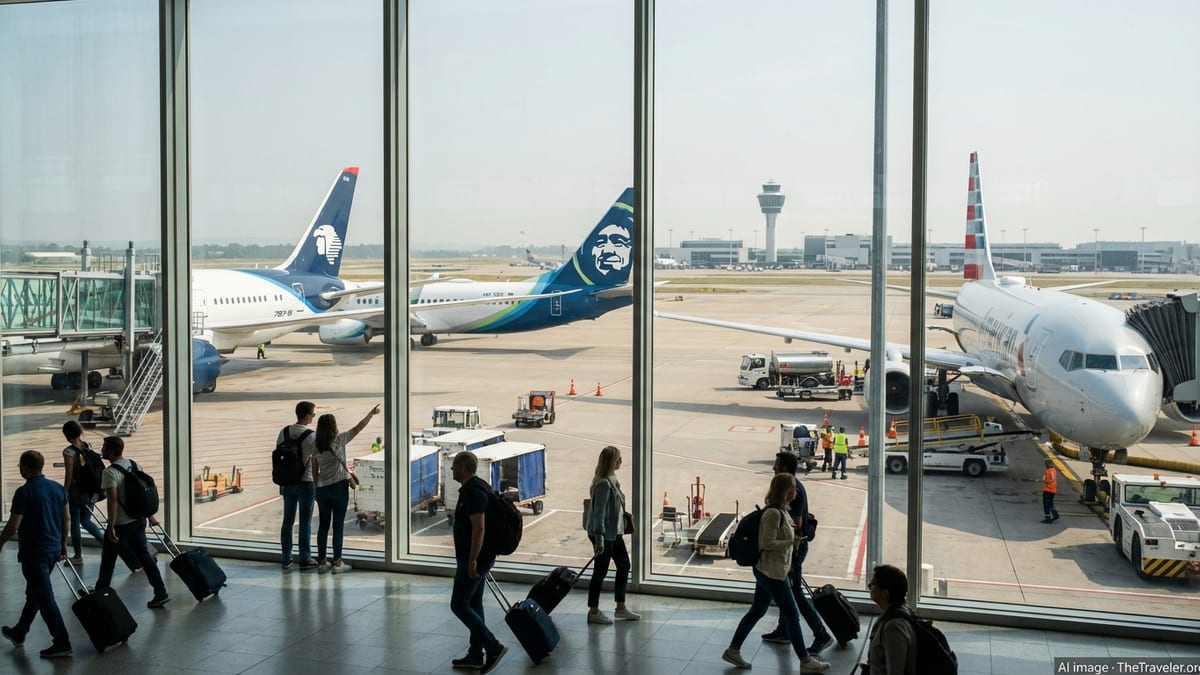
Host City Airports Prepare for Record Summer Crowds
The 2026 FIFA World Cup, running from June 11 to July 19 across 16 cities in the United States, Canada and Mexico, is expected to generate some of the busiest travel days North American airports have ever seen. Forecasts from mobility and aviation consultancies point to a sharp spike in international arrivals concentrated around opening matches and knockout rounds, especially at gateway hubs such as New York, Dallas, Los Angeles, Toronto, Vancouver, Mexico City and Monterrey.
Publicly available government planning documents and industry analyses indicate that customs and immigration processing has emerged as one of the primary operational risks. Authorities are preparing for a convergence of visiting supporters, international volunteers, charter flights and added scheduled services from airlines vying for World Cup traffic.
In this context, host city airports and their anchor airlines are moving to standardize and promote digital pre-clearance tools, trusted traveler lanes and advance customs declarations under a shared fast-track banner designed specifically around the 2026 tournament calendar.
United Airlines Joins Carrier Line-Up on New Protocol
United Airlines, which operates hubs at several World Cup host airports including Newark, Houston, Chicago and San Francisco, is the latest major carrier to publicly align its customer-facing messaging and airport procedures with the emerging fast-track customs framework. United already highlights its network of flights into the 2026 host cities and is expected to position the new protocol as a key part of its World Cup travel offering.
Under the approach described in airport and airline briefings, fans traveling on United to participating U.S. host airports will be encouraged to complete digital customs declarations before arrival, enroll in eligible trusted traveler programs where possible and use designated fast-track lanes where local infrastructure allows. Similar guidance is being prepared for connecting itineraries that route through Canadian and Mexican hubs.
United’s participation places it alongside Delta Air Lines, JetBlue Airways, Southwest Airlines and ITA Airways, which have already been associated with using or promoting expedited customs and immigration processing at key host city airports. Collectively, these carriers operate a substantial share of the capacity into World Cup venues, giving the protocol broad coverage across the tournament footprint.
Delta, JetBlue, Southwest and ITA Build on Existing Tools
Delta Air Lines and JetBlue Airways, both with strong footprints at New York, Boston and other East Coast host cities, have spent recent years rolling out digital document verification and expedited airport security products that can be adapted to World Cup travel. Delta’s identity tools and its promotion of trusted traveler programs are being incorporated into its tournament guidance to customers, with an emphasis on reducing time spent in queues at arrival and during domestic connections.
JetBlue, which serves multiple transatlantic and Latin American markets feeding into the World Cup, is expected to lean on its partnerships and its presence at congested airports such as John F. Kennedy International and Boston Logan. Public information from the carrier points toward a focus on pre-trip education about customs paperwork, mobile passport options where available and clear signposting of any dedicated fast-track lanes at arrival terminals.
Southwest Airlines, while primarily a domestic carrier, is an important player in distributing fans across the United States between host cities. Updated airport information from Southwest highlights new identity verification options and reminders around passport checks for international segments. That framework is being linked to the broader fast-track customs messaging so that fans connecting from Mexico or Canada onto Southwest services understand where customs, immigration and security will take place and how to use expedited options.
ITA Airways, which connects several European cities to North American gateways, is aligning with the same protocol to provide consistent expectations for Italian and other European supporters. Its World Cup communications emphasize coordination with local airport processes on arrival, particularly at major U.S. and Canadian hubs.
Digital Declarations and Trusted Traveler Programs at the Core
At the heart of the fast-track customs protocol are existing government-approved tools rather than entirely new systems. For arrivals into the United States and Canada, mobile customs and immigration declaration apps and online forms are being framed as the primary pathway to faster processing at airports serving World Cup matches.
Public information from border agencies shows that travelers who submit their customs information in advance can often use separate lanes or automated kiosks on arrival, depending on the airport. World Cup host city airports are planning dedicated communications campaigns to encourage fans to complete these steps before boarding their flights, in coordination with airline pre-departure emails and app notifications.
Trusted traveler programs such as Global Entry, NEXUS and Mexico’s equivalent schemes are also positioned as complementary tools. While enrollment capacity is limited and many visitors will not be able to join in time for the tournament, airlines and airports are highlighting these programs to frequent travelers and regional fans who may already qualify, as their use can significantly reduce time spent at passport control and customs checkpoints.
Importantly, the fast-track protocol does not change visa rules or admission criteria. Border officers at all three host nations retain full discretion over entry decisions, and travelers must still meet all standard requirements for visas, electronic travel authorizations and supporting documentation.
Operational Challenges and Traveler Expectations
Despite the coordinated effort, planners acknowledge that the World Cup will test airport capacity in ways that cannot be fully mitigated by technology or fast-track lanes. Studies on mobility impacts for 2026 point to overlapping peaks of match-day traffic, regular summer holiday travel and general business demand, particularly at U.S. coastal hubs and Mexico City’s main airport.
In Mexico City, recent reporting has highlighted efforts to add rapid-exit taxiways and modestly increase the number of aircraft movements per hour, in part to ease congestion ahead of the tournament. In Canada, federal guidance for fans traveling to World Cup matches stresses the importance of submitting customs and immigration forms in advance of arrival to reduce bottlenecks in terminal halls.
Travel advisory material from civil society organizations also notes concerns around longer processing times at some U.S. airports due to heightened security and immigration enforcement activity. These groups encourage visitors to allow additional time for border checks even when using mobile declarations or trusted traveler programs, underscoring that fast-track tools are designed to streamline processing but cannot eliminate the possibility of secondary inspection.
For airlines, aligning behind a shared fast-track customs protocol is seen as a way to set realistic expectations while promoting every available option to keep passengers moving. By coordinating messaging across carriers such as United, Delta, JetBlue, Southwest and ITA, host city airports aim to turn a complex patchwork of national and local systems into a more coherent experience for the millions of fans expected to arrive in North America for the 2026 FIFA World Cup.