


More news on this day
A United Airlines flight from Las Vegas to Newark was forced to return to Harry Reid International Airport after a passenger allegedly sent a text message referencing hijacking the aircraft, leaving 150 travelers stranded overnight before the journey resumed the following morning.
Get the latest news straight to your inbox!
Overnight disruption after security scare on United Flight 1681
According to published coverage, the incident occurred on Saturday, October 24, when United Flight 1681, a Boeing 737 operating from Las Vegas to Newark, turned back less than an hour after departure. Reports indicate that a member of the cabin crew became aware of a text message in which a passenger allegedly wrote that he was going to hijack the plane and "crash" a specific row of seats.
Publicly available information shows that the aircraft, carrying 150 passengers and six crew members, landed safely back at Harry Reid International Airport. Law enforcement officers met the aircraft at the gate and detained the passenger at the center of the complaint. No injuries were reported among travelers or crew.
Coverage from major U.S. outlets indicates that the suspected passenger was identified as a 25-year-old man traveling on the Newark-bound flight. An arrest report cited in news stories states that he was taken into custody on a charge of making a threat or providing false information regarding an act of terrorism, an offense that can carry a potential prison sentence of 1 to 20 years if a conviction is secured in court.
United Airlines issued a brief public statement after the event, noting that the flight returned to Las Vegas to address what the airline described as a "potential security concern." The company also stated that it was cooperating with law enforcement as the investigation continued.
Passengers face missed connections and airport overnights
Because of the unscheduled return to Las Vegas, the flight’s schedule was heavily disrupted. Based on airline statements cited in media reports, the aircraft remained on the ground overnight, with the onward journey to Newark rescheduled for Sunday morning after the arrival of a legal-duty crew.
Travel industry coverage notes that the disruption left the 150 passengers facing missed connections, unplanned overnight stays and rearranged ground transport on the U.S. East Coast. Many travelers heading to New York and neighboring states routed itineraries through Newark Liberty International Airport, United’s primary transatlantic and domestic hub in the region.
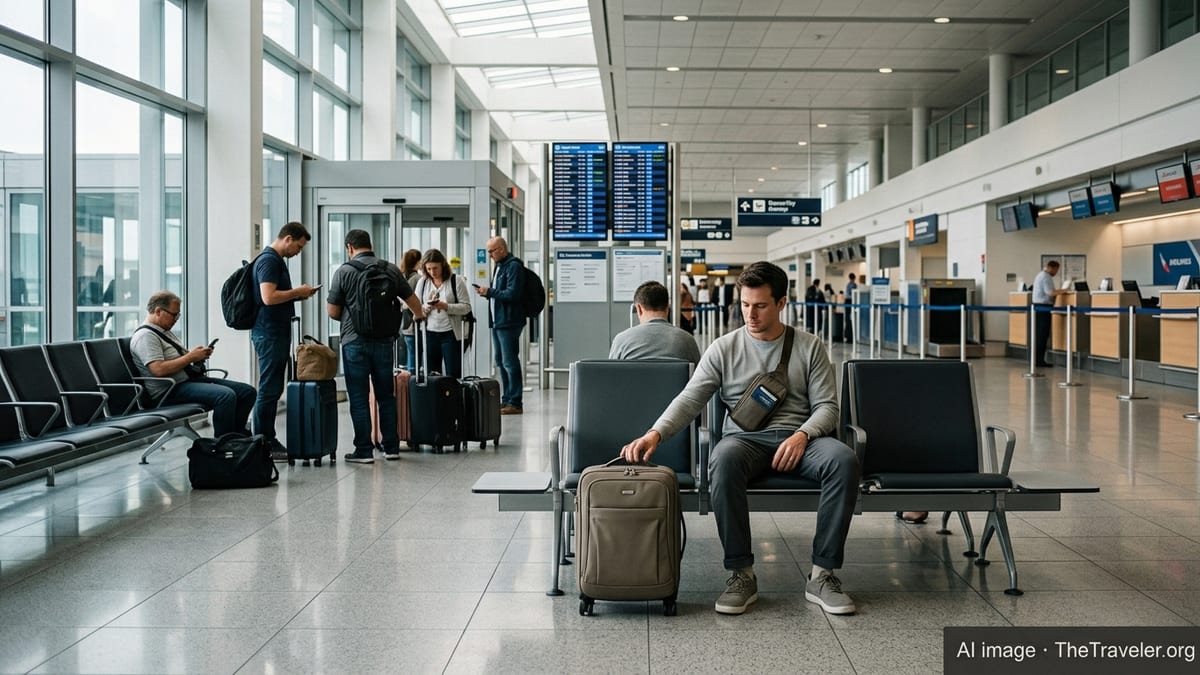
Accounts compiled from social media posts and local news reports suggest that some passengers remained in the terminal as they waited for updated departure information, while others sought hotel rooms near the airport. As is common in security-related delays, routine rebooking and compensation rules were limited by the fact that the schedule change stemmed from a law enforcement matter rather than a controllable operational issue such as crew scheduling or aircraft maintenance.
Available reporting indicates that the rescheduled flight to Newark departed Las Vegas the following morning without further incident. However, the overnight gap contributed to door-to-door delays of 12 hours or more for some travelers once onward connections and ground transfers were taken into account.
Legal case centers on alleged hijack text and "joke" defense
Court documents summarized in national coverage state that the arrested passenger is accused of sending a phone message during the flight that referenced hijacking the aircraft. The wording, as described in those reports, suggested the plane would be hijacked and crashed, with a focus on a particular row rather than the entire aircraft.
Subsequent reporting by several outlets notes that the passenger told investigators the message was intended as a joke exchanged between coworkers and was not meant to be seen by airline personnel or interpreted as an actual threat. He reportedly characterized the language as poorly chosen banter written after drinking.
Despite that explanation, published accounts of the arrest report indicate that investigators treated the wording as serious, in part because it was sent in flight and contained an explicit reference to hijacking. Under Nevada law and federal aviation security regulations, even statements later described as jokes can trigger criminal charges if they are deemed to cause public alarm or interfere with aircraft operations.
The case is expected to proceed through the Nevada court system, with further hearings to determine whether a grand jury will be convened or whether prosecutors will move forward under existing charges. Until those steps occur, information on potential plea discussions or additional counts remains limited to what appears in public court filings.
Heightened sensitivity to threats in the post‑9/11 travel era
Aviation security specialists quoted across previous coverage of similar incidents emphasize that airlines and airport authorities maintain a low threshold for responding to any mention of hijacking, bombs or terrorism-related language. The legacy of past attacks and hijackings has resulted in procedures that prioritize immediate safety over schedule reliability.
Publicly available federal guidance shows that crew members are instructed to treat all in-flight threats as credible until evaluated by law enforcement on the ground. That approach often leads to diversions, returns to the departure airport and full security sweeps of aircraft, even when no weapon or device is ultimately found.
Travel analysts note that this posture can produce major disruption for passengers, as seen in the United Las Vegas–Newark diversion and similar events at other carriers over recent years. However, they also point out that failure to act on a genuine threat would carry far greater potential consequences for passenger safety and for public confidence in commercial air travel.
In this case, reports indicate that the cockpit crew turned the aircraft back to Las Vegas soon after receiving word of the text, following established airline protocols for handling such warnings. The quick return allowed law enforcement to detain the suspect and permitted a complete security assessment of the aircraft before it was released to operate the delayed overnight flight.
What travelers should know when flights are diverted for security reasons
Travel-industry resources explain that when a flight is diverted or delayed because of a security investigation, airlines typically categorize the situation as outside their direct control. As a result, standard guarantees such as meal or hotel vouchers may be more limited than during delays caused by mechanical problems or crew scheduling issues.
However, passengers affected by significant delays can still take certain steps. Consumer advocates advise documenting the disruption, retaining boarding passes and delay notifications, and later checking with the airline for any discretionary vouchers, frequent flyer mileage credits or rebooking options that may be offered on a case-by-case basis after a security incident.
For international itineraries touching the United States, travelers can also review the Department of Transportation’s published consumer dashboards to compare how different carriers commit to handling extended delays and cancellations. While those tools do not create new legal rights specific to security diversions, they provide clarity on each airline’s public commitments regarding care and communication when flights are severely disrupted.
Security experts additionally remind passengers that messages sent over onboard connectivity are subject to monitoring and can be viewed by airline personnel under certain conditions. They stress that language referencing hijacking, bombs or other violent acts, even when intended as a private joke, can rapidly escalate into a full law enforcement response, as illustrated by the experience of the 150 travelers delayed overnight in Las Vegas.