


More news on this day
United Airlines has postponed the launch of 10 new regional routes from Chicago O’Hare International Airport after federal regulators ordered airlines to scale back schedules at the busy hub, signaling continued pressure on capacity as peak summer travel collides with major construction and chronic delays.
Get the latest news straight to your inbox!
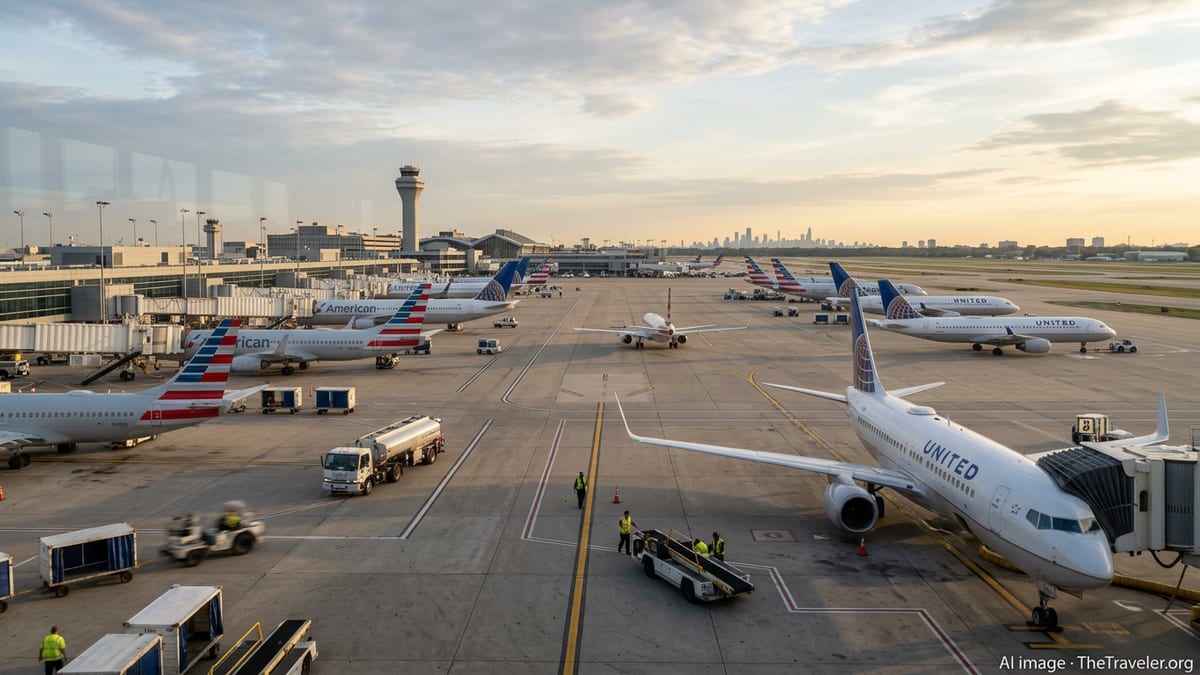
FAA limits curb O’Hare growth plans
Publicly available regulatory documents show that the Federal Aviation Administration ordered temporary operating limits at Chicago O’Hare for the main 2026 summer travel window, capping total daily flights to reduce overscheduling and long delays during peak periods. The cap, described in Federal Register filings, lowers planned daily operations by roughly 12 percent compared with carriers’ proposed schedules for the season.
The FAA action responds to a combination of factors at O’Hare, including ongoing construction tied to the airport’s long term terminal and airfield modernization, as well as a pattern of congestion that has frequently pushed departure and arrival banks into lengthy delay cascades. Capacity analyses cited by regulators indicate that without schedule reductions, the airport would likely face significant operational strain during busy afternoon and evening waves.
Reports on airline forums and local coverage indicate that the new operating limits are in effect from mid May through late October, a period when O’Hare typically sees some of its heaviest traffic. The temporary cap is intended as a short term measure while construction continues and while the FAA reviews performance data to determine whether further adjustments are needed.
The order applies across all scheduled carriers at O’Hare, but it has particular implications for the two dominant hub operators, United Airlines and American Airlines, which had both planned additional flights to bolster their positions in the Chicago market.
United defers launch of 10 new regional routes
Against that backdrop, published coverage and community flight tracking discussions indicate that United has pushed back the debut of 10 new regional routes that were slated to operate from O’Hare to smaller Midwestern and Mid Atlantic cities. The services, many of them high frequency short haul links operated by regional affiliates, had been marketed as a way to deepen connectivity through United’s primary Midwest hub.
Several of the delayed routes involve airports that have recently seen announcements of new or returning United service tied directly to O’Hare connectivity. Public information for airports such as the University of Illinois Willard Airport near Champaign shows that United outlined plans in early 2026 to re enter the market with multiple daily flights to O’Hare, but local reporting and traveler accounts now reference postponements aligned with the federal capacity cuts.
Similar patterns have emerged at other small and midsize airports in the region, where planned start dates for new O’Hare links have slipped from the main summer season into the autumn, or have been placed on hold without new firm launch dates. In some cases, travelers report that United has shifted passengers to existing connections on other carriers or advised them to use alternate hubs until the new flights can be rescheduled.
While the airline has not publicly detailed each affected route in a single announcement, booking data and airport statements suggest that the total impact amounts to 10 new O’Hare routes deferred beyond their original launch windows, all of them designed to feed additional traffic into United’s Chicago network.
Construction, competition and congestion shape the decision
The delay to United’s expansion underscores how a mix of infrastructure work, competitive dynamics and operational reliability concerns is reshaping growth strategies at O’Hare. FAA construction impact reports point to extensive taxiway changes and airfield projects near the main terminal area, which constrain how many aircraft movements the airport can handle efficiently at certain times of day.
At the same time, Chicago O’Hare remains a key battleground between United and American, each of which has historically used the airport as a cornerstone hub. In recent seasons, both carriers filed ambitious schedules that layered additional frequencies onto existing routes and opened new spokes, effectively pushing the airfield toward the edge of its practical capacity during peak hours.
Passenger accounts shared on aviation and local community forums throughout 2026 describe a noticeable rise in delays and cancellations on United flights into and out of O’Hare, particularly during stormy weather or during tight afternoon banks. Those first hand reports align with the FAA’s stated rationale in public documents for seeking to head off a potential traffic jam at the airport by imposing preemptive schedule reductions.
In that environment, airlines have faced difficult trade offs over which flights to keep and which to postpone. For a hub carrier such as United, trimming back still theoretical new routes has emerged as one way to comply with the cap while preserving as much of its established mainline and long haul network as possible.
Impact on travelers and regional connectivity
For travelers in the smaller communities that were counting on new links to Chicago, the deferrals represent a setback for local connectivity. Airports in central Illinois, Indiana, Ohio and neighboring states had promoted the planned United flights as a way to restore nonstop access to a major global hub, giving residents one stop connections to destinations across the United States and abroad.
Instead, passengers in those markets are being advised through airport notices, schedule displays and third party booking tools to expect continued reliance on existing service patterns, which often involve connections through other hubs or less frequent flights on competing carriers. In some areas, bus or ground shuttle connections to O’Hare, operated in coordination with airlines, remain the primary link to the Chicago hub while air service adjustments play out.
At O’Hare itself, the near term impact for most United customers is more subtle. The delayed routes were not yet operating, so the number of flights being removed from previously active schedules is smaller than it would have been if the expansion had gone ahead as planned. However, the absence of those additional frequencies may limit options for same day rebooking during irregular operations and reduce flexibility for travelers who prefer short haul nonstop flights into Chicago.
Travel advisors and frequent flyers posting in online communities have suggested that passengers build extra buffer time into itineraries involving O’Hare this summer and early autumn, both because of the FAA’s caps and because weather and construction can still trigger ripple effects across the hub’s complex schedule.
What comes next for O’Hare scheduling
The current FAA order envisions the O’Hare capacity limits as a temporary measure, with regulators indicating in public filings that they will review performance data, airline feedback and construction milestones before deciding whether to ease or extend the restrictions. The outcome of that review will shape when and how United can revive the 10 postponed routes and pursue further growth from Chicago.
If the cap is relaxed after the summer season and construction milestones are met, United and other carriers could seek to restore some of the shelved flying for late autumn or the following year, potentially bringing back the deferred regional launches in revised form. Local airports affected by the postponements are watching those timelines closely and have signaled through public statements that they remain interested in securing long term O’Hare service.
Industry analysts note in trade coverage that the situation at O’Hare reflects a broader tension in the United States aviation system between growing passenger demand and infrastructure that is often strained by weather, staffing and aging facilities. As one of the country’s largest hubs, O’Hare functions as an early test case for how regulators and airlines balance schedule ambitions with the need to preserve reliability.
For now, United’s decision to delay 10 new routes underscores that even large hub carriers must adjust plans when federal capacity limits enter the equation. Travelers, airports and airlines across the region will be watching how O’Hare performs under the new constraints and how quickly the deferred flights can be brought back into the schedule once regulators are confident that the airfield can handle more traffic without a return to chronic delays.