


More news on this day
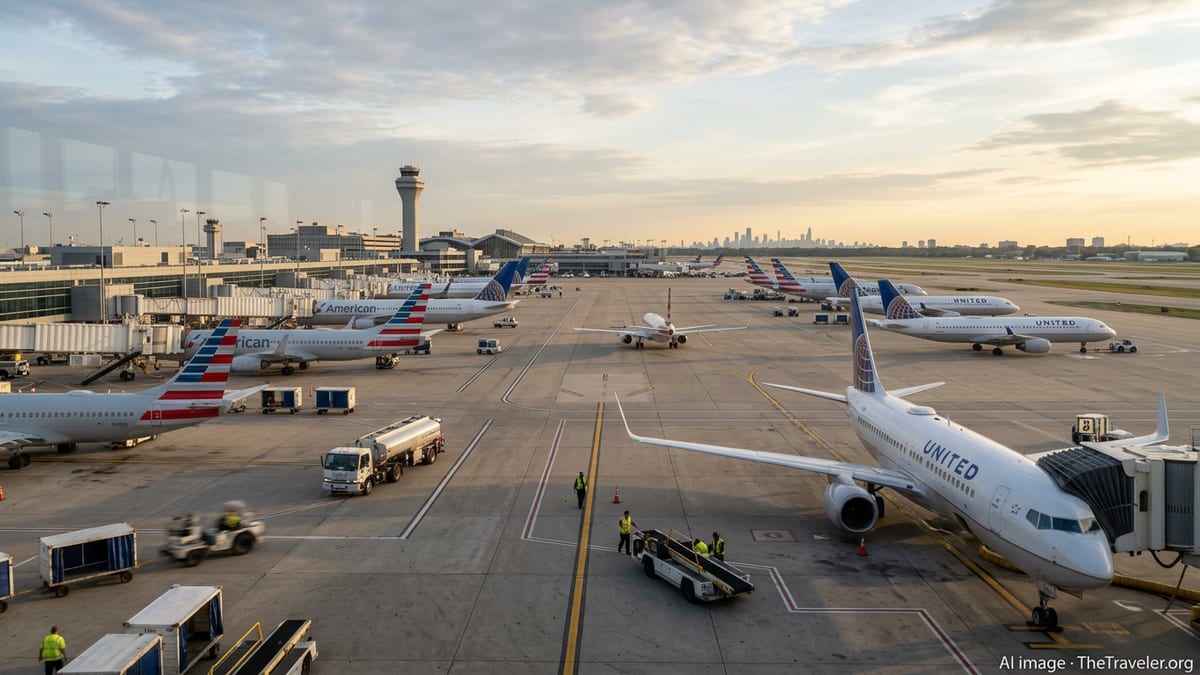
United Airlines is delaying the launch of new routes from Chicago O’Hare International Airport to a group of smaller Midwest and regional cities, adjusting an ambitious expansion plan in response to federal limits on flights at one of the nation’s busiest hubs.
Get the latest news straight to your inbox!
Expansion plan meets new federal flight caps
United has spent the past year positioning Chicago O’Hare as the centerpiece of a major domestic and international growth strategy, outlining plans to operate a record schedule of around 750 daily flights in 2026 and to add multiple new destinations in the Midwest and beyond. Publicly available company information highlighted new gates at O’Hare and an emphasis on expanding to smaller communities that rely on regional connections to a large hub.
Reports indicate that those plans have been complicated by a Federal Aviation Administration decision to temporarily cap flights at O’Hare through October 2027, in an effort to manage congestion and reduce the risk of cascading delays. The cap effectively limits how many additional takeoffs and landings airlines can add during peak periods, forcing carriers to reevaluate which routes move forward and which must be trimmed or delayed.
According to recent news coverage, United has now postponed or pulled back on several regional services that were expected to launch from O’Hare this year. While the airline is still marketing Chicago as its largest and most strategically important hub, the updated schedule reflects a more cautious rollout of new connections to smaller Midwest cities.
The shift underscores how quickly hub expansion plans can be upended by changes in federal slot and capacity policies. Even as United prepares to add hundreds of new aircraft over the coming years, near-term growth at O’Hare is now constrained more by runway and airspace limits than by fleet availability.
Regional cities feel impact of postponed routes
The delayed services primarily affect small and mid-sized communities across the Midwest and adjoining regions that had been counting on new nonstop flights to Chicago. Recent coverage from local outlets and regional airports points to cities in Illinois, Michigan, Wisconsin, Minnesota, Pennsylvania and Tennessee among those seeing start dates pushed back or routes removed from schedules.
Some of these airports, such as those in Champaign and Bloomington in central Illinois, had promoted the coming United flights as a way to restore or enhance connectivity to a major global hub. In Bloomington, airport statements earlier this year described multiple daily United flights to O’Hare as a significant boost for business travel and for residents seeking one-stop connections to dozens of other destinations.
In Champaign, home to the University of Illinois Willard Airport, the start of United service to Chicago has already been delayed more than once. Local reporting in May noted that launch dates originally targeted for late April, then June, were subsequently pushed into the fall, with the airport citing updated information from the airline. The broader context of O’Hare’s capacity cap has since raised further questions about how quickly additional frequencies will materialize.
Other regional communities, including airports in Michigan, Wisconsin and neighboring states, are seeing similar uncertainty. Routes that were announced as part of United’s push to deepen its Midwest footprint are now being reexamined, pared back or rescheduled, creating challenges for local planners who had built marketing campaigns and business forecasts around enhanced air service.
Balancing growth at O’Hare with operational constraints
The decision to slow the addition of new routes highlights the tension between United’s long-term growth ambitions in Chicago and the short-term operational realities at O’Hare. The airline has touted Chicago as a critical connecting point in its broader North American and international network, with more destinations served from O’Hare than by any other carrier at the airport.
At the same time, publicly available data and recent coverage show that O’Hare’s airfield and surrounding airspace are under sustained pressure, particularly during peak travel seasons. The FAA’s temporary cap is designed to stabilize on-time performance and reduce traffic bottlenecks, but it effectively forces airlines like United to make tradeoffs between maintaining existing routes, adding higher-yield long-haul services and launching new regional links.
Industry analysts note that in this environment, carriers often prioritize routes with strong revenue potential or strategic value, such as international long-haul flights and domestic trunk routes between major hubs. Smaller cities, especially those relying on regional jets, can be more vulnerable when capacity is constrained and every slot at a hub airport becomes more valuable.
For United, the recalibration at O’Hare comes as the airline is in the midst of a large fleet modernization program and ongoing efforts to strengthen premium products and long-distance connectivity. The combination of more capable aircraft and limited takeoff and landing opportunities may further tilt the balance toward higher-demand routes, at least until additional capacity or revised regulations allow more flexibility.
What the delays mean for Midwest travelers
For travelers in the affected Midwest cities, the postponed routes translate into fewer nonstop options to Chicago and, by extension, to United’s broader domestic and international network. Passengers who had anticipated one-stop itineraries through O’Hare may continue to face longer journeys involving connections through other hubs or carriers, or a reliance on ground transportation to larger airports.
The delays also come at a time when many travelers have already been experiencing heightened disruption, with anecdotal reports and recent commentary noting more frequent delays and cancellations across the system. When hub capacity is tightly controlled, weather events or operational issues can ripple more quickly through regional schedules, which often run with thinner margins and less backup capacity.
Local business groups and tourism organizations in some of the affected cities had positioned new United routes as tools for economic development, making it easier for companies to attract talent and for visitors to reach local attractions. With start dates now uncertain or pushed further into the future, those communities may need to adjust expectations or look to other carriers and transportation options to fill connectivity gaps.
Travelers are being encouraged by airports and consumer advocates to monitor schedules closely and to check for changes as airlines adjust their networks in response to O’Hare’s flight caps. While United continues to highlight Chicago as a cornerstone of its network, the pace at which new regional links come online will likely depend on how long federal limits on O’Hare’s traffic remain in place and how the airline chooses to allocate its constrained capacity.