


More news on this day
The United States currently tells its citizens not to travel at all to 24 countries, according to live trackers that compile U.S. State Department advisories, underscoring how war, political instability and surging crime continue to reshape the global risk map for American travelers.
Get the latest news straight to your inbox!
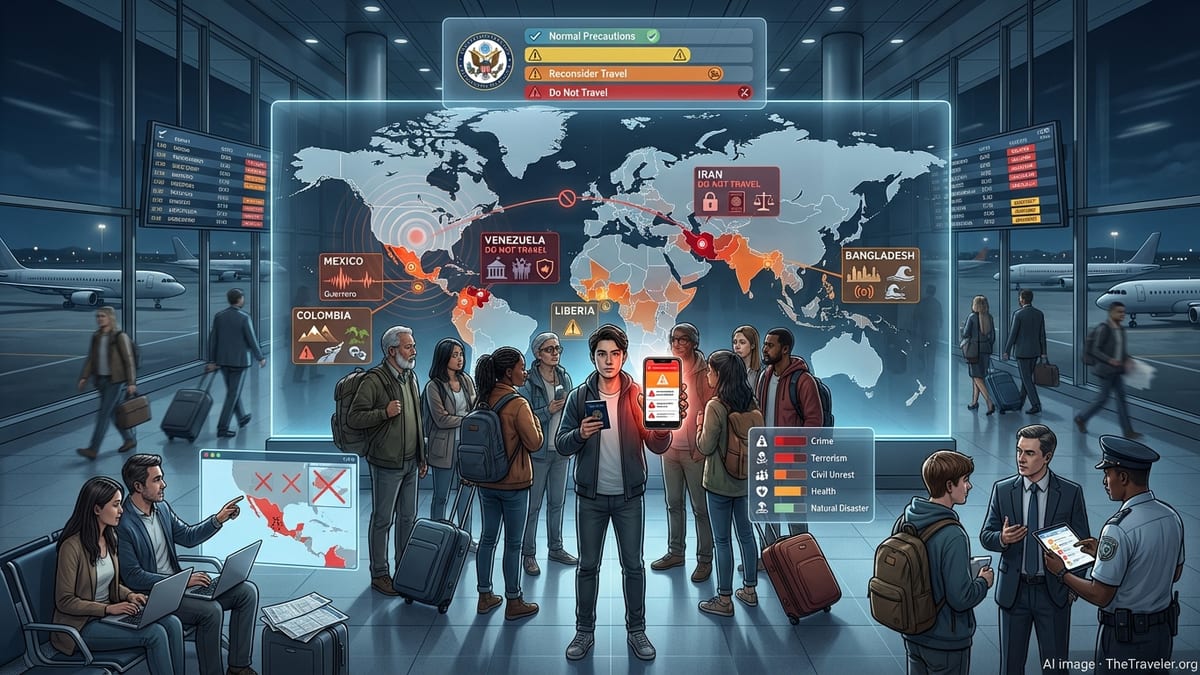
What a Level 4 “Do Not Travel” Advisory Really Means
The U.S. government uses a four-tier advisory system, from Level 1 “Exercise Normal Precautions” to Level 4 “Do Not Travel.” Publicly available guidance explains that Level 4 is reserved for destinations where life-threatening risks are elevated and the government expects to have very limited ability to assist citizens if something goes wrong. In plain terms, it is the strongest possible warning in the system.
Unlike looser cautions that urge increased vigilance, a Level 4 advisory explicitly states that U.S. citizens should not travel to the country or should leave as soon as it is safe to do so. The underlying reasons can include armed conflict, terrorism, civil unrest, kidnapping, violent crime, health emergencies or a collapse of local infrastructure.
Importantly, a Level 4 travel advisory is not a legal ban on private travel. Airlines may still operate flights, tour companies might continue to advertise packages and individuals can, in most cases, still cross borders. But the advisory signals that those who choose to go are doing so against clear, publicly posted U.S. government guidance and may find that there is only limited consular help if they need to evacuate or receive emergency support.
Advisories are reviewed continually and can change quickly. During the coronavirus pandemic, for example, global health concerns briefly pushed a large number of destinations into Level 4 before conditions improved. The present list of 24 countries reflects more localized and often long-running crises rather than a single worldwide trigger.
How the 24 “Do Not Travel” Countries Are Counted
Several independent trackers that pull data directly from the State Department’s public advisory feed report that, as of October 29, 2026, there are 24 destinations at Level 4 “Do Not Travel” for U.S. citizens. These services continuously read the same live data that underpins the advisory pages on the official government site and consolidate it into a global snapshot.
The exact number can fluctuate slightly between sources and from week to week as advisories are updated, territories are counted differently, or specific regions within a country are raised or lowered. Some databases, for example, separate certain territories or disputed regions, while others only count United Nations member states. A few trackers have recently cited figures ranging between 20 and 23 Level 4 destinations based on earlier snapshots in September and early October.
The latest composite figures aligning with Thursday, October 29, indicate that the count has edged up to 24 after changes in parts of the Middle East and North Africa. One widely watched risk map that compares U.S., Canadian and British advice notes that the U.S. side of its dashboard currently shows 24 jurisdictions in the “Do Not Travel” category, more than either Ottawa or London, and that 11 of those are simultaneously flagged as no-go zones by all three governments.
For travelers, the headline number is less important than the substance of each individual advisory. The State Department’s country pages spell out the specific threats, recent incidents, and any restrictions on U.S. government personnel that often serve as a bellwether for how serious officials judge the risks on the ground to be.
Conflict Hotspots, Collapsed States and High-Crime Destinations
The current “Do Not Travel” list skews heavily toward active or recent war zones, politically fragile states and countries where criminal violence has overwhelmed local authorities. Recent mapping of the Level 4 destinations highlights a band of high-risk countries stretching from Eastern Europe through the Middle East to the Sahel and Horn of Africa, along with outliers such as Haiti in the Caribbean and North Korea in East Asia.
Published analyses that overlay the U.S. data with allied government warnings identify a familiar core of destinations where risk has remained extreme for years. These include Afghanistan, Syria, Yemen and Libya, all of which have faced prolonged conflict and a patchwork of armed groups controlling territory. In such environments, the State Department notes that kidnap-for-ransom and targeted attacks on foreigners are credible concerns and that access to functioning medical facilities can be severely limited.
Russia, Belarus and parts of Ukraine also appear on contemporary lists of Level 4 destinations, reflecting continued security concerns after years of war and sanctions. In the Western Hemisphere, Haiti’s slide into pervasive gang violence and political paralysis has attracted intense coverage, with many trackers underscoring that Port-au-Prince and other key areas are subject to frequent roadblocks, shootings and kidnappings that have prompted multiple rounds of tightened U.S. warnings.
Across Africa, a cluster of Sahel and Horn of Africa states appear in the top risk tier, often due to a combination of jihadist insurgencies, coups, cross-border militancy and fragile state institutions. Commentators following the advisories note that the U.S. currently maintains its highest warning level for a double-digit number of African countries, many of which also face internal displacement crises and recurring humanitarian emergencies.
Why “Under Any Circumstances” Has Become a Watch Phrase
In media coverage and some advocacy materials, the U.S. “Do Not Travel” warnings are often paraphrased as telling Americans not to go to certain countries “under any circumstances.” The core advisory language on State Department pages does not typically use that exact phrase, but related messaging from other organizations sometimes does when echoing the Level 4 guidance.
For example, one widely circulated safety framework used by a national youth organization instructs its members not to travel to locations with a Level 4 advisory “under any circumstances,” adopting near-absolute language to eliminate ambiguity about acceptable destinations for its programs. Advocacy groups have also used similar wording when urging particular communities, including dual nationals, to avoid returning to certain high-risk countries while tensions are elevated.
In parallel, travel-focused commentary has drawn attention to recent security alerts stating that Americans should not travel to specific countries such as Iran at all, effectively treating them as off-limits for tourism and discretionary trips. While phrasing varies, the underlying message to ordinary travelers is consistent: a Level 4 designation signals that the government sees the risks as so serious that even well-prepared visitors are strongly urged to stay away.
This rhetorical shift matters because many travelers have grown accustomed to more moderate cautions that merely recommend “increased vigilance” or “reconsidering travel.” When headlines highlight countries that are framed as destinations to avoid entirely, it underscores that there is a qualitative difference between routine caution and the top-tier warnings now applied to 24 countries.
How Travelers Should Respond to the Expanding No-Go List
For Americans planning international trips in late 2026 and into 2027, the growing roster of Level 4 destinations is primarily a signal to incorporate official risk assessments into destination research rather than an instruction to panic or abandon overseas travel altogether. Most countries remain in the lower advisory tiers, and many popular tourism markets sit firmly in Levels 1 or 2.
Risk specialists recommend starting with the official advisory level, then reading the full text of the notice rather than relying only on a color code or number. The individual country page typically outlines recent security incidents, geographic areas of heightened concern, and any restrictions on the movement of U.S. government personnel, which can be a helpful proxy for underlying threats.
Because the list of Level 4 countries is dynamic, travelers who are booking trips months in advance may find that conditions have changed by the time of departure. Security analysts and travel insurers alike emphasize the importance of monitoring advisories periodically and again shortly before leaving, as a late-stage escalation in a country’s risk profile can affect insurance coverage, airline schedules and the availability of evacuation options.
Ultimately, the presence of 24 countries in the “Do Not Travel” column serves as a reminder that the world remains unevenly safe for American travelers. For those willing to adjust itineraries and pay attention to evolving guidance, however, there are still many destinations where the official message is significantly more reassuring.