


More news on this day
Millions of travelers moving through US airports in July 2026 are facing a choppy start to the peak vacation month, as storms, airspace constraints and airport technology issues combine to produce thousands of flight delays and a rising number of cancellations nationwide.
Get the latest news straight to your inbox!
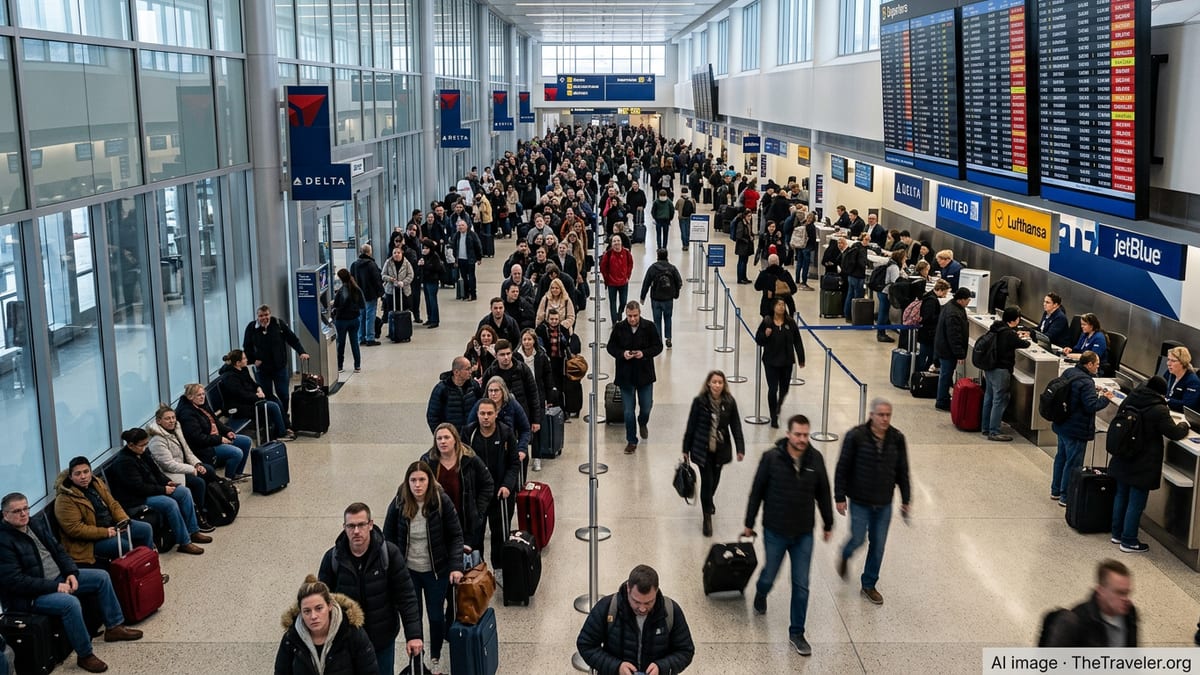
Storms and Ground Stops Hit Major Hubs
Severe summer weather remains one of the main drivers of flight disruption this month, with thunderstorms repeatedly triggering ground stops and delay programs at some of the country’s busiest hubs. Operational advisories show that airports including Charlotte Douglas, San Francisco, New York John F. Kennedy and Washington Dulles have all faced periods in recent weeks when departures or arrivals were restricted while storms moved through key traffic corridors.
Charlotte Douglas International Airport has been a particular hotspot in early July. Local coverage and tracking data indicate that a powerful storm cell on July 10 led to a temporary ground stop, followed by a cascade of late departures and missed connections. By late afternoon, the airport had logged more than 460 delayed flights and at least a dozen cancellations, illustrating how quickly weather disruptions at a single hub can spread throughout airline networks.
On the West Coast, San Francisco International Airport is contending with a combination of coastal weather patterns and broader traffic management measures. Reports from July 9 described a busy travel day in which a separate Federal Aviation Administration ground delay program slowed flights bound for San Francisco, contributing to more than 450 delays and a cluster of cancellations by evening. The situation underscores how low clouds, fog and congestion over the Bay Area can ripple far beyond Northern California.
Along the Eastern Seaboard and in the Mid-Atlantic, thunderstorms have periodically constrained traffic flows into and out of New York and Washington, prompting advisories of potential ground stops or delay programs at major airports. These targeted restrictions are designed to keep the system safe and manageable, but they also translate into longer taxi times, airborne holding and schedule disruptions for passengers during the busiest weeks of the summer.
Daily Disruptions Mount as Peak Travel Arrives
Operational statistics suggest that July 2026 is shaping up as one of the more challenging recent summer travel periods. Real-time data from flight-tracking services show that, on many days this month, more than 6,000 flights within, into or out of the United States are delayed, with several hundred cancelled outright. Those figures fluctuate with weather and demand but point to a persistently strained system as peak season unfolds.
The Federal Aviation Administration’s own outlook highlights the pressure. Agency materials for the summer forecast more than 56,000 flights on Thursday, July 9, described as one of the busiest travel days of July. With schedules running near capacity at large hubs and crew availability finely balanced, even minor disturbances can have outsized impacts on on-time performance for the remainder of the day.
Government performance data compiled in the latest Air Travel Consumer Report, covering recent months leading into July, offer context for what travelers are now experiencing. Across more than 600,000 domestic flights in the most recent reporting period, roughly 78 percent arrived on time, while close to 1 percent were cancelled and about 8 percent were delayed by late-arriving aircraft. These historical figures, combined with current traffic volumes and weather patterns, suggest that this July’s disruption levels are broadly consistent with a system operating close to its limits.
Travelers are also contending with extended tarmac waits at some airports, as aircraft queue for departure slots during ground delay programs or hold for available gates after storms. Recent analytical coverage of tarmac delay trends notes that 2026 is on pace to record some of the highest numbers of long onboard waits since federal time limits were introduced in 2010, reflecting the challenge of clearing backlogs once severe weather or airspace constraints ease.
Technology Strains and Infrastructure Constraints
Beyond thunderstorms, infrastructure and technology are contributing to July’s irregular operations. At San Francisco International Airport, passengers earlier this week felt the residual impact of a computer issue affecting airport systems, which was resolved but left knock-on delays as airlines worked through disrupted schedules. Such events are relatively rare but show how dependent modern operations have become on complex digital tools for everything from check-in to runway sequencing.
Nationally, the FAA and airport operators are pushing a range of modernization efforts aimed at improving throughput and resilience. Recent public documents describe ongoing work on ground-based augmentation systems and advanced precision approach procedures at New York’s John F. Kennedy International Airport, with completion timelines extending into late 2026. These investments are intended to support more efficient use of runways in low-visibility conditions and reduce delay minutes over time.
At the same time, the National Airspace System continues to rely on tactical measures such as ground stops, reroutes and miles-in-trail restrictions when demand exceeds capacity in certain regions. User guides and planning documents detail how ground delay programs are coordinated across facilities when weather, construction or equipment outages shrink available arrival and departure rates at a major hub. While these tools help manage congestion, they also translate directly into schedule changes for airlines and travelers.
Industry analysts note that as schedules have been rebuilt following the pandemic recovery, airport and airspace capacity in several metropolitan areas has remained tight. Construction projects, runway maintenance and terminal expansions, while necessary for long-term growth, can constrain operations in the short term, leaving carriers with fewer options to absorb disruptions without resorting to cancellations.
Which Airlines and Routes Are Hit Hardest
Recent ranking analyses of long delays suggest that performance varies considerably by carrier. One study published in early July, using federal delay data, identifies certain ultra-low-cost airlines as having a higher share of flights delayed by three hours or more, with Frontier cited as one of the worst performers on that metric so far in 2026. By contrast, several large network carriers and regional operators show higher on-time rates and lower cancellation percentages in the government’s consumer reports.
The Department of Transportation’s latest dataset breaks down on-time performance across major US airlines. Large carriers such as Delta, United and Alaska report on-time arrival percentages around or above 80 percent in recent months, with cancellation rates close to or below 1.5 percent. Others, including Southwest and some regional operators, show somewhat lower on-time rates and higher shares of late-arriving aircraft delays, reflecting the complexity of their connecting networks and high utilization of aircraft and crews.
Routes through congested hubs in the Northeast, Mid-Atlantic and upper Midwest appear especially vulnerable on stormy days, as do transcontinental flights linking those regions with the West Coast. When traffic management initiatives are put in place at airports like Newark, JFK or Chicago O’Hare, the resulting arrival metering can ripple across dozens of downstream segments, leaving travelers from smaller cities facing misconnected itineraries and overnight stays.
International services are also seeing targeted disruption. Travel alerts from global airlines indicate that flights on certain long-haul routes, particularly involving regions with geopolitical tensions or severe local weather, are being suspended or re-timed into late July. For US-based passengers, that can mean rebookings, extended layovers and, in some cases, last-minute changes of gateway airport.
What Travelers Can Expect for the Rest of July
With schools out and major sporting events drawing visitors to host cities, demand for seats is expected to remain strong through the end of July. FAA planning material and historical data suggest that busy days will continue to cluster around weekends and Mondays, when leisure and business travel patterns overlap. On these peak days, even routine afternoon thunderstorms can trigger a rapid buildup of delays that take hours to unwind.
Airlines and aviation agencies are urging passengers, through public advisories and consumer guidance, to monitor flight status closely and allow extra time at airports. Many carriers now highlight options for receiving disruption alerts and self-service rebooking when cancellations occur. Government rules require airlines to update publicly accessible flight information within 30 minutes of becoming aware of a cancellation or significant delay, giving travelers a clearer picture of their options as situations evolve.
Given the current pace of operations, analysts expect that July 2026 will likely close with overall cancellation rates still in the low single digits but with notable spikes on days affected by severe storms or localized outages. Delays, however, are likely to remain elevated across much of the month, especially at the largest hubs and at airports undergoing construction or modernization work.
For travelers, the pattern emerging this July points to a summer in which most flights ultimately operate, but a significant share depart or arrive later than scheduled. Flexible itineraries, early-day departures and build-in buffers for connections may help reduce the risk of trip disruption as the peak travel season continues.