


More news on this day
The United States has introduced a premium visa interview pilot program that allows certain visitors to pay an extra 750 dollars for a faster consular appointment, a move that places the country alongside a growing list of states using high-priced, highly structured visa channels and is prompting concern across Africa about who will be able to reach the front of the line.
Get the latest news straight to your inbox!
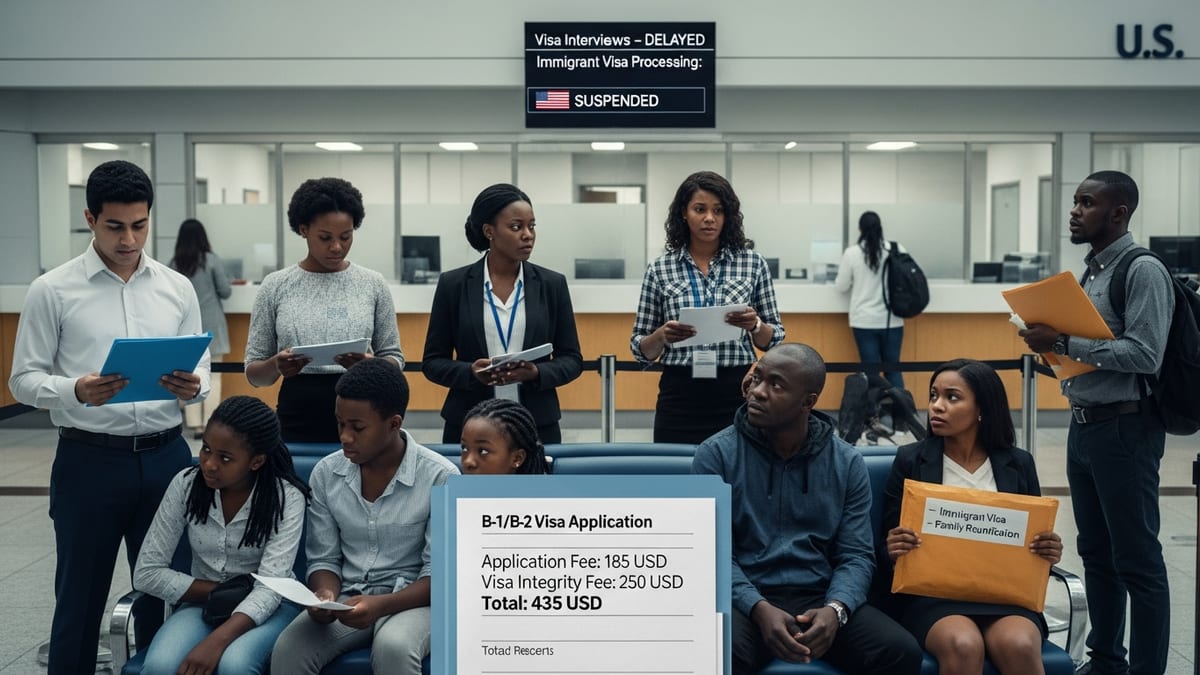
How the Premium Interview Pilot Works
Publicly available information from the Federal Register and subsequent reporting shows that the new pilot allows eligible B1 and B2 visitor visa applicants to pay a separate 750 dollar charge in addition to the standard nonimmigrant visa fee. In return, they are offered the possibility of an interview slot within roughly ten business days at participating embassies and consulates. The scheme is scheduled to run as a time-limited test and will operate only at posts selected by the US Department of State.
The pilot does not change the underlying visa adjudication rules. Applicants using the premium route remain subject to the same eligibility standards, documentary evidence requirements, and security checks as all other travelers. The payment affects only the timing and handling of the interview appointment and passport return. It does not guarantee visa issuance, nor does it alter the legal threshold for overcoming concerns about immigration intent or security risks.
US consular guidance already notes that interview wait times can vary widely by location and season, with some posts facing delays stretching for many months. The pilot is intended to test whether a sharply higher fee for faster access can both relieve pressure on backlogged systems and generate additional revenue, while providing a predictable pathway for travelers who face urgent business, medical, or family needs.
The program also formalizes a broader shift in global mobility policy, in which consular services are increasingly segmented between basic processing and paid premium options. While private visa centers and courier services have long charged extra for logistical support, the US move places the core interview slot itself behind an optional, high-cost paywall for those able to afford it.
Connecting to Existing Rigid Consular Practices in Africa
The introduction of a premium interview option arrives in a context where many African travelers already navigate a complex landscape of stringent requirements and long queues for US visas. Publicly available wait time trackers indicate that applicants in Nigeria, Ghana, Ethiopia, South Africa, Tanzania, Uganda, Rwanda, the Democratic Republic of the Congo, and other states often contend with delays of several months, and in some cases close to or above a year, before securing a standard appointment.
These long waits exist alongside a broader pattern of what analysts sometimes describe as rigid consular dictates: extensive document demands, strict scrutiny of financial ties and travel history, and low approval rates for certain profiles. Travelers from countries such as Ivory Coast, Senegal, Togo, Angola, Equatorial Guinea, Liberia, and Djibouti frequently report that even well-prepared applications can be derailed by limited interview capacity, small windows for rebooking, or brief interviews that yield little explanation of refusals.
Against this backdrop, the new premium channel appears to link the United States more closely with a group of states that already condition mobility on access to substantial financial resources. Wealthier travelers in Lagos, Accra, Addis Ababa, Johannesburg, Dar es Salaam, Kampala, Kigali, Kinshasa, Abuja, and beyond may now be better positioned to bypass congested standard queues, while lower-income applicants continue to wait in the same backlogs with no change in underlying capacity.
Observers of African mobility trends note that this layering of fees on top of already strict vetting frameworks risks deepening perceptions that nonimmigrant visas function less as neutral security tools and more as instruments that sort travelers by income, profession, and country of origin. The optics are particularly sensitive in countries where historical patterns of unequal access to travel and trade are already a frequent subject of public debate.
What Travelers in Affected Countries Need to Know
For would-be visitors from Ivory Coast, Ghana, Ethiopia, South Africa, Senegal, Tanzania, Djibouti, Uganda, Rwanda, the Democratic Republic of the Congo, Nigeria, Togo, Angola, Equatorial Guinea, and Liberia, the first key point is that the premium visa interview pilot is a scheduling add-on, not a new visa category. Applicants still begin with the same online form, fee payment, and document preparation as any other B1 or B2 candidate, and they must still demonstrate strong ties to their home country and credible reasons for travel.
Second, access to the premium option will depend on whether local embassies and consulates are designated to participate. Official consular channels are expected to list which posts can offer the 750 dollar add-on and how many slots are available. In practice, this means that a traveler in Accra or Lagos, for example, may see different offerings than an applicant in Kigali or Addis Ababa, even though the underlying program is global.
Third, standard interviews remain the default route. Available coverage suggests that many posts in Africa already struggle with high demand and staffing constraints. The pilot does not mandate that a fixed share of appointments be reserved for premium users, but it does create a parallel track that consular managers must balance against regular demand. Travelers who cannot or choose not to pay the extra fee should therefore continue to plan far in advance, monitor public wait time estimates, and prepare thoroughly for a single, tightly scheduled appointment.
Finally, applicants in these countries should be alert to the possibility of new patterns in appointment availability once the pilot begins. If premium users absorb a sizable share of short-notice slots, routine appointments may shift further into the future. On the other hand, if the extra revenue allows posts to expand operating hours or open additional interview windows, the net effect could be more nuanced, with some reduction in overall congestion.
Equity, Access, and the Politics of Visa Queues
The creation of a premium interview fee has quickly sparked debate over fairness. Advocacy groups and migration researchers have long criticized what they view as a two-speed global mobility system in which citizens of wealthier countries often enjoy visa-free entry, while those from many African and other Global South states must pay multiple fees, travel long distances to consulates, and face high refusal rates. The new pilot, critics argue, adds yet another layer of financial sorting on top of this architecture.
In this reading, the United States is joining a cohort of governments that use steep consular charges and narrowly defined interview windows as tools to regulate who crosses their borders, particularly from regions labeled as high risk for overstays or irregular migration. The inclusion of countries such as Nigeria, Ghana, Ethiopia, and the Democratic Republic of the Congo in discussions of the pilot’s impact reflects their already prominent place in both legitimate travel demand and in official narratives about migration control.
Supporters of the program point to another dimension. They argue that, as long as the basic visa route remains available at the standard fee, a voluntary premium option can serve travelers with urgent needs while generating revenue that might eventually fund more staff, better systems, and possibly shorter waits for all. They also note that the pilot does not alter the legal criteria for issuing visas and therefore does not directly disadvantage those who cannot pay.
Nonetheless, the optics of a 750 dollar fast lane are especially sharp in African economies where average monthly incomes fall well below the new fee. For many potential visitors from Ivory Coast, Senegal, Tanzania, Uganda, Rwanda, Togo, Liberia, or Equatorial Guinea, that sum may exceed the total cost of a round-trip ticket, reinforcing a sense that mobility rights are increasingly for sale. Even for middle-class professionals in South Africa, Ghana, Nigeria, or Ethiopia, the additive cost can turn a family visit or conference trip into a far more expensive undertaking.
What Comes Next for US–Africa Travel
The pilot is time-limited, with public information indicating that it is designed to run for a defined period while the State Department measures demand and operational effects. Data on how many travelers take up the offer, which posts see the most premium bookings, and whether standard wait times improve or worsen will likely shape whether the scheme is scaled up, modified, or discontinued.
If participation proves strong in Africa, consular planners may be encouraged to expand the premium model to additional posts or visa categories. That could deepen the alignment between US visa practice and the more rigid consular regimes already observed in some of the countries most affected by long waits and strict document checks. Conversely, if uptake is modest or public backlash grows, officials may face pressure to pivot toward reforms that prioritize broader access, such as more staff, expanded interview waivers, or regional processing centers.
For now, travelers across Ivory Coast, Ghana, Ethiopia, South Africa, Senegal, Tanzania, Djibouti, Uganda, Rwanda, the Democratic Republic of the Congo, Nigeria, Togo, Angola, Equatorial Guinea, and Liberia must navigate a new layer in an already complex process. The premium visa interview pilot offers speed at a price, without altering the fundamental barriers that have long shaped who can cross borders, how often, and on what terms.
As the first appointments under the 750 dollar option are booked, the program is set to become an important test of whether high-fee, high-control consular policies can respond to the practical realities of global travel while addressing deepening concerns about equity in access to mobility.