


For many international travelers, Flying Blue Gold is the sweet spot in the Air France KLM loyalty program: lounge access, SkyPriority, extra baggage and faster mileage earning without the heavy flying commitment required for Platinum. One of the most powerful shortcuts into this world is the Air France KLM American Express Gold card, which combines card perks with Flying Blue benefits and experience points (XP). If you are considering this card for the first time, or you just received it and want to make the most of it, understanding how it works in practice can save you time, money and several frustrating trips to the airport.
Get the latest updates straight to your inbox!
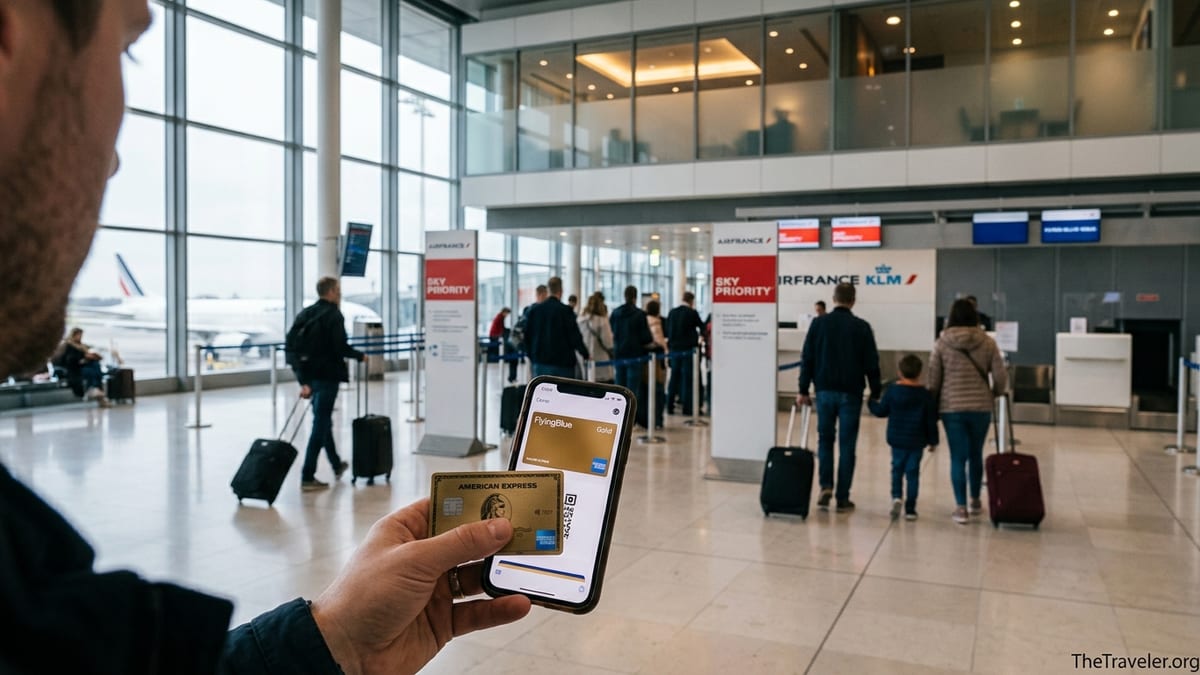
Flying Blue Gold and the Role of the Amex Gold Card
Flying Blue, the joint program of Air France, KLM and several partner airlines, has four public status levels: Explorer, Silver, Gold and Platinum, with an additional invitation-only Ultimate tier. Gold is the second Elite level and corresponds to SkyTeam Elite Plus, which means your benefits extend across partners such as Delta Air Lines, Korean Air and other SkyTeam carriers. To reach Gold purely by flying you normally need 280 XP: 100 XP to reach Silver, then 180 XP more to move up to Gold, all within your personal 12‑month qualification period.
The Air France KLM American Express Gold card changes the equation by adding XP from spending to the XP you earn from flights. In France, for example, the consumer Gold card can provide up to 40 XP per year on top of regular flying, while the Platinum version can offer up to 80 XP. That might not sound like much, but in practice it can be the difference between falling short of Gold by a couple of medium‑haul trips and comfortably locking in the status from your day‑to‑day purchases.
For a first‑time Gold candidate, this blend of flight and card‑earned XP is crucial. A traveler who flies between Paris and New York in economy three or four times a year may otherwise remain at Silver. With the Amex Gold card adding XP, that same pattern of flying, combined with strategic spending, can push them across the Gold threshold and keep them there year after year.
Equally important, the card keeps your Flying Blue miles alive. As long as you regularly use the card and miles keep posting, your mileage balance remains valid, which matters if you are saving for long‑haul business‑class awards and only take a few big trips per year.
Key Benefits of Flying Blue Gold You Will Actually Use
Flying Blue Gold status brings a list of benefits, but a few stand out in real‑world travel. First is lounge access. As a Gold member you and one guest can use most SkyTeam lounges when you fly internationally the same day on Air France, KLM or another SkyTeam airline. In practice, this could mean entering the Air France lounge at Paris Charles de Gaulle before a morning flight to Rome, or using a Delta Sky Club in New York before your overnight flight back to Europe, even if you are holding an economy ticket.
Next is SkyPriority. This branding covers priority check‑in, security lanes where available, priority boarding and priority baggage handling. On a busy Monday morning at Amsterdam Schiphol, for instance, priority check‑in and security can cut your wait time from 45 minutes to under 15. On arrival in Marseille or Lyon, your checked bag typically appears among the first on the carousel, which is a small but real advantage if you are rushing to catch a train or a meeting.
Extra baggage is another benefit that becomes very tangible when you travel with family or for longer stays. On many Air France and KLM operated flights, Gold members receive one additional checked bag free of charge on top of the regular allowance. A couple flying from Paris to Montreal for a three‑week trip could each check a large suitcase plus an extra shared bag of winter gear without paying the usual bag fee that might otherwise approach or exceed the monthly fee of the card itself.
Finally, mileage earning improves as you move up the tiers. A Gold member earns more miles per euro spent on eligible flights than an Explorer or Silver member. When you combine this boost with miles from the Amex Gold card, the effect compounds: the same Paris to New York round trip that once generated enough miles for a short‑haul reward might, after a year of Gold status and card spending, get you much closer to a transatlantic premium economy or business‑class redemption.
What the Air France KLM Amex Gold Card Actually Gives You
The Air France KLM American Express Gold card is designed primarily for residents of certain European countries such as France and the Netherlands, where it acts as both a payment card and a Flying Blue accelerator. While details vary slightly by market and can change over time, the core structure is consistent: a welcome bonus of Flying Blue miles after you reach a minimum spending requirement, a higher miles‑per‑euro earning rate on Air France and KLM purchases, a solid rate on everyday spending and a package of travel insurance protections.
In France, for example, promotional offers often include a welcome bonus in the range of ten thousand Flying Blue miles for new Gold cardholders who spend a specified amount in the first three months, with the first year’s annual fee waived. The published earning grid typically allows you to earn up to 15 miles per 10 euros spent, depending on the category and promotions in effect, plus up to 40 XP per year simply for using the card and keeping it active. In the Netherlands, a Flying Blue American Express Gold card may come with a different welcome bonus, such as several thousand miles, and a published rate around 1.5 miles per euro on Air France and KLM tickets.
The XP component deserves special attention. Rather than giving you miles only, the Gold card in many markets credits a fixed number of XP annually as long as you meet conditions set in the terms, such as holding the card for a minimum number of months and using it regularly. These XP are added directly to your Flying Blue XP balance and count toward earning or renewing status. For a frequent short‑haul traveler picking up, say, 60 to 80 XP per year from flights, an additional 40 XP from the card can be enough to transform two or three weekend trips into full Gold status.
The card’s insurance package can also be substantial. Typical coverage includes compensation for trip cancellation or interruption up to a defined ceiling per year, delayed baggage coverage covering emergency purchases, and basic travel accident insurance when the trip is paid with the card. A family flying to Guadeloupe for school holidays, for instance, might recover the cost of hotel nights and basic clothing if their checked bags are delayed more than a certain number of hours, a benefit that can offset a large chunk of the card’s ongoing fee.
Building a Strategy: From First Flight to Flying Blue Gold
To use the American Express Flying Blue Gold card effectively, you need to understand how XP are calculated. Flying Blue awards XP by segment, based on distance band and cabin, rather than on the price of your ticket. A short domestic flight in economy might earn a small number of XP, while a long‑haul business‑class flight can earn several times more. Since you need a cumulative amount within 12 months to climb from Explorer to Silver and then to Gold, planning a sequence of flights is almost like planning a points‑earning project.
Consider a traveler based in Paris who flies for both business and leisure. Without the card, they might book three or four Paris to New York economy round trips and a couple of intra‑Europe weekends per year. That pattern could leave them stuck at Silver because the total XP from those flights sits just below the threshold for Gold. With the Amex Gold card adding up to 40 XP annually, plus occasional promotions such as double XP on certain routes, they can reframe their year: perhaps one of the New York trips is upgraded to premium economy, and a separate weekend break is routed via Amsterdam rather than nonstop, adding a connection that yields additional XP segments.
Another example is a Dutch traveler living near Rotterdam and frequently visiting family in the French Antilles. By deliberately choosing KLM or Air France itineraries that route through Amsterdam or Paris, and charging all tickets to the Amex Gold card, they stack three XP streams: flight XP, card XP and higher mileage earning from Gold status once they achieve it. Over two to three years, this pattern not only secures Gold status but also produces enough miles for a business‑class award on the same route, effectively upgrading a future family visit for a fraction of the cash cost.
The key is to align your travel calendar with your XP qualification year. Because Flying Blue uses a rolling 12‑month period starting from the time you first earn XP, the timing of a large trip or a series of flights can push you over a threshold earlier and reset your year in a favorable way. Many experienced members deliberately cluster high‑XP trips and card‑spend milestones to reach Gold early in their cycle, allowing them to enjoy the benefits for as long as possible.
Real‑World Scenarios: How Travelers Use the Card
Take the case of a consultant based in Lyon who travels to clients across Europe. Before applying for the Air France KLM Amex Gold card, she flew several times a month on short‑haul routes to cities like Frankfurt, Barcelona and Rome, often with tight connections at Paris Charles de Gaulle. She held basic Explorer status and was frequently stuck in long security lines, boarding late and struggling to find overhead bin space. After adding the Gold card, she used the welcome miles to offset a personal trip to Lisbon and, more importantly, gained enough XP through a combination of flights and card‑earned XP to attain Gold within one year. The next summer, her travel routine changed: priority lanes reduced her airport stress, she accessed lounges for a quiet place to work and she stopped paying for an extra checked bag on longer assignments.
Another scenario involves a Franco‑Dutch family living between Toulouse and The Hague. They applied for the Gold card primarily for the baggage benefit and mile accumulation. Over two years, they charged not only flights but also large everyday expenses to the card: school fees, car insurance, monthly utilities and grocery shopping where American Express was accepted. The XP credit from the card, layered on top of two or three family trips a year to the Caribbean, allowed one partner to reach Gold and eventually share lounge experiences with the other using the guest entitlement. Their children benefited indirectly from shorter lines and more predictable boarding, especially during peak holiday seasons.
Finally, consider a digital nomad splitting time between Paris, Montreal and Mexico City. For this traveler, the Amex Gold card becomes both an earning engine and a form of travel security. By always purchasing tickets with the card, they benefit from built‑in insurance for delays and cancellations, which is particularly valuable when connecting across regions. The miles earned from long‑haul flights, combined with the card’s XP contribution, helped them reach Gold just before a six‑month stint in North America. During that period, they made regular use of SkyTeam lounges across Canadian and US airports, significantly improving their work‑travel balance.
Common Pitfalls and How to Avoid Them
Despite its advantages, the American Express Flying Blue Gold card is not a magic solution. One common pitfall is overestimating the XP you can earn from the card alone. While the annual XP credit is helpful, it is generally not enough by itself to take a completely infrequent flier to Gold. If you only fly once a year to a nearby destination, the card will extend the life of your miles and add modest XP, but you may never reach Gold. You should evaluate your expected flight pattern over the next 12 to 24 months before assuming Gold status is realistic.
Another trap is ignoring the annual fee after the promotional first year. Many offers include the first year free or discounted, but subsequent years can carry a substantial monthly or annual cost. If your travel drops or your employer changes airlines, the ongoing value of the card might no longer justify its fee. Regularly re‑calculating your personal benefit from lounge visits, baggage savings, insurance payouts avoided and miles earned can help you decide whether to keep, downgrade or cancel the card.
Card acceptance can also be an issue, especially for travelers based outside major European cities or in countries where American Express is less widely accepted. If you find yourself frequently using another card because merchants decline Amex, your mileage and XP earning strategy will weaken. In such cases, you may want to reserve the Gold card for big‑ticket purchases that you can reliably route through American Express, such as airline tickets, hotel stays booked directly with major chains and recurring bills, while using a different card for smaller everyday expenses.
Lastly, it is easy to confuse Flying Blue Gold status with simply holding a Gold‑colored credit card. The card and the status are related but distinct. Having the Gold card can help you earn Gold status, but the color of your plastic alone does not grant lounge access or SkyPriority. You must still accumulate enough XP within your qualification year and see your digital or physical Flying Blue card update to Gold before you enjoy those Elite benefits at the airport.
The Takeaway
For travelers who regularly fly with Air France, KLM or SkyTeam partners, the Air France KLM American Express Gold card can be a powerful tool to reach and keep Flying Blue Gold status for the first time. The card weaves together miles, XP and travel protections in a way that aligns naturally with the habits of frequent European travelers, particularly those whose flying pattern alone sits just below traditional Elite thresholds.
Used strategically, the card’s annual XP, enhanced earning rates and insurance coverage can offset its fee and materially upgrade your travel experience: shorter lines, lounge access, extra baggage and faster mileage accumulation toward meaningful award trips. The key is to approach it not as a prestige accessory, but as a practical instrument in your broader loyalty strategy.
Before applying, take an honest look at your expected travel over the next 12 months, the merchants in your area that accept American Express and your ability to channel big expenses through the card. If the numbers make sense, starting your Flying Blue Gold journey with the Amex Gold in your wallet can be a smart move that converts everyday spending into tangible benefits every time you step into an airport.
FAQ
Q1. Does holding the Air France KLM Amex Gold card automatically give me Flying Blue Gold status?
No. The card by itself does not grant Flying Blue Gold status. It provides miles and a fixed amount of XP per year, which you add to the XP earned from flights to reach the thresholds for Silver and Gold.
Q2. How many XP can I earn from the Amex Gold card each year?
The precise number depends on the current offer and the country where your card is issued, but consumer Gold cards in core European markets typically offer up to several dozen XP per year when you meet the card’s usage conditions.
Q3. Can the XP from the Amex Gold card help me renew Gold status, not just earn it the first time?
Yes. XP credited from the card count toward both qualifying for Gold the first time and requalifying in subsequent years, as long as they post within your personal 12‑month qualification period.
Q4. Is the first year of the Air France KLM Amex Gold card really free?
In many promotional campaigns, the first year’s fee is waived or discounted, especially in France. However, offers change over time, so you should always check the current terms before applying.
Q5. Do I have to buy Air France or KLM tickets with the card to earn miles and XP?
You earn Flying Blue miles on almost all eligible purchases charged to the card, not only on airline tickets. However, Air France and KLM tickets usually earn at a higher rate, and flight activity remains essential to accumulate enough XP for Elite status.
Q6. Can I share my Flying Blue Gold benefits with family members if only I hold the status?
You can bring one guest into most SkyTeam lounges when you travel together the same day, and your extra baggage allowance often applies to tickets issued in your name. However, priority lines and mileage bonuses are personal benefits tied to your own Flying Blue account.
Q7. What happens to my miles if I cancel the Amex Gold card?
Miles already credited to your Flying Blue account usually remain there as long as your account stays active under Flying Blue rules. What you lose are future miles, XP accrual from the card and any ancillary insurance or card‑specific benefits.
Q8. Is it worth upgrading from the Gold card to the Platinum version to reach Gold status faster?
For very frequent travelers, a Platinum card that offers more XP per year can shorten the path to or help secure higher status, but the fees are significantly higher. You should compare the extra XP and perks with the additional cost based on your own travel pattern.
Q9. Can I combine XP from multiple Flying Blue credit cards?
If you hold more than one eligible card tied to the same Flying Blue account, XP from each card that posts under the program rules will contribute to your single XP balance. What matters is the total XP within your qualification period, not the number of cards.
Q10. I live in North America. Can I still get an Air France KLM Amex Gold card to earn XP?
The co‑branded Air France KLM American Express Gold card is mainly marketed in certain European countries. In other regions you may need to rely on transferable‑points American Express cards that send points to Flying Blue instead of a dedicated XP‑earning co‑brand card.