


On MSC Cruises, your cruise card is your room key, your onboard credit card, your loyalty ID, and often your way on and off the ship. If you have never sailed with MSC before, that slim piece of plastic can feel surprisingly important the moment you step on board. Understanding how it works, how to activate it, and how to avoid common first-timer mistakes can make your first day far smoother and help you relax into vacation mode faster.
Get the latest updates straight to your inbox!
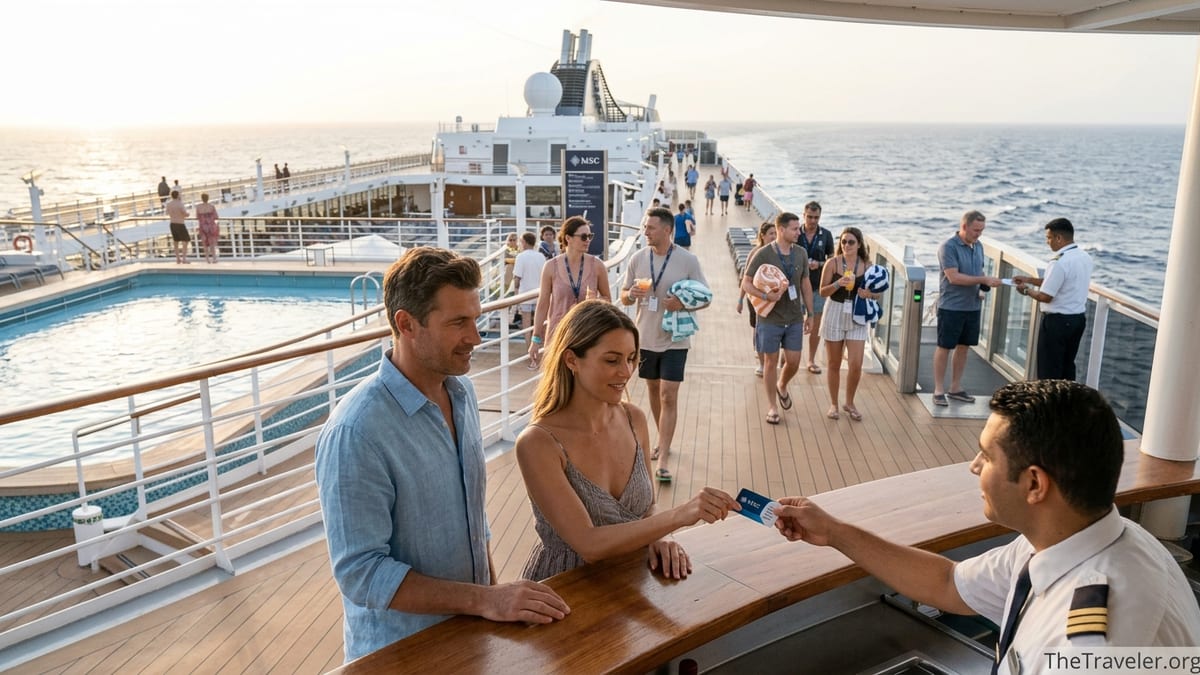
What the MSC Cruise Card Is (and Why It Matters)
MSC calls it a Cruise Card, but you might also hear people refer to it as a key card, ship card, or room card. Whatever the name, it is issued to every guest, including children, and it becomes your primary ID on board. You receive it soon after embarkation, usually waiting in an envelope in your stateroom, preprinted with your name, cabin number, and other key details such as your dining time, muster station, and sometimes your loyalty level.
Practically, the card serves three main purposes. First, it unlocks your cabin door and may also control the power in the room when you insert it into the slot near the door. Second, it is your onboard charge card, used to pay for drinks at the bar, shopping in the boutiques, spa treatments, excursions purchased on board, and extras like gelato, specialty coffee, or photos. Third, it acts as your security ID when you leave and reboard the ship in port, with crew scanning your card so the ship knows exactly who is on board.
Because there is no cash used at the bars or shops, you will use your MSC card dozens of times a day without thinking about it. On a typical seven-night Western Mediterranean cruise on a ship such as MSC Seaside, a family of four might tap their cards for morning cappuccinos, pay for kids’ arcade games, buy a few drinks by the pool, and pick up souvenir T-shirts in the duty-free shop, all routed back to a single onboard account.
For that reason, treat the card like a combination of your passport and your credit card while you are on the ship. Keep it secure in a lanyard, wristband, or wallet and get in the habit of checking you have it with you whenever you leave your cabin.
How to Activate Your Card and Set Up Payment
On MSC, your cruise card is not fully active for onboard purchases until you set up a payment method. After embarkation and once you have collected your card from your stateroom, you will see automated Cruise Card activation points positioned around the ship, usually near reception, guest services, or busy elevator lobbies. At these kiosks you insert or tap your card, then follow the prompts to register a credit, debit, or prepaid card, or to link your account as a cash account.
MSC typically allows you until around 11 p.m. on the day after embarkation to complete this step. Until then, small purchases like a first drink at the pool bar may still be permitted, but to avoid any frustration it is smart to activate the card shortly after boarding. For example, on a Caribbean sailing out of PortMiami, a couple might drop carry-on bags in the cabin, then go directly to a nearby kiosk to register a travel credit card. Once that is done, all their onboard spending for the week routes to that card automatically at the end of the cruise.
If you prefer not to use a credit or debit card, you can opt for a cash account at the Guest Services desk. In this case, you deposit a set amount in cash, which becomes your onboard spending limit. Many families on shorter three- or four-night cruises choose this approach to keep a firmer handle on their budget. As the balance runs low, you can add more cash. At the end of the voyage, any unused amount is refunded at reception before disembarkation, usually in the onboard currency.
When you register a bank card, MSC may place a temporary hold to cover expected onboard spending and then adjust it when settling the final bill. The amount of that hold can vary by itinerary and length of cruise, so it is wise to leave some buffer on your card. Travelers using debit cards in particular should be aware that these preauthorizations can tie up funds for several days after the cruise, depending on how quickly their bank releases the hold.
Daily Life On Board With Your Cruise Card
Once activated, you will use the MSC card constantly. At the door to your cabin, a quick tap or swipe unlocks it. Inside, inserting a card into the slot by the door usually activates the electricity and air conditioning. Many guests keep an old hotel key card in that slot so they do not have to leave their MSC card behind, but officially you are meant to use your cruise card to avoid unnecessary power use when the cabin is empty.
Throughout the ship, your card is the way you “pay” for almost everything. At the bar, a server will take your card, tap it on their handheld terminal, and return it to you with a receipt if requested. In the Marketplace Buffet, drink stewards push carts with beer and soda; again, they simply tap your card. In specialty restaurants like Butcher’s Cut or Kaito Teppanyaki, the waiter brings a slip to sign linked to your card, and the charges appear on your final folio.
The card is also how MSC tracks where you are in relation to the ship. As you disembark in port, security staff scan your card. When you return from a day in Cozumel or Barcelona, you scan back in at the gangway. The ship’s system shows everyone who is still ashore as sailaway approaches, which is why port staff insist on the card even if you carry your passport.
Finally, your card carries your dining assignment, which is useful on the first evening. For instance, if you are assigned “Early” dining at 6 p.m. in the Green Olive Restaurant on MSC Grandiosa, that information is printed right on the card, helping you and the maitre d’ find the correct table without confusion.
Using the Card for Drinks, Packages, and Extras
Most MSC guests will encounter the card first at the bar. Whether or not you have a drink package, every beverage order flows through your cruise card. If you purchased the Premium Extra Package before sailing, bar staff can see that on their screens as soon as they tap your card. You order a draft beer or an Aperol Spritz by the pool on an MSC Seashore sailing from Orlando, they tap your card, and the system confirms it is included within your package limits.
On ships and itineraries where MSC still offers multiple drink packages, you might have an alcohol-free package or a minors package for teens. The card carries a code that indicates which one you hold. A teenager on a Mediterranean school-holiday cruise might tap their card at a gelato bar and have sodas and mocktails covered, while their parents use their own cards for wine at dinner. Where daily limits apply, such as a cap on alcoholic drinks per day, those are tracked to the card rather than to the entire cabin.
The same principle applies to other pre-purchased extras. If you buy a multi-night specialty dining package, a photo package, or even a thermal spa pass before sailing, they are typically loaded digitally to your profile. When you show up at Hola! Tacos & Cantina for your reserved dinner, staff scan your card, see that you have a dining package, and redeem one of the included meals without any money changing hands.
One practical example: on a seven-night MSC Meraviglia cruise from New York, a couple might pre-book the Premium Extra drink package and a three-night specialty dining package. On board, they tap their cards for every drink. When they dine at Butcher’s Cut on night three, the waiter scans their cards and applies the dining package, so the only extra charge on their folio is any premium items beyond what the package covers, again linked to the card.
Kids, Families, and Managing Multiple Cards
Because every guest receives a card, families quickly find themselves juggling several. Parents should decide in advance how they want their children’s cards configured. On MSC, minors can have spending permitted or blocked, or limited just to certain categories such as soft drinks. This is handled at check-in or later at Guest Services. For example, some parents allow their 15-year-old to use their card to get sodas and arcade credits, but block jewelry or spa purchases.
On family-oriented sailings in the Caribbean, it is common to see kids wearing their cards on lanyards branded with MSC or the ship’s name. This helps children access their cabin if they go back to change for the pool or head to the kids’ club. Remember, though, the card is also used for security. When kids check into and out of youth clubs, their cards are scanned, and the system logs who is picking them up, adding another layer of safety.
If several adults share one cabin, they may have different spending patterns but share a single onboard account. All cards in a stateroom typically link back to the same folio. So if one person spends heavily in the casino and another focuses on spa treatments, it all settles to the same credit card or cash deposit. To keep track, it is smart to review your onboard account during the cruise using the self-service kiosks, the cabin TV, or the MSC for Me app where available.
First-time MSC guests sometimes worry that others can charge to their account by using a lost card. If you misplace your card, report it immediately to Guest Services. They will deactivate the old one and issue a replacement. In practice, bartenders and shop staff are used to checking the name on the card, especially for larger purchases, so fraudulent use is less common than many fear.
MSC Wristbands and the MSC for Me App
On newer MSC ships and many itineraries, you will see fellow passengers wearing colorful plastic or rubber wristbands. These are part of MSC’s MSC for Me technology and can act much like your cruise card. You tap the band instead of the card to unlock your cabin door, pay at bars and shops, and sometimes even check children into kids’ clubs. The bands are typically available for purchase on board and some of the revenue may support MSC’s charitable foundation projects, giving you a small philanthropic benefit alongside the practical one.
For a first-time cruiser, a wristband can dramatically reduce the chances of losing the card. It also makes life easier at the pool or water park on ships such as MSC Seascape, where you might not have pockets. A parent ordering ice creams for two kids does not have to juggle a wallet; they simply tap their wrist at the bar.
The MSC for Me app, where offered, ties into this ecosystem. After connecting to the ship’s free intranet on your phone, you can use the app to check your onboard account balance, see charges per card, and sometimes even locate family members if they are wearing connected bands. You still need the physical card or band for payments, but the app becomes your dashboard for everything that is happening on board.
As with all technology, availability varies by ship and homeport, and some features may not be enabled on every sailing. When you board, check the daily program or ask at Guest Services whether MSC for Me and wristbands are active on your specific cruise, and whether they are included for your cabin category or sold as an optional extra.
Security Holds, Onboard Currency, and Settling Your Bill
Behind the scenes, your cruise card is the front end of an onboard account denominated in the ship’s chosen currency. On most MSC sailings in Europe, that currency is euros. On many cruises in the Caribbean, Bermuda, Canada and New England, South America, South Africa, and parts of Asia, the onboard currency is US dollars. You can see which applies to your cruise in your booking documents and once on board at Guest Services or on your folio.
When you register a credit or debit card, MSC usually places a preauthorization hold. As an example, on a seven-night cruise in the Caribbean with two guests, that initial hold might be a few hundred dollars, then increased in increments if your spending rises during the cruise. This is not an actual charge but a reserved amount your bank temporarily sets aside. At the end of the cruise, MSC posts the real total, and any unused portion of the hold is released by your bank’s systems, often within a few business days.
If you choose a cash account instead, you will not see any bank holds, but you must be more proactive. Perhaps you start your cruise with a 300-dollar cash deposit. By day four, you check your account at a kiosk and see that, between drinks, a shore excursion booked on board, and a few souvenir photos, you only have 60 dollars left. You can then decide to top up with more cash, or deliberately limit spending for the remaining days.
The night before disembarkation, MSC usually delivers a printed statement to your cabin or makes it available via the app and TV. This lists each charge by date and location, plus any onboard credit you may have received from a promotion or as loyalty benefits. If you registered a bank card, you typically do not need to do anything; the final total will be charged automatically. If you have a cash account and a positive balance, you will need to visit Guest Services or a designated refund desk to collect any remaining cash before leaving the ship.
The Takeaway
Using an MSC cruise card for the first time can feel like learning a new payment system, but in practice it quickly becomes second nature. The key steps are simple: pick up your card in your cabin after boarding, activate it promptly at a kiosk or at Guest Services with a credit, debit, prepaid, or cash deposit, and keep it with you whenever you leave your room.
Once those basics are in place, the card takes care of almost everything else. It opens your cabin door, pays for your morning cappuccino and evening cocktails, records specialty dinners and spa visits, and tracks your movements on and off the ship for safety. Tools like MSC wristbands and the MSC for Me app add convenience, but the card remains the backbone of daily life on board.
For first-time MSC guests, a little preparation goes a long way. Decide in advance how each family member’s card should work, be aware of bank holds if you register a debit or credit card, and monitor your onboard account once or twice during the cruise. With those habits in place, your cruise card fades into the background and simply supports the reason you came on board in the first place: to relax, explore new ports, and enjoy your time at sea.
FAQ
Q1. When do I receive my MSC cruise card?
On most MSC ships, your cruise card is waiting in an envelope in your cabin when you first arrive after embarkation. Occasionally it is handed to you during the check-in process, but in either case you will have it within your first hour on board.
Q2. How do I activate my card for onboard purchases?
After boarding, you activate your card by registering a credit, debit, prepaid, or cash account. You can do this at self-service Cruise Card activation points located around the ship or at the Guest Services desk. Until you complete this step, your ability to make purchases may be limited.
Q3. Can I use a debit card instead of a credit card?
Yes, MSC generally allows you to register either a credit or debit card. Keep in mind that preauthorization holds can temporarily reduce your available balance, and those holds can take several days to clear after the cruise, depending on your bank.
Q4. What happens if I lose my cruise card?
If you lose your card, go immediately to Guest Services and report it. They will deactivate the lost card to prevent further use and issue a replacement. Any legitimate charges made before you reported the loss remain on your account, but staff will usually verify identity on higher-value transactions.
Q5. Can my children charge purchases with their cards?
Yes, but only if you allow it. At check-in or later at Guest Services, you can authorize or block spending on each child’s card, and in some cases restrict it to specific items like soft drinks. Many parents limit or disable charging for younger kids to avoid surprise expenses.
Q6. Does the cruise card show that I have a drink package?
The card itself may carry a code, and the ship’s system definitely knows which package you hold. When a bartender taps your card, they see whether a drink package is attached and whether the drink you ordered is included, then either apply the package or charge the item to your onboard account.
Q7. Do I need to carry my passport if I have my cruise card in port?
For getting on and off the ship, the cruise card is usually enough, as security staff scan it each time. However, some ports or shore excursions still require government ID, and many travelers choose to carry a passport copy or follow the specific guidance given in the daily program for each destination.
Q8. Can I pay my onboard account in cash instead of by card?
Yes. You can open a cash account at Guest Services by depositing a set amount of money in the onboard currency. Your spending draws down that balance. If there is money left at the end of the cruise, you can collect the remaining cash before disembarkation.
Q9. Is my cruise card valid on MSC’s private island?
Yes, on MSC private islands such as Ocean Cay in the Bahamas, the cruise card works just as it does on the ship for drinks, some food items, and many extras. Purchases there are added to your onboard account in the same way as onboard spending.
Q10. Can I share my cruise card or wristband with someone else?
No. Each cruise card is personal and linked to your identity, cabin, and onboard account. Sharing cards or wristbands is not permitted, and can cause billing confusion or security issues. If friends or family members need to make purchases, they should use their own cards linked to the appropriate account.