


More news on this day
The residential cruise experiment that promised an “endless” life at sea aboard Villa Vie Odyssey has come to a sudden stop in Cambodia, where around 200 long-term passengers have been ordered to leave the ship after the operator froze its global voyage over a financial squeeze tied to surging fuel prices.
Get the latest news straight to your inbox!
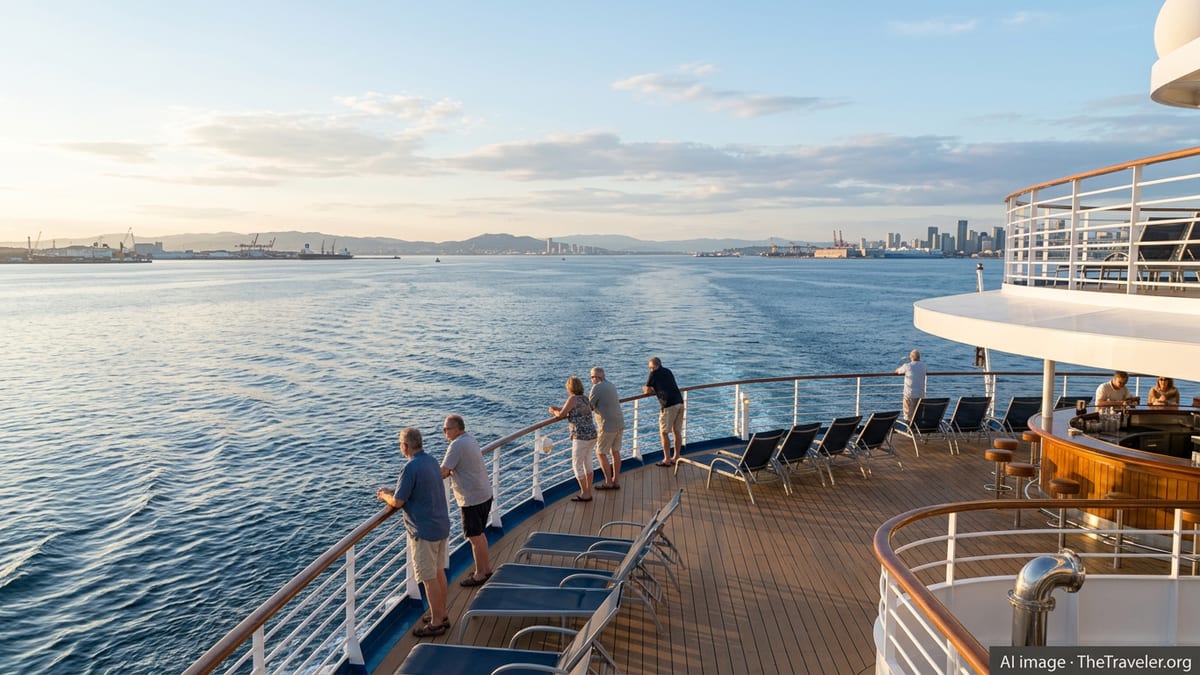
From endless horizons to an abrupt Cambodian stop
The Bahamas-flagged Villa Vie Odyssey arrived in the Cambodian port city of Sihanoukville this week after more than 750 days of continuous travel, only for residents to be informed that the ship’s three-and-a-half-year looping world voyage had been suspended. Publicly available information indicates that the instruction to disembark was issued on 27 October 2026, with passengers given a deadline of 2 p.m. local time to leave the vessel.
Reports indicate that about 200 passengers were living on board at the time, far below the ship’s capacity of roughly 650 to 970 residents, depending on configuration. Many had committed to the concept of a “cruise for life,” selling homes or securing long leases to finance cabins on what was marketed as a permanently roaming community at sea.
The Odyssey, built in 1993 and sailing under several names before being acquired by US-based Villa Vie Residences in 2023, had already endured a trouble-filled launch. Its departure from Northern Ireland in October 2024 was delayed by several months for repairs, a setback that observers say placed financial strain on the start-up operator even before fuel prices began to surge.
Fuel costs surge and the business model cracks
According to company statements cited in multiple news reports, Villa Vie Residences blamed “extraordinary” increases in marine fuel costs, particularly in Asian waters since the escalation of conflict involving Iran earlier this year, for making the Odyssey’s operating model unsustainable. Monthly fuel expenses calculated on a per-cabin basis were described as having risen from about 1,800 dollars to between 6,000 and 8,000 dollars in parts of Asia, an increase of more than 300 percent.
The operator said it had already tried to slow the itinerary, extend port stays and otherwise reduce consumption, but those measures were not enough to offset the higher bills. Publicly available material on the company’s residential program shows that passengers typically paid a large upfront sum for cabin ownership or long leases, plus ongoing monthly fees, rather than per-night cruise fares, which left limited scope to quickly pass on such sudden cost spikes.
Industry coverage notes that Villa Vie had also faced early cash pressures, including the costs of refitting the former Fred. Olsen Cruise Lines vessel and periods with substantial unsold inventory. The suspension in Cambodia appears to reflect a breaking point where mounting operating losses, a relatively small resident base and the fuel shock converged.
Stranded residents and a scramble onshore
When the order to disembark came, residents were told that crew would remain on board in Sihanoukville to keep the ship and essential systems running, while passengers were instructed to leave by early afternoon. Notices shared publicly by passengers stated that shuttles between the ship and shore would run until 6 p.m. the following day to allow people to collect remaining belongings.
News outlets and passenger blogs describe a chaotic scene in the Cambodian port, with residents suddenly needing to find accommodation and onward flights after assuming for years that their primary home would be at sea. Local officials cited in regional coverage have said there were just over 200 passengers and roughly 150 crew members in Sihanoukville once the operation was paused.
Accounts from residents published by international media indicate that some passengers feel they were provided limited practical assistance beyond transport from the port, while company statements emphasize that Villa Vie is “working with residents to coordinate disembarkation and identify temporary living arrangements.” The degree of direct financial support for hotel stays or onward travel has not been clearly detailed in public communications so far.
Boss acknowledges he is seen as ‘the villain’
As frustration built among stranded passengers, Villa Vie’s leadership moved to defend the decision to halt operations. In interviews and statements cited in recent coverage, executive chairman Mikael Petterson acknowledged the human cost of the suspension and conceded that he had become, in his words, “the villain” in the narrative for residents who suddenly found themselves off the ship in Cambodia.
Petterson has been quoted as saying that the company could no longer shoulder the mounting fuel losses and that simply passing the entire increase through to residents was not realistic. He has pointed to the war-related shock in bunker fuel prices as a decisive factor, while also conceding that the business was still in a start-up phase and vulnerable to unexpected costs.
Reports indicate that management had previously approached residents to discuss additional funding or investment injections to help stabilize finances before the Cambodia decision. Coverage of those talks suggests they did not yield the scale of support needed, leaving the company to shift to what it has described as a restructuring and recapitalisation process expected to take up to 60 days, with no guarantee the voyage will resume.
Uncertain future for a bold cruising experiment
Villa Vie Residences marketed its Odyssey program as a chance to “make the world your home,” with cabins advertised from around 120,000 dollars for interior units and higher prices for larger “villa suites,” plus monthly fees that could reach several thousand dollars. The promise was a slow-travel lifestyle, repeating a global circuit roughly every three and a half years while building a stable onboard community.
The sudden halt in Cambodia raises hard questions about whether niche residential cruise models can withstand sharp swings in costs and global instability. Industry analysts quoted in regional and international coverage suggest that while demand exists for long-term life-at-sea concepts, operators may need deeper capital reserves, more flexible pricing and clearer contingency plans for residents if voyages are interrupted.
For now, the Odyssey remains laid up in Sihanoukville while Villa Vie says it is exploring refinancing, new investors and potential changes to its itinerary or operating model. Passengers who once expected to watch the world drift by from the same cabin are weighing their next steps from Cambodian hotels and nearby airports, as the ambitious “endless” cruise that lured them aboard confronts the very real limits of cost and risk at sea.