


More news on this day
More than 200 passengers who bought into a years-long “endless” world cruise have been left unexpectedly stranded in Cambodia, after their residential ship suspended its multiyear voyage in Sihanoukville citing a surge in fuel costs and a lack of funds to continue sailing.
Get the latest news straight to your inbox!
Residential world cruise comes to an abrupt halt
The Villa Vie Odyssey, a 650-passenger residential vessel marketed as a floating community for long-term living, has been moored at Sihanoukville Autonomous Port on Cambodia’s southern coast since late October 2026. Reports indicate that the Florida-based operator, Villa Vie Residences, informed residents this week that operations were being suspended and the cruise’s three-and-a-half-year itinerary cut short.
The ship departed Belfast, Northern Ireland, in October 2024 on what was billed as a continuous global journey lasting more than three years. Cabins were sold as long-term “homes at sea,” with some travelers reportedly committing to live aboard for years. Instead, those residents have now been instructed to disembark in Cambodia with their belongings while the company pursues restructuring and financing options.
Coverage from international outlets and regional media describes passengers leaving the ship in Sihanoukville with limited notice, some still trying to work out how to continue their travels or return home. While overall capacity is 650, current estimates suggest just over 200 residents were still living on board when the suspension was announced, reflecting earlier departures by some guests concerned about the business model and rising surcharges.
Soaring fuel costs upend a fragile business model
Public statements from Villa Vie Residences and media reporting point to a sharp jump in fuel costs as the immediate trigger for the shutdown. The company has indicated that monthly fuel expenses per cabin, historically averaging around 1,800 US dollars, have risen in parts of Asia to an estimated 6,000 to 8,000 dollars per cabin. That represents an increase of more than 200 to 300 percent in a core operating expense.
The surge has been widely linked in coverage to the broader spike in global oil prices following the recent conflict involving Iran, which has affected the cost of marine fuel, aviation fuel, gasoline and diesel across multiple regions. Industry reports note that cruise and shipping operators globally have faced higher bunker prices throughout 2026, but the impact appears particularly acute for a smaller residential operator whose pricing and capital reserves were built on lower and more stable fuel assumptions.
Analyses of the Odyssey’s recent movements suggest the ship had already slowed and reduced time underway in the months before the suspension. Marine-tracking data cited in maritime forums indicate average speeds dropping and days at anchor increasing, consistent with efforts to conserve fuel as costs rose. The latest decision to keep the vessel in Cambodia and halt the multi-year schedule marks a breaking point where the operator could no longer reconcile its promised itinerary with the financial reality of fuelling a constantly traveling residential ship.
Passenger support, disputed payments and crew concerns
One of the most contentious aspects of the situation is the question of who pays for what now that the world cruise has stopped. According to publicly available statements referenced in news coverage, Villa Vie Residences has been covering local transportation and temporary hotel stays for some passengers in Sihanoukville, but has not, at time of writing, committed to funding onward international flights or full relocation costs.
Several outlets have reported that, before the suspension, residents were asked to accept additional fuel surcharges or even contribute toward fuel costs beyond their standard monthly payments. Some passengers have described these requests as evidence of mounting financial strain. Travel and consumer reports also highlight complaints from residents who say they have not yet received clear guidance on refunds or compensation for the remaining duration of their contracts.
Separate reporting from international media focuses on crew members, with some accounts stating that certain staff have not been fully paid and are themselves facing uncertainty in Cambodia. While details vary across sources and are still emerging, labor advocates tracking the case have raised concerns that prolonged lay-up of the ship without a clear financial resolution could complicate repatriation and wage settlements for crew from multiple countries.
Cambodia’s port city under the spotlight
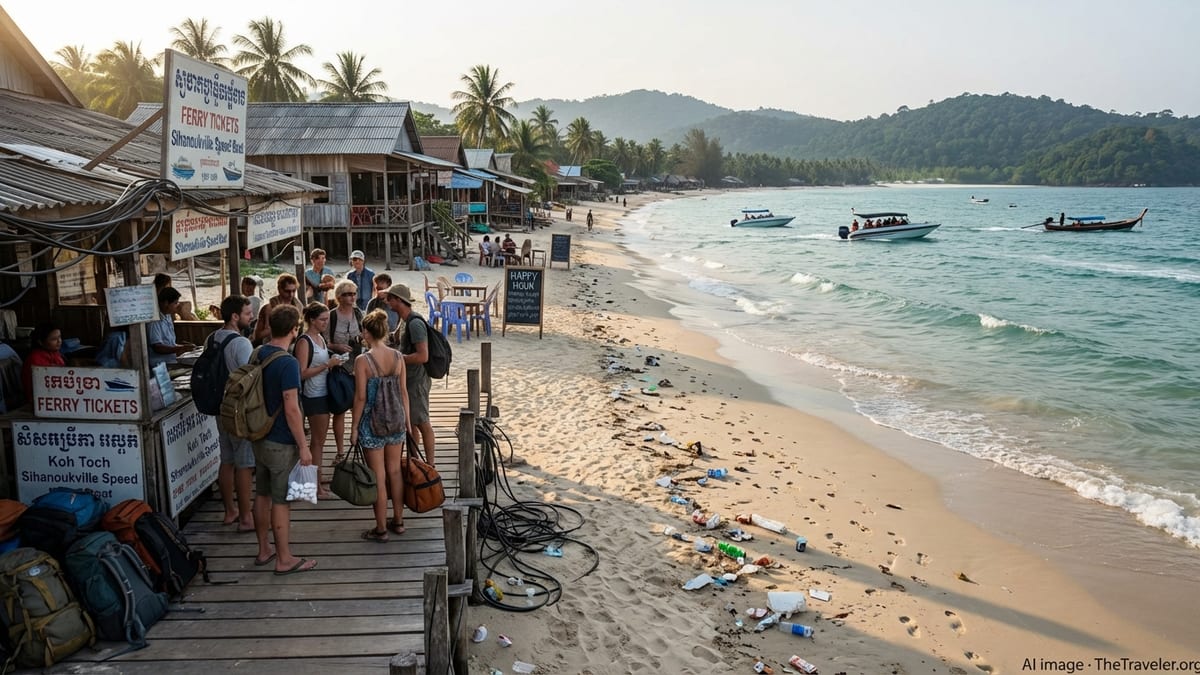
Sihanoukville, a growing deep-water port and beach gateway in southern Cambodia, has suddenly become the unexpected endpoint for a voyage that was marketed as having no fixed finish line. Local authorities quoted in regional coverage describe more than 200 foreign passengers from around 15 nationalities currently in the city, many of them seeking short-term apartments or hotel rooms while they decide their next steps.
Cambodian tourism officials and local media have also framed the event as an opportunity to showcase the country’s coastal attractions. Sihanoukville itself, nearby islands in the Gulf of Thailand, and onward routes to destinations such as Phnom Penh, Kampot and Siem Reap are being promoted to passengers now unexpectedly spending time ashore. However, the sudden nature of the disembarkation means many stranded travelers are balancing sightseeing with urgent logistical tasks, including arranging visas, flights, and storage or shipment of belongings accumulated over two years at sea.
The presence of the Odyssey in Sihanoukville has drawn attention to the port’s role in regional cruising and cargo traffic. The vessel is currently in lay-up status, remaining alongside while the operator explores options. Local reports suggest the ship has requested extensions to remain in port through at least the end of October while financial and legal questions are assessed.
Implications for “live aboard” cruise concepts
The sudden halt of the Villa Vie Odyssey highlights the risks facing a niche but growing sector of residential and “endless” cruises that promise a lifestyle of perpetual travel. These products typically rely on multi-year commitments and substantial upfront or ongoing payments in exchange for the convenience of a floating home that circles the globe, with residents free from many traditional housing responsibilities.
Travel industry analysts note that such models can be particularly vulnerable to external cost shocks, including fuel price spikes, geopolitical disruptions, and changing port regulations. Unlike conventional cruise lines that can adjust itineraries season by season, residential operators have less flexibility to scale back or reposition ships without undermining the central promise of constant world travel. In the Odyssey’s case, the combination of rising fuel bills, a capital-intensive refit of an older vessel, and the need to honor long-term residential contracts may have created financial pressures that quickly became unsustainable.
For travelers considering similar products, consumer advocates point to this episode as a reminder to scrutinize financial safeguards, refund policies, and contingency plans before committing to multi-year stays at sea. While the Villa Vie Odyssey’s full legal and financial outcome remains unresolved, its abrupt pause in Cambodia has already become a cautionary tale about ambitious cruise ventures built on thin margins in a volatile energy market.