


Driving into the green mountains above Utuado to visit Caguana Indigenous Ceremonial Park, I expected a quick historical stop. Instead, a few quiet hours among the stone-lined plazas and carved rocks reshaped how I understood Taíno presence in Puerto Rico today. This is not a theme park or a romanticized village recreation. It is a working archaeological site where you walk the same ground as the people who once played ball games, held ceremonies and carved symbols into stone. What follows is a detailed account of my visit, from the first curves on PR-111 to the moment I stepped back out through the gate.
Get the latest updates straight to your inbox!
Checking hours and planning the visit
Before setting out, I needed to resolve a basic but important confusion: when is Caguana actually open, and how much does it cost to enter? Official tourism content in 2026 has not been perfectly aligned. One Discover Puerto Rico feature about historic sites lists Caguana as open daily from 8:30 a.m. to 4:30 p.m. with admission of 5 dollars for adults and 4 dollars for children and seniors. Another profile page for the same park still describes admission as 3 dollars with free parking. Travel-planning articles and recent visitor reports add to the mix with references to fees between 2 and 5 dollars.
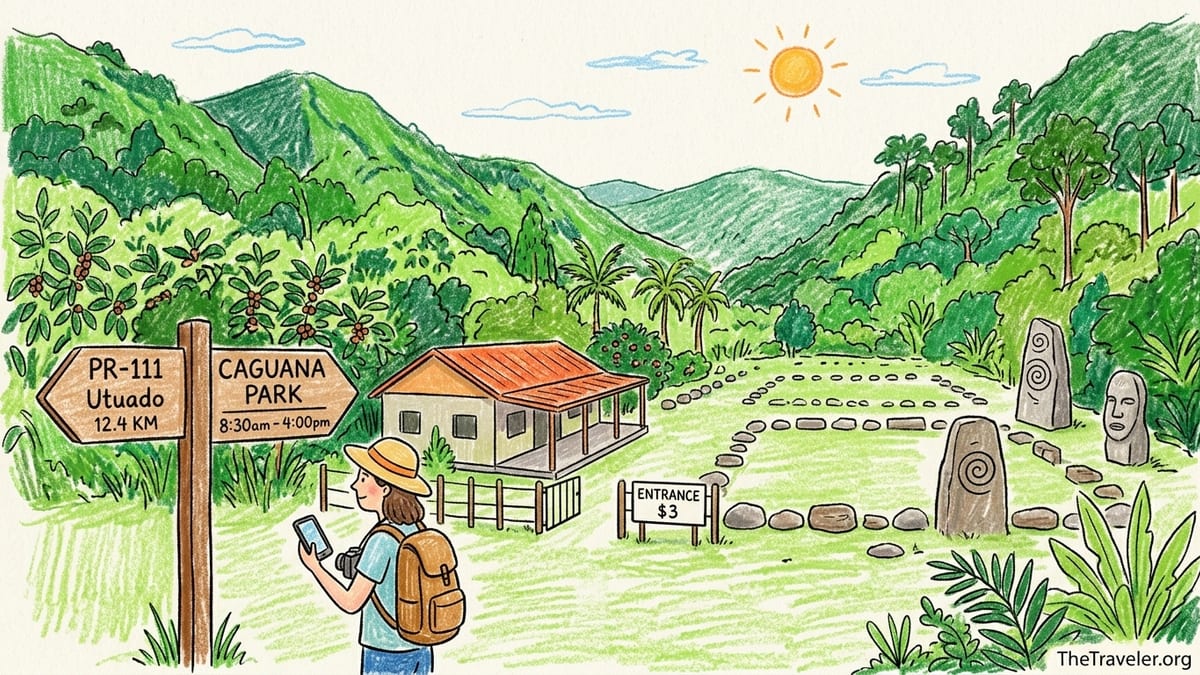
To get a current answer, I called the phone number listed for the park under the Instituto de Cultura Puertorriqueña, which manages the site, on the morning of my visit in October 2026. Staff at the small visitor office confirmed that, as of that day, the park was open from 8:30 a.m. to 4:00 p.m. daily except official Puerto Rico holidays, with last admission around 3:30 p.m. to give visitors time to walk the grounds. They confirmed a 3 dollar per-person admission for adults, with children paying a reduced fee and no separate charge for parking.
Because the park closes in the late afternoon and midday heat in the central mountains can be intense, I aimed to arrive in the morning. From the San Juan metro area, the drive is roughly an hour and a half, depending on traffic on PR-52 and PR-10. I left the coast around 8:00 a.m., which put me on the mountain road into Utuado by midmorning and at the park’s parking lot just after 9:30 a.m., well within operating hours but early enough that only a few other cars were present.
The road into Utuado and first impressions
The approach to Caguana gives you a sense of how remote this ceremonial center once was. After following PR-52 south from San Juan and connecting to PR-10 toward Utuado, the highway narrows and the scenery changes to steep, green ridges cut by river valleys. Coffee and plantain farms appear on the slopes, and the air feels cooler than on the coast.
From Utuado town, I followed PR-111 west toward the barrio of Caguana. The last stretch is on a curving two-lane road that tracks the contours of the hills. There are signs for the “Centro Ceremonial Indígena de Caguana” along PR-111, but they are modest. A navigation app helps, but I found it reassuring that the kilometer markers match what many guides mention: the entrance sits around kilometer 12.4, with a simple brown-and-white heritage sign and a short driveway up to the parking area.
Turning in, I first saw a cluster of tall trees and a low building with a covered porch. There were no tour buses when I arrived, just a handful of private cars. Free parking meant I did not need to deal with machines or attendants. The lot is unshaded gravel with a few trees at the edges, so cars sit in full sun most of the day. From the parking area, a short walk along a paved path leads to the ticket window and entrance gate.
Arrival, tickets and the visitor center
I reached the entrance around 9:40 a.m. A small sign near the gate displayed the day’s hours: 8:30 a.m. to 4:00 p.m. It also indicated that the last visitors are usually admitted by midafternoon, which matched what I had been told by phone. Having that sign at the gate rather than relying on older online listings was useful. It meant that anyone driving up could immediately see if there had been a schedule change that day.
Admission for my visit was indeed 3 dollars in cash per adult. There was no card reader in sight, so it is best to bring small bills. Children and seniors were paying slightly less, according to the handwritten rate chart posted next to the window. Parking was free. The staff member at the window handed me a small paper ticket and a simple brochure in Spanish, with a site map on one side and short descriptions of the main features on the other. An English-language version was not available that morning, though some multilingual staff are sometimes present.
Through the gate, the first building is essentially the visitor center and museum combined. It is modest in size. Inside, there is a reception area with basic information, a small exhibition room, and restrooms. Fans circulated the air, and although there was no large, elaborate interpretive display like at some national parks, the space gave me a concise grounding before I stepped out onto the plazas.
The small museum and what it explains
The museum room is not large, but it holds original artifacts and panels that contextualize Caguana without theatrics. In glass cases, I saw fragments of Taíno ceramics, stone tools, and carved stones recovered from the site and nearby areas. Labels focused on dates, materials, and excavation work rather than speculative stories. Many objects were dated approximately between the 13th and 15th centuries, which aligns with archaeological research that situates Caguana’s peak use in late precolonial times.
Wall panels explained that the site was first documented by researchers in the early 20th century and that the Instituto de Cultura Puertorriqueña placed it under protection and opened it as an archaeological park in the 1960s. One panel summarized how the stone-lined rectangles and ovals visitors see outside are ceremonial plazas and ball courts known as bateyes, where ball games, dances and political gatherings likely took place. Another panel offered a cautious overview of Taíno society and the ways colonial accounts, archaeology and ongoing Indigenous perspectives each contribute partial pieces to the story.
What struck me was that the museum did not try to assign definitive meanings to every spiral or figure carved on the stones. Where some Caribbean publications talk about petroglyphs as clear depictions of deities or astronomical markers, the on-site explanations used more careful phrases like “interpreted by some researchers as representing” or “possibly associated with.” That restraint shaped how I approached the stones outside. Instead of looking for a tidy legend to match each carving with a character or myth, I understood that much about Taíno belief and practice at Caguana remains uncertain, and that respectful interpretation means acknowledging those gaps.
Walking out to the bateyes: paths, shade and heat
Stepping out the back door of the museum, the landscape opens suddenly into a broad grassy field framed by mountains, with the main bateyes arranged in a line. The contrast between the enclosed museum and this open space is striking. From this vantage point, the stone alignments that once defined ball courts and plazas become clear, and a visitor path loops around them.
The main walking routes are a mix of short concrete segments and compacted dirt and grass. Under dry conditions like I had, they are easy to navigate in regular walking shoes or sturdy sandals. After rainfall, some parts could be muddy, so light hiking shoes would be wiser. The site is gently sloped but mostly level, and I saw older visitors moving slowly but comfortably along the main loop. A few short spur paths to individual petroglyph stones require stepping up or down small grassy ledges.
Shade and heat are real factors. The surrounding hills are lush, but the central playing fields are intentionally open, with only a few trees near the edges. By late morning, the sun was high and strong. There are pockets of shade under trees on the perimeter and at the edge of one plaza where a ceiba tree stands, but large portions of the walk are exposed. In October, temperatures in Utuado can sit in the low to mid 80s Fahrenheit with high humidity. Within thirty minutes I was grateful for the hat and water bottle I had brought, since there were no vending machines or kiosks on the grounds when I visited.
Among the plazas and petroglyphs: what felt clear and what did not
From the first batey, with its rectangular outline of stones, I could see why Caguana is often described as one of the most important Taíno archaeological sites in the Caribbean. There are around ten plazas visible across the grounds, some rectangular, some more oval. Stone monoliths, many brought from the nearby river, stand at edges or corners. Several of the most prominent stones bear petroglyphs: spirals, faces with large eyes, and more abstract patterns.
Each major court has a simple numbered marker that corresponds to the brochure map. A few information panels in Spanish near the path explain which plazas have been most studied and where key petroglyphs are located. The interpretation here is much lighter than in the museum. Signs state that ball games and ceremonial dances took place on these grounds, based on colonial descriptions of Taíno life and comparative studies with other Antillean sites. They describe petroglyphs as rock carvings that may be linked to spiritual beliefs, water, fertility or ancestral figures, drawing on regional research, but they stop short of asserting fixed meanings.
Walking slowly along the edge of one court, I noticed a stone with a spiral carved near its top, set in front of a large tree. Some interpret spiral motifs in the region as symbols related to water or movement, but on-site signage did not assign that meaning. Instead, it pointed out the carving’s age and context and left the symbolic interpretation more open. That honesty matched what I had read earlier about the need to avoid romanticizing Taíno culture by projecting modern desires for neat symbolism onto fragmentary evidence.
Spending almost an hour among the plazas, what I genuinely understood was less about specific myths and more about scale and continuity. The sheer size of the aligned courts, the labor involved in bringing and setting the stones, and the deliberate openness of the central field all underscored that this was a significant ceremonial center for the people living in these mountains before and during the first years of Spanish invasion. Seeing local families walking the grounds, some speaking with children about ancestry and history, made it clear that for many Puerto Ricans today, Caguana is not just a ruin but a living point of reference for Indigenous heritage, despite the gaps in the written record.
Time spent on-site, signage and overall visitor experience
From entry at the ticket window to exiting through the same gate, I spent just under two hours at Caguana. Roughly twenty minutes went to the museum and introductory panels, a full hour to roaming the bateyes and pausing at petroglyphs, and another fifteen minutes to circling back under the shade of perimeter trees and re-reading some of the interpretive signs. Visitors moving more quickly, taking a few photos at the main courts, could complete a visit in about an hour, but allowing more time helps the site feel less like a brief roadside stop.
Overall, interpretation felt honest but limited. The museum and a few outdoor panels provide enough historical and archaeological framing to understand what you are looking at: a complex of ceremonial plazas and ball courts used in the centuries before colonization, preserved and studied since the mid-20th century. They emphasize the site’s importance and the ways Taíno heritage survives in language, place names and cultural practices. However, there is not a detailed, court-by-court breakdown on the ground, nor are there extensive audio guides or mobile-activated QR codes in every corner, even though a mobile app for the site has been developed in previous years.
For a traveler used to major national parks or large museums, Caguana might feel under-interpreted. That can be frustrating if you arrive expecting to unlock every carving’s story in a single visit. For me, it forced a different kind of attention. Without an overload of text panels, I paid more attention to relationships between the courts, the line of sight to the surrounding mountains, and the experience of walking from one plaza to another. The signage did enough to keep me grounded in facts while leaving space for reflection without drifting into fantasy.
Leaving the park and what stayed with me
By the time I headed back toward the entrance, the sun was higher, and a few more cars had filled the parking lot. I stepped into the museum one last time to glance at the excavation photos, which show the site before restoration, with stones partially buried and vegetation encroaching. Seeing those images after walking the open courts made the work of preservation concrete. It highlighted that what looks timeless today is the product of deliberate, ongoing care by archaeologists, local workers and the cultural institute.
Checking my watch as I returned my brochure to the rack, it was just before 11:30 a.m. I passed back through the gate, crossed the hot parking area to my car, and pulled out onto PR-111 toward Utuado’s town center for lunch. The physical visit was over in less than two hours, but on the drive down I kept replaying certain details: the way one court lined up with a distant ridge, the worn edges of carved faces on stones that once stood at the heart of community rituals, the mix of certainty and uncertainty in every explanatory panel.
What I understood after visiting, more than any particular legend, was that Caguana anchors a conversation about Taíno heritage that is still unfolding. Archaeologists continue to refine dates and functions. Local communities and people who identify with Taíno ancestry continue to negotiate how these spaces figure into contemporary identity and sovereignty. As a visitor, the most responsible position felt like listening and observing, taking in the physical evidence and the cautious interpretations without demanding a perfectly complete narrative.
The takeaway
If you are building an itinerary around beaches and cities, it can be tempting to skip the drive into the mountains for what looks, on paper, like an hour or two among grassy rectangles and carved stones. After walking Caguana from the parking lot to the farthest batey and back, I would argue the site deserves its own space in any serious visit to Puerto Rico, especially if you want to understand the island as more than a colonial fortress and resort coastline.
In practical terms, allow at least 90 minutes on-site, and closer to two hours if you like to read every sign, photograph petroglyphs and spend a little time under the shade with the view of the mountains. Plan your visit in the morning, confirm hours by phone or through the cultural institute shortly before you go, and bring water, sun protection and small bills for the admission fee, which as of my October 2026 visit was 3 dollars per adult with free parking. The walking is not strenuous, but it is mostly exposed.
Is Caguana worth the trip even if you are not interested in canyoning, caving or other adventure activities that often draw travelers to Utuado? In my experience, yes. The road approach alone introduces you to a part of Puerto Rico that many coastal visitors never see, and the park itself offers a rare chance to stand in a major Indigenous ceremonial center without heavy commercialization. You will not leave with a complete guide to Taíno cosmology, and the park does not pretend to provide one. Instead, you step away with a grounded sense that long before forts went up in San Juan, people here organized complex societies, debated decisions, honored their ancestors and inscribed their presence into stone.
FAQ
Q1. Where is Caguana Indigenous Ceremonial Park located?
Caguana Indigenous Ceremonial Park sits in the mountainous municipality of Utuado in central Puerto Rico, along road PR-111 in the barrio of Caguana, about a 90-minute drive from the San Juan area by car.
Q2. What are the current opening hours?
On the day of my October 2026 visit, staff and posted signage listed hours as 8:30 a.m. to 4:00 p.m., with last entry in midafternoon. Because online sources still show slightly different schedules, it is wise to call ahead shortly before your visit to confirm the exact hours for that day.
Q3. How much is admission and is parking free?
During my visit, adult admission was 3 dollars per person, children and seniors paid a reduced fee, and parking in the on-site lot was free. Payment was taken in cash at a small ticket window near the entrance.
Q4. How much time should I plan to spend at the site?
I spent just under two hours, including the small museum and an unhurried walk around all the main bateyes. Travelers who move quickly can see the essentials in about an hour, but 90 minutes to two hours allows for reading signs, photographing petroglyphs and taking breaks in the shade.
Q5. What are the walking conditions like?
The main paths around the plazas are a mix of grass, compacted dirt and short paved segments. Under dry conditions they are easy in regular walking shoes, with only mild slopes and a few small steps. There is limited shade on the central field, so expect sun exposure and bring water and sun protection.
Q6. Is there good interpretation and signage?
Interpretation focuses on essentials rather than exhaustive detail. The small museum provides background on Taíno culture, archaeology and the history of the park, while outdoor panels identify main courts and explain that bateyes were used for ball games and ceremonies. The signage is careful not to assign definitive meanings to every petroglyph, acknowledging that some aspects remain uncertain.
Q7. Can I visit without a guide, or do I need a tour?
You can visit independently. Admission includes access to the museum and grounds, and a simple brochure map helps orient you. Guided group tours are sometimes offered by independent operators or on special occasions, but they are not required for a rewarding visit.
Q8. Are there services such as food, water or shops on-site?
When I visited, there were restrooms and a basic visitor area but no café, restaurant or vending machines on the grounds. It is best to bring your own water and snacks and plan to eat in Utuado town or along PR-111 before or after your visit.
Q9. Is Caguana suitable for children and older travelers?
Yes, as long as everyone is comfortable walking on grass and dirt paths with some sun exposure. The distances are short, and many families were exploring together during my visit. Bringing hats, sunscreen and water makes the experience more comfortable for both kids and older visitors.
Q10. Is Caguana worth it if I am not into adventure sports?
Absolutely. Even if you are not visiting Utuado for river activities or caves, Caguana offers a focused, culturally rich experience. The combination of a scenic mountain drive, a manageable walk among the plazas and a grounded introduction to Taíno heritage makes it a worthwhile half-day trip from coastal areas.