


Standing in the white rock of Cañón Blanco, with the Río Caonillas running glass-clear at my feet and petroglyphs carved into pale stone, I understood why every photo of this canyon goes viral. What surprised me was not the beauty but how different the reality felt from the simple phrase I kept reading in brochures: “a short hike from a small parking area.” The visit is absolutely worth it, but it is not a casual roadside stop. If you are picturing a flat riverside path, an obvious trailhead, or a lifeguarded swimming hole, you will be caught off guard.
Get the latest updates straight to your inbox!
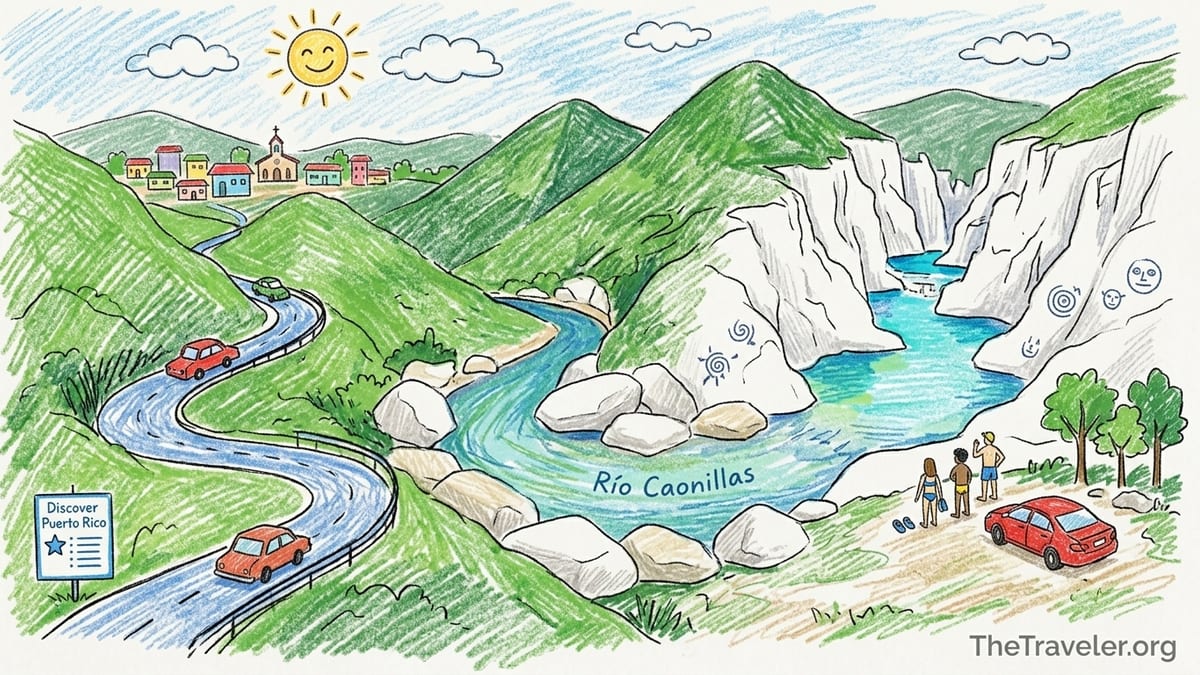
Getting There: The Exact Route I Used
I visited Cañón Blanco in October 2026, coming from Arecibo toward Utuado, then following PR‑10 into the central mountains. I used the official Discover Puerto Rico listing as my starting point, which correctly places Cañón Blanco near the Las Palmas / Paso Palmas area of Utuado but does not give turn‑by‑turn detail. In practice, you leave the main highway and follow smaller local roads that drop you toward the Río Caonillas valley. The last stretch is on a narrow, paved rural road with steep drop‑offs and almost no shoulder, the kind of road where you slow to let oncoming cars squeeze past.
The key reassurance is that, as of October 2026, you do not need a 4x4 to reach the usual access point in dry conditions. I drove a compact rental sedan. The pavement was patched, potholed in places and rough, but there were no deep ruts or river crossings on the road itself. Where online trip reports talk about parking “by the river,” they are describing a short unmarked pull‑off from the paved road down to a dirt and grass area above the riverbank. It looks more like a utility access than an official trailhead, and that ambiguity is what leaves many first‑time visitors wondering if they are in the right place.
From the road, you do not immediately see the canyon walls or the famous white formations. What you see is a bend in the Río Caonillas, trees, and smooth boulders. The pale rock that dominates social media photos is farther upstream. Expect to rely on your GPS trace or a downloaded map from a service like Veredas PR, which currently lists the Cañón Blanco route at roughly 0.5 kilometers of river walking one way, following the bed of the Río Caonillas through the canyon.
If you are uncomfortable driving narrow mountain roads, consider staying in Utuado town and arranging for a local guide or driver who knows the route. Several small guesthouses and fincas in the area now offer guided Cañón Blanco outings precisely because the access feels more intimidating than the distance would suggest.
Parking, Land Access, and Why You Must Double‑Check
The biggest practical issue I encountered was uncertainty around parking and land ownership. There is no developed parking lot with painted lines, fee station, or signage. Instead, you pull off onto a small dirt and grass area by the river that fits a handful of cars at most. In October 2026 there were no “no trespassing” signs posted at this pull‑off and no chains or barriers, and other cars were already parked there for canyon visits. However, there is at least one home directly across the road and agricultural land nearby, so it is essential to understand that you are entering a lived‑in rural community, not a remote national park.
Before my visit I cross‑checked local Spanish‑language blogs, Veredas PR’s trail description, and recent traveler reports on social platforms to confirm that people were still using this access without issue in 2026. I would strongly advise doing the same within a week of your own trip. Land arrangements and local tolerance can change, especially as Cañón Blanco becomes better known. If you see new signs, fences, or residents asking you not to park or pass, take that seriously and turn around instead of trying to “sneak in.”
When I arrived, I parked as far off the paved lane as possible to avoid blocking traffic or driveways. There were no facilities: no bathrooms, no trash cans, and no formal ranger presence. Everything you bring in needs to leave with you. I saw broken glass in one spot near the river and bits of old picnic trash caught in tree roots. That was a clear reminder that this place will only stay special if visitors treat it like a wilderness river, not a party spot.
I stayed approximately three hours in total, of which around forty minutes were spent walking and scrambling, and the rest swimming, resting, and photographing. That felt like the right amount of time for a first visit in dry, stable weather. With children or slower hikers, or if you plan to explore farther into the canyon, budget at least half a day.
The “Short Hike” in Reality: Distance, Trail, and Scrambling
On paper, the hike to Cañón Blanco sounds trivial. Veredas PR shows an informal route of about 0.5 kilometers each way with no significant elevation gain, and Discover Puerto Rico describes it as “a short hike from the small parking lot.” In reality, that short distance feels longer because you are moving over uneven, sometimes slippery surfaces and negotiating the river itself. This is a river scramble, not a groomed trail.
From the parking pull‑off, I walked down a rough dirt slope less than 50 meters to reach the riverbank. There is no formal trail sign. The path is simply where others have walked before, visible but a bit eroded. From there, the route heads upstream along the Río Caonillas. There are faint use paths along parts of the bank, but they appear and disappear. Within minutes you are choosing between walking on angled rock slabs, picking your way across rounded boulders, and stepping into the river to wade when the bank pinches out.
Scrambling is unavoidable. I repeatedly used my hands for balance on smooth limestone, especially near the narrowest canyon sections where the walls rise up to several meters above the water. At one point I needed to pull myself over a waist‑high ledge wet from spray, then lower myself down an equally smooth slope on the other side. Someone uncomfortable climbing onto and off boulders about knee to thigh height will struggle here.
The total distance I covered was about 1 kilometer round‑trip from the car to the heart of the white‑rock canyon and back. That included detours to view petroglyphs and a bit of upstream exploring beyond the main swimming pools. Moving slowly, stopping for photos, and watching my footing carefully, it took about 30 minutes each way in dry conditions. If the water is higher, expect more time and effort.
Water Levels, Slippery Rock, and When I Would Turn Around
Every local resource I checked repeated the same warning: higher water turns Cañón Blanco from a beautiful scramble into a dangerous trap. The Río Caonillas can rise suddenly and significantly after rain, even if it is not raining at the canyon itself. Veredas PR openly recommends avoiding the area entirely after recent or forecast rain and specifically advises against swimming in the narrow canyon sections where steep walls make rescue difficult.
On my visit, conditions were ideal. There had been no significant rain for several days. At the crossings I used, water was ankle to mid‑shin deep, with a couple of thigh‑deep spots in still pools. The current was gentle enough that I never felt pushed off balance. I could see the pale riverbed clearly, which made it easier to judge depth and avoid stepping into unexpected holes between boulders.
Even in good conditions, the white limestone is deceptively slippery where algae or fine silt cover it. Dry patches of rock had excellent friction for my shoes, but darker, damp zones were slick. Twice I watched other visitors step confidently onto a pale, wet slab only to skid because the surface was polished by thousands of wet feet. I had one small slip that ended in a harmless wet shoe but could easily have been a bruised hip.
My personal cutoff, which I would recommend to others, is simple: if the river is brown or opaque instead of clear, if you cannot see the riverbed where you plan to step, or if the water is moving fast enough that it tugs at your legs above the knee, turn around and do not enter the canyon. I would also leave immediately at the first sound or sight of rising water, such as floating debris speeding past, a sudden increase in noise, or water beginning to cover previously dry rocks. With steep walls and limited escape routes, this is not a place to “wait out” a storm or gamble with flash floods.
Footwear, Sun and Shade, and Comfort in the Canyon
I wore closed‑toe water shoes with grippy rubber soles and a snug fit, and I was glad I did. This is not a flip‑flop or bare‑foot‑friendly destination. You want shoes you can fully submerge, that protect your toes from hidden rocks and give you enough friction to edge up sloping slabs. I saw one person hiking in simple canvas sneakers; by the end of their visit those shoes were soaked, heavy, and the wearer was slipping more frequently than anyone in true water shoes or light approach shoes.
If I returned, I would consider low‑profile hiking shoes with aggressive tread that dry quickly, paired with synthetic socks, but I would still plan to get them completely wet. The route requires multiple in‑and‑out river crossings, and trying to keep your feet dry leads to riskier moves on awkward boulders. Accept that you will be wet from at least the knees down.
In terms of exposure, the canyon alternates between full sun and streaks of shade. During mid‑day in October, the air temperature felt hot, but the water was cool to cold. The white rock amplifies sunlight, reflecting glare from below as well as above. I wore a long‑sleeve sun shirt, a hat with a strap (because falls happen), and sunglasses with a strap. There is very little deep shade where you can sit and stay cool for long, so consider bringing water in a soft bottle you can clip to yourself, and reapply sunscreen frequently.
Bug pressure was surprisingly low during my visit, likely because I was in the open river corridor rather than dense jungle. That said, this is still a tropical river environment. I used a light layer of insect repellent on ankles and wrists and was bitten only once. In wetter or calmer conditions, mosquitoes could be more of an issue, particularly near the more static pools at the edges of the main flow.
Petroglyphs and Responsible Cultural Travel
One of the reasons Cañón Blanco stands out among Puerto Rican rivers is the presence of Indigenous petroglyphs carved into some of the canyon’s rocks. These are not museum‑protected behind railings. They appear unexpectedly: a spiral here, a face there, pecked into the pale stone near the waterline. For me, the most powerful moment of the day was not a swim or a cliff jump but the quiet experience of standing at river level and noticing a carved figure emerge from the rock once my eyes adjusted.
There is no on‑site interpretive signage, no ranger talk, and no staff reminding visitors how fragile these carvings are. That makes personal responsibility even more important. The baseline ethical standard is clear and non‑negotiable: view the petroglyphs without touching, tracing, chalking, wetting, or climbing over the marked surfaces. Every handprint adds oil and moisture. Every attempt to “make them show up better” with chalk, water, or digital enhancement directly damages material that has survived centuries of weathering.
I watched one traveler walk barefoot along a ledge, accidentally stepping directly over a carved symbol. They meant no harm, but the rock was wearing down at exactly the height where feet and backsides land when people use it as a lounging spot. That moment made me change my behavior: I gave obvious carvings a wide berth, chose sitting spots on unmarked rock, and kept my pack and wet gear away from carved surfaces. If you are visiting with children, you may want to show them photos of petroglyphs in advance and agree on simple rules like “we look with our eyes and cameras, but we never touch.”
If your primary goal is learning about Taíno culture rather than swimming, consider pairing Cañón Blanco with a visit to Caguana Indigenous Ceremonial Park in Utuado. Caguana offers a small museum, maintained petroglyphs, and context that the canyon lacks. In my experience, seeing the curated, protected stones at Caguana first helped me appreciate the vulnerability of the carvings at Cañón Blanco and behave more carefully when I reached the river.
Who This Canyon Is Really For: Kids, Mobility, and Visit Style
From the outside, Cañón Blanco often gets marketed as a dreamy swimming hole for everyone. After doing the approach myself, I would describe it differently. This is an excellent outing for people comfortable with uneven ground, basic scrambling, and getting thoroughly wet. It is not a good match for visitors with balance issues, knee or ankle instability, or those who are uneasy around moving water.
During my October 2026 visit I saw local families with grade‑school‑age children navigating the canyon successfully. The kids often moved better than the adults, hopping from boulder to boulder in life vests while parents guided them through deeper pools. However, all of those families appeared to be accustomed to river outings. Very young children were carried or kept close to shore. I would not bring a stroller, and I would avoid bringing toddlers unless you have enough adults to supervise closely at all times.
Less‑mobile travelers may enjoy the first few minutes from the parking area down to the open riverbank, where you can see the white rock and watch swimmers without committing to the full scramble. Beyond that, the footing quickly becomes demanding. If you need a cane or walking poles on flat ground, you will likely find the canyon itself too risky. There are no railings, no lifeguards, and no quick way to evacuate someone with a sprained ankle.
On the day I visited, the canyon “worked” for me mainly as a mix of scenery, swimming, and photography. I spent about an hour moving slowly upstream, stopping frequently to take pictures of the rock textures and pools, then another hour swimming in one of the calmer basins where the current spread out and slowed. The petroglyphs, while deeply meaningful, are not arranged in a gallery; you find them in ones and twos as you explore. If you come expecting an archaeological site with explanatory panels, you may be disappointed. Come for the landscape and treat any petroglyph you notice as a bonus that deserves quiet respect.
The Takeaway
Cañón Blanco is one of the most striking places I have visited in Puerto Rico: a white‑rock canyon shaped by clear mountain water, framed by green ridges, and animated by the presence of Taíno carvings along its walls. The brochures are not wrong when they call it a short hike, but they skip the important part: this short hike is across slick rock and running water, with real consequences for a misstep or sudden rise in river level.
If you decide to go, plan your visit around dry weather, wear shoes you are happy to soak, and build enough time into your day to move slowly and turn back if anything feels off. Double‑check current access and parking arrangements close to your travel dates, since the canyon is reached via informal rural pull‑offs rather than a formal trailhead. Once there, remember that you are walking through a living cultural landscape as well as a natural one. Viewing petroglyphs without touching them is a simple act of respect that allows future visitors to share the same sense of discovery you came for.
Treated with care, Cañón Blanco can be a highlight of a central‑mountain itinerary alongside Utuado’s lakes, coffee farms, and ceremonial sites. Treated casually, it can quickly become another overused river spot. Go prepared, go humbly, and let the canyon itself dictate how far and how long you stay.
FAQ
Q1. Is Cañón Blanco really just a “short hike” from the parking area?
In terms of distance, yes, you are looking at roughly 0.5 kilometers each way from the informal parking area to the heart of the canyon. In terms of effort, it feels longer because almost all of that distance involves uneven rock, shallow water crossings, and some scrambling.
Q2. Do I need a 4x4 vehicle to reach Cañón Blanco?
In dry conditions, a regular car can usually reach the common access point via narrow paved rural roads. The final approach is on rough but passable pavement with a short dirt pull‑off by the river. However, heavy rain or ongoing road work can change this, so you should verify recent reports before you go.
Q3. Is it safe to swim at Cañón Blanco?
Swimming can be enjoyable in calm pools when the river is clear and low, but it is never risk‑free. The Río Caonillas can rise quickly after rain, currents can be stronger than they appear, and the canyon walls limit easy exits. Avoid swimming in narrow sections with steep walls and leave immediately if water turns muddy or begins to rise.
Q4. What kind of footwear should I bring?
Closed‑toe shoes with good grip that you are comfortable fully submerging work best. Water shoes with firm soles or light hiking shoes that dry quickly are ideal. Avoid flip‑flops and loose sandals, which slide on wet limestone and offer little protection against hidden rocks.
Q5. Can young children or older adults manage the hike?
Active children used to rivers and scrambling may enjoy Cañón Blanco with close supervision and life vests. Older adults or anyone with balance, knee, or ankle issues are likely to find the uneven, slippery terrain challenging. Those visitors may prefer to enjoy views from the more accessible riverbank near the parking area rather than entering the true canyon.
Q6. How long should I plan to stay at Cañón Blanco?
A basic visit with time to walk from the car to the main canyon, explore slowly, swim briefly, and return will usually take two to three hours. If you plan to photograph extensively, picnic away from others, or explore farther upstream, budget a half day.
Q7. What is the sun and shade situation like in the canyon?
The canyon alternates between full sun and partial shade, with white rock reflecting a lot of light and heat. Mid‑day visits can feel very bright and hot on exposed slabs. A hat, sun‑protective clothing, sunglasses with a strap, and sunscreen are important year‑round.
Q8. How should I treat the petroglyphs I find there?
View petroglyphs only with your eyes and camera. Do not touch, trace, chalk, wet, or climb on carved surfaces, and avoid sitting or placing gear on stones that show carvings. If you are with children, agree beforehand that carvings are to be looked at, not touched.
Q9. Are there any facilities, fees, or official rangers on site?
At the commonly used access point there were no bathrooms, trash cans, ticket booths, or rangers present on my October 2026 visit. Access was informal and free. This could change, so check for updated information from local tourism offices or your accommodation before setting out.
Q10. When should I turn around instead of continuing into the canyon?
You should turn around if the water becomes muddy or opaque, if you cannot see the riverbed where you plan to step, if the current starts pushing strongly at knee level or higher, if you notice water rising over previously dry rocks, if thunder is audible, or if new signs, fences, or local residents indicate that access is restricted.