


I first saw the Blue Mosque from the tram window, its six minarets cutting into the Istanbul sky as the call to prayer rolled across Sultanahmet Square. By the time I stepped off at Sultanahmet station and walked toward its courtyard, I had already passed three touts, two tour sellers and one man insisting the mosque was closed. It was not. Over several visits in 2026, I learned how to experience the Blue Mosque respectfully, avoid the common frustrations and still feel the quiet beauty of this working place of worship. Here is what you should know before you go.
Get the latest updates straight to your inbox!
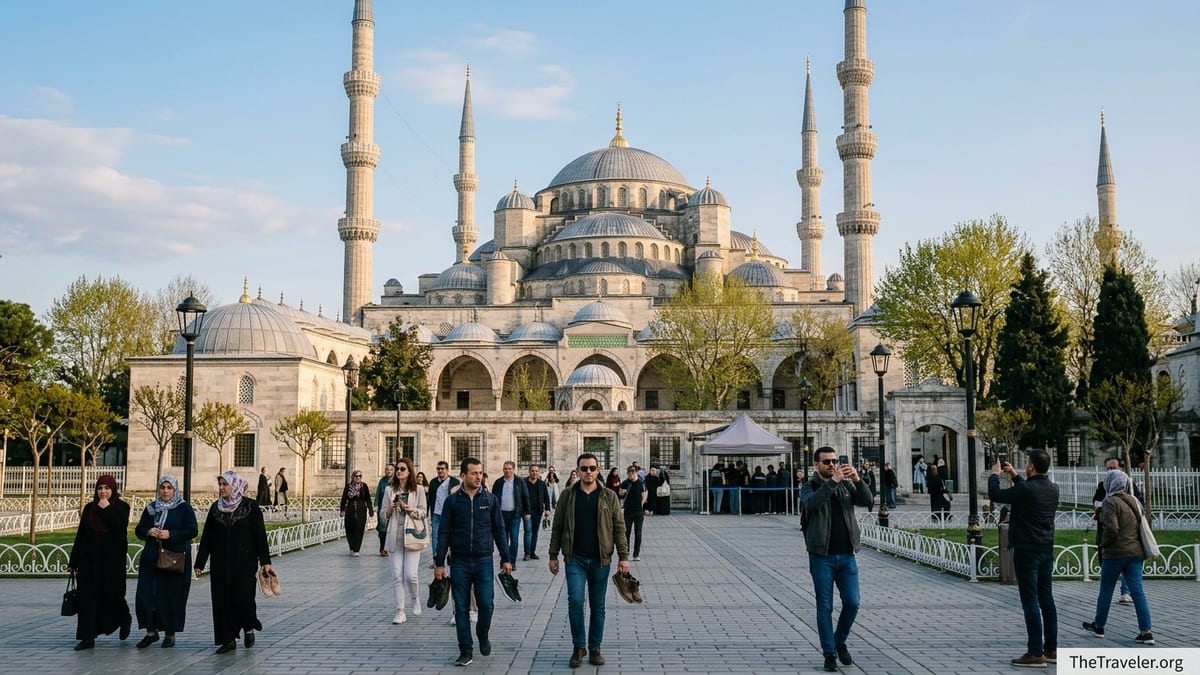
Understanding the Blue Mosque Today
Locals call it Sultanahmet Camii, after Sultan Ahmed I who ordered its construction in the early 1600s. Most visitors know it as the Blue Mosque, thanks to the roughly 20,000 blue İznik tiles that color its interior. Even after years of restoration work, which has left scaffolding up on and off throughout the 2010s and early 2020s, the mosque in 2026 feels freshly scrubbed, bright and cared for. Step inside and you will see the difference between the newly cleaned tiles and older sections that still bear the patina of centuries.
Unlike Hagia Sophia across the square, which now requires a pricy ticket for most visitor areas, the Blue Mosque remains free to enter. There is no official ticket office, no turnstiles charging admission and no online booking system for basic entry. You simply join the visitor line outside the southern entrance, pass a security check and step into the courtyard and then the mosque itself. You may pay for a private guide if you choose, but the building itself costs nothing.
It is also important to remember that this is a fully active mosque, not a museum. That reality shapes everything about your visit. The carpets are there for prayer, not for tourists to sprawl on. The lighting is tuned more for worshippers than for photographers. During busy prayer times, particularly Friday midday prayers, tourist access is significantly limited or paused entirely. If you visit with that in mind, respecting that you are a guest in a living religious space, your experience will be far more rewarding.
When I visited on a clear April morning, the contrast between the chaotic energy of Sultanahmet Square and the hush inside was striking. One minute you are dodging simit vendors and selfie sticks; the next you are under a dome that seems to float, surrounded by calligraphy, carpets and quiet murmurs. It is that shift, more than any single photograph, that makes the Blue Mosque unforgettable.
When to Go: Hours, Prayer Times and Crowds
The Blue Mosque is generally open to visitors every day, roughly from mid-morning to early evening, but the exact hours shift slightly with the seasons. What does not change is the rule that the mosque closes to tourists during the five daily Muslim prayer times, plus additional closure around Friday midday prayers. In practice, each closure window is about 30 minutes, though the Friday block can stretch past an hour.
On my last visit, I watched a tour group turned away at the security gate because they had arrived fifteen minutes before the midday prayer, assuming they could at least step inside to look around. They ended up waiting in the courtyard instead. To avoid that scenario, check the day’s prayer times on a reliable source before you set out, then aim to arrive at least 45 minutes outside any listed prayer time. For example, if midday prayer is at 1:15 p.m., plan to be inside by 12:30 p.m. or delay your visit until around 2:00 p.m.
In 2026, early morning and late afternoon continue to be the sweet spots for fewer crowds. When I arrived around 8:45 a.m. on a weekday in May, the visitor security line was only about ten minutes long, and there was enough space inside to pause and actually look up at the dome without bumping into anyone. By contrast, when I walked past at 1:00 p.m. on a sunny Saturday in June, the line snaked across much of the courtyard and an attendant was estimating a 45-minute wait.
Season matters too. In winter and early spring, even midday lines tend to be shorter, especially on rainy days when tour groups shuffle toward indoor attractions like the nearby Basilica Cistern instead. In peak summer, especially June through September, cruise-ship excursions and packaged bus tours can arrive in waves from late morning to mid-afternoon. If you are visiting in high season, think of your Blue Mosque stop as an early-morning or near-sunset experience and plan the rest of your day around it.
Getting There and Navigating the Area
The Blue Mosque sits in the heart of Sultanahmet, Istanbul’s historic peninsula. For most visitors, the easiest way to reach it is on the T1 tram line, which connects central areas such as Kabataş, Karaköy, Eminönü and Beyazıt. In 2026, a single ride paid with an Istanbulkart generally costs around 40 to 45 lira, depending on current municipal fares, and takes about 15 minutes from Kabataş to Sultanahmet. From the Sultanahmet stop, you simply follow the flow of people toward the square; the mosque’s six minarets are impossible to miss.
If you are staying in Taksim, the practical route is to take the M2 metro one stop down to Kabataş, then transfer to the T1 tram. Cruise passengers docking at Galataport can walk about ten minutes to the Karaköy tram stop and board the same T1 line. From the Asian side, frequent ferries from Kadıköy or Üsküdar to Eminönü or Karaköy connect smoothly with the tram. In all cases, having an Istanbulkart makes transfers much easier, since the card works across trams, metros, buses and ferries.
On foot, the Blue Mosque anchors one end of Sultanahmet Square, with Hagia Sophia facing it across the park. The main tourist entrance for the mosque is not the grand door facing the square, which is reserved for worshippers. Instead, visitors enter from the south side, roughly behind the mosque if you are looking at it from Hagia Sophia. When I first visited, I made the classic mistake of queuing at the wrong door and was politely redirected by a guard. Look for signs pointing to the “Visitor Entrance” and a line of people moving through a security tent.
The wider area is thick with souvenir stands, carpet shops and rooftop-terrace restaurants. While some are excellent, prices around the square tend to be higher than in nearby neighborhoods such as Sirkeci or Beyazıt. If you want a quieter break before or after your visit, consider slipping into a simple tea garden just off the main square, where locals sip tulip glasses of çay for a fraction of the price charged at the front-row cafes facing the mosque.
Dress Code, Etiquette and What It Feels Like Inside
The Blue Mosque’s dress code in 2026 is strictly enforced but straightforward. Shoulders and knees must be covered for everyone. Women are asked to cover their hair with a scarf. Men are expected to avoid sleeveless tops and short shorts. At the visitor entrance, staff will quickly scan the line; if someone’s clothing is not appropriate, they may be handed a free or low-cost cover-up cloak or long skirt. Scarves are usually available, though it is wiser and more comfortable to bring your own.
You must remove your shoes before stepping onto the carpeted interior. At the threshold, you will be given or directed to small plastic bags to carry your shoes with you. It is more respectful to avoid walking on the carpets in bare feet if possible; socks are strongly encouraged. On my first visit, I watched a family juggling loose shoes and cameras in the entry area. On the next trip, I came prepared with a lightweight fabric tote just for my shoes, which made the process much easier.
Inside, visitors are guided to a large section behind low wooden barriers, leaving the front area of the mosque free for people at prayer. Photography is allowed without flash, but using tripods or sprawling across the carpets for elaborate photo shoots is not. You should avoid pointing your camera directly at people who are praying, and keep your voice to a low murmur. When large tour groups surge in, a low hum of conversation can build, but there is a clear expectation from the mosque staff that visitors behave calmly and respectfully.
The first thing that strikes most visitors is the ceiling. The main dome, ringed by smaller semi-domes, seems to hover just above the forest of pillars. From the visitor area you can see the intense blue of the Iznik tiles around the lower walls, each panel with its own floral or geometric pattern. After the recent restoration work, the lighting feels brighter and warmer than it did a decade ago, highlighting the gold calligraphy bands that quote verses from the Quran. If you are patient and step aside from the main crowd, you can still find a corner to tilt your head back and take in the whole sweep of the dome in relative quiet.
Free Entry, Tours and Common Scams to Avoid
One of the most important facts for 2026 visitors is that the Blue Mosque is free to enter. There is no official entrance fee. That makes it accessible, but it also creates room for confusion and occasional scams just outside the mosque walls. On each of my visits, within a few steps of the entrance I met at least one person insisting the mosque was “closed for prayer” while offering to take me instead to a carpet shop or to a “museum section” that supposedly required a ticket. In every case, the mosque was in fact open or about to reopen.
If someone approaches you on the square and claims the mosque is closed or that you must buy a ticket from them, treat it as a red flag. The only reliable indicators are the security gates and the staff at the official entrance. If the security scanner is running and people are allowed through, the mosque is open. During genuine closures for prayer, guards will simply stop the visitor line and ask people to wait. No one will try to sell you a workaround.
Guides are a different matter. Licensed guides do wait around Sultanahmet Square and offer 45- to 60-minute tours inside and around the mosque, often for a flat fee per group. Prices in 2026 typically range from the equivalent of 25 to 60 euros, depending on the guide’s experience, language skills and how eager you are to negotiate. A knowledgeable guide can genuinely enhance your visit, explaining details such as why the mosque has six minarets or how its interior compares to Ottoman imperial mosques like Süleymaniye. The key is to confirm clearly that the guide fee is separate from mosque entry, which is free.
Be wary, however, of any “guide” who insists you must follow them through a different entrance, or who steers you aggressively toward a shop afterward with the suggestion that you are now obliged to buy something. If you want a tour, consider arranging one through a reputable agency or via your hotel in advance, or agree to a price and duration with a guide in the square before you set off together. Ask to see an official guiding license card, which professional guides usually carry on a lanyard.
Pairing the Blue Mosque With Nearby Sights
Because the Blue Mosque sits at the center of Istanbul’s historic peninsula, it makes sense to weave your visit into a broader walking itinerary. One classic route is to start at Gülhane Park in the morning, wander through its trees toward Topkapı Palace, then walk downhill to Sultanahmet Square by late morning. After touring the Blue Mosque in the early afternoon, you can cross the square to Hagia Sophia, then finish the day weaving through the covered lanes of the Grand Bazaar before returning to your hotel by tram.
In 2026, Hagia Sophia operates under a more complex ticketing system, with separate fees for different visitor areas. Many travelers find themselves surprised by the cost when they arrive with only a vague idea from older guidebooks. By contrast, walking into the Blue Mosque after paying for Hagia Sophia feels refreshingly simple. Budget-wise, you might treat the mosque as a quiet counterpoint to more expensive sites like the Basilica Cistern, where tickets for foreigners often rise each year.
If you have more time, consider visiting the Blue Mosque twice: once during the day, when you can see details of the tiles and calligraphy, and once just after sunset, when its domes are lit softly against the darkening sky. On my last trip, I watched the evening call to prayer unfold from a simple bench in the square, the Blue Mosque on one side, Hagia Sophia on the other, both glowing amber while locals strolled by with ice cream and roasted corn. That moment cost nothing, but it framed the entire historic quarter in a way no ticketed attraction could match.
Food-wise, you will find tourist-focused restaurants wrapping around Sultanahmet Square, many with rooftop terraces advertising panoramic views of the mosques. Some deliver exactly what they promise, with solid meze and grilled fish. Others rely more on the view than the kitchen. If you prefer less touristy prices, follow the tram line toward Çemberlitaş or Beyazıt and duck into a lokanta where the lunchtime crowd looks mostly Turkish, not foreign. A plate of beans and rice and a glass of ayran there will generally cost a fraction of a view-heavy lunch facing the mosque.
Practical Tips From Recent Visits
A few small choices can make a big difference to your experience. First, bring your own scarf or light shawl if you might need to cover your hair or shoulders. While the mosque often provides scarves and cloaks, they are shared items and can run short when large groups arrive. A thin, neutral-colored scarf that you can also use on ferries or windy rooftops is a practical travel item beyond the mosque visit itself.
Second, wear socks you are comfortable walking in. You will be on your feet inside for at least 20 to 30 minutes if you want to take in the interior properly. On one of my visits, I watched a man hesitate at the threshold because he had worn sandals without socks and was reluctant to go barefoot on the communal carpet. Spare socks in your daypack are a small but useful addition.
Third, consider timing your visit between large tour group arrivals. In practice, this often means avoiding the top of the hour in peak season, when full buses tend to disgorge visitors all at once. When I visited at 11:25 a.m. one day in June, the line was just beginning to grow, but by 11:40 a.m. it had doubled in length after two groups arrived simultaneously. Shifting your schedule by 20 or 30 minutes can mean the difference between shuffling through in a dense crowd and having space to pause and look.
Finally, keep an eye on your belongings without being anxious. Sultanahmet is heavily policed, and violent crime is rare, but the sheer number of people creates opportunities for pickpockets. Inside the mosque, I keep my daypack zipped in front of me rather than on my back and avoid leaving cameras or bags on the floor while I step away to take a photo. Outside, I politely but firmly decline offers from overly insistent “helpers,” whether they are trying to guide me to the entrance or sell an unnecessary transport card.
The Takeaway
The Blue Mosque is one of those places that risks becoming a postcard rather than a real encounter. It appears on every brochure and Instagram feed, and it sits in a square ringed with souvenir shops and tour groups. Yet, when you strip away the hustle at its gates, the mosque remains a working house of worship with a surprisingly gentle interior, where tiles, carpets and calligraphy continue to hold meaning for the people who pray there five times a day.
Visiting in 2026 means accepting a few practical realities: variable opening hours shaped by prayer, security checks and crowds, and a certain amount of noise on the square from touts and tour sellers. It also means free entry to one of the world’s most famous mosques, the chance to stand beneath a 17th-century dome still glowing blue, and the opportunity to see Istanbul’s history layered in one compact space alongside Hagia Sophia and the Hippodrome.
If you come prepared to dress modestly, to plan loosely around prayer times, and to say “no, thank you” to unnecessary offers, the logistics fade into the background quickly. What remains is the moment you step onto the carpet, tilt your head back and realize that behind all the photos and superlatives, the Blue Mosque is first and last a living place, quietly doing what it has done for more than four centuries.
FAQ
Q1. Do I need a ticket to enter the Blue Mosque in 2026?
Entry to the Blue Mosque is free in 2026. You do not need a ticket, voucher or online reservation for standard visits, only to pass the routine security check.
Q2. What are the current visiting hours for the Blue Mosque?
The mosque is generally open from late morning to early evening, but closes to tourists during each of the five daily prayer times and for a longer period around Friday midday prayers.
Q3. How long should I plan for a visit inside the Blue Mosque?
Most visitors spend about 20 to 40 minutes inside, depending on how crowded it is and how much time they devote to studying the tiles, calligraphy and domes.
Q4. What should I wear to visit the Blue Mosque?
Dress modestly with shoulders and knees covered. Women should bring a scarf to cover their hair. Everyone removes shoes before stepping onto the carpets, so socks are recommended.
Q5. Can I take photos inside the Blue Mosque?
Yes, photography without flash is allowed in the visitor area. Tripods and professional lighting are not permitted, and you should avoid photographing people while they are praying.
Q6. How do I get to the Blue Mosque using public transport?
The simplest route for most visitors is to take the T1 tram line to Sultanahmet station, then walk a few minutes to the mosque following signs toward the main square.
Q7. Is it better to visit the Blue Mosque or Hagia Sophia first?
If you start early, many travelers visit Hagia Sophia first to handle its ticketing and longer queues, then enjoy the free and slightly more flexible visit at the Blue Mosque afterward.
Q8. Are there guided tours available at the Blue Mosque?
There is no official mosque-run tour, but licensed guides offer paid tours around the site. You can also prebook a city tour that includes the Blue Mosque as one stop.
Q9. How early should I arrive to avoid long lines?
Arriving close to opening time on a weekday, or in the late afternoon away from peak tour-bus hours, usually keeps waiting times under 20 minutes in most seasons.
Q10. Is the Blue Mosque suitable for children and families?
Yes, families are welcome as long as children are supervised, dressed modestly and encouraged to speak quietly. Removing shoes can even be a fun ritual for younger visitors.