


The Blue Mosque, or Sultan Ahmed Mosque, is one of Istanbul’s most photographed landmarks and the spiritual heart of the old city. Sitting opposite Hagia Sophia on Sultanahmet Square, it is a working mosque, a major tourist attraction and a masterpiece of Ottoman architecture all at once. Visiting is not difficult, but a little preparation will help you avoid long queues, awkward dress code surprises and closed doors at prayer time. Here is a practical, up to date guide to everything you need to know before stepping inside.
Get the latest updates straight to your inbox!
A Brief History and Why the Blue Mosque Matters
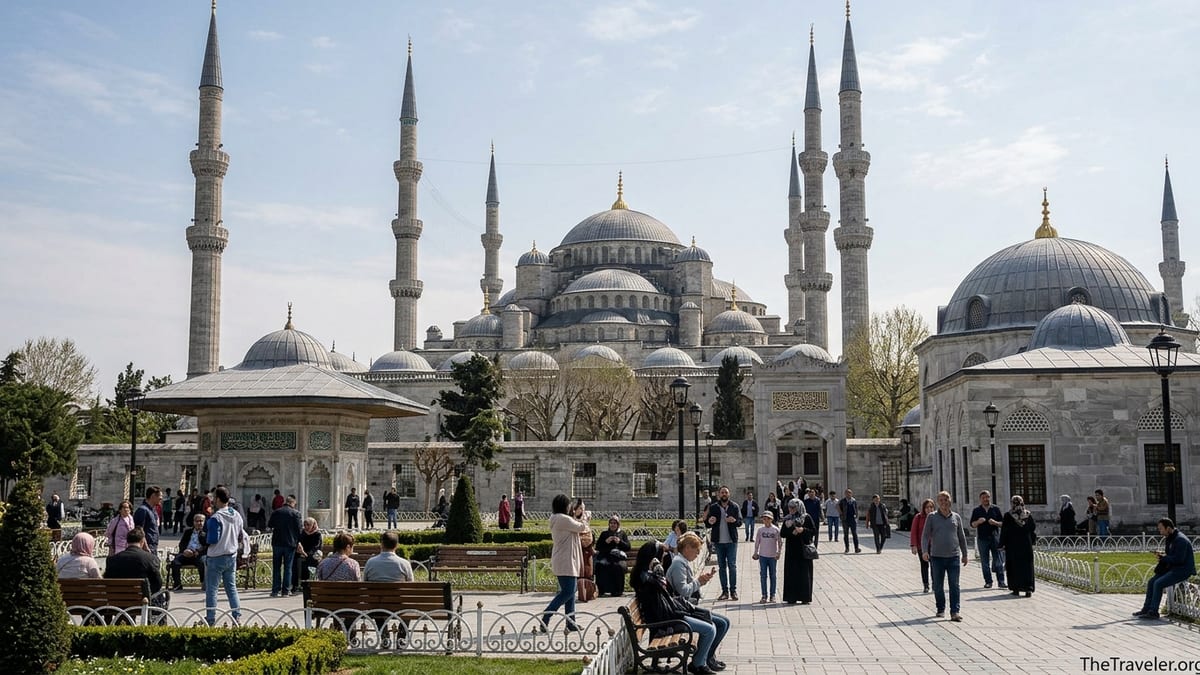
The Blue Mosque, officially the Sultan Ahmed Mosque, was completed in the early 17th century during the rule of Sultan Ahmed I. It was designed by architect Sedefkar Mehmed Agha, a student of the great Sinan, and deliberately built opposite Hagia Sophia as a statement of imperial power and piety. From the outside you notice its cascading domes and six slender minarets, a number usually reserved for the mosque in Mecca, which caused controversy at the time until an extra minaret was reportedly added there.
Inside, the mosque is famous for its Iznik tiles that line the walls and galleries. There are thousands of hand painted ceramic tiles in floral and geometric patterns, with distinctive shades of blue, turquoise and green that catch the daylight filtering through more than 200 stained glass windows. This interior is what gave the mosque its popular nickname, the Blue Mosque, and it remains one of the reasons many visitors list it as a highlight of their time in Istanbul.
The mosque is part of the UNESCO listed Historic Areas of Istanbul, along with Topkapi Palace, Hagia Sophia and the ancient city walls. When you stand in the central courtyard and look through the main gate toward Hagia Sophia, you are seeing layers of history from Byzantine Constantinople to the Ottoman Empire and modern Turkey in a single frame. That mix of living religious site and world heritage monument is what makes a visit here feel different from touring a museum.
Unlike many historic buildings that function only as attractions, the Blue Mosque is still an active place of worship. Five times a day the call to prayer echoes from its minarets, worshippers stream through side doors, and tourist entry stops. Keeping that dual role in mind is important when you plan your visit and when you are inside the building.
Current Visiting Conditions, Restoration and What to Expect in 2026
The Blue Mosque went through a long, multi stage restoration that started in the late 2010s and continued well into the 2020s. For several years visitors found much of the interior covered in scaffolding, sections of tile work hidden, and the courtyard partly closed. As of 2026, major structural work has largely been completed and most of the interior is again visible, though you may still see some smaller areas cordoned off or scaffolding around certain domes or upper galleries.
Recent visitor reports describe the main prayer hall as mostly free of heavy scaffolding, with large chandeliers hanging low and the calligraphy, stained glass and tiled walls clearly visible again. In practical terms this means that if you are hoping for classic photographs of the blue tiled interior and the carpeted floor beneath the main dome, you can now usually get them without a forest of metal poles spoiling the frame, especially if you arrive when it is less crowded.
From the outside, you should expect some ongoing maintenance since historic stone and lead roofs need regular care. For example, it is common to see sections of the outer courtyard walls or one minaret surrounded by lighter scaffolding or protective netting. This does not normally affect visitor flow or entry, but it can slightly alter wide angle photos. If you are planning professional photography, be prepared to work around one or two visually busy sections and to focus on angles from Sultanahmet Square, the fountains, or the garden paths leading toward Hagia Sophia.
Because this is a working mosque, opening patterns can shift around religious holidays and Ramadan. Tourist visiting hours typically pause during midday and late afternoon prayers and may shorten on Fridays and major Islamic holidays. If your trip falls around such dates, ask your hotel to call the mosque information desk the day before or check with the tourist information booth on Sultanahmet Square to confirm that visiting is running normally.
Opening Hours, Entry Rules and Dress Code
Entry to the Blue Mosque is free, unlike nearby museums such as Topkapi Palace or the Basilica Cistern that charge admission. However, there is a clearly marked donation box near the exit and a suggested contribution. Many visitors leave the equivalent of a few euros or dollars in Turkish lira, especially if they have taken many photos or stayed longer inside.
In typical weeks, tourists are allowed into the mosque from mid morning until early evening, with closures around each of the five daily prayers and a longer closure during Friday midday prayers. As a rule of thumb, you should avoid trying to visit around 30 minutes before and after the call to prayer. In practice this means that a window such as 9:30 to 11:30 in the morning or mid afternoon after about 14:00 often works well. The exact prayer times change daily, so on the day of your visit check a prayer time board often posted near the main gate or use a prayer time app filtered to Istanbul to plan your arrival.
Dress code is one of the main points that surprises first time visitors. Both men and women must have shoulders and knees covered. Women are expected to cover their hair with a scarf and avoid tight or transparent clothing. Men should not enter in shorts that end above the knees or in sleeveless shirts. At the main tourist entrance on the western side, staff will check clothing and can provide free loaner garments: long wrap skirts for anyone with short trousers or skirts, and simple scarves for women who do not have one. These loaners are perfectly acceptable but not very flattering, so many visitors prefer to bring their own scarf and wear long trousers or a modest skirt.
Everyone is required to remove shoes before entering the carpeted interior. You will find shoe racks and often a supply of plastic bags at the entrance. A very practical habit is to bring a lightweight reusable bag from home and place your shoes inside, then carry them with you. This avoids confusion on busy days when dozens of pairs of similar sneakers fill the same cubby. If you wear easily removable shoes, you will move through the line faster and feel less rushed when staff ask visitors to keep moving.
How to Get to the Blue Mosque from Around Istanbul
The Blue Mosque stands in the heart of the Sultanahmet district on the historic peninsula, and the easiest way to reach it is by public transport on the T1 tram line. The T1 runs between Bağcılar and Kabataş and stops at Sultanahmet station, a short walk from both the mosque and Hagia Sophia. From the tram platform you simply follow the crowd up the gentle slope toward the central square. This is the same tram line most tourists use to shuttle between the old city, the Spice Bazaar at Eminönü and hotels around Karaköy or Galata.
If you are arriving from Istanbul Airport on the European side, you currently have a few realistic options. The M11 metro line now connects the airport with the city, and one common route is to take the M11 to Gayrettepe, change to the M2 line and ride down to Yenikapı, then transfer to the T1 tram toward Bağcılar and get off at Sultanahmet. This option takes roughly 75 to 90 minutes depending on waiting times and costs the equivalent of a few US dollars using an Istanbulkart transport card. For travelers with smaller bags and a daytime arrival, it is often the most predictable choice.
For a simpler, luggage friendly ride, many visitors still choose official yellow taxis or reputable transfer companies from the airport. Typical daytime taxi fares to Sultanahmet in 2026 are significantly higher than a few years ago because of inflation and distance, and you should expect to pay in the low thousands of Turkish lira for a 45 to 60 minute ride in normal traffic. At night or in heavy congestion, allow more time and budget. There are also airport shuttle buses operated under the Havaist brand that run to central districts like Aksaray, from which you can connect to the T1 tram or take a short taxi ride to your hotel.
If you are staying on the Asian side in Kadıköy or Üsküdar, a pleasant route is to take a ferry across the Bosphorus to Eminönü. From the ferry terminal it is about a 15 to 20 minute uphill walk through Sirkeci and Gülhane, or you can ride the T1 tram for just a couple of stops to Sultanahmet. Many travelers combine this with a morning at the Blue Mosque and nearby sights, then return by ferry in the evening to enjoy the skyline views back toward the old city domes and minarets.
Planning Your Visit: Best Times, Crowds and Photography
The Blue Mosque is one of Istanbul’s top sights, so crowd levels matter. Large tour groups tend to arrive between 10:00 and 15:00, often after visiting Hagia Sophia or Topkapi Palace in the morning. If you want a quieter experience, aim to arrive soon after tourist opening time or later in the afternoon, avoiding both midday heat in summer and the busiest tour bus windows. In winter, the light can be beautiful in the early afternoon when the low sun illuminates the interior tiles through the stained glass.
Sunrise and sunset are the most atmospheric times to photograph the mosque exterior. Just before sunrise, you can stand by the fountains in Sultanahmet Square with almost no one in the frame and capture the mosque glowing in pale blue and pink tones as the first call to prayer sounds. Around sunset, the warm light hits the stone and the sky behind the domes often turns deep orange or purple. Locals and visitors gather on benches around the square, sipping tea from glass tulip shaped cups bought from nearby street vendors.
Inside the mosque, flash photography is discouraged and tripods are typically not allowed for security and crowd control reasons. A fast lens or smartphone with good low light performance will help you capture the ceiling details and calligraphy without harsh light. When photographing, be careful not to point your camera directly at people who are praying or sitting in quiet reflection, especially around the mihrab and minbar area. Staff may gently remind you to move on if you linger in one spot too long or block pathways in search of the perfect angle.
In high season, queues can form outside the main tourist entrance, especially just after a prayer time when the mosque reopens. These lines can stretch across the courtyard and into the square. To minimize waiting, avoid arriving right at those peak moments. If you find yourself in a long queue under summer sun, consider bringing a hat, water and sunscreen, as there is little shade in the open square. Queues usually move steadily, but delays sometimes occur when large groups arrive at once or when security wants to slow entry to keep the interior from becoming overcrowded.
Respectful Behavior Inside a Living Place of Worship
For many Istanbul residents, the Blue Mosque is their local place of prayer, not only a landmark in guidebooks. Keeping that in mind can help you decide how to behave once inside. Conversations should be kept low and phones on silent. While it is natural to feel excited when you step under the vast central dome, try to let that awe remain quiet rather than shouted across the carpet as you call over friends or family.
There are areas close to the front of the mosque reserved primarily for worshippers. Tourists are often asked to remain behind a low barrier or rope line, which still offers a clear view of the main dome, chandeliers and the mihrab niche that indicates the direction of Mecca. Respect these boundaries even if you see someone slipping under them for a photo, since staff sometimes need to remind groups repeatedly. If you wish to sit and absorb the atmosphere, choose a spot along the side walls or toward the back where you are less likely to be in the way.
Children are welcome, but it helps to explain basic rules before you enter. Running, climbing on railings and loud play can disturb people who are praying or reading. Many families find it useful to visit earlier in the day when younger children are less tired and the carpets still feel fresh. If a small child becomes restless, stepping outside to the courtyard for a few minutes is often more comfortable for everyone.
If you happen to be there during a call to prayer, the atmosphere inside changes noticeably as tourists are guided out and worshippers take their places. You are not expected to join prayers, and you can simply move toward the exit calmly. Outside in the courtyard or on the square, you can pause to listen to the layered calls coming from multiple mosques across the neighborhood, a sound that many visitors remember long after their trip.
Combining the Blue Mosque with Nearby Sights
The Blue Mosque sits at the center of one of the densest clusters of major sights in Istanbul, which makes it easy to combine with other visits. Directly opposite across Sultanahmet Square is Hagia Sophia, whose massive dome and historic mosaics draw their own crowds. Many travelers choose to visit both in a single morning, often starting at Hagia Sophia while it is still relatively quiet and then crossing the square to the Blue Mosque later in the morning or early afternoon.
Just behind the Blue Mosque, a short walk down a side street, lies the Great Palace Mosaic Museum, which preserves intricate floor mosaics from the Byzantine imperial palace that once stood on this site. The museum is relatively small and can be comfortably visited in under an hour, and it is often far less crowded than the big ticket sights. As of 2026 it is included in most versions of the official Museum Pass, which can be good value if you plan to visit Topkapi Palace, the Istanbul Archaeology Museums and other state run sites within a five day period.
A few minutes’ walk downhill from the square takes you to the Basilica Cistern, an underground forest of ancient columns made famous among travelers for its atmospheric lighting and cool temperature on hot summer days. Slightly further away but still walkable are the Istanbul Archaeology Museums near Gülhane Park and the Grand Bazaar near Beyazıt, both easy to pair with a morning or afternoon around the mosque.
Because everything is packed into a relatively compact area, it helps to plan your route in terms of energy rather than pure distance. For example, a common one day loop starts with the Blue Mosque, then the Great Palace Mosaic Museum, followed by lunch at a simple lokanta or kebab shop on a side street away from the most touristy menus. In the afternoon you might continue to the Basilica Cistern and the Archaeology Museums, finishing in Gülhane Park for a rest in the shade before taking the tram back to your hotel.
Practical Tips: Money, Safety and Accessibility
Although the Blue Mosque is free to enter, the surrounding area is filled with opportunities to spend money, both good and bad. Around Sultanahmet Square you will encounter carpet sellers, tour touts and restaurant staff inviting you to look at menus or consider private guiding services. A polite but firm “no thank you” usually suffices if you are not interested. If you would like a guide, it is safer to book through a well reviewed agency, your hotel concierge or official information points rather than accepting unsolicited offers in the square.
For small purchases like bottled water, simit bread rings or chestnuts from street vendors, try to carry some smaller denomination Turkish lira notes and coins. While many businesses in Istanbul accept contactless cards, casual vendors and some older cafes still prefer cash, especially for amounts under the equivalent of a few euros. Currency exchange offices around Sultanahmet often advertise zero commission but use less favorable rates than banks or ATMs in more local neighborhoods, so it is wise to withdraw cash elsewhere when possible.
In terms of safety, Sultanahmet is one of the most heavily policed and tourist monitored areas of the city, and violent crime against visitors is rare. The most common issues are pickpocketing in crowds and minor scams such as being steered into a bar or café where prices are far higher than implied. Keep your phone and wallet in front pockets or a zipped bag, especially in tram crowds and entry queues, and check menu prices before ordering. Inside the mosque complex itself, there is security screening at the entrance and visible staff helping direct visitors.
Accessibility is improving but still imperfect. The approach from the tram stop to the mosque involves some uneven paving stones and a gentle slope. Within the courtyard, surfaces are generally flat but can be slippery in rain. The main tourist entrance has a few steps and the need to remove shoes, which can be challenging for visitors with limited mobility. If you or someone in your group uses a wheelchair or has difficulty walking, consider reaching out to your hotel or a local guide service in advance to discuss the most suitable entrance and timing, since staff may be able to assist outside peak periods.
FAQ
Q1. Do I need a ticket or reservation to visit the Blue Mosque?
Entry is free and you do not need a ticket or reservation, but you must follow the dress code and enter during tourist visiting hours outside prayer times.
Q2. Is the Blue Mosque still under renovation in 2026?
Most major restoration work has finished and the main interior is largely visible, though you may still see smaller areas with scaffolding or maintenance equipment.
Q3. How long should I plan for a visit inside the mosque?
Most visitors spend about 30 to 45 minutes inside, including time to observe the interior, take photos, sit quietly for a few minutes and exit through the designated route.
Q4. Can I visit the Blue Mosque during Friday prayers?
Tourist visits pause during Friday midday prayers, and the mosque can be closed to non worshippers for a longer period than on other days, so plan to come earlier or later.
Q5. Are children allowed inside the Blue Mosque?
Yes, children are welcome, but parents should ensure they are dressed appropriately, move calmly on the carpets and avoid loud play that might disturb worshippers.
Q6. Does the Istanbul Museum Pass include the Blue Mosque?
No, the Blue Mosque is a functioning mosque with free entry, so it is not part of the paid museum pass, although nearby museums behind and around it are often included.
Q7. What is the best way to get to the Blue Mosque from Istanbul Airport?
Most travelers either take the M11 metro with transfers to reach the T1 tram and get off at Sultanahmet, or use an official taxi or pre booked transfer directly to their hotel.
Q8. Can I pray inside the Blue Mosque as a non Muslim?
Non Muslims are not expected to join congregational prayers, but anyone who is respectful, properly dressed and familiar with basic etiquette may pray quietly in designated areas.
Q9. Are there specific times when photography is not allowed?
Photography is generally allowed for personal use, but flash and tripods are discouraged, and you should avoid photographing people during prayers or when staff ask visitors to stop.
Q10. What should I wear if I forget to bring a scarf or modest clothes?
Staff at the tourist entrance can lend simple scarves and wraparound garments free of charge, though many visitors prefer to bring their own scarf and wear modest clothing.