


If you last heard about Istanbul’s Blue Mosque when it was wrapped in scaffolding, 2026 looks very different. After a multi‑year restoration finished in 2023, Sultanahmet Camii has its domes and Iznik tiles back on full display, and Istanbul itself is welcoming record visitor numbers. That has made the mosque both more beautiful and more crowded. So is it still worth weaving it into your 2026 itinerary, or has it become an overrated box to tick while you hurry on to other sights?
Get the latest updates straight to your inbox!
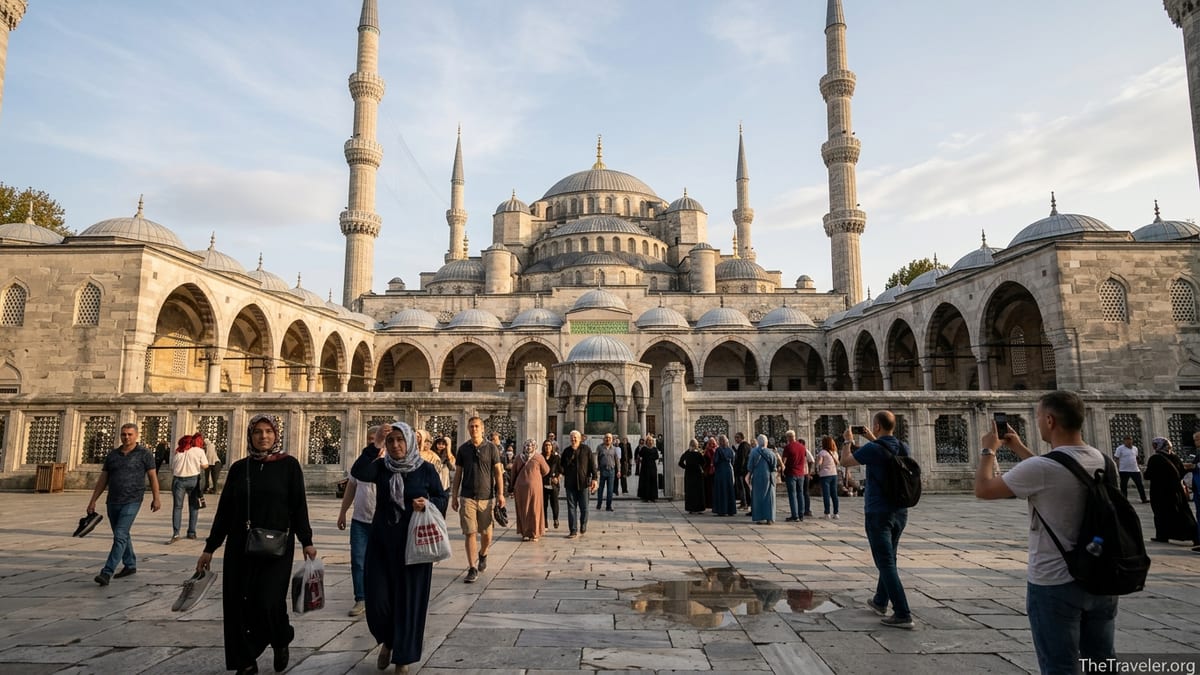
What the Blue Mosque in 2026 Actually Looks and Feels Like
By mid‑2026, the Blue Mosque is fully functioning as both an active place of worship and one of Istanbul’s most photographed landmarks. The six minarets and cascading domes that dominate Sultanahmet Square are free of large-scale scaffolding, a major change from the restoration years when entire facades and large sections of the interior were partially obscured. Visitors now enter through the south-side tourist entrance into a bright courtyard where the marble paving, ablution fountains and arcades have been cleaned and repaired, giving a far clearer sense of the 17th‑century complex than many travelers saw just a few years ago.
Inside the main prayer hall, the effects of restoration are even more striking. The famous blue Iznik tiles are cleaner and better lit, the calligraphy bands around the dome are legible again, and damaged stonework and windows have been stabilized. Travelers who visited pre‑2018 often remember dim lighting and darkened details high in the dome; in 2026, many of those architectural and decorative elements are easier to appreciate, especially in the late morning when natural light pours through the stained glass.
The atmosphere, however, depends heavily on when you visit. In peak season from roughly May to October, especially between 10:00 and 15:00, the interior can feel like a slow‑moving river of tour groups, with guides speaking into microphones and clusters of visitors stopping for the same photos. On a quiet winter weekday, or just after evening prayer in shoulder season, the space can still feel contemplative, the soundscape shifting from camera shutters to the hum of recitation.
Outside the mosque walls, Sultanahmet in 2026 is one of the busiest historic neighborhoods in Europe. Istanbul received well over 15 million international visitors in 2025, with projections climbing toward 19–20 million for 2026, and the bulk of first‑timers still anchor their stay around Hagia Sophia, the Blue Mosque and Topkapi Palace. That swell translates directly into crowd levels, tout activity and higher prices for everything from pomegranate juice in Sultanahmet Square to mid‑range hotel rooms within walking distance of the mosque.
The Practicalities: Cost, Hours, Dress Code and Queues
From a budget point of view, the Blue Mosque remains one of Istanbul’s best values: entry is free for independent visitors. There is no official ticket desk, and in 2026 you do not need to book an entrance time just to step inside. This stands in sharp contrast to Hagia Sophia across the square, where foreign visitors now pay a significant gallery ticket fee that can rival the cost of major European cathedrals. Many travelers build their day around paying to see Hagia Sophia’s upper galleries, then appreciate that the neighboring mosque still welcomes tourists without an entrance charge.
The main cost at the Blue Mosque is your time. On a typical summer day, queues at the south-side visitor entrance often run 30 to 60 minutes between late morning and mid‑afternoon. In shoulder season or on rainy winter days, you might wait 15 to 30 minutes. There is no genuine skip‑the‑line system operated by the mosque itself, even if some guides and agencies market “priority” or “fast-track” tours. In practice, almost everyone filters through the same security screening, with guides mainly adding context rather than bypassing the queue.
Opening hours for tourists in 2026 still revolve around the five daily prayers. The mosque generally closes to non‑worshippers for roughly 30 minutes before and after each prayer, and longer around Friday midday prayers and major religious holidays. Visitors who turn up 20 minutes before dhuhr on a Friday are often surprised to be turned away, even in midsummer. The most reliable visiting windows tend to be from about 08:30 to 11:30 and from mid‑afternoon until shortly before sunset, avoiding prayer times listed at the mosque and on local information boards.
The dress code is actively and visibly enforced. Everyone must cover shoulders and knees; women must cover their hair, and both men and women remove their shoes before entering, carrying them in small plastic bags. In 2026, free headscarves and wraps are still typically available at the entrance, but lines move faster if you bring your own scarf or wear trousers or a skirt that clearly covers your knees. Travelers routinely report being asked to adjust scarves to cover all hair or wrap an extra layer around tight leggings or above‑the‑knee shorts, so it is wise to err on the conservative side.
How the Experience Compares to Hagia Sophia and Other Istanbul Icons
A common dilemma in 2026 itineraries is how to balance time between the Blue Mosque, Hagia Sophia, Topkapi Palace and the Basilica Cistern. Hagia Sophia has the stronger global name recognition and a unique layered history as church, mosque, museum and mosque again. It now charges a ticketed entrance fee for foreign visitors, and interior access is more controlled, with some areas roped off and viewing concentrated in the upper galleries. Many travelers leave describing Hagia Sophia as the more overwhelming interior, with its massive dome, hanging chandeliers and faintly visible mosaics.
Where the Blue Mosque stands out is in symmetry, color and the feeling of a working neighborhood mosque on a monumental scale. The rhythmic rows of columns, repeating tile patterns and lower ceiling height in parts of the prayer hall can feel more intimate than Hagia Sophia’s cavernous nave. The courtyard also offers better vantage points for photography, especially in the early morning when soft light catches the stone arcades and minarets without the crowds that clog the square by late morning.
Compared with other mosques in Istanbul, the Blue Mosque is neither the quietest nor the most atmospheric, but it remains the easiest for a first‑time visitor to incorporate. Suleymaniye Mosque, perched above the Golden Horn, often offers a calmer and more contemplative visit with sweeping city views, while the newer Çamlıca Mosque on the Asian side dwarfs Sultanahmet in scale and can feel less burdened by tour groups. Travelers with three or more days in the city often remark that their most memorable mosque moments happened in these less crowded complexes, yet nearly all of them still stop at the Blue Mosque because of its location opposite Hagia Sophia.
Time‑pressed travelers, especially those on a long layover or cruise stop, often pair Hagia Sophia, the Blue Mosque and a quick walk through the Hippodrome and Basilica Cistern in a single half‑day circuit. In that context, the Blue Mosque functions as both an architectural highlight and a pause point to sit in the courtyard, listen to the call to prayer echo between domes and watch Istanbul’s layered history move around you in real time.
Who Will Find the Blue Mosque Worth It in 2026
For first‑time visitors with at least a full day in the historic peninsula, the Blue Mosque remains strongly worth visiting. It delivers several core Istanbul experiences in a compact package: an introduction to Ottoman religious architecture, an encounter with living Islamic practice, and the sense of walking through streets where empires once staged ceremonies. Travelers interested in art and architecture will appreciate the restored tiles, the muqarnas details on column capitals and the proportion of the central dome relative to the semi‑domes, especially if they visit with a knowledgeable guide who can point these elements out.
Budget‑conscious travelers also benefit. In a city where ticketed attractions such as the Basilica Cistern, Topkapi Palace and modern museum complexes can quickly add up, the Blue Mosque offers high visual impact without impacting your wallet. Backpackers staying in Sultanahmet hostels often choose to visit more than once, ducking in for a few minutes at different times of day just to experience the shifting light and soundscape without worrying about getting “value” from a paid ticket.
Travelers focused on photography usually find the mosque very worthwhile, provided they plan carefully. Early‑morning shots from the tram line or benches in Sultanahmet Square can capture the full profile of the mosque, while late afternoon brings warmer tones on the stone and a view back toward Hagia Sophia framed by fountains. Interiors are more challenging: tripods are not allowed, flash is discouraged, and the crush of visitors can make it difficult to set up composed images, but patient photographers with a fast lens still come away with striking hand‑held shots of chandeliers, tiles and arches.
Finally, the mosque is particularly meaningful for travelers from Muslim‑majority countries or those curious about contemporary religious practice. Because it functions as an active place of worship, you are likely to see locals arriving for daily prayers, students from nearby religious schools learning to recite, and families treating a visit as both devotion and outing. That lived context is something you do not always feel as strongly in repurposed religious buildings in Western Europe, and it can add depth to your understanding of Istanbul beyond its monuments.
Who Might Consider Skipping or Shortening a Visit
Despite its beauty, the Blue Mosque is not a perfect fit for every traveler in 2026. Visitors who have only a few hours in the city and are primarily motivated by architecture or history sometimes find that a paid, in‑depth visit to Hagia Sophia or Topkapi Palace yields a richer experience than waiting in line for a brief walk‑through of the mosque interior. If your flight layover allows just three or four hours in the city center, you may decide that seeing the mosque from the outside while focusing your time and energy on a ticketed site is a better trade‑off.
Those with limited patience for crowds also need to weigh the experience carefully. At busy times, the visitor flow can feel almost like an airport security queue that funnels you onto a carpeted circuit, with little opportunity to linger in one spot. Travelers who dislike being herded, or who find it difficult to stand for long periods in slow‑moving lines, may end up more frustrated than inspired, especially in midsummer heat. In that case, a quieter mosque such as Suleymaniye or Rustem Pasha, visited at off‑peak hours, might deliver more of the serenity and visual detail you are looking for.
Some repeat visitors to Istanbul also opt to skip the interior entirely on later trips, especially if they saw it before the restoration and have no particular need to compare. They might choose instead to book a Bosphorus ferry ride, explore neighborhoods like Balat and Kadiköy, or spend an afternoon in a museum such as the Istanbul Archaeology Museums or the Museum of Turkish and Islamic Arts. For them, walking through Sultanahmet Square, hearing the call to prayer and glancing up at the minarets as part of a wider city stroll provides enough of a reconnection.
Finally, travelers who are uncomfortable with religious spaces or anxious about adhering to strict dress codes may prefer to experience the mosque from outside its gates. While staff are generally used to guiding non‑Muslim visitors and the rules are clearly signposted, the obligation to cover, remove shoes and move respectfully around worshippers can feel stressful for some. If that tension will dominate your visit, you may be better served concentrating on secular historic sites.
Strategies to Make a Visit More Rewarding
If you decide the Blue Mosque belongs on your 2026 itinerary, timing is your most powerful tool. Aim to arrive close to opening, around 08:30, or late in the afternoon a couple of hours before sunset, avoiding published prayer times and the midday tour‑bus rush. Travelers who make the effort to be in Sultanahmet Square early often report walking straight in or waiting only a few minutes in line, and they experience a calmer interior where the architecture rather than the crowd is the dominant impression.
Pairing the mosque with other nearby sights can turn a brief stop into a coherent day. A common pattern is to visit the Blue Mosque first thing, wander through the Hippodrome area to see the ancient obelisks, then continue to the Basilica Cistern or Hagia Sophia. Another option is to schedule the mosque for late afternoon, then linger in the square or in the small Arasta Bazaar behind the mosque, before walking down to the waterfront in Eminönü for sunset views over the Golden Horn. Organizing your day by neighborhood reduces time lost in transit and makes queues feel more like brief pauses between substantial experiences.
Consider how much context you want. A guided tour, whether pre‑booked online or arranged through a reputable Istanbul agency, typically costs a modest fee per person and lasts about an hour. Guides explain why the mosque has six minarets, point out design features like the “elephant foot” pillars and help navigate prayer‑time closures. For a first‑time visitor who does not plan to read extensively beforehand, this commentary can transform a pretty building into a story about Ottoman power, aesthetics and religion. On the other hand, confident independent travelers who enjoy researching on their own may find a self‑guided visit completely sufficient.
Small practical steps also improve the experience. Wear socks since you will be walking barefoot on shared carpets, carry a lightweight scarf or shawl even if you are not sure you will need it, and store valuables in a secure daypack so your hands are free to manage shoes and clothing at the entrance. If you are sensitive to crowds, build in a quiet break on the benches of Sultanahmet Square afterward, or retreat to a café on a side street away from the tram line before diving into your next attraction.
The Takeaway
In 2026, the Blue Mosque occupies a complex place in Istanbul travel. It is simultaneously more photogenic than it has been in years, more crowded than ever and still one of the city’s rare headline sights that charges no entry fee. Whether it is worth visiting comes down to your time, priorities and tolerance for queues. For most first‑time visitors with at least a full day in the old city, it remains a strong yes: the combination of restored architecture, living religious practice and its setting opposite Hagia Sophia delivers an experience that feels uniquely Istanbul.
However, it is also reasonable to limit your visit to the exterior or to skip the interior on repeat trips, particularly if you prefer quieter, less touristed spaces or need to conserve energy for sites that require more walking and more detailed exploration. Istanbul in 2026 offers far more than one mosque: neighborhoods on both the European and Asian sides, waterfront promenades, contemporary galleries and everyday markets all compete for attention. The Blue Mosque still deserves its place on the postcard, but it does not need to dominate your itinerary.
If you choose to go inside, go early or late, dress respectfully and treat the mosque not only as a monument but as a living place of worship that shapes daily life in Sultanahmet. Do that, and a short, thoughtful visit can anchor your understanding of the city, even if you ultimately decide that your favorite moments in Istanbul happened far from its most famous domes.
FAQ
Q1. Is the Blue Mosque still under renovation in 2026?
The major multi‑year restoration that began in 2018 finished in 2023, so by 2026 the mosque is open and largely free of large scaffolding, although minor ongoing maintenance is always possible in such a historic building.
Q2. Do I need a ticket or reservation to visit the Blue Mosque?
No. As of 2026, entry for independent visitors is free and does not require a ticket or time slot, although organized tours may sell guiding services that include a planned visit.
Q3. How long should I plan for a visit, including waiting time?
Most travelers spend about 30 to 45 minutes inside, plus anywhere from 15 to 60 minutes in the entrance queue depending on season and time of day, so budgeting 1 to 1.5 hours is sensible.
Q4. What is the dress code, and will I be turned away if I am not prepared?
Everyone must cover shoulders and knees, women must cover their hair, and shoes must be removed; staff often provide free scarves and wraps, but if your clothing cannot be reasonably adjusted, you may be refused entry until you comply.
Q5. When is the best time of day to visit to avoid crowds?
Arriving close to opening time around 08:30 or in the late afternoon a couple of hours before sunset, while avoiding scheduled prayer times, usually results in shorter lines and a calmer interior.
Q6. Can I visit during Friday prayers or religious holidays?
Tourist access is significantly restricted around Friday midday prayers and major Islamic holidays, when the mosque prioritizes worshippers, so it is best to schedule your visit for another time if you want to see the interior as a visitor.
Q7. Is the Blue Mosque suitable for travelers with limited mobility?
Access involves security checks, some walking on uneven stone in the courtyard and a step at the threshold, but once inside the prayer hall the floor is flat and carpeted; travelers who use mobility aids can usually visit with some assistance.
Q8. Are photos allowed inside the Blue Mosque?
Photography without flash is generally allowed in designated visitor areas, but tripods are not permitted, and visitors are expected to avoid photographing people who are praying and to respect any instructions from staff.
Q9. Should I book a guided tour, or is an independent visit enough?
A guided tour can add depth by explaining the symbolism and history in about an hour, which many first‑time visitors find worthwhile, while independent travelers who read up in advance or focus mainly on atmosphere may be satisfied exploring on their own.
Q10. If I have already visited before the restoration, is it worth going again?
Many repeat visitors enjoy seeing the mosque after cleaning and repairs, particularly the brighter tiles and clarified details, but if your time in Istanbul is short, you might reasonably choose to prioritize new neighborhoods or other mosques instead.