


More news on this day
European Commission President Ursula von der Leyen has publicly acknowledged “technical problems” with the European Union’s new Entry/Exit System for non-EU travellers, as long queues and missed flights at major airports raise urgent questions about the readiness of the bloc’s flagship digital border project.
Get the latest news straight to your inbox!
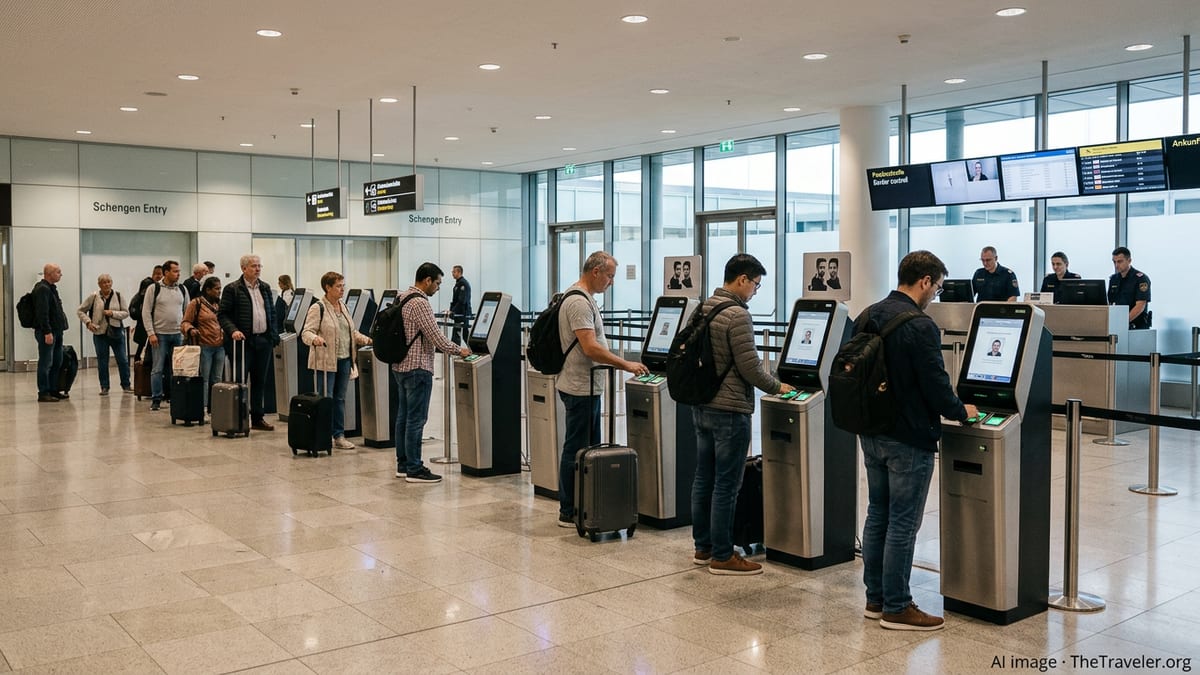
New Digital Checks Strain Europe’s Summer Travel
The Entry/Exit System, known as EES, replaces manual passport stamping for most non-EU nationals entering or leaving the Schengen area. Instead of a simple ink stamp, travellers must now provide biometric data, including fingerprints and a facial image, which are stored in a central database each time they cross the external border.
Publicly available information shows that the system, in use since late 2025, was intended to tighten security and track overstays more accurately while ultimately speeding up controls. It applies across most Schengen states, including popular holiday destinations such as Spain, France, Italy and Greece, but not in Ireland or Cyprus, which have separate arrangements.
Reports from aviation outlets indicate that the initial summer peak has exposed serious bottlenecks. At several large hubs, the combination of high passenger volumes and time-consuming biometric enrolment has pushed waiting times well beyond pre-EES levels, affecting both arriving and departing passengers.
According to recent coverage from European news services, millions of third-country travellers have already been processed through the system, but a minority of complex cases and repeated technical glitches are having an outsized impact on airport flows at busy times.
Von der Leyen Concedes “Work to Do” on EES Rollout
Speaking at a press appearance in Cork, Ireland, on July 3, von der Leyen acknowledged that the rollout has been far from smooth. Published reports quote her describing the difficulties as “technical issues” and stating there is still “quite a lot of work to do” before the system functions as intended across all participating states.
Coverage by several European outlets notes that the Commission president emphasized cooperation with national governments to stabilise the technology and improve operations at border posts. The comments mark one of the clearest public recognitions from Brussels that the ambitious digital border project is struggling under real-world conditions.
Previous Commission messaging largely framed EES as a long-term upgrade that would strengthen security and eventually shorten queues. The latest remarks signal a shift in tone towards acknowledging short-term disruption and the need for adjustments during the high-pressure summer season.
Reports indicate that von der Leyen also pointed to the sheer scale of the undertaking, with more than one hundred million crossings already recorded through the new architecture since its launch. The admission that a complex system of this size remains a work in progress is likely to feed ongoing political and industry debate about its pace and design.
Aviation Sector Warns of “Critical Point” for Airports
Airport and airline associations across Europe have sounded increasingly urgent alarms in recent days. According to published industry letters and interviews, the sector views EES as having reached a “critical point,” with some operators reporting waits of several hours at passport control during peak periods.
Travel and aviation news outlets describe scenes of snaking lines at major hubs, particularly where large numbers of non-EU passengers must be enrolled for the first time. In some cases, delayed processing at border control has cascaded into missed connections, aircraft departing late, and mounting pressure on staff managing queues.
Industry representatives are calling for greater flexibility in how the new rules are applied over the summer, including the possibility of temporary suspensions of certain checks or a phased approach for the busiest airports. These appeals are framed not as opposition to the system itself, but as a plea to avoid further damage to passenger confidence and airline schedules at the height of the holiday period.
In parallel, aviation-focused publications report that operational workarounds are already emerging on the ground, with some airports reverting to more traditional manual checks when queues threaten to overwhelm terminal capacity, even as they remain formally connected to the EES framework.
Why EES Matters for Non-EU Travellers
For travellers from countries such as the United Kingdom, United States, Canada and many parts of Asia, EES represents a significant procedural change at the EU border. Instead of simply presenting a passport for stamping, visitors on short stays must undergo biometric registration the first time they enter after implementation.
Once enrolled, subsequent crossings are expected to be faster, with automated checks verifying a traveller’s identity and stay history. Public information materials from European institutions explain that the system records the time and place of entry and exit, helping authorities identify overstays without relying on manual stamps.
Travel advisories and news reports currently urge non-EU visitors to factor in extra time at airports, particularly for initial registration. Passengers are being encouraged to follow airport guidance on which lanes to use, have travel documents ready, and expect that border police may need more time than usual for each individual check while the technology and staffing patterns settle.
Experts cited in European media note that once the initial wave of first-time registrations passes and technical issues are resolved, the system could, in theory, lead to more predictable flows and better data for managing external borders. For now, however, the experience on the ground remains uneven across countries and airports.
Political Pressure Builds for Short-Term Fixes
The growing disruption has quickly taken on a political dimension. National governments are facing domestic criticism over airport scenes, while also relying on the EU-level system they helped approve. Commentaries in European press point out that governments must balance security and migration management objectives with the economic importance of smooth travel.
Aviation groups have urged Brussels and member states to consider immediate mitigation measures, such as reinforcing staffing at border points, adjusting shift patterns to match peak periods, and clarifying contingency rules that allow temporary fallback to manual processing when systems falter.
Analysts quoted in policy and travel coverage suggest that the EES episode may influence how future EU-wide digital projects are designed and rolled out. Questions are already being raised about the extent of pre-launch testing, the readiness of local infrastructure, and how much autonomy airports should have to adapt implementation to their specific conditions.
For the travelling public, the key issue in the near term is whether queues will ease before the height of the August holiday rush. With von der Leyen now openly acknowledging technical problems and “work to do,” the coming weeks will test how quickly European institutions and national authorities can turn that admission into visible improvement at border checkpoints.