


More news on this day
Travelers at Oklahoma City’s Will Rogers International Airport faced mounting frustrations on May 19, 2026, as 62 flights were delayed and eight were canceled, disrupting operations for Southwest, American Airlines, Delta and other carriers across key domestic corridors and newly launched international connections.
Get the latest news straight to your inbox!
Operational Disruptions Hit Key U.S. Hubs
Data from live flight-status boards and tracking services on May 19 indicated that departures and arrivals at Will Rogers International skewed heavily toward delays, affecting traffic to Dallas, Denver, Chicago and Atlanta. These cities serve as primary connection points for both business and leisure travelers across the United States, magnifying the impact as missed links rippled outward through airline networks.
Southwest, American Airlines and Delta all reported affected operations at Oklahoma City, with regional partners and codeshare services also experiencing knock-on delays. Flights to Dallas Fort Worth and Dallas Love Field saw rolling pushback times as aircraft waited for available slots, while services to Denver and Chicago contended with congestion at those hub airports as well as slow turnarounds in Oklahoma City.
Tracking information for services between Oklahoma City and Denver, including United-operated regional flights, showed schedule changes and extended ground times as carriers worked to rebalance their operations. Similar patterns were visible on routes feeding Chicago and Atlanta, where delayed Oklahoma City departures risked missing onward connections on already busy midweek schedules.
Published airport statistics show that Will Rogers has seen steadily rising passenger volumes over the past year, leaving less margin for irregular operations. When disruptions cluster around major hubs, even modest local scheduling issues can cascade quickly, stretching gate availability and crew assignments at an airport that functions as an important regional node rather than a large fortress hub.
Weather and Airspace Constraints Compound Delays
Publicly available weather observations for Oklahoma City on May 19 pointed to overcast conditions and cool temperatures at Will Rogers, following a period of unsettled spring weather in central Oklahoma. While conditions at midafternoon were not described as severe, earlier passing showers and changing wind patterns contributed to a more cautious operational tempo during key morning and midday departure banks.
National airspace monitoring for the same period indicated broader flow programs in effect across sections of the United States, including measures designed to meter departures and arrivals at busier hubs. When those programs are active, airports such as Oklahoma City can be instructed to hold departures bound for affected hubs, which lengthens turnaround times and can trigger a chain of late departures and arrivals.
Moderate weather at the surface can mask operational challenges aloft, where congestion around major hubs like Dallas and Chicago leads to spacing requirements between aircraft. Carriers operating from Will Rogers faced the added complexity of coordinating with national traffic management initiatives while still moving growing volumes of passengers through a compact terminal footprint.
Airport planning documents for Will Rogers emphasize procedures for managing extended tarmac holds and diverted flights, reflecting lessons learned from past weather and congestion events. Those plans are designed to balance safety and regulatory requirements with the need to return passengers to the terminal when ground delays approach time limits, but they also underscore how quickly routine operations can become strained when multiple flights are held simultaneously.
Stranded Travelers Navigate Cancellations and Rebooking
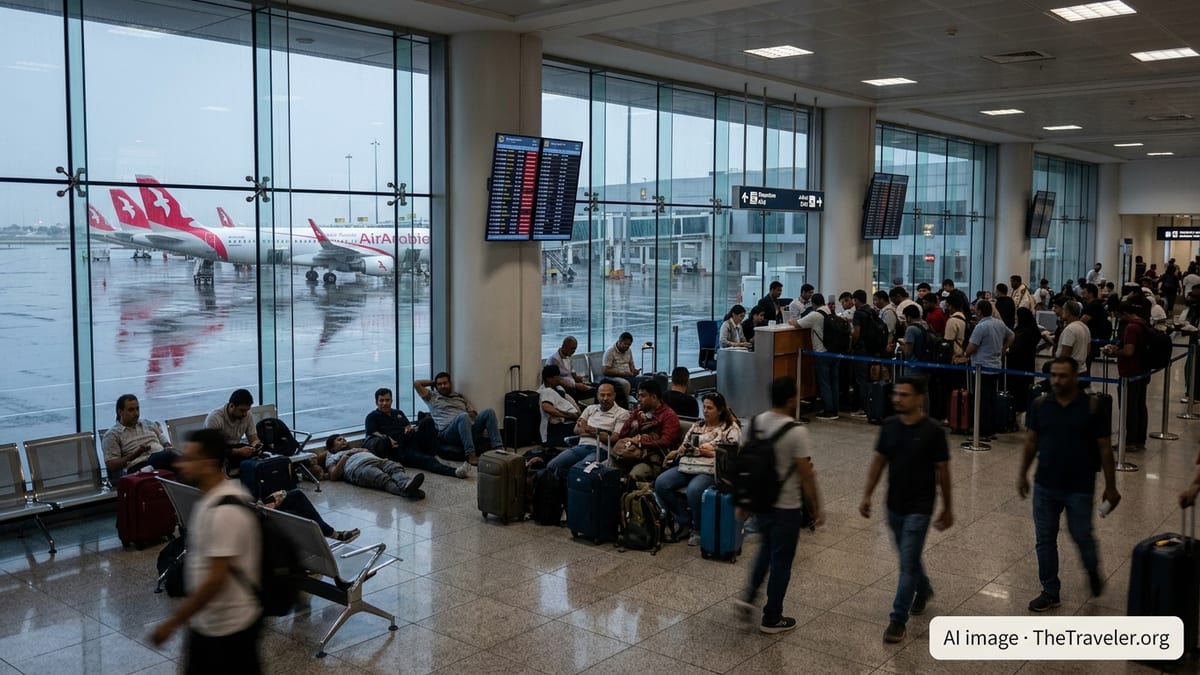
As delays accumulated and eight flights ultimately canceled, travelers at Will Rogers found themselves confronting long lines at ticket counters and customer service desks. With several large carriers affected at once, rebooking options grew more limited, particularly for those bound for smaller regional cities that depend on one or two daily connections via major hubs.
Online comments and traveler reports from Oklahoma City on May 18 and May 19 described an airport that is typically efficient and easy to navigate but increasingly crowded during early morning and midmorning departure peaks. Under normal conditions, passengers often clear security quickly, yet the wave of delays and cancellations on May 19 tightened space at gates, rest areas and concession stands as people waited for updated departure times or alternative routings.
For some travelers, particularly those connecting to international flights through Dallas, Denver, Chicago or Atlanta, the disruption raised the prospect of missed long haul segments and overnight stays. Published advice from travel and consumer outlets generally recommends that passengers in such situations prioritize securing new itineraries through airline apps or websites while simultaneously queuing at service desks, a strategy that appeared especially relevant amid the Oklahoma City disruptions.
The delays also highlighted the importance of flexible planning during the late spring storm season in the central United States. Travel guidance frequently urges passengers to build longer connection windows when routing through weather sensitive hubs, especially when originating from secondary airports where alternative flights may be less frequent.
New International Links Add Complexity
Will Rogers, rebranded recently as an international airport, has been gradually expanding its portfolio of cross border connections. Public information about the facility’s development points to the opening of a new customs area and the introduction of non stop and one stop services linking Oklahoma City with destinations in Mexico and Central America, as well as additional seasonal routes to U.S. coastal cities that feed vacation traffic abroad.
On May 19, the same network dynamics that enable convenient one stop connections for Oklahoma travelers also magnified the effect of delays. Late departures to hubs such as Dallas and Houston threatened onward flights to Latin American destinations, while any schedule irregularities on newly introduced routes forced airlines to juggle limited aircraft and crew resources dedicated to those services.
Route announcements for 2026 indicate that Oklahoma City is poised to add more leisure oriented flying, including seasonal services to Gulf Coast and East Coast destinations. While these flights are popular with vacationers, they often operate just a few times per week, meaning that a single cancellation can leave travelers with multi day gaps before the next available departure.
The disruptions on May 19 therefore arrived at a delicate moment in the airport’s evolution, as it seeks to position itself as a more globally connected gateway while still relying heavily on domestic hubs for most international onward journeys.
What Travelers Can Expect in the Days Ahead
By late on May 19, national airspace status updates suggested that system wide conditions were gradually stabilizing, though some flow programs and minor delays persisted at major hubs. For Oklahoma City, that implied a gradual normalization of operations into May 20, even as airlines continued to work through residual crew and aircraft imbalances created by the earlier disruptions.
Travel planning tools that track airport wait times advised passengers departing Will Rogers to continue arriving well ahead of schedule, with guidance generally favoring at least two hours before domestic departures and three hours before international flights. That recommendation reflects both the airport’s growing passenger volumes and the potential for renewed weather or air traffic constraints during a season known for fast changing storm systems.
Recent experience at Oklahoma City suggests that passengers booked on early morning flights may still enjoy relatively smooth processing through check in and security, but those leaving during busier daytime periods should be prepared for lines and occasional gate changes when irregular operations strike. Flexible itineraries, travel insurance that covers weather related disruptions and an understanding of airline rebooking policies can help mitigate the impact of events like those seen on May 19.
As Will Rogers International Airport continues to grow its route map, the events of this latest disruption underscore the balancing act facing mid sized U.S. airports. They must accommodate rising demand and new international ambitions while remaining resilient in the face of weather, airspace constraints and resource pressures that can quickly turn a routine travel day into an exercise in patience for hundreds of stranded passengers.