


Whether you are topping up a loved one’s account back home from a hostel in Lisbon or wiring an emergency cash pickup to yourself in Bangkok, Western Union is one of the first names that appears on the high street and inside airport terminals. It is convenient and everywhere, but the real cost can be confusing. For travelers and international families in 2026, understanding Western Union’s fees and exchange rates is essential if you want your money going to people, not to charges.
Get the latest updates straight to your inbox!
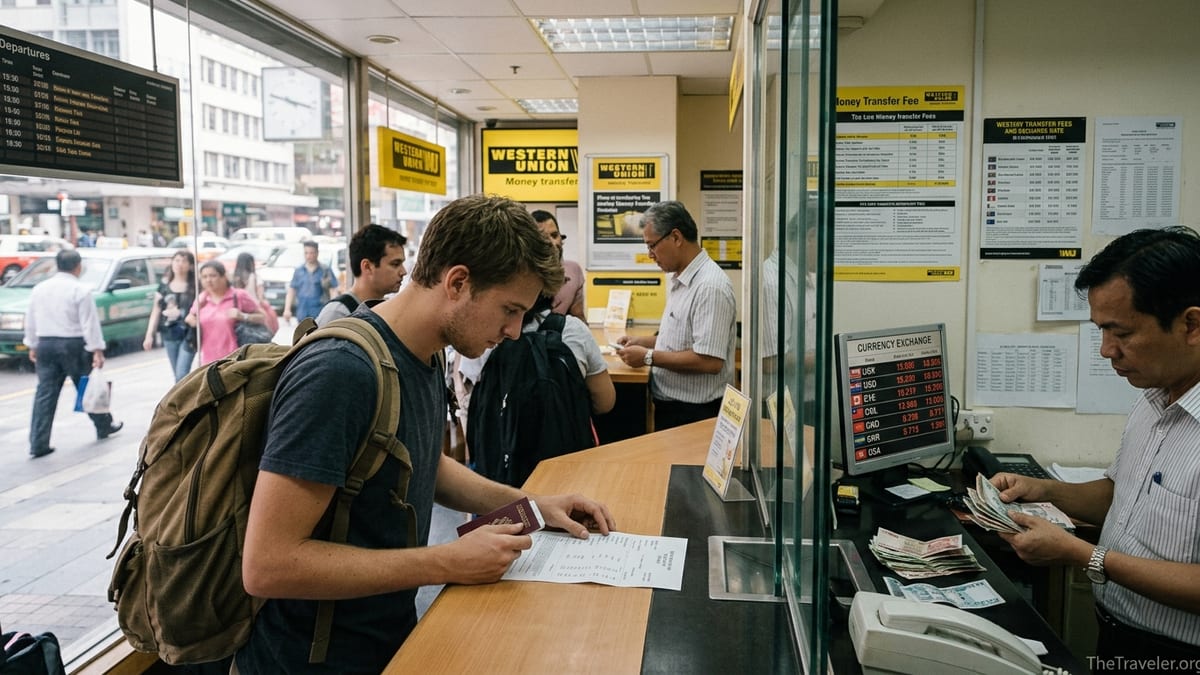
How Western Union Works for Travelers Today
Western Union is a global money transfer network with hundreds of thousands of agent locations across more than 200 countries and territories. For travelers, that means you can often find its yellow logo in places where your home bank has no presence at all: inside small supermarkets in rural Mexico, electronics stores in Eastern Europe, or currency exchange booths near train stations in Southeast Asia. You can send money online or through the mobile app before you travel, or step into an agent location and pay in cash while on the road.
From a fee perspective, Western Union splits its business into two broad pieces: how you fund the transfer and how your recipient receives the money. You might pay by US bank account, debit card, credit card, or cash at an agent. The receiver might get a bank deposit in euros, a mobile wallet credit in Kenyan shillings, or a cash pickup in Philippine pesos. Each combination has its own pricing, which is why two people sending the same amount can end up paying very different total costs.
All transfers have two price components. First is the visible transfer fee, which is the amount Western Union lists as a “send fee” when you get a quote. Second is the exchange rate markup on cross-currency transfers. Western Union applies its own exchange rate, which typically includes a margin on top of the mid-market rate you would see on financial news sites. The overall cost of sending money is the combination of this fee and that margin, not just the fee alone.
Regulators now require Western Union and similar providers to show you the transfer fee, the exchange rate being used, and an estimate of what your recipient will receive before you pay. This makes it easier for travelers to compare a Western Union quote with what a digital provider or bank wire might charge, especially for larger transfers like rent deposits or tuition payments while abroad.
Breaking Down Western Union’s Main Fee Types
When you send money with Western Union, you are really navigating three kinds of cost: the explicit transfer fee, the exchange rate margin, and any extra taxes or charges triggered by how you fund the transaction. The explicit fee is straightforward. For example, a US traveler sending 200 dollars online from a bank account to a friend’s bank account in Germany might see a service fee of just a few dollars, while the same amount funded by a credit card and paid out as cash pickup in Mexico could show a higher send fee.
The exchange rate margin is less obvious but often more important. Suppose you are in Chicago sending 500 dollars to India. If the real mid-market rate is roughly 1 USD to 83 Indian rupees, the pure conversion without any margin would yield around 41,500 INR. A Western Union quote might instead apply a slightly weaker rate, for instance something in the region of 81.5 to 82.5 INR per dollar. That difference of 1 to 1.5 rupees per dollar translates into several hundred rupees of hidden cost, even if the stated fee looks low at 0 to 4 dollars for a bank-funded online transfer.
Then there are funding-related charges outside Western Union’s control. If you pay with a credit card, your card issuer may treat the transaction like a cash advance. In that case, you could pay a cash advance fee of 3 to 5 percent plus an immediate high interest rate, even before Western Union’s own fee and exchange rate margin. Some US travelers discovered this the hard way when using credit cards to fund frequent remittances from Western Union’s app, only realizing later that their card issuer had been layering on extra charges every month.
Local taxes can now be part of the picture as well. In the United States, a new 1 percent federal remittance tax applies from January 1, 2026 on certain international money transfers funded with cash, money orders, or cashier’s checks. That means a traveler walking into a convenience store in Texas to send 1,000 dollars in cash to family overseas could pay an extra 10 dollars in federal tax on top of whatever Western Union fee and FX margin already apply. Funding the same transfer from a US bank account or debit card avoids that specific 1 percent tax, which is one reason Western Union promotes digital payment methods for US-based senders.
Real-World Fee Examples on Popular Travel Routes
To understand how these charges feel in practice, it helps to look at realistic scenarios. Consider a student from India studying in Boston whose parents occasionally need to send emergency cash. If the parents use Western Union online from India to send the equivalent of 500 US dollars funded from their bank account with payout as a US bank deposit, the explicit fee could be relatively modest. However, the rupee-to-dollar exchange rate they receive might be a few percentage points below the mid-market rate, meaning the student effectively receives less than 500 dollars’ worth after conversion.
Now flip the direction. A US traveler in New York sending 500 dollars to family in India via the Western Union website, funding from a US bank account and choosing bank deposit as the payout, may see a send fee ranging from 0 to around 4 dollars. The FX rate in June 2026 on this corridor commonly sits about 1 to 2 percent below the mid-market rate. On a 500 dollar transfer, that couple of percent can represent roughly 10 dollars of hidden currency cost on top of the visible fee, which is still cheaper than many traditional bank wires to India but more expensive than some low-margin digital competitors.
Take another common travel route: US to Mexico for cash pickup. Many Americans support relatives in Mexico or need to send themselves travel money to pick up on arrival. Western Union often prices cash pickup higher than bank deposits. An in-store transfer funded with cash at a US agent location for same-day pickup in pesos in Mexico can attract a noticeably higher up-front fee than an online bank-funded transfer. On top of that, the USD to MXN rate used may include a wider spread than on bank-to-bank routes, reflecting the convenience of being able to walk into a neighborhood chain like Elektra or a small grocery and leave with cash in hand.
The pattern repeats across popular travel destinations. Payout to bank accounts tends to be cheaper than cash collection at an agent. Online or in-app transfers funded from a bank account generally cost less than in-person cash-funded transfers. Where Western Union shines for travelers is in corridors where agent networks are dense and banking penetration is low, such as rural parts of North Africa or Central America. In those cases, you may decide the extra cost is worth the ability for your relative to collect physical cash without needing a bank account.
Western Union vs Banks and Digital Rivals
For many years Western Union filled a gap that banks did not cover well. Traditional bank wires often cost 35 to 50 dollars to send internationally from US accounts, with recipients paying incoming wire fees of their own. Delivery could take several days, and transferring to someone without a bank account was nearly impossible. Western Union’s model of quick payouts to agents and later to mobile wallets solved a real problem for travelers, migrant workers, and expats.
In 2026, the competitive landscape looks different. Digital remittance companies now offer bank-to-bank transfers using the mid-market exchange rate with a small transparent fee, while Western Union usually layers more of its revenue into the FX rate. For example, one independent comparison of a 1,000 dollar US to euro transfer in early 2026 showed Western Union’s online option charging a fee in the neighborhood of 5 to 10 dollars with a 2 to 4 percent rate margin, while some digital rivals charged similar or slightly higher explicit fees but a much smaller margin on the exchange rate. The end result was that the recipient often received more euros through the low-margin FX provider, even when its listed fee was higher.
Yet Western Union still has important advantages that banks and some app-only competitors cannot match. In emergencies, a traveler who has lost cards in Thailand or Turkey can have a friend or family member send a cash pickup transfer that is available within minutes. In some developing countries, Western Union’s network reaches far beyond the capital city’s banking district, making it easier for a recipient to collect funds while spending little on local transport. Some mobile phone plans and loyalty programs in 2026 even bundle Western Union transfers as benefits, such as offering periodic fee-free sends or reward points that partially offset costs.
For a typical traveler or international student, the smartest approach is to treat Western Union as one tool among several. Use it when you genuinely need cash pickup in the local currency or rapid delivery into a mobile wallet in a country where banking is limited. For predictable, recurring payments like rent to a landlord in Europe or monthly support to parents in a major city, compare Western Union’s quote with a specialist international transfer service, a multi-currency account, or even a reasonably priced bank wire to see which option yields the highest local-currency amount after all fees and FX margins.
How to Estimate Your True Cost Before You Send
Because Western Union’s fees change by country corridor, amount, funding method, and payout type, the only reliable way to know your cost is to get a live quote before you send. Western Union’s website and app include a fee estimator where you enter your send country, receive country, amount, and funding method. Before you confirm, you will see the transfer fee in your currency, the exchange rate being used, and the amount your recipient is expected to get. This makes it possible to compare the quote side by side with a digital competitor or bank wire before committing.
When comparing, focus on the total outcome, not just the headline fee. Imagine you are sending 700 dollars to your partner who is studying in Spain. Western Union might quote a 7 dollar fee and a slightly weaker USD to EUR rate, leading to your partner receiving around 640 euros. Another service might charge a 12 dollar fee but use a rate very close to the mid-market, resulting in your partner receiving perhaps 650 to 655 euros. Even though Western Union’s fee is lower, the second option could be better value because more money arrives at the other end.
It also pays to experiment with different combinations inside Western Union itself. Sometimes changing your funding method from credit card to bank account can sharply reduce the explicit fee and avoid cash advance charges from your card issuer. In other cases, opting for bank deposit instead of cash pickup lowers both the fee and the margin on the FX rate. If you have time, test multiple amounts too. Some Western Union pricing tiers mean that sending one larger transfer per month is cheaper than several small ones, especially when the service charges a fixed fee for transfers within a certain range.
US travelers should additionally keep an eye on the new 1 percent remittance tax when paying with cash or certain paper instruments. If you usually carry physical dollars to an agent location to send money abroad, calculate how much extra the tax adds at your typical send amount. On a 2,000 dollar remittance funded from cash, that is an extra 20 dollars in tax alone. Switching to a bank account or debit-funded digital transfer through Western Union or an alternative provider may save you that cost while often lowering the transfer fee at the same time.
Strategies to Reduce Western Union Costs When You Travel
For many travelers, the goal is not to stop using Western Union altogether but to make each transfer as efficient as possible. A straightforward strategy is to default to bank-account funding and bank-account or mobile-wallet payout whenever those are realistic options. For example, if your parents in Manila have basic bank accounts or a widely used mobile wallet, it will almost always be cheaper to send a bank deposit or wallet top-up than to pay for an in-person cash pickup. Over a year of regular transfers, that difference can add up to the value of a flight.
Planning ahead also helps. If you know you will need to pay a 1,500 euro apartment deposit in Berlin in two months, you can shop around weeks in advance and observe how Western Union’s rate compares with other services for that corridor. You might find that using Western Union for occasional emergency cash pickups in Germany makes sense, while a specialist bank-to-bank provider offers a much tighter exchange rate for the big one-time deposit. Splitting your money movement this way lets you leverage Western Union’s strengths without overpaying when you do not need its network of agents.
Loyalty programs and partnerships can reduce costs at the margin. Western Union frequently runs promotions such as fee-free first transfers for new customers or discounted fees on specific corridors. Some mobile carriers and financial apps in the US now include a limited number of Western Union transfers in premium plans. If you already pay for such a plan for other reasons, it can be worth checking whether it includes one or two low-fee or no-fee Western Union sends per month, especially for small support payments while a family member is traveling.
Finally, always maintain a backup option. Seasoned travelers often keep both a Western Union account and at least one digital alternative ready to use. That way, if Western Union’s system is temporarily unavailable at an agent location in Sofia or Lima, or if regulations tighten on a particular corridor, you can still get money where it needs to go without resorting solely to card cash advances or expensive emergency bank wires.
The Takeaway
Western Union remains one of the most visible money transfer brands in the world, and for good reason: it connects people in places where traditional banks and app-only startups struggle to reach. For travelers, expats, and international families, it can be the difference between being stuck without funds and having cash in hand within minutes in a foreign country.
At the same time, those yellow signs come with a complex fee structure. The total cost of a Western Union transfer is not just the posted send fee, but also the exchange rate margin and any external charges such as credit card cash advance fees or, in the US, the new 1 percent remittance tax on certain cash-funded transfers. Routes that favor cash pickup and in-person cash funding tend to be the most expensive, while bank-to-bank transfers funded online or in the app are usually more competitive.
If you treat Western Union as one tool in a wider travel money toolkit, you can lean on it when its strengths matter most and look elsewhere when you merely need a bank deposit in a heavily banked country. By checking live quotes, comparing total amounts received in local currency, and being mindful of how you fund each transfer, you can keep more of your money focused on your journey and the people you support, rather than on fees.
FAQ
Q1. How much does it usually cost to send money with Western Union while traveling?
The cost varies by country, amount, funding method, and payout type. A small online bank-funded transfer might cost only a few dollars in visible fees, while an in-person cash-funded transfer for cash pickup can cost significantly more once you factor in both the send fee and a weaker exchange rate.
Q2. Is Western Union cheaper than using my bank for international transfers?
It depends on the corridor and how you send. For many common routes, Western Union’s online bank-to-bank transfers can be cheaper than a traditional US bank wire that charges 35 to 50 dollars plus recipient fees. However, digital remittance specialists that use the mid-market exchange rate with a low, transparent fee may still beat Western Union on total cost.
Q3. Why is the exchange rate important when I use Western Union abroad?
The exchange rate determines how much foreign currency your recipient actually receives. Western Union usually builds part of its revenue into the rate, offering a slightly weaker rate than the mid-market level. Even if the transfer fee looks low, a poorer exchange rate can mean your recipient gets less money overall.
Q4. Are Western Union cash pickups more expensive than bank deposits?
In many cases, yes. Cash pickups and in-person cash-funded transfers tend to carry higher explicit fees and sometimes larger exchange rate margins compared with online bank-funded transfers to bank accounts or mobile wallets. You are paying for the convenience and reach of the cash network.
Q5. Can my credit card company charge extra fees when I use Western Union?
Yes. Some card issuers classify Western Union transactions as cash advances, adding a separate cash advance fee and higher interest rate on top of the Western Union send fee. To avoid this, many travelers prefer to fund transfers from a bank account or debit card instead of a credit card.
Q6. What is the new 1 percent remittance tax in the United States, and does it affect Western Union?
Beginning in 2026, certain international money transfers funded with cash, money orders, or cashier’s checks in the US are subject to a 1 percent federal remittance tax. If you use Western Union and pay in cash at a US location, that tax can add an extra cost on top of normal fees. Funding your transfer from a bank account, debit card, or digital wallet avoids this particular tax.
Q7. How can I estimate the total cost of a Western Union transfer before sending?
Use Western Union’s online or in-app estimator to enter your send and receive countries, amount, and funding method. Review the displayed send fee, the exchange rate, and the estimated amount your recipient will receive. Then compare that figure with quotes from other providers for the same route and amount.
Q8. Is Western Union a good option for emergency cash while I am abroad?
Yes, Western Union can be very useful in emergencies. A friend or family member can send money to you for cash pickup at a nearby agent location, often within minutes. You may pay more in fees and exchange rate margin for this convenience, but in urgent situations the ability to access cash quickly can justify the cost.
Q9. How can I reduce Western Union fees if I send money regularly while traveling?
Whenever possible, fund transfers from a bank account or debit card and choose bank deposits or mobile wallet payouts instead of cash pickup. Consolidate several small transfers into a single larger one if the fee is fixed over a range, and watch for loyalty programs or promotions that discount fees on your most common routes.
Q10. Are there situations where I should avoid Western Union altogether?
Western Union may be less attractive when both you and your recipient have bank accounts in well-connected countries and do not need cash pickup or immediate delivery. In those cases, a specialist international transfer service or a competitive bank wire that uses a near mid-market exchange rate can often deliver more money to the recipient for the same send amount.