


In Orlando, the billboards and phone calls promising cheap theme park getaways and spacious condo-style suites often trace back to one thing: a timeshare presentation. Westgate Resorts, one of the biggest vacation ownership brands headquartered in Orlando, aggressively promotes “resort preview” deals that pair discounted nights with a mandatory sales pitch. Before you trade a few hours of vacation for cheaper park tickets or a low nightly rate, it pays to understand exactly how Westgate’s vacation ownership offers work, what the fine print looks like, and how intense the sales experience can be.
Get the latest updates straight to your inbox!
How Westgate Orlando Timeshare Deals Usually Work
Westgate Resorts runs ongoing “resort preview” or “discovery tour” offers in Orlando that bundle a deeply discounted stay with a required sales presentation about vacation ownership. On the surface, these packages can look extremely attractive. Travelers routinely report offers such as three nights at Westgate Lakes Resort & Spa or Westgate Vacation Villas for a little over one hundred dollars total, sometimes paired with gift cards or theme park tickets worth several hundred dollars. One current promotion marketed through a third-party timeshare marketing site, for example, advertises a three-night Orlando stay at Westgate Lakes Resort & Spa plus a 200 dollar prepaid gift card in exchange for completing a timeshare tour.
Instead of booking through typical channels, guests usually respond to a phone call, a “scratch-off” style mailer, a booth at a mall or tourist area, or a banner ad promising Orlando for a fraction of the usual cost. Westgate’s own website also encourages travelers to book a resort preview package where the low rate is tied to attending a discovery tour of the property and learning about ownership options. The discounted pricing is not random. It is heavily subsidized by the company’s sales budget, with the expectation that a portion of guests will sign contracts for long-term vacation ownership.
The general pattern is that your room and any bonuses are conditional. You pay a low, often nonrefundable amount up front for lodging. In return, you agree that all adults in your party who qualify under the promotion’s rules will sit through a presentation on a specific date and time. Only after you complete the full presentation and meet all requirements do you receive any promised incentives such as gift cards, attraction tickets, or resort credits. If you leave early, decline to attend, or do not meet the qualifications, Westgate or the marketing company can withhold the incentives and may charge you the resort’s standard rack rate instead of the promotional price.
Eligibility Rules and Fine Print You Should Read Carefully
Westgate and its marketing partners attach detailed eligibility rules to Orlando timeshare preview packages, and those rules can be stricter than many travelers expect. Internal offer documents for recent promotions spell out that the package is typically “designed for married or cohabitating couples” or, in some offers, single women, usually within a set age range such as 27 to 70 years old. Some offers require a minimum household income, often around 50,000 dollars per year, and may require that at least one adult have a qualifying credit score. Guest must present a valid government-issued ID and a major credit or debit card at check in and at the tour reception desk.
Geography can also matter. Certain Orlando-focused promotions exclude people who live too close to the resort, such as within a 60-mile radius of Orlando or within specific nearby counties like Orange, Osceola, or Seminole. The logic is that Westgate wants fresh prospects who are likely to use a vacation ownership week for travel, not locals just seeking cheap lodging. Many offers also state that you cannot have attended a Westgate sales presentation or stayed on another promotional package in the previous 6 or 12 months. If you have already toured recently, the company may not honor a new discounted preview.
If you fail to meet these qualifications, the consequences can be expensive. Guests who arrive and do not meet the age, relationship, or income requirements, or who refuse to provide a credit card, may be told they must either pay the regular nightly rate for their stay or cancel and find alternate accommodation. For example, a family that responded to a three-night package but did not realize that both partners had to attend together at the same time could be deemed non-qualifying if one adult refuses to go to the sales center. In that scenario, Westgate might cancel the promotional incentives and re-rate the stay at standard prices, turning what seemed like a bargain weekend into something close to regular resort pricing.
Before you give a deposit or book flights, ask the agent to email the full written terms of the promotion, not just a verbal summary. Read the sections labeled “Qualifications,” “Tour Requirements,” and “No-Show or Early Departure Policy” carefully. If you do not clearly meet every condition listed, clarify in writing or consider skipping the deal. The exact criteria can vary from one campaign to another, so do not assume that because your friend qualified last year, you will automatically qualify this year.
What Really Happens During a Westgate Orlando Sales Presentation
On paper, Westgate typically describes its presentations as a 90- or 120-minute “resort tour and ownership discovery session.” In reality, the time commitment can be significantly longer. Online reviews and complaints filed with consumer organizations describe guests who expected 90 minutes and instead reported spending three to five hours at the sales center. A common pattern in real-world accounts is that the clock does not start when you arrive on property, but when you sit down with a salesperson, and that transitions between breakfast, group presentations, property tours, and one-on-one sales conversations are not counted toward the official time.
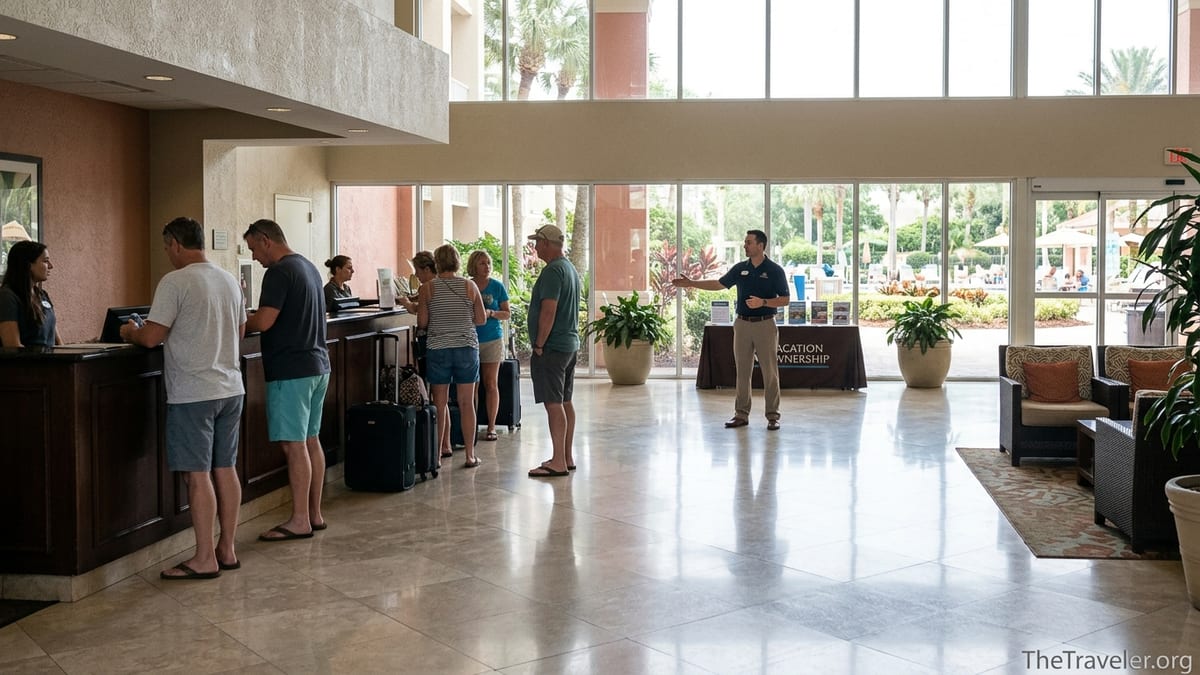
The sales day often begins with a check-in at a preview center where staff verify your IDs, credit card, and eligibility. You may receive a complimentary breakfast buffet or snacks in a large room shared with other guests. A presenter or video will introduce the concept of vacation ownership, emphasize the rising cost of hotels, and highlight features of Westgate’s Orlando resorts and other destinations in its network. Guests are then typically matched with individual sales representatives who escort them on a property tour, showing off larger units, upgraded views, and amenities like water parks, pool complexes, and on-site restaurants. At Westgate Lakes Resort & Spa, for example, that might include a golf cart ride around the lakeside buildings and a walk through a newly renovated two-bedroom villa that looks far more luxurious than the entry-level unit many preview guests actually booked.
After the tour, the core sales conversation starts. The salesperson may write numbers on a sheet or tablet, comparing the cost of a lifetime of hotel stays to a financed timeshare week, emphasizing projected “savings” if you vacation at least once a year. Real-world reviews mention interest rates approaching or exceeding typical credit card rates on some developer financing, but sales staff may focus more on monthly payment amounts than total cost. If you decline the initial offer, a manager or “closer” often joins the table to present discounted options, trial memberships, or smaller packages. Guests who continue to say no may be passed to yet another representative who offers last-chance mini-vacation packages in exchange for considering a future purchase.
This multi-step process is why many travelers find the presentation feels far longer and more draining than the promotional materials suggest. While some visitors report that they were able to firmly say no and leave within something close to the quoted time, a substantial number describe persistent pressure, repeated attempts to overcome objections, and a reluctance by sales staff to release them until every possible angle has been tried.
Understanding the Vacation Ownership Product and Ongoing Costs
Even though you might attend the presentation only for the free or discounted trip, it helps to understand what Westgate is actually selling. In Orlando, the company’s timeshare offerings typically involve either deeded weeks at specific properties such as Westgate Lakes Resort & Spa or Westgate Vacation Villas, or points-based vacation club arrangements tied to a network of Westgate resorts. Sales staff often highlight owner perks such as access to other destinations, discounted additional nights, and the ability to use ownership for cruises or partner resorts through exchange programs.
What may be less emphasized in the sales room are the long-term financial commitments attached to ownership. Purchase prices for a week or equivalent points package can run into the tens of thousands of dollars. Many buyers finance directly through the developer at interest rates that can be higher than typical home loans or prime consumer loans, leading to large amounts of interest over time. In addition to any loan payment, owners must pay annual maintenance fees that generally increase over the years, along with potential special assessments for major renovations or repairs. Online owner discussions frequently point out that their maintenance fees have risen steadily while the practical value of what they can book sometimes feels lower than what they could find using standard hotel deals.
Resale value is another key issue. Public listing sites often show Orlando-area Westgate timeshares advertised for just a few hundred dollars or even for free, with sellers mainly trying to get out from under ongoing fees. That real-world market picture contrasts sharply with the implication in some sales conversations that ownership is a financial investment that will hold or increase its value. Travelers who walk into a presentation informed about the resale market and the true cost of maintenance fees are generally better equipped to evaluate whether any offer in the room makes sense for their situation.
For some families who travel to Orlando frequently and who are comfortable with both the purchase price and lifetime fees, ownership at a specific resort can make emotional sense. They like returning to the same condo-style villa each year, having kitchen and laundry facilities, and knowing they have a week set aside for vacation. But that is a lifestyle choice, not a conventional financial investment. Prospective buyers should compare what it would cost to rent similar accommodations each year through standard booking channels or vacation rental platforms before making a commitment.
Perks, Incentives, and the Real-World Value of Attending
The main reason many travelers consider a Westgate Orlando timeshare presentation is the promise of perks: cheap or free nights, gift cards, attraction tickets, or resort credits. Examples frequently reported online include a three-night stay plus a 150 to 200 dollar Visa or prepaid card, or heavily discounted tickets to major parks such as Universal Orlando or SeaWorld after completing the tour. Some guests report that the combined value of their lodging and perks was several hundred dollars more than what they paid, even after factoring in resort fees and taxes.
The practical value of these incentives depends on your travel style and tolerance for sales situations. If you were already planning a budget three-night stay near the attractions, getting upgraded from a basic hotel room to a one-bedroom villa with a kitchen at Westgate Lakes Resort & Spa for around 100 to 150 dollars total can be a significant upgrade. Add in a 150 dollar gift card or discounted theme park tickets, and the math can look compelling. One traveler comparing a Westgate promo to a standard package through a warehouse club travel agency noted that the timeshare deal saved well over 1,000 dollars on a weekend that included park admission, at the cost of one long morning spent listening to a sales pitch.
The flip side is the time and emotional cost. A presentation that stretches across most of a morning can cut deeply into a short trip, especially if you have children anxious to get to the parks. Some guests come away feeling that no incentive would have been worth the stress of repeated sales pitches and the pressure they felt at the table. Others report leaving frustrated because the perks they expected were reduced or withheld when minor technicalities were invoked, such as arriving a few minutes late, not bringing a particular document, or refusing to sit with yet another manager at the end. To preserve the value of your incentive, arrive early, bring every piece of documentation listed in your confirmation, and remain calm and polite but firm during the sales process.
It is also wise to treat any additional “today only” perks described during the presentation with skepticism. Limited-time cruise deals, bonus weeks, or rental income projections may sound attractive in the moment, but they often come with conditions that are hard to verify quickly. Unless you were already seriously considering vacation ownership and have done outside research on the product, it is usually better to enjoy the baseline incentive that brought you there and decline any new offers that require on-the-spot decisions.
Sales Pressure: What Travelers Report and How to Protect Yourself
Many third-party reviews, complaint summaries, and personal accounts paint a consistent picture of high-pressure tactics during some Westgate Orlando presentations. Common themes include salespeople framing timeshare purchases as smart financial investments, emphasizing that prices will rise if you do not buy now, and suggesting that maintenance fees are minor compared to the cost of future hotel stays. Some guests report being told that they can easily rent out their week for profit, refinance high-interest developer loans quickly through banks, or resell ownership later for near what they paid. Others describe being discouraged from reading the contract in detail or from taking documents away to review.
These patterns are not unique to Westgate, but they are important to anticipate. The best defense is to set boundaries before you ever sit down. Decide in advance that you will not sign any contract or financing agreement on the spot, regardless of how attractive the numbers look. Tell your salesperson up front that you are there solely for the presentation and will not be making a purchasing decision that day. If you are traveling with a partner, agree beforehand on a safe word or phrase that signals “we need to walk away” if either of you feels overwhelmed.
Stay focused on concrete numbers rather than emotion. If you do engage with an offer out of genuine curiosity, insist on seeing the full purchase price, interest rate, repayment term, and every fee in writing, and then compare those numbers to the cost of simply booking a similar villa each year through regular channels. Remind yourself that any “today only” discount can almost always be matched or beaten later if you truly want to buy, since the developer is primarily motivated to close deals, not to maintain consistent pricing. If you feel trapped at the table beyond the agreed presentation time, you are still free to stand up. Calmly state that you have fulfilled your obligation, that you need your completion form or voucher, and that you will be leaving.
Finally, keep in mind that the people working in the sales center are trained professionals whose livelihood depends on closing contracts. You do not owe them a purchase or extended debate. You already paid for your discounted stay with your time and attention. It is perfectly acceptable to say you are not interested, decline to explain your personal finances, and repeat that you wish to conclude the meeting.
Is Attending a Westgate Orlando Timeshare Presentation Worth It?
Whether a Westgate Orlando timeshare presentation is “worth it” depends on your expectations, your financial situation, and how comfortable you are under sales pressure. For budget-conscious travelers who view the presentation purely as a transactional trade of time for savings, the math can work. If you value your time at, for example, 50 dollars per hour and you spend three hours in a sales center but receive lodging and perks worth 500 to 700 dollars more than you paid, that can feel like a reasonable exchange. This is particularly true for families who need a larger villa with a kitchen and separate bedrooms and who were already planning to spend most of their time at the resort and nearby parks.
However, the equation changes if the experience damages your vacation mood or tempts you into a purchase you later regret. There are numerous real-world stories from guests who went into a Westgate presentation strictly for the perks and emerged as owners, only to later discover that their maintenance fees, limited booking windows, or resale realities did not match what they believed in the room. For them, the long-term cost of an impulsive decision far outweighed the short-term savings on one trip. If you know that you are highly susceptible to persuasive sales techniques, that you struggle to say no, or that you might be tempted by the idea of a “once-in-a-lifetime” deal, you may be better off paying regular rates for your Orlando stay.
Another factor is trip length. On a seven-night vacation, giving up a half-day for a presentation may not feel as disruptive, especially if you schedule it for a non-park day. On a two- or three-night getaway, losing a full morning to check-in, breakfast, tours, and sales conversations can take a serious bite out of your fun. If you are traveling with young children who may be restless during long waits or who cannot sit quietly while you focus on numbers, the stress level may climb quickly, even if kids’ club activities or playrooms are available nearby.
In the end, the decision comes down to control and awareness. If you go in clear-eyed, with a firm personal rule never to sign a contract on the spot and a realistic expectation that the “90-minute” tour may last significantly longer, you are more likely to walk out with your perks and without regrets. If the very idea of a high-pressure environment undermines your vision of a relaxing Orlando vacation, then the discounted stay probably is not worth the tradeoff.
The Takeaway
Westgate’s Orlando resorts can provide spacious accommodations and convenient access to the area’s theme parks, and its timeshare preview packages sometimes offer real savings for travelers willing to exchange time and patience for discounts. At the same time, the company’s sales presentations are often longer and more intense than advertised, and the long-term costs of ownership can be far higher than what is emphasized in the sales room. By studying the fine print before you book, setting strict personal rules for the presentation, and viewing any purchase offer as a lifestyle choice rather than an investment, you can better protect yourself.
If you are the kind of traveler who enjoys negotiating, has a high tolerance for sales environments, and is absolutely confident in your ability to say no, then a Westgate Orlando timeshare presentation can be a calculated way to access a nicer stay and some extra perks. If you prefer your vacations pressure-free or know that you might be swayed by glossy promises, you may find that paying a bit more up front for a standard hotel or vacation rental is the more relaxing and ultimately cheaper path.
FAQ
Q1. How long does a Westgate Orlando timeshare presentation really last?
Many offers advertise a 90- or 120-minute presentation, but real guests frequently report spending three hours or more once check-in, breakfast, property tours, and multiple sales conversations are included. Plan for at least half a day, especially if the resort is busy.
Q2. What happens if I refuse to attend the presentation once I arrive?
If you skip the presentation or leave before being formally released, Westgate or its marketing partner can withhold your promised perks and may re-rate your stay at the resort’s standard price instead of the promotional rate. In practice, that can turn a bargain package into something close to regular rack rate.
Q3. Can I really just say no and still get my gift card or park tickets?
Yes, as long as you meet all eligibility rules, show up on time, complete the required presentation, and remain polite but firm when you decline to purchase. Guests who calmly repeat that they are not buying today and request their completion paperwork usually do receive their promised incentives before leaving the preview center.
Q4. What kind of perks do people actually get for attending?
Common incentives in Orlando have included heavily discounted three- or four-night stays in villa-style accommodations, prepaid gift cards in the 100 to 200 dollar range, and discounted or promotional tickets to major attractions such as Universal Orlando or water parks. The exact perks change regularly and are tied to specific promotions.
Q5. What eligibility requirements should I expect for a Westgate preview package?
Typical requirements include being within a certain age range, meeting a minimum household income, having a valid government-issued ID and major credit or debit card, and, for many offers, being married or in a cohabitating relationship and attending the presentation together. Some promotions also exclude people who live within a set radius of Orlando or who have recently attended another Westgate presentation.
Q6. Are Westgate timeshares in Orlando a good financial investment?
From a purely financial perspective, most timeshares, including those at Westgate, should be viewed as prepaid vacations rather than investments. Resale prices for Orlando-area weeks are often far below original developer prices, and annual maintenance fees can rise over time. For some families, ownership provides emotional value and vacation structure, but it rarely functions like a traditional appreciating asset.
Q7. Will Westgate run my credit if I attend a presentation?
If you show interest in purchasing and apply for developer financing, Westgate will typically perform a credit check. For guests who only attend the presentation to receive incentives and clearly state they are not buying, a credit check is generally not necessary, though you will still need to present a major credit or debit card for identification and security.
Q8. Can I bring my kids to the presentation?
Children are usually allowed on property, and some Westgate resorts provide limited kids’ activities or play areas near the sales center. However, young children may become restless during long waits and sales discussions. If possible, schedule the tour for a time when another adult in your party can watch the kids, or bring quiet activities to keep them occupied.
Q9. What should I do if I feel misled or pressured into buying?
If you sign a contract and quickly regret the purchase, review your paperwork for the legally required rescission or “cooling-off” period, which allows you to cancel in writing within a short window after signing. If you feel you were misled, document your experience in detail and consider contacting state consumer protection agencies or seeking independent legal advice.
Q10. Is it better to book a regular room or a timeshare presentation package in Orlando?
The answer depends on your tolerance for sales pressure and the value of the offered perks. If you prioritize a low-stress trip and dislike high-pressure environments, paying a bit more for a standard booking at a hotel or vacation rental is often worth it. If you are well-informed, comfortable saying no, and willing to trade several hours of your time for substantial discounts, a Westgate presentation package can be a financially efficient option.