

Thailand sells a powerful dream: golden temples, turquoise bays, fragrant street food and smiles at every turn. Much of that dream is still real, and traveling here can be one of the most rewarding experiences in Southeast Asia. Yet Thailand in 2026 is not the same place many backpackers fell in love with a decade ago. Costs are higher, crowds thicker, and the fine print of travel has become more complex. After several extended trips, here is what I genuinely loved about traveling in Thailand, and what I learned to hate enough to plan differently next time.
The Everyday Magic: Food, Markets and Street Life
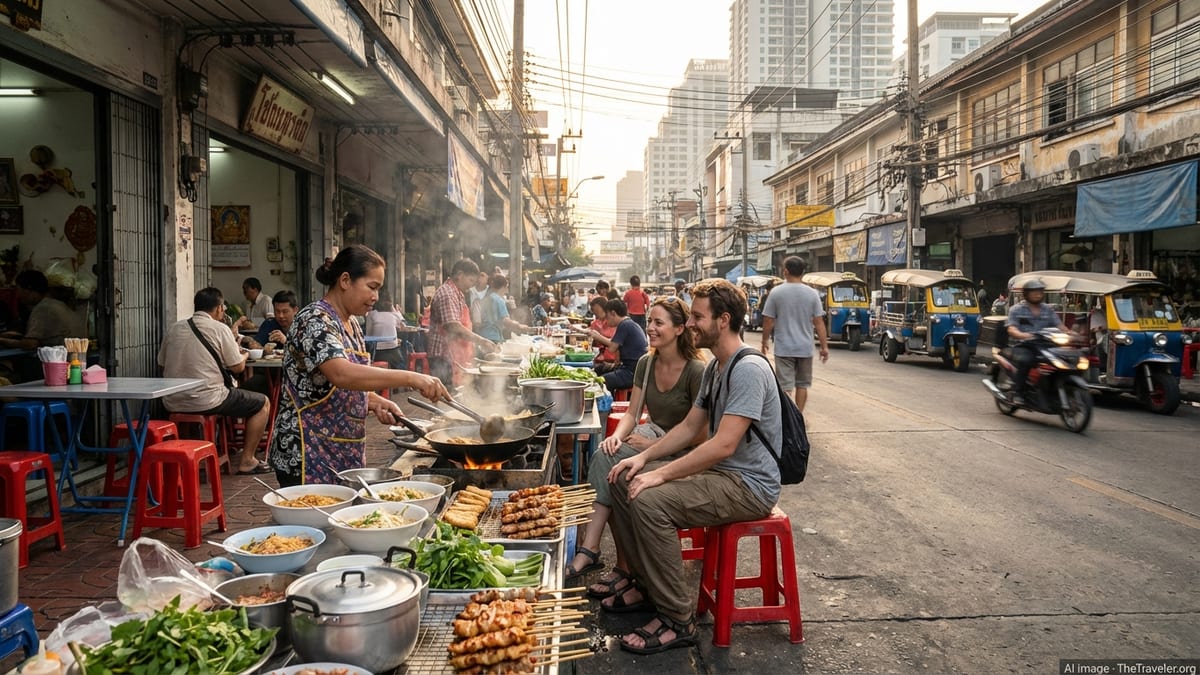
Thailand’s food culture is the first thing that made me fall hard for the country. It is not just that the dishes are flavorful, but that good food is woven into daily life in a way few destinations can match. In Bangkok, stalls appear on the sidewalk at dawn, ladling congee and coffee to office workers. By midday, plastic stools and tiny shophouses serve curries fragrant with lemongrass and galangal for the price of a coffee back home. In the evening, night markets take over entire streets, filling the air with charcoal smoke from grilling pork skewers and the sharp scent of chili and lime from papaya salad stands.
What I loved most was how democratic that food culture felt. You might find yourself eating shoulder to shoulder with taxi drivers, families with kids and suited office workers. The best meals I had were rarely in polished restaurants. Instead, they came from aunties who had been perfecting a single noodle recipe for thirty years, or from a cart that appeared outside a 7-Eleven precisely at 6 p.m. Eating in Thailand is not a side activity to sightseeing. It becomes the skeleton around which you build your days.
Street life in general is part of the country’s charm. From morning monks collecting alms in saffron robes to late-night flower markets in Bangkok, there is always something happening on the sidewalks. Even smaller towns feel animated after dark, when food carts, clothing stalls and impromptu stages appear. That energy, combined with the generally relaxed attitude toward lingering over a drink or a plate of food, created many of my happiest travel memories here.
There is also a sensory generosity that I came to appreciate: the ready availability of fresh fruit, ice-cold drinks, random massage shops when your legs give up, and convenience stores on nearly every corner. For a traveler, it means that minor discomforts never last long. You are rarely far from shade, a fan and something cold to drink, which made long days of exploring far more manageable than they might be in other hot countries.
Landscapes to Fall in Love With
Thailand’s geography is another reason it continues to seduce travelers. Within a single trip you can move from humid capital to misty northern mountains, and then down to islands where limestone cliffs rise straight out of the sea. I loved the way the landscape shifted on overnight trains: falling asleep to the industrial edges of Bangkok and waking up to rice paddies and palms rushing by your window on the way to the north.
In the north, places like Chiang Mai and Pai are surrounded by hills and cooler air. Mornings can be surprisingly crisp at certain times of year, and the light over temple roofs just after sunrise is memorable even if you are not especially religious. Hiking trails, waterfalls and coffee farms are close enough that you can be out in real countryside after a relatively short drive. I found the pace here slower and more reflective, with more time for wandering quiet sois and stepping into neighborhood temples that see very few foreign visitors.
In the south, coastal Thailand delivers those postcard scenes that made the country famous. White-sand beaches, longtail boats with bright scarves tied to their prows, and water so clear you can see the shadow of every fish. Snorkeling and diving remain excellent in many areas, especially if you are willing to travel a bit farther or pay attention to seasonal conditions. Even on more developed islands, an early start often meant I had an almost empty beach for an hour or two before the crowds arrived.
National parks added another layer of appreciation. Inland reserves offer jungle treks where you might spot gibbons or hornbills, while marine parks protect coral reefs and islands with stricter visitor limits. I loved that, despite heavy tourism in many places, Thailand still has pockets where you can feel far from the usual routes if you time it well and do some homework.
The Warmth and Frustrations of Thai Hospitality
Thailand’s brand identity as the Land of Smiles did not come from nowhere. I encountered countless small kindnesses: a vendor showing me how locals eat a dish instead of letting me drown it in chili, a stranger in Chiang Rai who walked me three blocks to the right songthaew stand, staff in family-run guesthouses who remembered my name and coffee order after a single night. A simple greeting in Thai and an attempt to be polite usually opened doors that were not visible to more impatient visitors.
There is a flexible, can-do attitude that makes travel logistics easier. Need a last-minute bus ticket, a custom boat transfer or help mailing a box of souvenirs home? Someone will usually know a cousin or a neighbor who can make it happen. Guesthouses routinely help book tours, onward transport and motorbike rentals, and while there is sometimes a small markup, the convenience is hard to overstate. Traveling independently here rarely felt lonely, because every interaction had the potential to turn into a conversation or a bit of shared humor.
At the same time, I learned that the same hospitality industry that produces such warmth can also be transactional in ways that feel draining. In some heavily touristed areas, smiles clearly come with a script. Tuk-tuk drivers, tailors and tour touts repeat the same lines all day, every day, and it shows. Negotiations over price become routine, and after a while, the constant dance between genuine friendliness and hard selling left me tired. It is not personal; tourism is a major income source, and visitors are the market. But as a traveler you have to adjust your expectations and boundaries.
Communication can be another source of friction. English is widely spoken in major hubs, but it is not universal. In smaller towns or when dealing with official forms and procedures, misunderstandings are common. I grew to appreciate translation apps, hotel business cards in Thai script and the value of patience. Expecting everything to be as streamlined as in Western tourist centers sets you up for frustration. Accepting that some things will take longer, and that smiling and clarifying details twice is part of the process, made my trips far smoother.
Costs, New Fees and the Hidden Price of Popularity
One thing I disliked about traveling in Thailand recently is how much more expensive it feels compared with its budget backpacker reputation. The country is still good value compared with many Western destinations, but that old image of Thailand as a place where you can live on a handful of coins no longer matches reality in the more popular areas. Accommodation, especially in peak season and on well-known islands, can be surprisingly pricey for what you get. Even basic guesthouses raise rates when arrivals spike, and modern mid-range hotels in city centers often charge close to what you might pay in parts of Europe.
Local surveys and news out of Bangkok have highlighted how the strength of the baht and rising operating costs influence visitor decisions. Travelers reported that the exchange rate and overall cost of travel were major factors in whether they chose Thailand or a neighboring country. While individual prices still look low on paper, the add-ons accumulate quickly: domestic flights, airport transfers, national park entrance fees, and marked-up tours on islands or in resort towns. It is easy to spend more than you expect, especially if you fall into the habit of accepting every quoted price rather than comparing options.
New charges have also entered the picture. A small per-person tourism development fee has been introduced to help fund emergency medical assistance for visitors, environmental conservation and tourist police operations. In many cases this fee is now bundled into flight tickets or paid at immigration. The amount itself is modest, but it signals a broader shift: Thailand is actively looking to balance mass tourism with infrastructure and safety investments, and visitors are being asked to contribute directly to that effort.
The popularity of Thailand also shows up in less obvious costs. When attractions are overcrowded, you pay in time and patience rather than just money. Queues for famous viewpoints, boatloads of people arriving simultaneously on small beaches, and heavy traffic jams around holiday weekends all exact a tax on your energy. For me, the challenge became accepting that iconic locations might no longer offer the kind of tranquil experience their photos suggest, and budgeting more time and flexibility to find quieter corners nearby instead.
Scams, Dual Pricing and Safety Concerns
Few things eroded my affection for traveling in Thailand as quickly as dealing with scams and opaque pricing. While most encounters were honest, the risk of being overcharged or misled felt noticeably higher in tourist hotspots. Survey data from late 2025 showed that foreign visitors ranked scams, especially involving taxis and unofficial tour operators, as their top safety concern in Thailand. That matched what I saw on the ground: drivers refusing to use meters, ride offers that sounded too cheap but came with surprise stops at shops, and tour stands selling excursions that were either heavily padded with shopping or did not match the description.
Dual pricing, where locals pay one rate and foreigners another, is another sensitive issue. Officially, Thai authorities have said they want to address unfair pricing practices. In reality, different prices for domestic and international visitors remain common at some attractions and services. I understand the argument that locals should pay less for their own cultural sites, especially given income differences. Still, it can feel unpleasant when the foreign price is several times higher and not clearly posted. Transparency helps; finding out about the higher rate only at the ticket window, with a queue behind you, is more irritating than the amount itself.
Beyond money, safety is an area where perceptions matter a lot. Thailand remains generally safe for tourists in terms of violent crime, and authorities have coordinated police, military and civil agencies to increase visible protection in major destinations. Tourist police stations and assistance centers now exist in every province, and a dedicated app helps visitors reach them. That said, concerns about petty theft, fraudulent online visa and arrival card services, and isolated high-profile incidents have affected traveler confidence. Immigration officials have warned visitors about fake digital arrival card and e-visa websites that mimic official portals, taking money and sensitive data without providing a real service.
My personal takeaway was that Thailand is not uniquely dangerous, but it does require smart, situationally aware travel. I learned to photograph rental motorbikes before riding, agree on taxi prices or insist on the meter before getting in, and avoid giving my passport as collateral. I booked tours through my accommodation or well-reviewed operators rather than random street stands, and I became skeptical of anyone insisting that a major temple was closed while suggesting an alternative shop or attraction. Once those habits were in place, my trips felt safer, but I still disliked how much mental energy went into staying alert in environments that marketed themselves as carefree.
Overtourism, Environmental Strain and the Changing Mood
There is no denying the impact of overtourism on some of Thailand’s most famous places. After the return of large volumes of international visitors, especially under expanded visa-free arrangements with key markets, pressure on beaches, islands and cultural sites has intensified. Some bays and islands have previously been closed for years to allow their ecosystems to recover from mass tourism, only to reopen to tremendous demand. When you arrive on a small beach at mid-morning and share it with dozens of speedboats and day-trip groups, it is hard not to feel complicit in a problem you dislike.
Environmental concerns show up in smaller, daily ways as well. Single-use plastic still dominates convenience store purchases and takeaway drinks, even though reusable cups and water refill stations are slowly appearing. Coral reefs near heavily visited islands bear obvious scars from boat anchors and novice snorkelers. Air quality in certain cities can deteriorate sharply during burning season, affecting visibility and comfort. I found that choosing where and when to go mattered. Visiting islands in shoulder season or early in the day helped, as did favoring operators that limited group size and emphasized reef-safe practices.
The human side of overtourism is more subtle but just as important. Locals in some communities have expressed fatigue with crowds, disruptive behavior and rising living costs linked to tourism demand. News coverage in Thai media reflects a tension between the need for tourism income and concern about safety, scams and the country’s international image. When videos of isolated violent incidents or scams go viral, they can overshadow the millions of uneventful visits and lead to policy reactions that make entry procedures or regulations stricter for everyone.
As a traveler, I felt that mood shift most in places that rely almost entirely on tourism, where patience sometimes ran thin on both sides of the interaction. It made me more conscious of my own impact: dressing respectfully at temples, keeping noise down at night, refusing to support animal attractions that exploit wildlife, and tipping fairly where appropriate. Traveling in Thailand is no longer just about consuming experiences; it increasingly comes with an ethical layer that thoughtful visitors cannot ignore.
Navigating Rules, Visas and Digital Paperwork
Another part of Thailand that I both appreciated and disliked is the evolving web of entry rules, visas and digital paperwork. The country offers visa exemptions or visa-on-arrival options to many nationalities, and recent years have seen experiments with longer visa-free stays to attract visitors. That flexibility is a clear positive for travelers planning extended trips in the region. At the same time, immigration authorities have tightened enforcement against people using short-term visas to live or work in Thailand long-term without proper permits.
Digitalization has reshaped the arrival process. The old paper arrival card has been replaced by an online form that foreign travelers must complete shortly before entering the country. This digital arrival card collects details about your passport, finances, travel plans and recent health history. In theory, the system speeds up immigration processing and helps authorities better understand visitor patterns. In practice, it adds one more pre-departure task to remember, and not every traveler is comfortable with the data being collected or with navigating official websites, especially given the existence of fake copycat sites.
Authorities and airlines have warned travelers about fraudulent portals that mimic official visa or arrival card services while charging extra fees or harvesting personal information. Some of these sites look polished enough to fool even experienced travelers. I grew to rely on information provided directly by airlines and official government communications before filling out any online forms. It is one of the less glamorous sides of modern travel: before you ever set foot on a Thai beach, you may have spent a fair amount of time doing digital housekeeping.
Once you are in the country, local regulations around things like driving motorbikes, consuming alcohol or visiting national parks can be stricter than they appear at first glance. Rental shops readily hand over scooters to people who have never driven one, but police can and do fine riders without proper licenses or helmets. Park rangers may enforce rules around drone use, smoking or littering that surprise visitors used to more lenient environments. I did not love the feeling of navigating inconsistent enforcement, but I came to respect that many of these policies exist for safety and environmental reasons, and that ignorance rarely counts as an excuse.
The Takeaway
Traveling in Thailand today is an exercise in holding contradictions. I loved the food, the warmth of everyday interactions, the beauty of the landscapes and the ease of moving around a country built to welcome visitors. At its best, Thailand offers a rare blend of comfort and adventure: you can eat sensational meals for a modest price, find a massage within five minutes of deciding you need one, and still stumble onto a quiet temple or beach that feels like a discovery.
I also learned to hate certain aspects enough to change how I travel here. The crowds at iconic sites, the constant low-level negotiation over prices, and the mental load of staying alert to scams chipped away at the carefree image that first drew me in. Rising costs and new fees, while understandable from a policy standpoint, mean Thailand is no longer an automatic budget paradise. Digital entry requirements and stricter enforcement around visas and paperwork demand more planning than many travelers realize.
Yet for all of that, I still believe Thailand is worth the effort. The key is to arrive with realistic expectations and a willingness to adapt. Build in time to explore beyond the busiest corners, be deliberate about where your money goes, and treat local communities with respect. Lean into the parts that make Thailand extraordinary rather than chasing an outdated version of the country that lives on in backpacker legends and glossy brochures. If you can do that, you are more likely to leave with a balanced view: not a fantasy of perfection, but a deep, enduring appreciation for a place that is changing, complicated and still, in so many ways, unforgettable.
FAQ
Q1. Is Thailand still safe for tourists in 2026?
Thailand remains generally safe for tourists, especially regarding violent crime, but visitors should be alert to scams, overcharging and petty theft in busy tourist areas.
Q2. Have travel costs in Thailand increased a lot compared with previous years?
Travel costs have risen noticeably in popular destinations, with higher accommodation prices, more fees and a stronger baht, though Thailand can still offer good value with careful planning.
Q3. What common scams should travelers watch out for in Thailand?
Frequent issues include taxi drivers refusing meters, overly cheap tuk-tuk tours with unwanted shopping stops, inflated jet ski or motorbike damage claims, and fake online visa or arrival card services.
Q4. How can I avoid problems with taxis and transport?
Agree on a fare or insist on the meter before getting in, use reputable ride-hailing apps where available, and be cautious of unsolicited offers that sound much cheaper than typical prices.
Q5. Do I need to complete any digital forms before arriving in Thailand?
Most foreign travelers now need to complete a digital arrival form before entering Thailand, so check current entry requirements with your airline and official government sources before you fly.
Q6. Is overtourism really that bad in Thailand’s islands and beaches?
Some famous islands and beaches experience heavy overcrowding, especially in peak season and during midday tour arrivals, so timing your visit and seeking lesser-known spots can make a big difference.
Q7. How can I travel more responsibly in Thailand?
Choose locally owned accommodation and tours, avoid exploitative wildlife attractions, reduce plastic use, dress respectfully at temples and be mindful of noise and behavior in residential areas.
Q8. Is Thailand still a good destination for budget travelers?
Thailand can still work for budget travelers, particularly away from major resort areas, but it now requires more research, flexible destinations and a realistic daily budget to avoid cost creep.
Q9. What should solo travelers keep in mind when visiting Thailand?
Solo travelers should share itineraries with someone at home, use registered taxis or ride-hailing, avoid excessive drinking in unfamiliar bars and trust their instincts if a situation feels uncomfortable.
Q10. When is the best time to visit Thailand to avoid crowds and extreme weather?
Shoulder seasons around the edges of the cool, dry months often balance tolerable heat, lower rain chances and fewer crowds than peak holiday periods, though conditions vary by region.