


The word “Chianti” appears on wine lists from New York to Tokyo, yet many travelers only discover what makes this Tuscan region unique when they finally drive its winding roads between Florence and Siena. Chianti is more than just a famous name on a bottle. It is a distinct landscape, culture, and wine-making tradition that sets it apart from other Italian regions like Piedmont, Veneto, or Sicily. For travelers planning a wine-focused Italy itinerary, understanding those differences can help decide where to spend precious days on the ground.
Get the latest updates straight to your inbox!
A Compact Heartland With Centuries of Identity
Unlike many Italian wine names that cover broad areas, “Chianti Classico” refers to a relatively compact historic heartland between Florence and Siena, roughly 70,000 hectares in total, of which about 10,000 are vineyards. Within that, just over 7,000 hectares are registered for Chianti Classico production, making it one of Italy’s most important but still human-scaled quality appellations. By comparison, the wider Chianti DOCG area spreads far beyond these hills, and regions like Prosecco or Montepulciano d’Abruzzo span much larger zones with more industrial-scale production.
This tight geographic focus is not new marketing. Records mention Chianti wine as early as 1398, and in the Middle Ages villages like Gaiole, Castellina, and Radda formed the “Lega del Chianti,” an alliance that effectively marked the original production zone. When you stand today in the main piazza in Radda in Chianti or on the walls of Castellina’s fortress, you are in places that have been politically and economically tied to wine for over 600 years. Many other Italian wine regions, including famous ones like Franciacorta or Etna, rose to prominence far more recently.
Chianti’s identity was further formalized in the 20th century. In 1932 the Italian government officially delimited Chianti and singled out the central, historic area as “Classico.” Later, national wine laws granted Chianti Classico its own DOCG status in 1984, separate from the broader Chianti DOCG. That split matters for travelers: a Chianti Classico label on a wine list in Florence almost always signals a smaller area, stricter rules, and usually higher quality than a generic “Chianti” from elsewhere in Tuscany.
When you tour wineries in other regions, you will often hear about family history, but in Chianti you are just as likely to hear about how those family vineyards fit into this longer political and legal story. Estates such as Castello di Ama, Castello di Brolio, or Fattoria di Felsina often weave medieval battles between Florence and Siena into their tasting narratives, something you are less likely to encounter in the relatively newer DOCGs of southern Italy or the alpine zones of the north.
Sangiovese at Altitude: Terroir That Shapes the Glass
Chianti’s signature grape is Sangiovese, but what sets the region apart is how that grape is grown. Vineyards often lie between 250 and 600 meters above sea level, with many of the best parcels on rocky galestro and alberese soils. The altitude and proximity to the Apennines make for hot summer days followed by significantly cooler nights, which helps preserve Sangiovese’s naturally high acidity and aromatic lift. In the glass that often translates into red cherry, sour cherry, violet, and dried herb notes with a distinctly savory edge.
Compare that to other Sangiovese-based regions. South of Siena, Brunello di Montalcino grapes ripen in generally warmer, slightly drier conditions on different mixes of clay and marl. The wines there, especially from producers around the town of Montalcino, tend to feel richer and more robust, with darker fruit and more pronounced tannins, and they are usually aged longer before release. To the north-east, in Emilia-Romagna, many “Romagna Sangiovese” wines come from lower altitudes and can taste softer, with riper red fruit and less edge. Tasting a Chianti Classico from Radda next to a Brunello from Montalcino is a clear practical way to feel how altitude and microclimate shift Sangiovese’s personality.
For travelers, that terroir expresses itself in both wine style and scenery. Driving from the town of Greve up towards Lamole, you wind through narrow switchbacks between terraces of old vines clinging to steep, stone-studded slopes. A tasting at a small estate there often reveals lighter-colored Chianti Classico with piercing acidity and floral aromas. An hour south, around Montepulciano or lower-lying parts of Umbria, vineyards typically roll more gently and the resulting reds, though still based on Sangiovese or its local clones, can be fuller-bodied and less taut.
Chianti’s mosaic of microzones has recently been formalized even further. In 2021 the Chianti Classico consorzio approved “Unità Geografiche Aggiuntive,” or UGAs, a set of smaller named areas such as Radda, Gaiole, Greve, and Panzano. From the 2020 vintage onwards, producers can indicate these on labels for their top-tier Gran Selezione wines, signaling a push toward Burgundy-style village and cru expression that most other Italian regions have only partly embraced.
Strict Rules, Black Roosters, and the Evolution of Quality
The legal framework that governs Chianti today is another core difference from many Italian wine regions. Chianti Classico DOCG requires wines to be made from at least 80 percent Sangiovese; many estates use 90 to 100 percent. White grapes are no longer permitted, a sharp break from older formulas. By contrast, the broader Chianti DOCG rules are more flexible, allowing a lower minimum of Sangiovese and the inclusion of both local and international varieties. Regions like Veneto’s Valpolicella or Sicily’s Etna have their own regulations, but Chianti’s long, highly public debate over blending and quality has made its rulebook particularly visible to consumers.
This evolution is easy to trace in restaurants and enotecas. Older travelers may remember Chianti mostly as light, rustic red in squat fiasco bottles wrapped in straw. That style still exists in souvenir shops around Florence, but most serious producers have moved decidedly upmarket. At a wine bar in Florence or Siena today, a by-the-glass Chianti Classico from a reputable estate often starts around 7 to 9 euros, with Riserva or Gran Selezione options at 10 to 15 euros per glass. Bottles at winery tasting rooms commonly begin around 14 to 18 euros for basic Chianti Classico, rising above 40 euros for top single-vineyard Gran Selezione wines.
The black rooster symbol, the Gallo Nero, also sets Chianti apart visually. Bottles of Chianti Classico carry a small seal depicting a black cockerel, a reference to a medieval legend about a race between Florence and Siena that used a ravenous black rooster to mark the Florentines’ cunning. Travelers quickly learn that this emblem is not decorative but an authentication mark controlled by the consortium. In Piedmont or Alto Adige you will see different consorzio logos, but none are as globally recognizable as Chianti’s rooster, making it one of the simplest visual shortcuts for quality in Italian wine.
Another distinctive feature is Chianti’s tiered classification. Within Chianti Classico, wineries can produce Annata (minimum aging period, generally the freshest wines), Riserva (longer aging, more structure), and Gran Selezione (from estate-grown grapes, with the longest minimum aging). In practice, a traveler tasting across these tiers at an estate like Castello di Querceto or Fontodi can explore a ladder of increasing concentration and complexity from the same vineyards. While other regions have their own hierarchies, such as Barolo’s cru designations or Amarone’s “Classico” label, few combine historical branding, strict rules, and a tiered quality system as clearly as Chianti Classico.
An Accessible Wine Road Network and Agriturismo Culture
From a traveler’s perspective, one of Chianti’s biggest differences is how easy it is to visit. The Chianti Classico zone sits neatly between Florence and Siena, roughly an hour’s drive from either city, with well-marked wine roads and a dense network of small towns. By contrast, Piedmont’s famous Barolo and Barbaresco villages require a longer transfer from major airports, and Sicily’s Etna vineyards are spread widely across the volcano’s slopes. In Chianti, you can leave Florence after breakfast, taste at two wineries near Panzano, stop for lunch in Greve’s main piazza, and still make it to Siena in time for an early evening stroll.
The region’s agriturismo culture is another key difference. Chianti is dotted with farm stays that combine small-scale wine production with guest rooms or apartments, often in restored stone farmhouses. Nightly rates in shoulder seasons commonly start around 120 to 180 euros for a double room with breakfast at a working winery near Castellina or Radda, which typically includes at least a basic tasting of the estate’s wines. In many other Italian regions, especially outside Tuscany, agriturismi exist but are less consistently integrated with cellar visits and structured tastings.
Chianti has also leaned into experiential tourism. Visitors can book everything from vineyard picnics and sunset tastings overlooking cypress-lined ridges to pruning workshops in winter and harvest days in September. A mid-range example might be a 2-hour tour and tasting at a family-run estate outside Gaiole, including a walk through the vineyards, a visit to the barrel cellar, and a guided tasting of four wines paired with local cheeses and salumi for around 30 to 45 euros per person. In contrast, some high-profile Barolo estates or Etna wineries may focus more on formal seated tastings and less on immersive farm experiences.
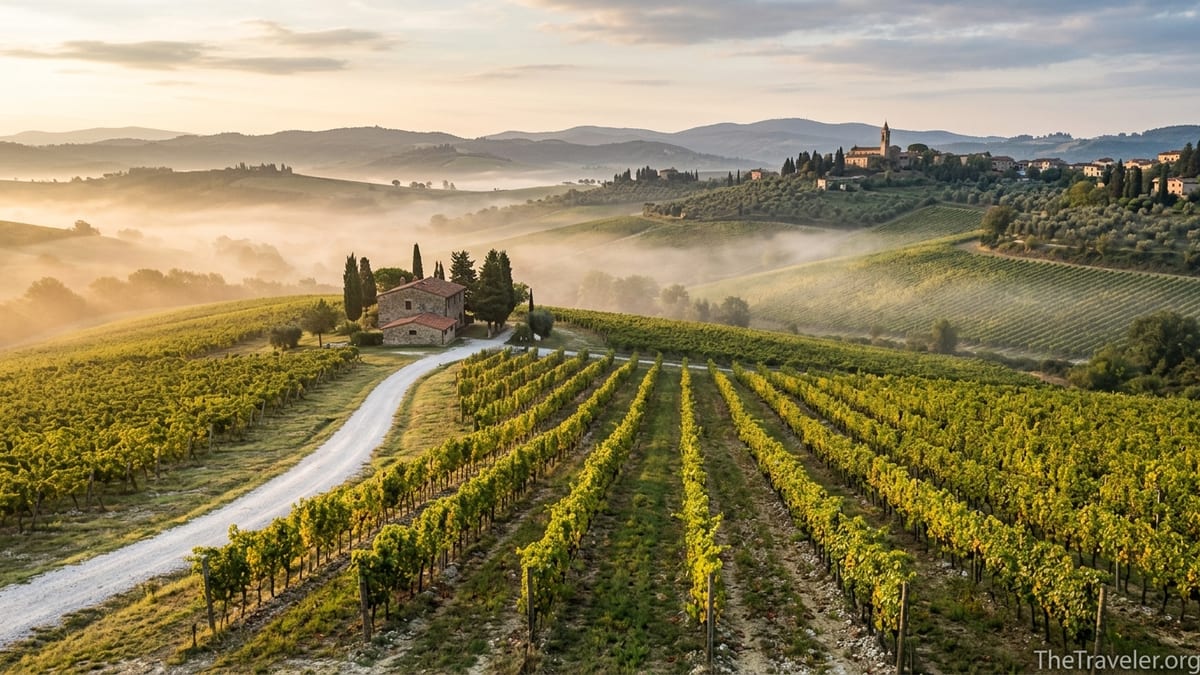
Even the non-wine attractions feel distinct. Chianti’s landscape of olive groves, stone terraces, and isolated Romanesque churches gives it a more rural, softly rolling character than the dramatic Alpine amphitheaters of Alto Adige or the coastal vistas of Liguria. Cyclists share the same white gravel roads that host the vintage bike race L’Eroica, and many wineries now offer e-bike charging stations or partnerships with local rental shops. For travelers who want to mix tasting with gentle outdoor activity, Chianti is often more forgiving than steeper, rockier regions like Valtellina.
Balancing Tradition and Innovation in the Glass
Chianti has long been a testing ground for debates about tradition versus innovation in Italian wine. In the late 20th century, some Tuscan producers famously broke away from local regulations to create “Super Tuscans,” powerful blends of Sangiovese with Cabernet Sauvignon, Merlot, or other international grapes, often aged in new French oak. Many of these wines originated along the coast near Bolgheri, but the cultural shock waves ran straight through Chianti, where some estates began planting Cabernet and experimenting with smaller barrels and denser styles.
Today, travelers to Chianti encounter a region that has largely reconciled these tensions. Classicists champion pure Sangiovese, long macerations, and large old casks, aiming for transparency of site. Others still produce IGT-labeled blends with noticeable oak spice and darker fruit. At a single estate you might taste a traditionally styled Chianti Classico with pale garnet color and bright cherry notes alongside a richer, barrique-aged IGT wine built for steakhouse wine lists in London or New York. This dual track is less pronounced in some other Italian regions, where either tradition still dominates overwhelmingly or modern styles have taken over more completely.
For visitors, this means tastings in Chianti can double as an educational seminar on Italy’s wine evolution. A host might pour you a Chianti Classico Annata from a recent vintage and encourage you to compare it with a Riserva aged longer in large Slavonian oak. They might then show an older bottle from the late 1990s to demonstrate how the style has shifted away from heavy new oak toward fresher, more terroir-driven expression. In Piedmont or Trentino you will certainly hear about similar stylistic debates, but the sheer global familiarity with “Chianti” makes the story feel more immediately relatable.
Chianti’s versatility at the table also differentiates it. With its naturally high acidity and moderate alcohol, a typical Chianti Classico pairs as easily with a simple plate of pappardelle al ragù in a village trattoria as with bistecca alla fiorentina at a white-tablecloth restaurant in Florence. Compare this with the often very tannic, slow-to-open Barolos of Piedmont or the sweet power of Amarone from Veneto, which can be thrilling but more demanding in terms of food and occasion. Travelers who are still learning their preferences often find Chianti to be the most forgiving red to order by the carafe at lunch and by the bottle at dinner.
Chianti Versus Other Italian Icons: Practical Differences for Travelers
When plotting an Italian wine itinerary, the choice is rarely Chianti or nothing. Travelers often weigh Chianti against regions like Piedmont (for Barolo), Valpolicella (for Amarone), or Sicily (for Etna). The differences are not only about flavor profiles but also about logistics, atmosphere, and cost. A long weekend based in the town of Greve or Castellina might involve short drives, flexible walk-in tastings at small estates, and dinners where house Chianti Classico is poured by the glass for under 8 euros. A similar stay in Barolo often means more advance reservations, higher tasting fees at marquee estates, and evening wine bars that lean toward serious collectors.
Climate and seasonality also play in Chianti’s favor. Spring and autumn offer mild temperatures, clear light, and relatively reliable driving conditions on the region’s narrow country roads. Early October, around harvest, is especially atmospheric, with yellowing vines and the smell of fermenting must rising from open windows in winery courtyards. In contrast, winter visits to Alto Adige or Friuli can involve snow and icy passes, while Sicily in high summer can be intensely hot for hiking between terraces on Etna’s black volcanic soils. Chianti certainly sees summer heat, but the altitude of many vineyards and the stone architecture of villages like Radda and Panzano help moderate the extremes.
Price-wise, Chianti is not a budget destination, but it often offers better value at the mid-range level than Italy’s rarest wine zones. In a Siena enoteca, it is still common to find solid Chianti Classico bottles from reputable producers in the 18 to 30 euro range, while top Barolo or Brunello labels on the same shelf can easily climb above 60 or 80 euros. Tasting-room fees in Chianti, especially at family-scale properties, frequently remain around 15 to 25 euros for several wines, sometimes waived with bottle purchases. In more collectible regions, structured tastings can sit higher and may require prepayment.
Perhaps the most important difference for many travelers is Chianti’s blend of accessibility and authenticity. The region is well prepared for international visitors, with English widely spoken at wineries and tourist offices, yet plenty of everyday life continues largely untouched by tourism. You might taste at a polished estate in the morning and stop for lunch at a bar in a small village where the locals are drinking simple house wine and debating local football results. That mix is harder to find in some heavily touristed appellations, where wine tourism has become a more singular focus.
The Takeaway
Chianti stands apart from other Italian wine regions because it combines an unusually long and clearly defined identity with a very modern, visitor-friendly wine culture. Its compact heartland between Florence and Siena, high-altitude Sangiovese vineyards, strict Chianti Classico regulations, and iconic black-rooster branding give it a coherence that places like Prosecco’s sprawling hillsides or Sicily’s wide-ranging vineyards do not always share. At the same time, the region remains stylistically diverse, home to both traditionally light, savory reds and richer, oak-influenced interpretations born from the Super Tuscan era.
For travelers, this means Chianti is often the easiest gateway into Italian wine. You can learn about DOCG rules one moment and watch those rules translate into flavor in your glass the next. You can wake up in a stone farmhouse surrounded by olive trees, spend the day visiting family wineries and medieval hill towns, and return to Florence or Siena the following morning without long transfers. Other regions excel in their own ways, from Barolo’s age-worthy structure to Etna’s volcanic drama, but few offer such an immediate, approachable synthesis of wine, landscape, and everyday Italian life.
Whether you are planning a first Italian wine trip or adding another region to a seasoned traveler’s map, understanding what makes Chianti different clarifies not just what you will drink, but how you will experience it. This is a place where centuries of history, evolving wine laws, and modern hospitality meet in a single glass of Sangiovese, best enjoyed with local pecorino, a view of rolling hills, and time to linger.
FAQ
Q1. What is the difference between Chianti and Chianti Classico on a wine label?
Chianti is a broader appellation that covers a wide area of Tuscany with more flexible rules, while Chianti Classico comes from the historic heartland between Florence and Siena under stricter DOCG regulations, including a higher minimum percentage of Sangiovese and no white grapes.
Q2. How does Chianti compare in taste to Barolo or Brunello di Montalcino?
Typical Chianti Classico is medium-bodied with bright acidity, red cherry and herbal notes, and moderate tannins, making it very food friendly, while Barolo and Brunello often show darker fruit, more tannin, and a more powerful, structured profile that can require longer aging and more robust food pairings.
Q3. Is Chianti a good region for first-time wine travelers in Italy?
Yes, Chianti is one of the most accessible wine regions for beginners, with short driving distances from Florence and Siena, many English-speaking wineries, and agriturismi that combine accommodation with tastings, making it easy to plan without prior wine travel experience.
Q4. What does the black rooster symbol on Chianti bottles mean?
The black rooster, or Gallo Nero, is the official symbol of the Chianti Classico consortium and appears on bottles that meet the region’s quality and origin rules, signaling that the wine comes from the historic Chianti Classico area rather than the broader Chianti zone.
Q5. When is the best time of year to visit the Chianti region?
Late April to June and September to mid-October are ideal, with mild temperatures, good road conditions, and active vineyards, while early October around harvest often offers especially atmospheric visits with colorful vines and cellar activity.
Q6. Are winery visits in Chianti expensive compared to other Italian regions?
Generally, tasting fees in Chianti are moderate, often around 15 to 25 euros for several wines at smaller estates, with many wineries waiving or reducing fees when you purchase bottles, which is often less costly than tastings at high-profile estates in Barolo or Brunello.
Q7. Do I need a car to explore Chianti’s wineries?
A car offers the most flexibility, as public transport within the hills is limited and wineries are spread across rural roads, but travelers can also join organized small-group tours from Florence or Siena that handle driving, reservations, and logistics.
Q8. Can I stay directly on a winery property in Chianti?
Yes, many estates operate agriturismi or small guesthouses on-site, allowing you to sleep in renovated farmhouses surrounded by vineyards and often including tastings, winery tours, and sometimes meals based on local produce.
Q9. How does Chianti pricing compare with other famous Italian wines?
Mid-range Chianti Classico bottles from respected producers commonly retail around 18 to 30 euros in local shops, which is often more affordable than equivalent-quality Barolo or Brunello, while still offering a clear step up from everyday table wines.
Q10. Is Chianti only about red wine, or can I find whites and rosé too?
While Chianti is primarily known for red wines based on Sangiovese, many estates also produce white wines from Tuscan and international varieties and fresh rosé styles, usually labeled under different appellations or as IGT Toscana rather than Chianti Classico.