


On a coastline famous for grand hotels, glittering beach clubs and crowded promenades, Plage des Ondes on Cap d’Antibes feels almost out of place. This tiny crescent of sand between Antibes and Juan les Pins offers the classic French Riviera palette of turquoise water and distant mountains, but on a far more intimate, human scale. For travelers willing to trade champagne buckets and DJs for quiet swims, sunset light and the faint clink of halyards from moored sailboats, Plage des Ondes can be one of the most rewarding stops on the Côte d’Azur.
Get the latest updates straight to your inbox!
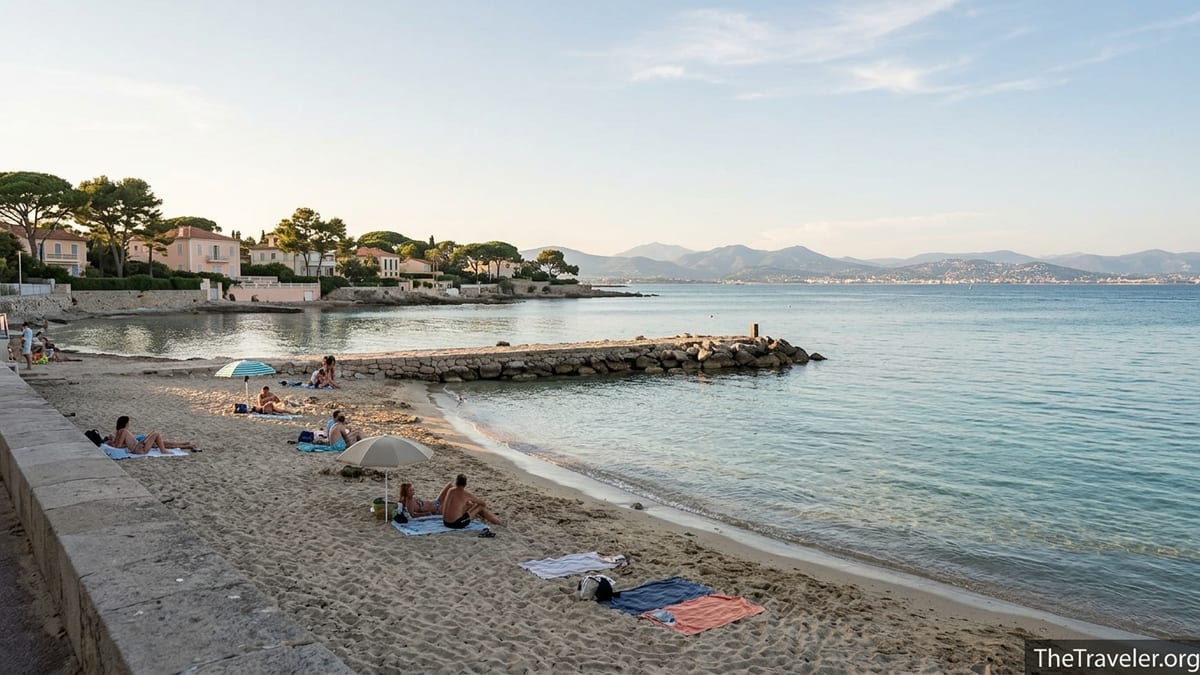
A Tiny Crescent in a Prime Riviera Setting
Plage des Ondes sits on the west side of Cap d’Antibes, facing the Bay of Cannes and the low, rust-colored Esterel mountains. The setting would suit a grand resort, yet the beach itself is simply a narrow public strip of sand, framed by pines and a low sea wall. From the waterline you can pick out the outline of Cannes across the bay and, on clearer days, the silhouettes of the Lérins Islands, a reminder that you are still deep in the heart of the French Riviera even if the atmosphere feels much gentler.
The beach is genuinely small, especially compared with long urban strands like Nice’s Promenade des Anglais or the broad sands of Juan les Pins. At the height of summer it might take you no more than a minute to stroll from one end of Plage des Ondes to the other. That scale is part of the charm. You are never far from the water, never far from the shallows where children splash, and there is no sense of the beach stretching on endlessly with row after row of sun loungers.
The cove is naturally sheltered, which creates a calm surface most days. Compared with exposed pebbly beaches in Nice, where swells can be strong and the seabed drops quickly, Plage des Ondes usually feels like a protected pool. On many mornings in June and September you will see locals wading in with their coffee in hand, taking an unhurried swim before commuting into Antibes or Cannes.
Although some parts of Cap d’Antibes are defined by high walls and hidden villas, the public character of Plage des Ondes is very clear. The low wall behind the sand is used as an informal bench by locals reading the newspaper, and the few sets of steps down from the road encourage quick dips for joggers and dog walkers. You are not entering an exclusive, controlled environment but a slice of everyday Riviera life that just happens to be framed by million-euro views.
No Beach Clubs, No Noise, Just the Sea
One of the sharpest contrasts between Plage des Ondes and many other French Riviera beaches is what is not there. There are no private beach clubs with their branded parasols and set menus, no pumping sound systems, and no long lines of rental loungers. Facilities are minimal: usually a fresh-water shower, some bins, and little else beyond the sand and the sea. Visitors used to the full-service experience of Cannes’ La Croisette or Antibes’ own Plage de la Gravette can find that stark at first, but that simplicity is exactly what many regulars cherish.
Because there are no on-sand restaurants or snack kiosks, you plan your visit more like a small coastal picnic than a club day. Typical summer visitors arrive with a foldable cooler from a local supermarket in Antibes, baguette sandwiches from a boulangerie near Place de Gaulle, and a chilled bottle of rosé from Provence. Once set up on the sand, you will not have staff taking your order, but you also will not have prices that creep toward 100 euros for lunch and loungers, which is common in the more fashionable clubs further along the coast.
The absence of clubs also means a different soundscape. Instead of curated playlists, you hear the chop of little waves, conversation in low voices, and the occasional splash as children leap from the small stone jetty. On most evenings outside peak August, it is possible to sit on the wall behind the sand and hear the rigging of anchored sailboats chiming in the breeze, something you are unlikely to notice above the music and traffic noise at busier sites like Plage de la Salis or the main beaches in Cannes.
Practically, this no-frills setup makes Plage des Ondes a better fit for travelers who do not mind carrying their own shade and supplies. A compact folding umbrella bought for 20 to 30 euros at a beach shop in Antibes, a light Turkish towel instead of a thick beach towel, and a soft cooler are the kind of items that transform the experience from bare-bones to comfortable. Those who want waiter service, cocktails on demand, and cabanas will likely prefer nearby Garoupe Beach, where private establishments such as Keller or Plage Joseph offer the classic Riviera club experience at corresponding prices.
A Local Beach in a Land of Destinations
Accessibility shapes who uses Plage des Ondes, and that in turn is a key part of its character. There is no large, dedicated car park by the sand. Instead, there are a few small side streets leading down toward the sea, each with a limited number of spaces that fill quickly on summer mornings. This scarcity of parking naturally restricts the number of visitors and makes the beach feel more local than destination-focused spots like Villefranche-sur-Mer, where trains, buses and nearby car parks funnel in day-trippers from across the coast.
Public transport does reach Plage des Ondes, but not in a way that encourages huge crowds. From Antibes’ main station, the local Envibus line that loops around Cap d’Antibes typically runs about once an hour on weekdays, dropping passengers near Chemin des Ondes. From there it is a short walk downhill to the sea. Many hotel guests in Antibes and Juan les Pins opt to use this bus, especially in July and August when coastal traffic can be heavy and parking tight.
In practice, the people you will meet on the sand are a mix of local residents, repeat visitors who rent the same nearby apartment each summer, and a scattering of in-the-know travelers who have read about the beach in small guidebooks or personal blogs rather than glossy brochures. Regulars might bring down a paddleboard they store in a nearby garage, or carry their snorkeling gear in a mesh bag, treating Plage des Ondes less as a once-a-year day out and more as a quasi-private extension of their neighborhood.
Compared with the international scene at places like Pampelonne Beach near Saint-Tropez, where yachts shuttle guests ashore for long lunches at high-profile clubs, Plage des Ondes feels almost modest. There are no branded photo walls, no staff polishing sunglasses, no VIP ropes. For travelers who prefer to stay slightly under the radar, perhaps renting a small apartment in Antibes’ old town or a room in a mid-range hotel in Juan les Pins, that modesty is precisely the attraction.
Shallow Water, Gentle Entry and Family Appeal
For families and less confident swimmers, the physical profile of Plage des Ondes is one of its biggest advantages. The seabed here slopes gradually, so you can walk out several meters and still be in waist-deep water. Parents often choose this beach over pebble beaches in Nice or the deeper drop-off at some coves on Cap d’Antibes because children can paddle and play without immediately losing footing. In summer, you will often see toddlers wearing inflatable armbands exploring the shallows while grandparents sit on folding chairs at the water’s edge.
Unlike many Riviera beaches that are almost entirely pebble, the sand at Plage des Ondes is mostly fine, with only occasional rocky patches. That makes it easier to walk barefoot and to set up simple games like building sandcastles or playing with buckets and spades bought at a seafront kiosk in Antibes for a few euros. Parents who have tried to keep a wobbly toddler upright on the round stones of Nice quickly understand the difference a sandy base can make.
The calm water and manageable depth also suit older travelers or anyone with limited mobility. There is no need to navigate rolling pebbles that shift underfoot, and the entrance to the sea is usually straightforward unless storms have shifted some rocks closer to shore. In practice, many visitors choose inexpensive water shoes, widely sold in local supermarkets for under 15 euros, to make the occasional stony patch irrelevant.
Safety is supported by consistently monitored water quality. Local authorities regularly test bathing water along the Antibes coastline, and Plage des Ondes is typically rated good or excellent. While conditions can vary after heavy rain, travelers can expect generally clean, clear water, something that snorkeling enthusiasts appreciate when they follow schools of small fish around the rocky corners of the cove.
Views, Light and That Riviera Jetty
Photographs of Plage des Ondes often feature its small stone jetty that reaches a short distance into the bay, sometimes with a simple flagpole at the end. In person, that jetty is both functional and symbolic. Children line up along it to jump into deeper water while parents supervise from the sand, and couples often sit at the very tip in the early evening, legs dangling above the surface, with the Esterel peaks glowing pink on the horizon.
The orientation of the beach gives it particularly atmospheric light in late afternoon and at sunset. Because it faces west across the bay, the sun sinks over the water rather than behind the headland. Travelers who have spent the day wandering Antibes’ old town or visiting the Picasso Museum often time their visit to Plage des Ondes for that golden hour, bringing a simple picnic to the wall behind the beach. As the light deepens, the facades of Cannes begin to glitter across the bay and boat lights appear one by one.
The sense of space is also different from more enclosed coves on the Riviera. While places such as the calanques near Marseille offer dramatic cliff walls and feeling of isolation, Plage des Ondes balances intimacy with openness. You feel the cove’s shelter at your back, but your gaze can travel across open water to distant headlands. That combination of feeling held and yet visually connected to the wider coast is part of what many regulars describe as uniquely calming.
For photographers, especially those traveling with a mid-range DSLR or even just a modern smartphone, the scene rewards paying attention to small details: the texture of the sand where waves recede, the reflections of pastel villas in the shallows, the contrast between a simple striped beach towel and the muted tones of the sea. Practical touches like a polarizing filter can help cut glare in midday shots, but the most evocative images often come from relaxed, unposed moments late in the day.
How Plage des Ondes Compares to Other Riviera Beaches
Understanding what makes Plage des Ondes different is easier when you place it alongside its neighbors. In Antibes itself, city beaches such as Plage de la Gravette and Plage du Ponteil are broader, more accessible and closer to cafes and ice-cream shops. They are perfect for a quick swim between sightseeing stops or for families who want amenities nearby. Yet they are also busier, with more transient visitors and a stronger sense of being in a resort town. Plage des Ondes, by contrast, feels like a small detour into a quieter world, even though it is only a short bus ride or drive away.
On the eastern side of Cap d’Antibes, Garoupe Beach offers some of the most photographed scenery on the coast, with transparent water, sandy shallows and private beach clubs that have appeared in countless travel features. You pay for that postcard setting with higher prices and more structured space: rows of loungers, staff guiding you to your spot, menus with elaborate seafood platters and fine wines. Plage des Ondes provides no such infrastructure, and for many travelers that absence is a relief rather than a drawback.
Further afield, the long bay of Nice and the compact beach at Villefranche-sur-Mer represent archetypal Riviera experiences. Nice’s pebbled shoreline is backed by a continuous urban promenade, busy traffic and a full array of city services. Villefranche’s horseshoe bay offers depth and classic village views with painted facades dropping almost straight to the water. Both are beautiful, but neither provides the quietly domestic atmosphere of Plage des Ondes, where you might share the sand with a handful of neighboring families and hear far more French than English or Italian.
Even when compared with better-known “secret” spots like the coves of Cap d’Ail or the rocky shelves near Cap Ferrat, Plage des Ondes stands out for its balance of accessibility and understatement. You do not need a strenuous coastal hike to reach it, nor do you need to book loungers months in advance or step off a tender from a chartered yacht. A local bus ticket, a short walk and a simple beach bag are enough.
Planning Your Visit: Practical Tips and Seasonal Nuances
Because Plage des Ondes is small, timing matters. In July and early August, locals often arrive early, around 9 am, to claim a patch of sand before the main heat of the day. By late morning, especially on weekends, the beach can feel full simply because there is not much of it. Travelers who prefer a quieter experience might target late June or early September, when sea temperatures are still comfortable but overall visitor numbers on the Riviera are lower.
If you are staying in Antibes or Juan les Pins without a car, factor the bus timetable into your day. Buses around Cap d’Antibes may run only hourly, especially outside peak season. Many visitors choose to walk part of the way back, following the road that loops around the cape and offers views toward Juan les Pins and the Alps, then picking up a bus closer to town. Comfortable sandals and a hat make that stroll much more pleasant in the afternoon sun.
Food planning is straightforward but important. The nearest cluster of restaurants and cafes is not immediately behind the beach, so assume you will be on your own for at least a few hours. A common approach is to shop in Antibes’ covered market in the morning, buying cheese, fruit and charcuterie, then adding bread from a nearby bakery and carrying everything in a simple tote. Bringing a reusable water bottle is wise; while there are sometimes public fountains along the roads of Cap d’Antibes, you should not rely on finding one right by Plage des Ondes.
Weather on this stretch of coast is generally favorable between late May and early October, but it is not uniform. After episodes of strong easterly winds or storms, seaweed can accumulate in the shallows, making entry less pristine until municipal clean-up teams have passed. On such days, some travelers pivot to more managed beaches where staff clear wrack more quickly. If you have a flexible schedule, checking local conditions either through your accommodation or recent photos on social platforms can help you choose the best day for a Plage des Ondes visit.
The Takeaway
Plage des Ondes is not the French Riviera of glossy posters and high-profile parties. It is a narrow, modest sliver of sand on one of the coast’s most desirable peninsulas, with no beach club and limited parking. Yet precisely because it resists the louder, more commercial patterns of nearby resorts, it offers a rare glimpse of a slower, more personal Riviera, one marked by repeat habits, familiar faces and quiet afternoons in the sun.
If you are planning a trip that includes Antibes, Juan les Pins, Nice or Cannes, consider setting aside at least half a day for this little cove. Bring your own shade, your own picnic and an open schedule. Swim in the calm, shallow water, linger on the wall as the sky begins to color, and watch lights bloom across the bay. You may find that what makes Plage des Ondes different from other beaches on the French Riviera has less to do with scenery and more to do with how easily life narrows there to a few simple, satisfying elements: sea, sand, and time well spent.
FAQ
Q1. Where exactly is Plage des Ondes on the French Riviera?
Plage des Ondes lies on the west side of Cap d’Antibes, between Antibes and Juan les Pins, facing across the bay toward Cannes and the Esterel mountains.
Q2. How do I get to Plage des Ondes without a car?
From Antibes, you can take the local bus that loops around Cap d’Antibes and get off near Chemin des Ondes, then walk a few minutes downhill to the beach.
Q3. Are there restaurants or beach clubs directly on Plage des Ondes?
No, there are no restaurants, bars or private beach clubs on the sand at Plage des Ondes, so you should bring your own snacks, drinks and shade.
Q4. Is Plage des Ondes suitable for children and less confident swimmers?
Yes, the seabed slopes gently and the water is usually calm and shallow near shore, which makes it popular with families and people who prefer easy entry into the sea.
Q5. How does Plage des Ondes compare with beaches in Nice or Cannes?
Plage des Ondes is much smaller and quieter, with no clubs or promenade, offering a more local, low-key feel than the long urban beaches of Nice or the busy private strands in Cannes.
Q6. Is the beach sandy or pebbly?
Plage des Ondes is predominantly sandy with some rocky patches, so it is more comfortable underfoot than the pebble beaches further east, although light water shoes can still be useful.
Q7. When is the best time of year to visit Plage des Ondes?
Late June, early July and September are ideal, when the sea is warm but overall visitor numbers are lower than in peak August and the beach feels less crowded.
Q8. Are there showers or toilets at Plage des Ondes?
Facilities are minimal, but there is typically at least a basic outdoor shower and waste bins near the beach. Public toilets may be available but are not extensive.
Q9. Is parking available close to the beach?
Parking is limited to small street spaces on the roads leading down toward the sea, and these usually fill quickly in summer, so arriving early or using the bus is recommended.
Q10. Can I watch the sunset from Plage des Ondes?
Yes, the beach faces west across the bay, making it an excellent spot to watch the sun set behind the Esterel hills, especially in late spring and early autumn.