


On a coastline where beach clubs and crowded promenades often steal the spotlight, Plage des Ondes on Cap d’Antibes remains a quietly spectacular exception. This small sandy cove, framed by a stone watchtower in the shallows and long views toward the Esterel mountains and the Lérins Islands, rewards anyone willing to time their visit carefully. With the right arrival hour, tide, and light, you can have some of the French Riviera’s most photogenic scenery almost to yourself.
Get the latest updates straight to your inbox!
Getting Your Bearings on Plage des Ondes
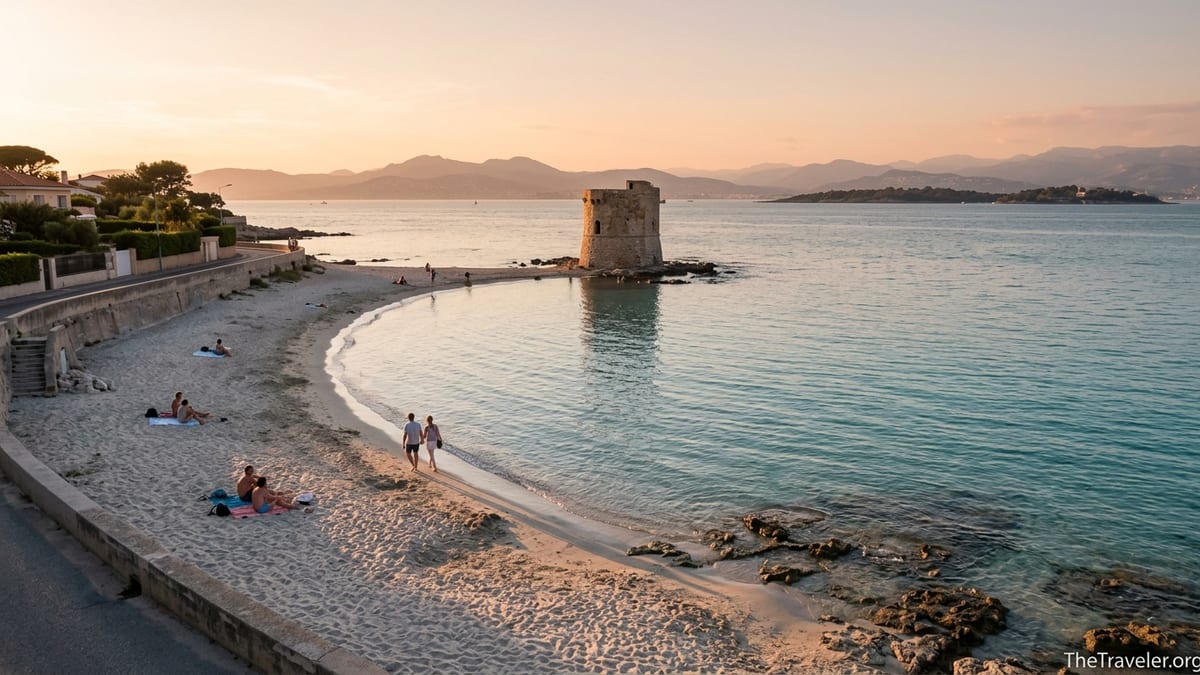
Plage des Ondes sits on the western side of Cap d’Antibes, between Juan-les-Pins and the grand villas further around the headland. The beach takes its name from the nearby Chemin des Ondes and forms a narrow crescent of pale sand facing due west across the Golfe Juan. On clear days you can see the red-tinted Esterel range on the horizon and the outlines of the Lérins Islands off Cannes, which gives the bay an almost cinematic backdrop when the light turns golden.
Unlike the heavily commercial stretches of sand in central Juan-les-Pins, Plage des Ondes is public, compact and low-key. There are no lines of paid sunloungers or full-service beach clubs planted directly on the sand. Instead, a simple strip of beach is backed by a low concrete wall and the road, with a residential neighborhood immediately behind. Facilities are basic but sufficient for most visitors: a shower, public toilets, rubbish bins and concrete ramps for easier access down to the sand. You will be sharing the water mainly with local families, long-term residents and a handful of visitors who have looked beyond the better-known names.
The beach is predominantly sandy with a few rocky patches and a sheltered cove configuration. That shape, together with the breakwater and natural curve of the coastline, usually keeps the water calm and clear. It is not a guarded beach, so there are no lifeguards, but the shallow gradient in the nearshore zone makes it inviting for confident swimmers and older children when the sea is flat. For nervous swimmers, the lack of large waves and the ability to stand quite far from shore are often more reassuring than the busier supervised beaches nearby.
The most distinctive feature of Plage des Ondes is the squat stone tower set a short distance offshore. In photographs it often appears like a miniature fort sitting in the sea, and in person it gives the bay a focal point that changes character with the light. At midday on a bright summer day it throws a crisp shadow on the turquoise surface; at sunset it becomes a dark silhouette against the glowing sky. Many visitors come here specifically to capture that tower with the red Esterel mountains behind, which is one reason the timing of your visit matters.
When To Go for the Quietest Hours
Despite its reputation as a “hidden gem,” Plage des Ondes is no secret to residents, and its small size means it feels full quickly. In July and August by late morning, towels can be almost edge-to-edge. To experience the quietest hours, aim for either early morning or late afternoon, and adjust your expectations according to the season.
In high summer, arriving between 7:30 and 9:00 in the morning usually offers the best chance of space and calm. At that hour the sun is already above the hills but still gentle enough for a comfortable swim, while the day visitors driving from Nice or Cannes have not yet arrived. The few people you are likely to encounter are joggers following the coastal road, dog walkers and local residents enjoying a quick dip before work. The beach tends to remain relatively uncrowded until around 10:00, when families begin to settle in with parasols and coolers.
Late afternoon into evening provides a second window of relative quiet. On hot days, many families leave between 17:00 and 18:00, especially those with younger children. From about 18:30 until sunset the atmosphere softens: conversations drop to a murmur, the heat eases and the water often takes on glassy reflections. In June and early July you can expect sunset around 21:15 to 21:30, which gives a generous two to three hours for a relaxed swim, some photography and a picnic on the wall without the midday crush.
Outside the peak months of July and August, the rhythm changes. In May, September and often early October, you can arrive mid-morning and still find plenty of space, particularly on weekdays. Even then, long weekends and local school holidays can bring surprising surges in visitors, so early arrival remains a good habit if peace and quiet are your priority. If you are visiting in shoulder season, check the weather forecast the day before: the first sunny day after a cloudy spell tends to draw more people, even out of high season.
Chasing the Best Light and Views
Because Plage des Ondes faces west, it excels at afternoon and sunset light rather than early-morning golden hour. In the morning, the sun rises behind Cap d’Antibes, casting much of the beach in softer, diffused light. This can be ideal for swimmers who want to avoid strong glare and photographers aiming for pastel tones and minimal contrast, but it will not deliver the dramatic silhouettes that make the tower famous in local guidebooks.
For photographers and anyone who cares about atmosphere, the most striking views usually occur from late afternoon onward. On clear days, the sun lowers behind the Esterel range and the distant cliffs take on deep orange and pink tones. The tower becomes a sharp dark outline against the bright path of the sun on the water, and subtle colors emerge in the shallows where the sand shifts from pale gold to greenish-blue. If you are using a smartphone, this is the time when even automatic settings tend to produce rich, balanced images without much editing.
Those with dedicated cameras often favor a standard zoom in the 24 to 70 millimeter range. A wider focal length captures the full curve of the bay, the tower and the hazy outline of the Lérins Islands in one frame. A slightly longer focal length tightens the composition around the tower and the mountains, compressing distance and emphasizing the layers of color. Even if you are not a serious photographer, simply walking a few meters along the wall and experimenting with angles can transform what you see. Many visitors stand near the southern end of the beach to shoot back toward the north, using the curve of the sand as a leading line toward the tower.
Weather also plays a role in how impressive the views feel. On mistral days, when a strong northwest wind clears the air, the distant mountains often appear sharply etched, and the water becomes an intense, saturated blue. These winds can also make the beach feel less comfortable if you are not prepared for flying sand, but the visual payoff can be significant. On humid, still days, by contrast, the horizon softens, and colors take on a more muted, painterly quality. Both moods can be beautiful; it simply depends whether you prefer crisp drama or hazy calm in your photographs and memories.
Getting There Without Losing the Mood
Because Plage des Ondes is set slightly away from the train stations and major town centers, the way you arrive influences how relaxed you feel when you finally step onto the sand. Driving is the most flexible option but also the most stressful in peak season. There is a small pocket of street and perpendicular parking close to the beach, but spaces are few and typically fill by mid-morning in July and August. If you do come by car, aim to arrive before 9:00 or after 18:00, and be ready to walk several minutes from whichever spot you eventually find along nearby streets.
Many visitors combine the beach with public transport and a short walk. From central Antibes or Juan-les-Pins, local buses that loop around Cap d’Antibes stop within a few minutes’ walk of Plage des Ondes, though schedules can be irregular, especially in the evening. Check the latest timetable at the tourist office or on local transport apps before relying on a late return journey. If you are staying in Juan-les-Pins, a practical alternative is to walk: the seafront promenade gradually gives way to quieter residential roads, and the stroll to Plage des Ondes typically takes 25 to 35 minutes, depending on your exact starting point.
Cycling is another pleasant way to reach the beach while avoiding the frustration of parking. A green-painted cycle route runs along much of the coastline between Antibes and nearby towns, and rental shops in Antibes and Juan-les-Pins offer both traditional bicycles and electric models. With an e-bike, the ride from Antibes old town usually takes around 20 minutes at a leisurely pace, and you can lock up on the railings or designated stands near the road behind the beach. This option allows you to leave whenever the light or mood feels right, without watching the clock for bus departures.
However you arrive, keep in mind that your first impression of Plage des Ondes may be modest. From the road, it appears as a simple patch of sand backed by a low wall. The magic is in the combination of scale, setting and light rather than in showy infrastructure. Plan a few extra minutes to simply stand at the top of the steps, watch how the light hits the water, and let your eyes adjust to the subtle details: the tower, the boats anchored further out, the curve of the shoreline toward Garoupe and beyond.
Practical Tips to Keep It Peaceful
Because the beach is unsupervised and compact, a little preparation goes a long way to preserving the quiet atmosphere. Shade is limited, especially around midday, so bringing a compact umbrella or a lightweight beach tent can make the difference between a brief visit and several comfortable hours. Local supermarkets in Antibes and Juan-les-Pins sell simple parasols at modest prices during summer, which are far more comfortable than trying to huddle against the wall when the sun is overhead.
There are no restaurants or snack kiosks directly on Plage des Ondes, which contributes to its restful feel but also means you should plan ahead for food and drink. Many visitors pick up sandwiches, fruit, and bottled water from bakeries and grocery stores near their accommodation, then bring everything in a small cooler bag. A classic pattern is to arrive in the late afternoon with a bag containing baguette sandwiches, olives, and a few soft drinks, then stay through sunset without needing to leave the sand. Remember that glass is not permitted on many Riviera beaches, and taking reusable cups and bottles helps keep waste to a minimum.
Noise levels depend largely on visitor behavior. Local etiquette leans toward quiet conversation rather than loud music or speaker systems. If you want to listen to music or podcasts, headphones are the most considerate option. The beach’s small size and the way sound reflects off the wall mean that even a single portable speaker can dominate the soundscape. Observing this unspoken rule is one of the simplest ways to help keep Plage des Ondes serene for everyone, including you.
Finally, consider what you leave behind when you pack up. Trash bins are available near the access points, but they can overflow on busy days. Carrying out any waste that does not fit comfortably in the bins is an easy way to protect the look and feel of the beach. Sand toys, inflatable rings, and lightweight chairs can all be rinsed quickly at the public shower before you depart, which helps keep rentals and hotel rooms free of salt and sand. Treat the beach as if you were a guest in someone’s garden and the atmosphere will remain that much more welcoming.
Combining Plage des Ondes With a Wider Cap d’Antibes Day
One of the pleasures of visiting Plage des Ondes is how naturally it fits into a longer exploration of Cap d’Antibes. The western end of the coastal trail known as the Sentier du Littoral finishes close to the beach, which makes it an appealing reward after a half-day walk along rocky paths and hidden coves. Many hikers start near the Garoupe area, follow the trail around the headland, then arrive at Plage des Ondes in the late afternoon ready for a cooling swim and a quiet rest before returning to town.
If you are based in Antibes or Juan-les-Pins for several days, you can easily combine the beach with other nearby spots without feeling rushed. One practical itinerary is to spend the morning wandering Antibes’ old town and the covered market, pick up picnic supplies, and then catch a bus or cycle to Plage des Ondes for a long, lazy afternoon. Another option is to enjoy a late breakfast and swim on the broader sands of Salis Beach near Antibes, then move to Plage des Ondes as the light shifts and the crowds on the larger beaches begin to peak.
The surrounding neighborhood itself has a different character from the denser urban areas of Antibes. Leafy streets, garden walls covered in bougainvillea and glimpses of historic villas create a quietly upscale atmosphere. Without beach clubs or high-rise buildings directly on the sand, the horizon remains open. Even if you are not staying in one of the nearby villas or apartments, spending part of a day here gives you a sense of the slower, more residential side of the Riviera that locals cherish.
In the evening, once the sun has dropped below the mountains and most swimmers have left, the road behind the beach becomes a gentle promenade for people heading home, walking their dogs or pausing to talk with neighbors. If you linger a little after sunset, you may find that the most memorable moment of your visit is not a photograph or a swim, but that brief period when the sky holds a faint afterglow, the tower turns into a shadow and the sounds of the day fade into a soft background hum.
The Takeaway
Plage des Ondes rewards visitors who care more about light, space and atmosphere than about services or spectacle. It is a small beach with a surprisingly large sense of place, framed by a stone tower, distant mountains and the changing colors of the Mediterranean. Because it is unguarded and minimally developed, it remains quieter than many nearby options, as long as you time your visit outside the midday peak and respect the understated mood that locals value.
To experience it at its best, arrive early or late, come prepared with shade and simple provisions, and allow enough time for the light to change around you. Whether you reach it by bicycle from Antibes, on foot from Juan-les-Pins or by car at off-peak hours, try to build your day around that slow unfolding of views rather than squeezing it into a rushed itinerary. If you do, Plage des Ondes is likely to stay with you not as just another stop along the Côte d’Azur, but as the place where you finally saw the Riviera at a quieter, more human scale.
FAQ
Q1. Is Plage des Ondes suitable for families with children?
Yes, the beach’s shallow, generally calm water and sandy seabed make it popular with families. However, there are no lifeguards, so parents should supervise children closely, especially when the sea is choppy or during busy hours.
Q2. When are the quietest times to visit Plage des Ondes?
The calmest periods are typically early morning between about 7:30 and 9:00, and late afternoon into evening after around 18:00, particularly outside late July and early August when local and visiting families peak.
Q3. Are there restaurants or beach clubs directly on Plage des Ondes?
No, there are no restaurants, bars or formal beach clubs on the sand at Plage des Ondes. This helps keep the atmosphere peaceful but means you should bring your own snacks and drinks or plan to eat in the surrounding area before or after your beach time.
Q4. How difficult is parking near the beach in summer?
Parking is limited to nearby streets and a small cluster of spaces, which fill quickly in high season. In July and August it is common for all spots within easy walking distance to be taken by mid-morning, so arriving early, coming by bus, walking or cycling often provides a more relaxed experience.
Q5. What should I bring to make my visit more comfortable?
Plan on bringing shade such as a small umbrella, plenty of water, snacks or a picnic, sunscreen, and something to sit on, since there are no loungers for hire. A light sweater or shawl can be useful if you plan to stay through sunset when temperatures drop slightly.
Q6. Is Plage des Ondes accessible for visitors with limited mobility?
The beach has concrete ramps and steps from the road down to the sand, which help compared to steep, rocky access paths elsewhere on Cap d’Antibes. However, the sand itself can still be challenging for wheelchairs or walkers, and there are no specialized beach access mats or amphibious chairs reported in regular use.
Q7. Can I swim out to the tower at Plage des Ondes?
Many confident swimmers do swim near the tower when conditions are calm, but there are no official platforms, lifeguards or safety rails. Anyone choosing to approach it should be a strong swimmer, keep an eye on boat traffic, and avoid climbing on slippery or sharp surfaces.
Q8. Are there showers and toilets at Plage des Ondes?
Yes, there is a basic public shower for rinsing off and public toilets near the beach access points. They are simple facilities, so it is wise to bring your own tissues or hand sanitizer in case supplies run low on busy days.
Q9. Is it acceptable to sunbathe topless at Plage des Ondes?
On many public beaches along the French Riviera, discreet topless sunbathing is generally accepted, and Plage des Ondes is no exception. Visitors should remain respectful of those around them and be aware that norms can feel more conservative when families with young children are present.
Q10. Can I visit Plage des Ondes outside summer?
Yes, the beach is open year-round and can be particularly peaceful in spring and autumn. While the water may be cooler, these seasons often bring gentler crowds, softer light and a more local feel, making it an appealing time to enjoy the views in near solitude.