


Everyone comes to Plage des Ondes for its perfect little crescent of sand, shallow turquoise water and postcard view across the bay. Yet the real magic of this Cap d’Antibes cove begins once you look up from your towel and step beyond the shoreline. This is where Plage des Ondes stops being just another pretty French Riviera beach and becomes a doorway into a slower, more intimate slice of local life.
Get the latest updates straight to your inbox!
Understanding Plage des Ondes Beyond the Postcard View
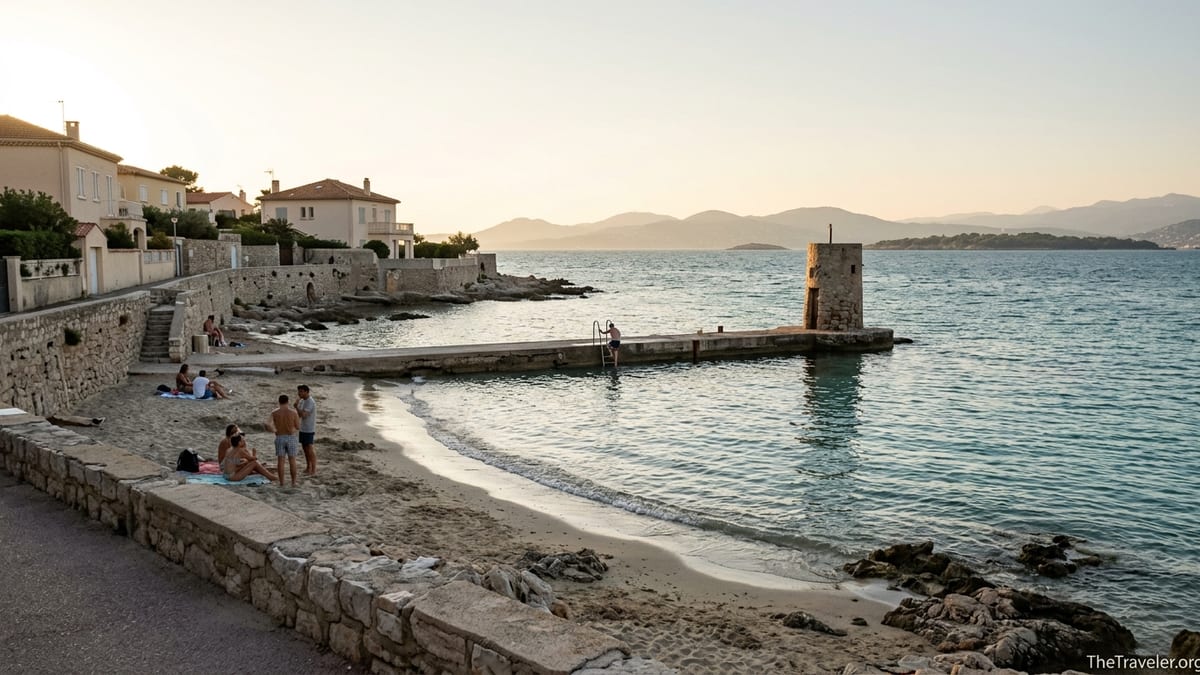
Plage des Ondes sits on the quieter west side of Cap d’Antibes, between Port de l’Olivette and Port du Crouton, facing the Lérins Islands and the distant red Esterel hills. It is officially a public beach with no clubs on the sand, a rarity on this part of the Côte d’Azur. You will not find rows of private loungers or waiters delivering cocktails to your chair. Instead there is a narrow strip of pale sand, some rocky edges, and a simple concrete jetty that locals use as a swim platform.
Because there is only on-street parking along the perpendicular residential lanes, most day-trippers bypass it for bigger, more obvious names like La Garoupe or the beaches in Juan-les-Pins. That limited access is precisely why Ondes is still primarily used by people who live or stay nearby. You will see parents walking down from villas with inflatable rings under one arm, teenagers arriving with snorkel masks slung around their necks, and older residents carrying fold-out chairs and a thermos of coffee.
Stand at the water’s edge and you notice what most visitors never stop to register: the orientation of the bay makes this one of the best sunset-facing spots on the peninsula. In late summer the sun drops roughly behind the Esterel mountains, turning their outline from blue to dark orange. On clear winter evenings snow sometimes appears on the distant Alps behind Antibes, and you can watch the last light catch those peaks while the sea around you stays almost unnaturally calm.
The setting also links Plage des Ondes to a wider protected environment. The bay and the south of Cap d’Antibes form part of a Natura 2000 conservation area that stretches out to the Lérins Islands, home to seagrass meadows and rich marine life. Onshore, Ondes is the human-scale edge of that protected world, a place where you can still swim with fish in clear water just a few strokes from the road.
The Local Rhythm: Early Swims, Long Lunches and Quiet Evenings
If you arrive at Plage des Ondes at midday in August, you might think it is simply a small, crowded family beach. Come back at 7 a.m. on a weekday in June and you will see why residents love it. At that hour the water is usually flat as glass, with only faint ripples where early swimmers slice through. A handful of regulars leave towels on the low wall by the road, wade straight in, and swim slow laps between the jetty and the buoys for 20 or 30 minutes before work.
Mid-morning, child-sized fishing nets appear and the beach fills with people who have walked over from holiday rentals around Avenue du Maréchal Juin. Many bring baguette sandwiches or fruit from bakeries and small supermarkets in nearby Juan-les-Pins, preferring to picnic instead of going back to town for lunch. It is common to see families leave umbrellas and toys on the sand, walk up the steps to rinse feet at a basic public shower, then vanish for an hour to eat at home or in a nearby apartment before drifting back down in the afternoon.
Even on busy days, late afternoon begins to empty out as visitors head back toward Antibes or Nice. From around 5:30 p.m. people who work in the technology and finance firms around Sophia Antipolis pull up in compact cars and scooters, slip out with a beach bag and plunge in for a fast swim before dinner. You might hear bursts of French, Italian and English as they chat on the wall in wet swimsuits, sharing local gossip and restaurant tips.
After 7:30 p.m. in high season, Plage des Ondes often changes again. Tripods and smartphones appear as photographers arrive specifically for golden hour and sunset. Locals know exactly where to stand on the jetty to line up the silhouette of the stone tower and the Esterel hills behind it. Couples bring a chilled half-bottle of rosé and plastic cups, sit on the sand, and watch cruise ships out in the bay turn on their lights one by one. Many visitors have already left long before this nightly ritual begins.
Off the Sand: Exploring the Cap d’Antibes Coastal Paths
Most beachgoers at Plage des Ondes never realize they are only a short walk from some of the most memorable coastal paths on the Riviera. Cap d’Antibes is ringed by routes that piece together small roads and sections of the Sentier du Littoral, the sea-edge path that winds around the southern cliffs of the peninsula. One of the easiest introductions starts right behind Ondes, following Chemin des Ondes and quiet lanes toward La Garoupe and the famous Sentier de Tire-Poil.
From Plage des Ondes you can walk in roughly 20 to 30 minutes, depending on your pace, to the wider sands of La Garoupe, where the official coastal trail begins. The full Tire-Poil path, around 3 to 5 kilometers depending on the start and end points used, hugs the rocky shoreline between La Garoupe and the area near Villa Eilenroc. Parts of the trail are currently affected by a temporary closure of a short section under cliffs for safety works until late 2026, so access and exact distance can vary. Check locally at the Antibes tourist office for the latest status before setting out.
Even if you walk only a small segment, you will see a side of Cap d’Antibes that beach-only visitors miss: wind-sculpted pines bent over translucent coves, old stone steps cut into the rock, and occasional glimpses into legendary estates hidden behind walls. On calmer days you can spot kayakers and paddleboarders passing below the villas, and in spring the rocks are dotted with wildflowers that somehow cling to cracks just a few meters from the sea.
Many travelers assume these routes are only for serious hikers, but for most reasonably fit visitors in normal summer conditions the paths around Cap d’Antibes feel more like vigorous seaside walks. The key is to treat them as excursions anchored by Plage des Ondes: swim in the morning, walk for an hour or two when the sun is lower, then come back to the cove for a second dip. That simple pattern turns a standard beach day into a full exploration of the peninsula without ever needing a car.
Underwater Secrets: Snorkeling and Marine Life Close to Shore
At first glance Plage des Ondes looks like a flat, sandy-bottomed bay made purely for wading and floating. Slip on a mask and snorkel and a more varied underwater landscape appears just a few meters from shore. On the north side of the cove, near the rocks toward Port de l’Olivette, you will find patches of seagrass, small clusters of urchins clinging to rock, and shoals of small fish, especially in the early morning when the water is clearest.
Conditions are usually calmer here than out on the exposed southern cliffs of the cape, which is one reason families with children choose Ondes as a first snorkeling spot. For about the price of a café crème in Antibes old town you can buy a simple plastic mask from supermarkets in Juan-les-Pins or larger sports stores in Antibes, and that small purchase opens up an entirely different experience of the bay. Children often start by chasing tiny silvery fish in knee-deep water near the jetty, then graduate to floating over the darker patches where seagrass harbors more life.
The water quality along this stretch of coast is monitored regularly in summer and is typically rated excellent, which helps explain the clarity on good days. You do not need a boat or organized tour. The most rewarding snorkeling tends to be along the edges of the bay, where rock meets sand. On still afternoons, swimmers sometimes paddle out beyond the last line of bathers to float on their backs and watch yachts moving slowly along the 10-knot speed-limited coastal corridor around the cape.
As with any Mediterranean snorkeling, the experience depends heavily on conditions. After storms or days of strong wind from the south, visibility can drop significantly and there may be bits of seaweed or debris in the water. Locals simply wait a day or two for the sea to settle before bringing out their masks again. If you are staying in Antibes for a week, paying attention to how clear the water looks on arrival at Ondes can help you decide whether this is a day for long underwater explorations or for reading on the sand with quick dips to cool off.
Views Above the Sea: The Lighthouse, Plateau and Panoramic Walks
Most first-time visitors experience Plage des Ondes at water level and never realize that some of the best perspectives lie just above, on the high ground of the Garoupe plateau. From the cove it is a short but steep journey inland, either on foot or by car, to reach the Garoupe lighthouse and its neighboring chapel complex. From up there you can scan the entire curve of the coastline from Nice and the Baie des Anges to the Alps and around toward Cannes.
The lighthouse itself has a long maritime history, guiding ships into the approaches of Antibes and the wider Côte d’Azur since the 19th century. Nearby stands the small sanctuary of Notre-Dame de la Garoupe, a place of seafarers’ devotion filled with maritime ex-votos and old photographs. Many travelers devote an entire day to Antibes and never make it here, even though the viewpoint is one of the most complete on the Riviera and lies only a couple of kilometers from Plage des Ondes as the crow flies.
In practical terms, this plateau is easiest to slot into a day that already includes the beach. One popular pattern among repeat visitors is to swim or relax at Plage des Ondes in the morning, retreat to accommodation for a mid-afternoon break, then drive or walk up to the plateau in time for the late-afternoon light. Standing at the viewpoint in that soft light lets you trace the shape of the entire bay where you swam earlier, including the faint curve of Ondes itself, before heading back down for dinner in Antibes old town or Juan-les-Pins.
Those interested in longer walks can also combine the plateau with portions of the coastal paths to create a loose loop: up from the shoreline into pine woods and back down to the sea. There is no single official marked circuit that everyone follows, but using online maps and local tourist-office leaflets makes it relatively straightforward to design a two to three-hour walk that connects Plage des Ondes, the lighthouse, and another beach such as La Garoupe or La Salis.
Practical Ways to Experience Plage des Ondes Like a Local
Plage des Ondes has no restaurants or bars sitting directly on the sand, and that absence shapes how locals use it. Rather than ordering food to their loungers, people come prepared. A typical day for residents staying nearby might start with a stop at a bakery in Juan-les-Pins for croissants and a baguette, followed by a visit to a supermarket for fruit, bottled water and perhaps a chilled local rosé. Back at the beach they will set up a small folding cooler under an umbrella and treat the cove as an outdoor extension of their living room.
If you are coming from Antibes or farther along the coast by bus or car, it can be tempting to overpack. In practice, a light setup works best. One or two compact umbrellas, foldable chairs or mats, a soft cooler and a beach bag with reef-safe sunscreen and a hat are usually enough. There are no rental loungers at Ondes, so anything you want to sit or lie on must come with you. Local visitors often keep a basic kit in the trunk of their car all summer so they can stop spontaneously after work when they happen to find a parking spot.
Parking itself is one of the most practical challenges. Spaces along the side streets fill quickly on hot days, especially between late morning and mid-afternoon. Arriving before 10 a.m., or waiting until after 4:30 p.m., dramatically improves your chances of finding a place. If you are staying in Antibes or Juan-les-Pins, consider walking or cycling instead. Bicycles and e-bikes have become a common sight along Avenue du Maréchal Juin in recent years, and reaching Plage des Ondes from central Juan-les-Pins by bike typically takes around 10 to 15 minutes.
Budget-conscious travelers also appreciate that Ondes itself is free. There is no entry fee, and your main costs are transport, food and any gear you choose to buy or rent elsewhere. Compared with private beach clubs in nearby areas, where a full day on a lounger with lunch can easily add up to a substantial amount per person in high season, a day spent at Plage des Ondes with a picnic and a simple coffee or ice cream in Juan-les-Pins afterward offers an appealingly low-key alternative.
The Takeaway
Plage des Ondes is one of those rare Riviera spots where the cliché of the French Mediterranean quietly falls away. On the surface it is simply a small, family-friendly cove on the west side of Cap d’Antibes. Look closer and it becomes a crossroads between everyday local routines and some of the most striking natural and cultural elements of the peninsula: coastal paths that skirt famed villas, underwater life just off the sand, historic viewpoints above the sea and informal sunset gatherings that feel almost like a neighborhood ritual.
What most visitors miss here is not a hidden beach club or a secret restaurant. It is the chance to weave all these layers together into a single day. Swim with early-morning regulars, walk a stretch of the Sentier du Littoral, look back at the bay from the Garoupe plateau, then return to the sand in time to watch the Esterel hills burn orange at dusk. Do that once and Plage des Ondes stops being just another pin on a Riviera map and becomes a place you understand from the inside.
FAQ
Q1. Is Plage des Ondes suitable for children and non-swimmers?
Yes. The bay is shallow for several meters, with a mostly sandy bottom and usually calm water in summer, which makes it popular with families and cautious swimmers.
Q2. How do I get to Plage des Ondes without a car?
You can take a local bus from Antibes or Juan-les-Pins toward Cap d’Antibes and get off near Avenue du Maréchal Juin, then walk a few minutes down residential streets. Many visitors also walk or cycle from central Juan-les-Pins.
Q3. Are there showers, toilets or changing facilities on the beach?
Facilities are basic. In season there is usually at least one public shower near the steps and sometimes a simple changing area, but there are no full-service beach pavilions or large restroom blocks right on the sand.
Q4. Can I rent sunbeds or umbrellas at Plage des Ondes?
No. Plage des Ondes is a public beach without private clubs on the sand, so you need to bring your own umbrella, mat or chair if you want more comfort.
Q5. Is snorkeling at Plage des Ondes worth it compared with other spots on Cap d’Antibes?
For casual snorkelers and families, yes. You will not see dramatic cliffs, but there are fish, patches of seagrass and rocky areas close to shore with generally clear water on calm days.
Q6. When is the best time of day to visit Plage des Ondes?
Early mornings offer the calmest water and fewer people, while late afternoons and sunset provide beautiful light over the Esterel mountains and a quieter atmosphere after day-trippers leave.
Q7. Is Plage des Ondes affected by closures of the Sentier du Littoral?
Occasional safety works and temporary closures have affected sections of the coastal path on the southern side of Cap d’Antibes, but the beach itself has remained accessible. Always check locally for current information if you plan to hike.
Q8. Are there restaurants or cafés directly on Plage des Ondes?
No. The beach is backed by a road and residential buildings rather than bars or restaurants. Many visitors bring picnics or walk to nearby areas of Juan-les-Pins or Cap d’Antibes for meals.
Q9. Is parking difficult near Plage des Ondes in summer?
Parking is limited to street spaces, which fill quickly in peak season and around midday. Arriving early, coming later in the afternoon, or walking or cycling if you are staying nearby can make things easier.
Q10. Can I combine a visit to Plage des Ondes with other sights in Antibes in one day?
Yes. Many travelers spend a few hours at Plage des Ondes, then visit Antibes old town, the Picasso Museum, or the Garoupe lighthouse and plateau, creating a varied day that mixes beach time with culture and views.