

I arrived in Rochester, New York expecting a faded industrial city with a famous photography past and long winters. What I found instead was a riverfront in the middle of a bold reinvention, a downtown much livelier than the clichés suggest, and neighborhoods where murals, coffee shops, and century-old houses coexist in ways that feel quietly confident rather than curated for Instagram. The biggest surprises revealed themselves not in grand attractions, but in the way Rochester lives: at street level, along the Genesee River, and in the small, very local rituals that give this city its personality.
The Riverfront That Refuses To Be Background
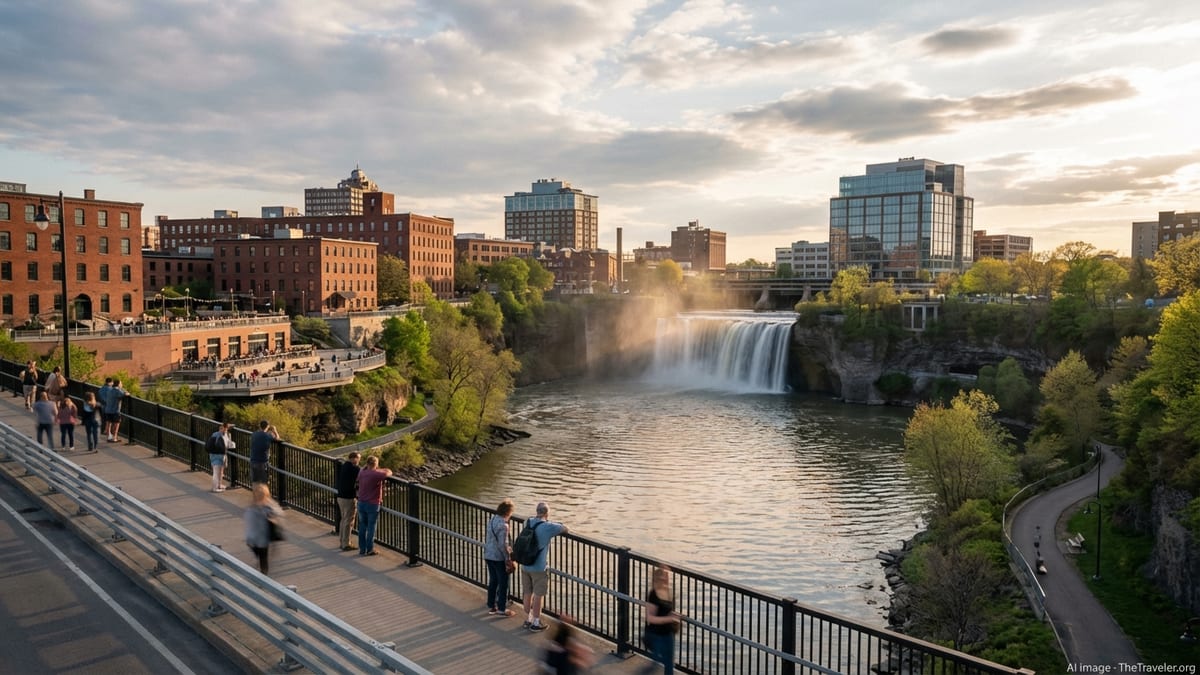
If you picture Rochester, chances are you think of Kodak or maybe snowdrifts. The Genesee River probably does not make your mental postcard. It should. The river cuts straight through downtown, dropping dramatically at High Falls before pushing north toward Lake Ontario. What surprised me most is how determined the city now is to make that water the main event rather than something you speed past on a bridge.
ROC the Riverway, a multi-phase initiative focused on the downtown river corridor, has quietly reshaped how visitors experience Rochester’s core. Sections of riverfront that once felt like leftover infrastructure now hold upgraded parks, new plazas, connected trails, and pocket spaces for sitting with a coffee and watching the current slide by. Recent projects around the Aqueduct District, Genesee Gateway Park, and the upgraded Pont de Rennes bridge have stitched together what used to be fragments into a walkable, almost linear park threading the city center.
Standing on the Pont de Rennes, looking across to the redeveloped terraces and down into the gorge, you feel something that does not match the stereotype of a shrinking Rust Belt town. There is construction fencing, yes, but also joggers on the Genesee Riverway Trail, families with strollers, and cyclists treating the river like their daily backdrop. Future plans for a High Falls State Park and further aqueduct reimagining signal that this is not a one-off beautification effort. For a visitor, it translates into an unfolding waterfront story worth returning to in a few years just to see what has changed.
What makes this riverfront particularly compelling is its mix of raw geology and earnest urban repair. Sheer rock faces and the roar of the falls coexist with clean new railings, public art, and gathering spaces. It is not as glossy as some other American waterfront redevelopments, and that is precisely what makes it feel authentic. Rochester is still working on itself in the open, and the Genesee is where you can watch the city negotiating its future in real time.
A Downtown That Is Far Busier Than Its Reputation
People love to say downtowns are struggling, and you can find that narrative attached to Rochester as readily as anywhere. On paper, this is a mid-sized city in upstate New York with a legacy of economic shifts and population loss. In practice, walking around on a summer evening, downtown Rochester feels busier and more resilient than the gloomy headlines would have you believe.
Recent visitation data from local development groups paints a picture of steady growth: millions of visits each year to the downtown core, with year-over-year increases and new residential units under construction in the heart of the city. You do not need a chart to sense that momentum. It is evident in the number of people spilling out of new bars and cafes, the small but noticeable line at a bodega on a side street, and the way office towers share blocks with fresh apartment buildings that are very much lived in rather than just marketed.
The surprise here is not that Rochester is revitalizing. Many American cities are in some stage of that story. What caught me off guard is the scale and texture of the activity compared to the city’s modest national profile. It is easy to find a lunch spot doing brisk business, a locally owned coffee shop with laptops and quiet conversations, or a small gallery hosting an evening opening. Conventions bring another wave of bodies to the sidewalks, and local festivals and summer concert series plug into central squares and parks, giving the area a distinctly communal energy.
There are still empty storefronts and blocks that go quiet after dark, especially on the edges of the core. But the broader impression is of a downtown that has climbed well past its low point and now hums with a kind of work-in-progress optimism. For visitors, that means you can stay in the city center and actually feel in the middle of something, not orbiting a hollowed-out business district.
Playfulness Is Practically A Civic Value
Of all Rochester’s surprises, its commitment to play is perhaps the most disarming. This is a city whose history is heavy with industry and invention, yet so many of its signature experiences are about joy, curiosity, and childlike wonder. You feel it first at the Strong National Museum of Play, a world-class institution dedicated to the history and culture of play that routinely expands people’s expectations of what a museum can be.
The Strong is not a quirky local oddity; it is a serious, sophisticated museum that happens to plunge you into video games, toys, comic books, and interactive exhibits with the same rigor other institutions devote to sculpture and oil paintings. Adjacent public spaces and parks echo this spirit, from splash pads and skating rinks to climbing structures tucked into urban plazas. Even the design of certain newer public areas along the riverfront and downtown squares leans purposely toward fun, with colorful installations, flexible lawns for events, and details meant to invite lingering rather than merely passing through.
This theme of play extends into the city’s programming calendar. Festivals celebrating everything from flowers to local art to international jazz frequently include family zones, hands-on activities, and low-cost or free concerts in parks. In warmer months, it is entirely possible to stumble on live music after dinner or wander into a pop-up event simply by following the sound of a band warming up in an urban park or public square.
What stands out is not that Rochester has things for kids to do, but that it has embraced play as a cross-generational, year-round asset. In a region synonymous with long winters, the city’s investment in playful spaces and experiences makes a persuasive case: if you are going to spend serious time indoors part of the year, you might as well devote some of that time to delight.
An Arts Scene That Feels Far Bigger Than The City’s Size
Rochester’s population would suggest a respectable, regional arts scene. Instead, the city punches well above its weight in everything from photography and classical music to street murals and independent film. The legacy of George Eastman and Kodak still shapes the cultural landscape in subtle ways. The George Eastman Museum, housed in the industrialist’s former home, is one of the world’s leading photography and cinema museums, complete with the Dryden Theatre, which screens everything from archival nitrate prints to contemporary foreign films.
Spending time here, you begin to understand how deeply visual culture runs in the city’s veins. Exhibitions spill out of institutions into public spaces, with murals layered on brick walls, gallery windows turned into installations, and sculpture tucked into parks and campuses. Rochester’s many colleges and universities add to the density, seeding the city with student work, visiting artists, and steady programming that might surprise travelers used to equating big-city art with only the largest metros.
Music, too, occupies an outsized place. A respected philharmonic orchestra, jazz festivals, and a network of small venues keep a full calendar of performances in play. Neighborhood churches and historic halls transform into stages, and there is a sense that live music is something you encounter in Rochester rather than something you have to hunt for weeks in advance. On any given weekend, you might find classical concerts, indie bands, and experimental sets happening within a short drive of one another.
Perhaps because expectations are low, the experience of discovering this arts ecosystem feels almost conspiratorial, as if the city has been quietly building a creative infrastructure while the rest of the world was not paying close attention. For travelers, it means you can design an itinerary around culture, not just slot it in as an afterthought.
Neighborhoods With Personality Instead Of Postcards
Rochester’s neighborhoods rarely make national travel lists, which might be why exploring them feels so rewarding. They are not polished into uniform charm. Instead, you get layers: early 20th-century houses, corner bars and bakeries, mid-century apartment buildings, and the occasional splash of modern infill. The result is a lived-in urban fabric that reveals itself slowly as you walk.
The Neighborhood of the Arts, east of downtown, is an example of how Rochester has spun its creative energy into a specific district. Galleries, studios, small museums, and independent cafes cluster on walkable streets, frequently punctuated by murals and public art. It is the sort of place where you catch sight of a ceramics studio in one direction and a tattoo parlor in the other, with a community garden filling in the space between.
Other areas add their own flavors. Park Avenue, long known locally for its tree-lined sidewalks and dense retail strip, hosts one of the city’s biggest summer art festivals, drawing hundreds of artists and crowds that can easily reach into the six figures over a weekend. Strolling here on an ordinary day, you still sense that festival energy in the outdoor patios, the eclectic mix of shops, and the simple volume of pedestrians. Further south, leafy residential districts near Highland Park and Mount Hope Cemetery showcase Rochester’s historic housing stock, from stately Victorian homes to meticulously restored rowhouses.
The surprise is not that these neighborhoods exist, but that they feel so relatively undiscovered. National chains are present but not dominant, and many of the most memorable spots are fiercely local, from corner coffee shops to specialty groceries. For visitors accustomed to highly packaged neighborhood “experiences,” Rochester’s districts offer something different: a chance to slip, however briefly, into the city’s everyday rhythm.
Four Seasons That Actually Get Used
It is impossible to write about Rochester without acknowledging the weather. Snow is part of the regional identity, and statistics will tell you that the city sees meaningful snowfall each winter. The surprise, especially for outsiders, is not the amount of snow but the way Rochester leans into its four-season reality instead of merely enduring it.
In spring, the city’s horticultural heritage takes center stage. Highland Park’s collection of lilacs forms the backbone of the Rochester Lilac Festival, a free, multi-day event that combines bloom-chasing with art, music, and food vendors. Tens of thousands of shrubs burst into color and fragrance, creating a seasonal marker that locals treat with near-religious enthusiasm. Smaller gardens, like the historic Ellwanger Garden, contribute to the sense that this is a city where landscaping and public plantings matter more than you might assume.
Summer belongs to parks, waterfronts, and festivals. Urban green spaces such as Dr. Martin Luther King Jr. Memorial Park at Manhattan Square transform into hubs for outdoor concerts, family events, and open-air movie nights. Along Lake Ontario and across nearby state and county parks, beaches and trails fill with walkers, cyclists, and picnickers. The city’s calendar is thick with events, from neighborhood art shows to regional music festivals, many of them free or low cost, which spreads visitors across different parts of town rather than funneling everyone to a single marquee venue.
Fall brings a quieter kind of beauty, as trees along the river gorge and in residential streets trade green for deep reds and golds. Farmers markets stay active as long as temperatures reasonably allow, and surrounding wine and apple regions become easy day trips. By the time winter arrives in earnest, Rochester is already primed with adaptations. Outdoor ice rinks, holiday light displays, and winter festivals stake a claim to the colder months, and locals gear up rather than retreat. Long winters do not disappear, but in Rochester they are counterbalanced by deliberate, communal ways of staying out in the world.
A Food And Drink Scene Rooted In Comfort, Not Hype
Rochester’s dining reputation outside the region tends to begin and end with one late-night curiosity: the “garbage plate,” a chaotic, beloved pile of meat, potatoes, macaroni salad, and hot sauce that has become a rite of passage for curious visitors. Order one if you must, but do not make the mistake of assuming this is the only culinary story in town.
Spending time here reveals a food and drink scene driven more by comfort and consistency than trend-chasing. Neighborhood diners still matter, and many have loyal followings stretching back decades. Independent coffee shops treat their roasting and sourcing with as much seriousness as any big-city third-wave barista, yet the atmosphere tends to be relaxed, almost stubbornly unpretentious. Bakeries, delis, and corner pizzerias anchor blocks in a way that makes it easy to imagine living here rather than simply passing through.
Craft beer has taken firm root, with breweries scattered across the metro area and tap lists that frequently foreground local ingredients and regional collaborations. Many tasting rooms feel more like community living rooms than design showcases, complete with board games, food trucks, and rotating events. Casual restaurants explore a wide range of global cuisines, often in low-key settings where the focus is firmly on the plate rather than on theatrics.
The surprise in Rochester is not a single destination restaurant that justifies a detour, but the cumulative effect of many low-profile, high-comfort options. You eat well here without needing a long reservation lead time or a strategy to secure a table. For travelers, that ease is its own luxury.
The Takeaway
Spending meaningful time in Rochester unsettles a lot of assumptions. It is not the frozen, post-industrial afterthought that distant stereotypes portray, nor is it a glossy, over-marketed mini metropolis. Instead, the city sits in an interesting in-between space: large enough to sustain serious culture, yet small enough that you still recognize faces after a few days of walking the same streets.
What surprised me most was how much of Rochester’s appeal exists outside the classic tourist checklist. The riverfront renaissance, the devotion to play and horticulture, the above-its-weight arts ecosystem, and the everyday pleasures of its neighborhoods combine into a place that feels genuinely livable. You do not need to strain to see “potential” here; you can see the work already happening, and you can feel how locals have decided to claim and shape their city rather than wait for someone else to define it.
For travelers, Rochester rewards curiosity and time. Stay long enough to catch a film at the Dryden Theatre, wander the Neighborhood of the Arts, trace the river’s edge from High Falls toward downtown parks, and share a table at a neighborhood diner. The city will not shout for your attention. Instead, it invites you to lean in a little closer, and, in doing so, it proves far more interesting than its modest reputation suggests.
FAQ
Q1. Is Rochester, New York a good destination for a weekend trip?
Yes. Rochester works very well for a long weekend, with enough museums, neighborhoods, and riverfront walks to fill three or four days without feeling rushed.
Q2. What is the best time of year to visit Rochester?
Late spring through early fall is ideal, especially May for the Lilac Festival or summer for outdoor concerts, lake trips, and neighborhood events.
Q3. Is downtown Rochester safe to walk around?
Downtown is generally safe in the main entertainment and business areas, especially during events and evenings, though standard urban precautions still apply.
Q4. Do I need a car to explore Rochester?
You can see key downtown attractions on foot or by rideshare, but a car makes it much easier to reach waterfronts, parks, and outlying neighborhoods.
Q5. What is Rochester best known for historically?
Rochester is historically linked to Kodak and the photography industry, as well as the women’s suffrage and abolitionist movements centered around figures like Susan B. Anthony and Frederick Douglass.
Q6. Are there family-friendly things to do in Rochester?
Absolutely. The Strong National Museum of Play, city parks, festivals, and seasonal events provide a wide range of activities for children and adults together.
Q7. How cold does it really get in winter?
Winters are cold with regular snow, especially from December through February, but the city is well adapted with plowed streets and winter-focused activities.
Q8. Is Rochester an expensive city to visit?
Compared with many larger U.S. cities, Rochester is relatively affordable, with moderate hotel rates, accessible dining prices, and many free or low-cost attractions.
Q9. Can I visit Rochester without planning far in advance?
Yes. Outside of major festival weekends, you can usually find accommodations on short notice and enjoy attractions without long lines or heavy crowds.
Q10. How many days should I spend in Rochester?
Two to three days is enough for a good introduction, but four or more allow time for day trips to Lake Ontario, nearby parks, and surrounding wine or apple regions.