


Stony Man Trail is one of Shenandoah National Park’s most beloved short hikes, rewarding visitors with sweeping Blue Ridge and Shenandoah Valley views for relatively modest effort. In peak season, though, this gentle classic can feel surprisingly intense: parking lots fill early, viewpoints crowd up, and changeable mountain weather catches unprepared hikers. Understanding how Stony Man works during the park’s busiest months will help you trade stress for scenery and enjoy that summit vista the way it is meant to be seen.
Get the latest updates straight to your inbox!
Why Stony Man Is So Popular During Peak Season
Stony Man Mountain rises over 4,000 feet, making it one of Shenandoah National Park’s highest summits and the most northerly 4,000-foot peak in the Blue Ridge. The main Stony Man Trail, however, is only about 1.6 miles round trip from the upper parking area near Skyland, with roughly 350 feet of elevation gain. For many visitors, that combination of “big mountain” views and “short family hike” distance is irresistible. On a clear day in October, you can look out over patchwork fall color in the Shenandoah Valley and see why guidebooks and visitor center staff consistently recommend it as a first hike in the park.
Peak season in Shenandoah typically refers to autumn foliage, especially weekends in October when Skyline Drive and popular trails like Stony Man see the heaviest visitation of the year. Spring wildflower weekends and clear summer Saturdays are also busy, but fall can bring slow traffic caravans, backed-up overlooks, and parking areas at capacity by mid-morning. Stony Man’s trailhead sits just off Skyline Drive near Skyland Resort, so anyone lodging or dining there has a temptation to stroll up, further increasing foot traffic on good-weather days.
Because the hike is manageable for children and many older adults, it attracts a wide range of visitors who may not hike often. On a sunny afternoon you are likely to see families from Washington, D.C. up for the day, tour groups from nearby Luray, and road trippers who saw a photo of the rocky summit on social media and decided to pull over. That broad appeal is what makes Stony Man feel crowded in peak season compared with more strenuous trails like Old Rag or lesser-known forest walks away from Skyline Drive.
Understanding that you are heading to one of the park’s marquee viewpoints changes the mindset you need to bring. Treat this short hike like you would a popular European city attraction at midday in summer: plan your timing, expect company, and decide in advance how you will handle lines, noise, and limited space at the best vantage points.
Permits, Fees, and Park Logistics You Need to Know
All visitors driving to Stony Man Trail use Skyline Drive, which is inside Shenandoah National Park. As of 2026, the standard park entrance fee is about 30 dollars per private vehicle for a seven-day pass, or approximately 15 dollars per person for those entering on foot or bicycle. The fee is collected at entrance stations such as Thornton Gap or Swift Run and covers unlimited re-entry along Skyline Drive for a week, so you can come back for sunrise hikes or visits to other trails without paying again.
The park has moved toward cashless fee collection, and recent announcements indicate that by mid-2025 entrance and many campground payments are card or digital only. Travelers who are used to paying with cash at rural attractions should be prepared to use a credit card, debit card, or mobile payment at Shenandoah’s gates. It is wise to check the National Park Service’s Shenandoah page just before your trip for any adjustments to pricing or payment methods, especially if you are planning a visit late in the season when new fee structures sometimes take effect.
No special day-use permit is currently required for Stony Man itself, unlike Old Rag Mountain which has used a separate ticketing system in recent years. That said, Stony Man is part of a broader backcountry where overnight camping now requires a paid permit, introduced in 2024. If you are pairing your hike with a backpacking trip along the Appalachian Trail or nearby side trails, you will need to secure that backcountry permit in addition to your entrance pass. Day hikers who return to their car the same day only need the park entrance fee.
For many travelers, an annual pass makes sense. The Shenandoah-specific annual pass costs more than a single vehicle entry but pays for itself in two or three weekend trips. The national America the Beautiful annual pass, while more expensive, covers entrance to all U.S. national parks for a year. Cost-conscious road trippers who might combine Shenandoah with Great Smoky Mountains or New River Gorge within twelve months often choose that option to simplify logistics and budgeting.
Trailheads, Parking, and Beating the Crowds
Stony Man can be reached from two main areas along Skyline Drive: the Stony Man parking area near the Skyland complex and the Little Stony Man trailhead slightly to the north. Most visitors doing the classic short loop park at the signed Stony Man lot above Skyland, where a kiosk and trail map mark the start of the blue-blazed path. Another popular variation leaves from Little Stony Man, following a steeper stretch of the Appalachian Trail to dramatic cliffs, then continuing to the main summit.
The challenge in peak season is not finding the trailhead, which is well signed, but finding a parking spot. On October Saturdays with clear weather, the lot at Stony Man can be full by 9 or 10 a.m. Cars then circle or line up waiting for spaces, and rangers may restrict roadside parking to protect vegetation. A family driving up from Charlottesville for a mid-morning hike might discover they need to continue several miles up Skyline Drive before finding legal parking and rethinking their plan entirely.
The simplest way to beat the crush is to hike early or late. Arriving at the Stony Man lot around sunrise often guarantees a space and a quieter trail, plus softer light on the valley. For example, a couple staying at Skyland for a long fall weekend can roll out of bed at 6:30 a.m., sip hotel coffee in their room, and still be among the first on the trail by 7:15. Conversely, many day visitors leave by late afternoon, so a 4 or 5 p.m. start in summer offers better odds of parking and cooler temperatures, though you must watch sunset time to avoid hiking out in the dark.
If you do arrive to a full lot, have a backup plan ready. Nearby options include the Millers Head Trail, which shares the general area but tends to stay slightly quieter, or a drive south to Hawksbill for a somewhat steeper but rewarding summit. Some hikers start from Little Stony Man instead; while its small parking area also fills, the turnover may be faster, and the cliffs there offer a satisfying viewpoint even if you decide not to push on to the main Stony Man summit.
Weather, Terrain, and Seasonal Conditions on the Trail
Although Stony Man is not a long or technically difficult hike, it unfolds on a high ridge where weather can change quickly. The summit sits over 4,000 feet, and temperatures can be markedly cooler than in the nearby Shenandoah Valley. In October, a sunny afternoon in Luray might sit in the low 60s Fahrenheit while a breeze on Stony Man makes the ridge feel closer to the low 50s. Spring and early summer can bring thick fog, obscuring what would otherwise be sweeping vistas, while late summer sometimes introduces haze that softens but does not erase the view.
The trail itself begins under mixed hardwood forest, with a dirt and rock surface that can be damp after rain. Roots and uneven stones are common, particularly around switchbacks and near the Appalachian Trail junction. In peak fall season, a blanket of leaves can hide these trip hazards, so sturdy footwear is more than a fashion choice. Visitors who try to hike in smooth-soled casual sneakers, especially when the ground is wet, often find themselves slipping on leaf-covered rocks or mud patches.
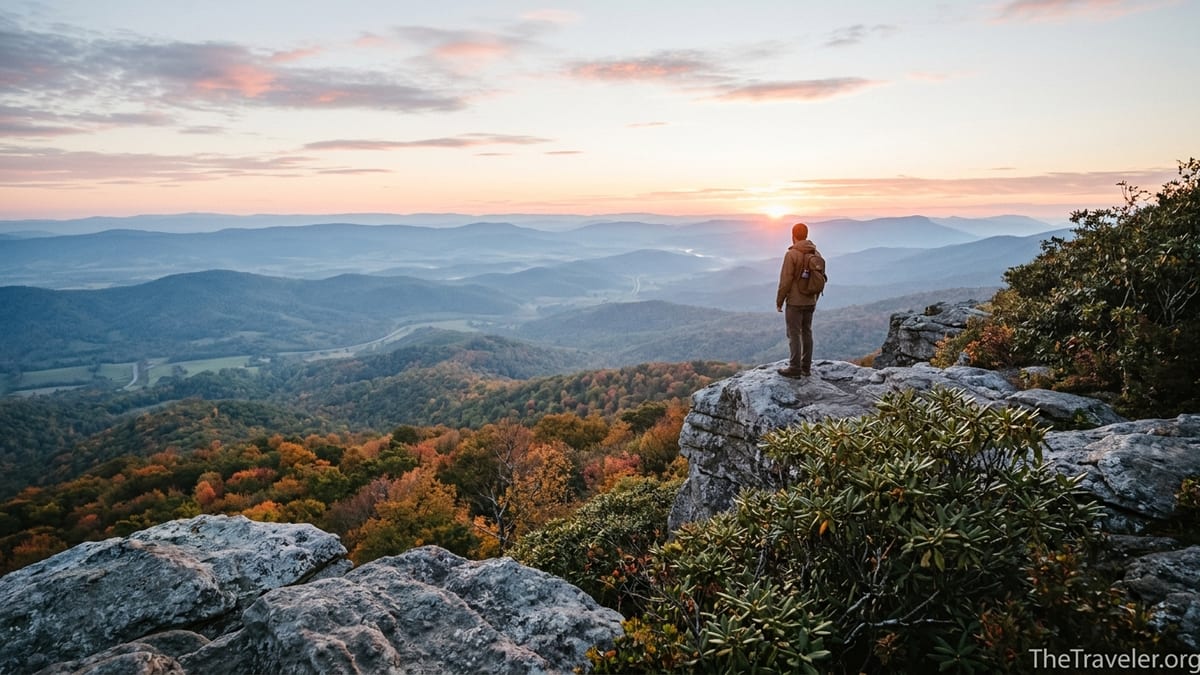
At the summit, a broad rock outcrop forms the primary viewpoint, dropping away sharply toward the valley. There are no railings, and the cliff edge can be deceptive, particularly when dozens of people are spread out trying to take photos. In wet or icy conditions, the lichen-covered rock can be slick. In late October or November cold snaps, there may be patches of frost on shaded sections of the trail, even if lower elevations feel mild. Hikers who pack light gloves and a windproof layer, plus shoes with decent traction, are more comfortable than those who rely on street clothes.
Thunderstorms are another seasonal concern. In summer, a clear midday sky can shift within an hour to cloud buildup and distant rumbles. Because Stony Man’s summit is so exposed, it is not a safe place to linger during lightning. Checking a detailed local forecast before you drive onto Skyline Drive, then revisiting it from a lodge or wayside with cell service, is a smart habit. If radar shows a line of storms approaching from the west, consider a forested waterfall hike instead, where you can more easily retreat if conditions deteriorate.
Safety, Regulations, and Protecting the Cliffs
Stony Man’s rocky summit and nearby Little Stony Man cliffs are not just scenic but ecologically sensitive. The National Park Service has a rock outcrop management plan in place, and seasonal or permanent climbing restrictions may apply in some areas to protect rare plants and prevent erosion. You might notice signs near certain cliff sections instructing you not to descend off designated paths or approach beyond specific markers. Respecting these closures is not only a safety matter but also crucial for preserving fragile high-elevation habitats.
From a personal safety standpoint, the main risk on Stony Man is a fall from or near the cliff edge, usually when hikers are stepping backward to frame a photo or navigating around other people. During busy weekends, it is common to see groups queuing for the most dramatic point on the rock. A prudent strategy is to be patient, avoid crowding onto narrow promontories, and firmly decline if someone urges you to “back up a little more” for a better shot. Many of the best photos on Stony Man are actually taken a few meters back, where you can include foreground rock and distant ridges without flirting with exposure.
Pets are not permitted on Stony Man Trail, one of several dog-restricted routes in Shenandoah. This surprises some visitors who are used to pet-friendly hikes elsewhere in the park. A typical scenario in peak season involves a family arriving with a leashed dog only to learn from a ranger at the trailhead sign that pets must stay off this particular trail. To avoid disappointment, dog owners can plan alternative hikes like the nearby Appalachian Trail segments or less-restricted viewpoints where leashed pets are allowed, leaving Stony Man for a separate pet-free outing.
Standard Leave No Trace principles matter even more when many people share a short path. In practice, that means carrying out snack wrappers, packing out orange peels instead of tossing them under leaves, and stepping aside on the uphill as needed to keep traffic flowing. Restrooms are not located at the trailhead itself; the nearest facilities are typically at Skyland Resort or other developed areas along Skyline Drive. Many hikers use those before starting to avoid contributing to informal “bathroom” spots near the trail.
Timing Your Hike, From Sunrise to Sunset
During peak season, the time of day you choose for Stony Man can shape your entire experience. Sunrise hikes, while requiring an early wake-up and careful attention to driving Skyline Drive in the dark, are often the most peaceful. In October, first light might arrive around 7:15 a.m. in this region, with official sunrise shortly after. Arriving at the trailhead 45 to 60 minutes beforehand allows you to walk up under headlamp or early dawn and watch the valley brighten from the summit. Photographers who time their visit this way often capture low fog in the Shenandoah Valley glowing beneath pink clouds, with only a handful of other visitors present.
Midday and early afternoon are the busiest, particularly on Saturdays and Sundays when tour buses and day trippers converge. The trade-off is convenience: you can enjoy breakfast in town, drive up without rushing, and make a leisurely stop at overlooks on either side of your hike. If you choose this window, build in extra time for slow-moving traffic along Skyline Drive and potential waits for parking. Many travelers heading from Washington or Richmond underestimate how long it takes to complete even a relatively short distance on a winding mountain road with frequent scenic pull-offs.
Late afternoon and sunset offer a second calm window. In summer, when daylight stretches past 8 p.m., starting around 5 p.m. lets you hike up in comfortable temperatures and linger for golden light on the ridges. The key is to carry a headlamp or small flashlight for the descent and know the exact sunset time in case clouds delay the show. In autumn, the earlier sunset compresses this option; a 3 or 4 p.m. start is often safer. A real-world example: a group of friends leaving Washington after work on a Friday in October might only realistically catch a short stroll to a nearby overlook before dark, while a properly planned Saturday with an early start could fit a full Stony Man hike plus additional stops.
Regardless of timing, always treat travel along Skyline Drive as part of your schedule. Speed limits are low, wildlife crossings are common, and fog or rain can reduce visibility sharply. Adding 30 to 45 minutes of extra buffer for the drive between the park entrance and the Skyland area is prudent, especially in peak foliage season when traffic tends to be heavier than usual.
What to Pack and How to Prepare for a Short but Serious Hike
Because Stony Man is “only” about 1.6 miles round trip on the main trail, many visitors treat it as a casual stroll. Yet peak-season conditions quickly remind you that you are on a real mountain. At a minimum, plan to carry one small daypack for your group with water, a light insulating layer, and basic safety items. A half-liter of water per person might be enough on a cool October morning, but on a sunny August afternoon you will want more. There are no water fountains at the trailhead itself, so filling bottles at Skyland or another developed area beforehand is essential.
Footwear is where many travelers’ comfort diverges. Trail running shoes or lightweight hiking boots provide good traction on roots and rocks. For instance, a visitor who wears everyday canvas sneakers may find their feet wet and cold after stepping in a puddle, while someone in breathable hiking shoes with grippy soles can move more confidently over uneven terrain. Trekking poles are optional but useful for hikers with knee concerns, especially on the descent when fallen leaves or mud hide smaller obstacles.
Layering is also important. A typical packing list for an October peak-season hike might include a synthetic or merino base layer, a fleece or light puffy jacket, and a windbreaking shell that can be rolled into a small bundle when not needed. Even in summer, carrying a thin long-sleeve layer protects against both chill and sun. A compact emergency kit, including a bandage, blister care, and a small flashlight or headlamp, turns a minor misstep or later-than-planned descent into an inconvenience rather than a crisis.
Finally, consider parking logistics and navigation tools. Downloading offline maps from a reliable mapping app before you enter the park compensates for spotty cell service along Skyline Drive. Taking a photo of the trailhead map on your phone gives you a quick reference if you feel uncertain at a junction, especially around the Appalachian Trail crossings where multiple colored blazes can be confusing to first-time visitors.
The Takeaway
Hiking Stony Man Trail during Shenandoah’s peak season can feel crowded and occasionally hectic, but it remains one of the park’s most rewarding short walks. By treating it like the popular alpine viewpoint it is, you can sidestep the common frustrations that catch unprepared visitors: full parking lots, unexpected fees, chilly ridge-top breezes, and congested cliff edges. An early or late start, realistic expectations about crowds, and simple gear like sturdy shoes and layers transform the experience from “checklist stop” into a memorable mountain outing.
Shenandoah National Park continues to refine its fee systems, permit rules, and visitor management as interest grows, especially in iconic locations such as Stony Man and Old Rag. Before you go, a brief check of current conditions on the park’s official channels will help you confirm entrance prices, payment methods, and any temporary closures or advisories. Once you are on the trail, slowing down, sharing space courteously, and respecting the cliffs and forest will ensure that Stony Man keeps offering big views and quiet moments, even in the heart of the busy season.
FAQ
Q1. Do I need a special permit to hike Stony Man during peak season?
No separate day-use permit is currently required for Stony Man. You only need a valid Shenandoah National Park entrance pass unless you are backpacking overnight, in which case a backcountry permit is also required.
Q2. How much does it cost to access Stony Man Trail?
As of 2026, expect to pay around 30 dollars per private vehicle for a seven-day Shenandoah entrance pass or about 15 dollars per person if entering on foot or bicycle. This covers access to Skyline Drive and the Stony Man trailheads.
Q3. When is peak season for hiking Stony Man?
Peak visitation typically occurs in October during fall foliage, especially on weekends with clear weather. Spring wildflower season and sunny summer Saturdays are also busy, but the heaviest crowds are usually tied to autumn color.
Q4. How early should I arrive to get parking at the Stony Man trailhead?
On peak fall weekends, arriving by 8 or 9 a.m. significantly improves your chances of finding a space at the main Stony Man lot. After mid-morning, parking often fills and you may need to wait for turnover or adjust your plans.
Q5. Are dogs allowed on Stony Man Trail?
No. Pets are not permitted on Stony Man Trail, even on a leash. If you are traveling with a dog, choose alternative routes in Shenandoah where pets are allowed and plan Stony Man as a separate pet-free hike.
Q6. Is Stony Man suitable for children and beginner hikers?
Yes. The main loop is relatively short, with moderate elevation gain, and many families hike it together. However, the rocky summit has steep drop-offs, so close supervision of children is essential, especially in crowded conditions.
Q7. What should I wear for a peak-season Stony Man hike?
Wear sturdy shoes or hiking boots with good traction, plus layers to handle cooler, windier conditions at the summit. In fall, a light fleece or jacket and a windproof shell are helpful even if the valley feels mild.
Q8. What happens if the weather turns foggy or rainy?
Fog and rain are common in Shenandoah and can quickly obscure views from Stony Man. If conditions deteriorate, reconsider your hike, carry rain protection, and be prepared for slippery rocks and reduced visibility on the trail and Skyline Drive.
Q9. Can I watch sunrise or sunset from Stony Man?
Yes, many hikers enjoy sunrise or sunset at Stony Man, especially in summer when days are long. Plan extra time for the drive, carry a headlamp for the hike in or out, and check sunrise or sunset times so you are not navigating the trail in the dark unprepared.
Q10. Are there restrooms and water at the Stony Man trailhead?
There are typically no restrooms or water fountains directly at the Stony Man parking area. Use facilities at nearby developed areas such as Skyland Resort before you start, and bring your own drinking water for the hike.