


Palazzo Vecchio is not just another museum stop in Florence. It is the city’s fortress-like town hall, a working seat of government and a richly decorated Medici palace in one. Visiting for the first time can be unforgettable, but it also comes with practical details that are easy to miss: separate tickets for the tower, security rules, partial closures for civic events, and new cashless payment norms. Understanding how the building actually works today will help you spend more time under Vasari ceilings and less time in ticket lines on Piazza della Signoria.
Get the latest updates straight to your inbox!
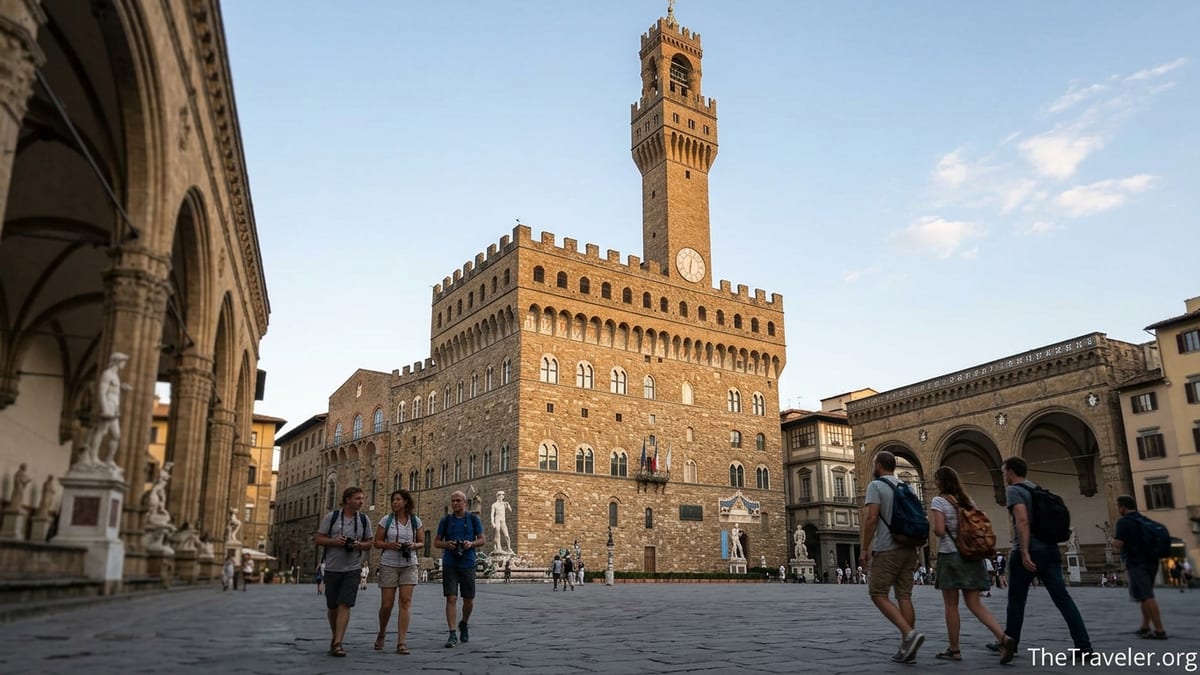
Understanding What Palazzo Vecchio Is Today
Many first time visitors arrive at Palazzo Vecchio expecting a conventional museum. In reality, this massive, crenellated palace on Piazza della Signoria serves two roles: it is both Florence’s medieval town hall and a civic museum filled with Medici-era art and interiors. Offices of the mayor and city council still function here, which is why you may see suited officials sharing corridors with tour groups. This dual identity explains why, on certain days, parts of the palace close temporarily for official ceremonies even when the museum is open.
Inside, you are walking through centuries of Florentine power. The highlight for many is the Salone dei Cinquecento, a soaring hall lined with frescoes and battle scenes attributed to Vasari and his workshop. Elsewhere you will find intimate spaces such as the Studiolo of Francesco I, a windowless cabinet packed with mannerist paintings and secret doors, and the private apartments associated with Cosimo I de’ Medici and Eleonora di Toledo. Knowing in advance that this is a layered political and private residence, not just an art gallery, can help you slow down and look for details like Medici symbols carved into doorways and hidden staircases.
The palace’s location is also important context. Palazzo Vecchio anchors Piazza della Signoria, with a copy of Michelangelo’s David and Cellini’s Perseus standing just outside. It is a natural stop between the Duomo and the Uffizi, which means the square is busy from mid morning through evening almost year round. If you are short on time, factor in that simply navigating the crowds and enjoying the outdoor sculpture terrace of the Loggia dei Lanzi beside the palace can easily add an extra half hour to your visit.
Current Opening Hours, Closures and Best Times to Visit
As of 2026, Palazzo Vecchio generally opens daily from around 9:00 to 19:00, with last museum admission roughly one hour before closing. On Thursdays the museum often closes earlier in the afternoon, typically around 14:00, to accommodate civic functions. Access to the Arnolfo Tower, the open air bell tower above the palace, usually ends earlier than the museum itself, with final climbs scheduled about 50 minutes before tower closing in the late afternoon. Exact times can shift slightly by season, so it is wise to check the latest schedule shortly before you travel.
The palace is closed on December 25 and January 1, and there are occasional partial closures for official ceremonies, conferences or city council events. For example, the Salone dei Cinquecento may be reserved for a public ceremony while the rest of the museum remains open, or a state reception might block access to some of the Medici apartments in the afternoon. At ticket desks, staff generally post same day notices, but if you are planning a once in a lifetime visit and particularly want to see the great hall or climb the tower, checking for extraordinary closures a few days in advance can prevent disappointment.
In terms of timing, mid morning and late afternoon are usually the busiest periods, especially between April and October. Recent visitor reports from spring and early summer note that ticket lines can stretch across Piazza della Signoria, with waits of 60 to 90 minutes at peak times on busy days. If you prefer a quieter experience, aim to arrive close to opening time on a weekday, particularly Tuesday or Wednesday, or in the late afternoon outside of peak holiday weeks. In shoulder seasons like March, early April, late October and November, crowds ease noticeably and you may be able to move more freely through the grand halls.
Tickets, Passes and How to Avoid Long Lines
First time visitors are often surprised to discover that Palazzo Vecchio has several different ticket types. A standard museum ticket covers the palace interiors only. A separate ticket is required to climb the Arnolfo Tower, and there are additional, limited capacity tickets for special experiences such as secret passage tours or visits to the underground archaeological area. Combined tickets that include both the museum and the tower are sometimes available but sell out faster than stand alone entries, especially in high season.
Base museum ticket prices are moderate by European city standards, and reduced rates are typically offered for young visitors, students or children, while very young children often enter free. Prices can change annually, so it is safer to think in approximate terms and budget the equivalent of a typical major city museum ticket for the standard visit, with a supplement for tower access. Secret passage or thematic tours cost a bit more because they are led in small groups and involve spaces that are otherwise closed to the public.
To avoid losing time in line, advance purchase is now strongly recommended for most of the year. The city encourages visitors to book timed entry tickets for Palazzo Vecchio online, and many authorized resellers offer skip the line options that send you a mobile QR code. When demand is high, entry slots for late morning and early afternoon can sell out several days ahead, and on the day itself there may be limited or no availability for the tower or special tours. Travelers staying only one or two days in Florence should consider booking palace plus tower or palace plus secret passages at least one to two weeks in advance, and up to four weeks out for peak summer weekends.
If you are planning to visit several museums, the official Firenze card, a 72 hour pass that includes admission to dozens of Florence sites, is worth checking. Palazzo Vecchio is usually among the included civic museums, and the pass often allows a separate, priority entrance lane. For a short city break, using the card for Palazzo Vecchio, the Uffizi, the Accademia and one or two smaller sites can be both time saving and economical compared with buying separate skip the line tickets at each attraction.
Security, Cashless Payments and Practical Rules Inside
Recent rule changes in Florence have made major civic and state museums, including Palazzo Vecchio, much more digital and security conscious. At the entrance, you will pass through airport style screening. Large backpacks, suitcases and bulky items are not allowed past security and may need to be left in a cloakroom where available, so arriving without big luggage is significantly easier. Tripods, drones, professional lighting gear and similar equipment are prohibited, and staff may also restrict the use of selfie sticks in crowded rooms.
Tickets and services are increasingly cashless. Timed entry passes are typically scanned from a QR code on your phone rather than printed vouchers. Many visitors now receive their tickets directly into Apple Wallet or Google Wallet and are advised to take a screenshot before entering, because mobile reception inside the thick stone walls can be weak. At the on site ticket office and museum bookshop, card payments are the default, and some counters explicitly prefer or require electronic payment. Carrying at least one widely accepted bank card or digital wallet will make the visit smoother.
Photography for personal use is usually allowed throughout the museum areas, but flash is not permitted in rooms with frescoes and sensitive artworks, such as the Salone dei Cinquecento and the private chapels. In the tower and on exposed staircases, staff may ask you to keep phones and cameras secured with straps and to avoid blocking narrow passages for photos. As in many Italian museums, eating and drinking are not allowed in the exhibition spaces. If you bring a refillable water bottle, choose one that closes securely and keep it in your bag between sips.
Dress is generally casual, but respectful clothing is recommended. Palazzo Vecchio is a civic building that sometimes hosts official ceremonies, and a small chapel is part of the visit route. Sleeveless tops are accepted, but extremely revealing outfits may attract attention, and a light scarf or shawl can be useful if you wish to be discreet in chapel areas. Comfortable, closed toe shoes are strongly advised: stone floors, long corridors and stairs to the battlements and tower can be tiring in sandals or thin soles.
Planning Your Route: Highlights You Should Not Miss
A typical first time visit to Palazzo Vecchio lasts between 1 and 2 hours for the museum alone, and up to 3 hours if you add the Arnolfo Tower or a special tour. To make the most of that time, it helps to have a simple route in mind before stepping through the courtyard. Many visitors start in the monumental Cortile di Michelozzo, the inner courtyard decorated with frescoes of Habsburg towns, then move up to the grand staircase toward the Salone dei Cinquecento, the single most impressive interior space in the palace.
From the great hall, you can explore the Medici private rooms, including the Quartiere di Leone X and the Quartiere degli Elementi, each room themed with allegorical paintings and coffered ceilings. In the Studiolo of Francesco I, look for the tiny, almost hidden doors that once connected to secret passages and storage spaces. Another highlight is the map room, Sala delle Carte Geografiche, where 16th century maps stretch across cabinet doors and a large globe anchors the center of the room. Knowing that these cabinets once concealed secret staircases leading directly to the private apartments adds an extra layer of intrigue.
If your ticket includes the Arnolfo Tower, you will follow a separate, supervised route from within the palace up a long, steep staircase. The climb is physically demanding, with several hundred narrow steps and limited passing space, but the payoff is a panoramic view of Florence. From the top terrace, you can look straight across to Brunelleschi’s dome and down onto Piazza della Signoria. Visitors who prefer a gentler experience can opt instead for the battlements walk on the palace roof, which offers good city views with fewer steps and less exposure.
For those particularly interested in Medici history or hidden architecture, specialized guided tours such as the “secret passages” experience provide access to spaces outside the standard route. These small group tours might take you through narrow staircases inside the walls, hidden entrances once used by guards and dukes, or even down into the archaeological remains of the Roman theater beneath the palace courtyard. Availability is limited and tours often run only at set times in Italian or English, so this is something to book well ahead of your travel dates.
Accessibility, Fitness Levels and Visiting With Children
Because Palazzo Vecchio is a medieval fortress converted into a museum, accessibility varies by area. The main courtyard, ticket hall and key exhibition floors are accessible by elevator, and staff can guide wheelchair users and visitors with reduced mobility along adapted routes that avoid steep or uneven staircases. However, certain sections, including the Arnolfo Tower and some roof level battlements, are only reachable via long flights of narrow stairs and are not suitable for wheelchairs or anyone with serious mobility or balance issues.
The tower climb is physically challenging and is typically subject to weather and safety restrictions. Access may be suspended in heavy rain, strong wind or extreme heat. There are usually age restrictions for children, and only those above a specified minimum age are allowed to climb. Even for fit adults, the combination of steep steps, confined spaces and height requires caution. If you suffer from vertigo, claustrophobia, heart or respiratory conditions, it is better to enjoy the palace interiors and consider alternative viewpoints in Florence, such as Piazzale Michelangelo, instead of forcing yourself up the tower.
Families will find that the palace offers plenty to keep children engaged, from armor and heraldic symbols in the grand halls to stories of dukes and conspiracies. Some days feature family friendly activities and educational materials developed by the civic museums. Still, the museum can feel overwhelming for very young children, and strollers may be difficult to maneuver on crowded staircases and in narrow corridors. A practical approach is to use a lightweight stroller on the ground level only and a baby carrier in the upper floors, keeping in mind that certain areas with delicate flooring or historic staircases may require you to carry the child in your arms.
For visitors with sensory sensitivities, it is worth noting that popular rooms like the Salone dei Cinquecento can become noisy when multiple tour groups are present. The echoing acoustics and dense crowds may be tiring. Planning your visit for early morning on a weekday, or breaking it into shorter segments with a rest in Piazza della Signoria or a nearby cafe, can make the experience more manageable. Earplugs or noise reducing headphones can help children and adults alike stay comfortable.
Combining Palazzo Vecchio With the Rest of Florence
Because of its central position, Palazzo Vecchio easily fits into a wider day of sightseeing. Many itineraries pair a morning visit to the Uffizi Gallery with an afternoon at Palazzo Vecchio, since the two are only a few minutes’ walk apart. Another common combination is to explore the Duomo complex in the morning, including the cathedral and nearby bell tower, and then move south to Piazza della Signoria for the palace in the later afternoon when its interior provides a break from the sun.
If you hold a museum pass like the Firenze card, it becomes tempting to cram Palazzo Vecchio between other headline sites such as the Accademia and Pitti Palace. In practice, most travelers find it more enjoyable to slow the pace. One realistic plan is to dedicate one half day to the Duomo and Baptistery area, and another half day to Palazzo Vecchio and the Uffizi, leaving time to sit in the square with a coffee or gelato. Rushing from queue to queue reduces the impact of the interiors, especially in a building where the atmosphere is as important as the individual artworks.
Even if you are not a dedicated museum goer, Palazzo Vecchio rewards a focused visit. Travelers who have been to Florence multiple times often name it as a favorite site, ranking the Salone dei Cinquecento and the palace rooftops alongside Brunelleschi’s dome as essential experiences. Approaching it as a living seat of government, a Renaissance showpiece and an urban viewpoint all at once helps it stand out from more conventional art museums in the city.
The Takeaway
Visiting Palazzo Vecchio for the first time is most rewarding when you prepare for both its history and its practicalities. Knowing that it remains Florence’s town hall explains why hours can change, parts of the building close for events and security is tight at the entrance. Understanding the ticket structure helps you decide in advance whether to include the Arnolfo Tower, a secret passages tour or simply focus on the palace interiors, and booking online reduces the risk of losing precious hours in line on Piazza della Signoria.
Inside, planning a simple route through the courtyard, Salone dei Cinquecento, Medici apartments and map room ensures that you see the essential highlights even on a short visit. Comfortable shoes, a charged phone with your QR tickets saved offline, and realistic expectations about stairs and crowds will make the experience smoother. With a bit of preparation, Palazzo Vecchio becomes more than an impressive facade on a famous square: it turns into a vivid introduction to Florence’s political past and present, framed by some of the city’s richest Renaissance interiors.
FAQ
Q1. How long should I plan for a first visit to Palazzo Vecchio?
For most first time visitors, 1 to 2 hours is enough to see the main palace interiors at a comfortable pace. If you add the Arnolfo Tower climb or a special tour such as the secret passages, plan on 2 to 3 hours total to allow time for security, stairways and photo stops.
Q2. Do I need to book Palazzo Vecchio tickets in advance?
Advance booking is strongly recommended, especially from spring through early autumn and on weekends. Timed entry slots for late morning and early afternoon, as well as combined museum and tower tickets, can sell out days ahead in busy periods. Buying online before you arrive in Florence reduces the risk of long lines or limited same day availability.
Q3. Is the Arnolfo Tower included in the standard ticket?
No, the Arnolfo Tower is usually not included in the basic museum ticket. You typically need either a separate tower ticket or a combined palace plus tower ticket, which costs more and has limited capacity. The tower also has its own closing time, earlier than the museum, so check the time printed on your ticket carefully.
Q4. Can I pay cash for tickets and services inside Palazzo Vecchio?
Card and digital payments are now the norm at Palazzo Vecchio. The on site ticket office and bookshop typically accept major bank cards and contactless payments, and online bookings use QR codes rather than printed vouchers. While small amounts of cash may still be accepted in some situations, relying on a debit or credit card or a mobile wallet is safer and more convenient.
Q5. Is Palazzo Vecchio suitable for visitors with reduced mobility?
Large parts of the museum, including the main exhibition floors, can be reached by elevator or via adapted routes, and staff can assist visitors with reduced mobility. However, the Arnolfo Tower and some roof level areas are only accessible via long, narrow staircases and are not suitable for wheelchairs or those who cannot manage steep steps. If mobility is a concern, focus on the interior rooms and courtyard rather than the tower climb.
Q6. What is the dress code inside Palazzo Vecchio?
There is no strict formal dress code, and casual clothing is acceptable. However, Palazzo Vecchio is a civic building that sometimes hosts official events and includes a small chapel, so respectful attire is encouraged. Comfortable, closed toe shoes are very helpful for stone floors and staircases, and a light scarf or shawl can be useful if you prefer to cover shoulders in more formal spaces.
Q7. Can I take photos inside the palace and on the tower?
Personal photography is generally allowed throughout the museum, but flash is not permitted in rooms with frescoes and sensitive artworks. Tripods and professional lighting equipment are not allowed, and staff may ask you not to block narrow passages for photos, particularly on staircases and in the tower. On the tower and battlements, keep phones and cameras securely in hand or on a strap, as dropping them could be dangerous.
Q8. What is the best time of day to visit Palazzo Vecchio?
Early morning on a weekday, especially Tuesday or Wednesday, is often the quietest time, allowing you to enjoy major rooms like the Salone dei Cinquecento with fewer crowds. Late afternoon can also be pleasant, though summer evenings remain busy. Midday and early afternoon in high season usually bring the longest lines and the most tour groups, so avoid those hours if you prefer a calmer visit.
Q9. Can children visit Palazzo Vecchio and the Arnolfo Tower?
Children are welcome in the museum, and many enjoy the grand halls, maps and historic stories. However, the Arnolfo Tower has age and safety restrictions, and very young children may not be allowed to climb. Even when permitted, the steep, narrow stairs can be tiring for small legs and challenging for parents carrying infants. For families with young children, focusing on the interiors and courtyard is often more comfortable than attempting the full tower climb.
Q10. How can I combine Palazzo Vecchio with other Florence sights in one day?
A popular plan is to visit the Uffizi Gallery or the Duomo complex in the morning, then explore Palazzo Vecchio in the afternoon, since it sits on Piazza della Signoria between these major landmarks. If you hold a museum pass like the Firenze card, you can combine Palazzo Vecchio with one or two other sites in the same 72 hour window, but leaving time to rest in the square or at a nearby cafe will make your day in Florence more enjoyable than rushing between consecutive queues.