


For many U.S. travelers, Chime has become a go to everyday account at home. Using it abroad, however, is a bit more nuanced. You can tap or swipe your Chime Visa card in most countries without a foreign transaction fee, but ATM costs, withdrawal limits, card restrictions and real world quirks can still trip you up if you are not prepared. This guide walks through what actually happens when you take Chime overseas and how to avoid surprises on the road.
Get the latest updates straight to your inbox!
Where Chime Works Abroad and When It Does Not
Chime issues a Visa debit card and a secured Visa credit card, which means you can generally use your card in most countries where Visa is accepted. That covers common destinations for U.S. travelers such as Canada, Mexico, the United Kingdom, most of Western Europe, Japan and much of Latin America and Southeast Asia. In practice, travelers report being able to pay with Chime at restaurants in Paris, grocery stores in Tokyo and ride hailing apps in Mexico City as long as the merchant accepts standard Visa debit.
There are some exceptions. Chime blocks card usage in a small list of countries for risk and compliance reasons. The list can change, but it typically includes destinations subject to broad U.S. sanctions or high fraud risk. Travelers have posted examples of cards not working in places like Cuba or North Korea, and certain regions in the Middle East and Africa can be restricted or unreliable. Before a big trip, it is wise to check the latest wording in Chime’s help center or app settings so you know if your destination is fully supported.
Access to the Chime app itself can also be limited in some countries. In recent discussions, customers have mentioned difficulty logging in or contacting support from abroad in certain regions because Chime’s services are not available or local telecom networks block access. That may not affect your ability to pay at a card terminal, but it can matter if you need to move money between accounts, unfreeze a locked card or get help with a declined charge while you are traveling.
Because these blocks are based in part on compliance rules that can change with geopolitics, you should not assume that what worked for a friend a year ago will still work today. If you are heading somewhere less common like Tanzania, Jordan or Vietnam, test your Chime card ahead of time on a small online purchase denominated in the local currency, and always carry a backup card from a different issuer in case Chime is blocked or does not route properly.
Foreign Transaction Fees, Exchange Rates and Dynamic Currency Conversion
One of Chime’s biggest selling points for travelers is that it does not charge a foreign transaction fee on card purchases. Traditional banks often add around 3 percent on every purchase in a foreign currency. For example, if you spend the equivalent of 500 dollars on hotels and restaurant meals in Italy with a big brick and mortar bank card, you might see an extra 15 dollars tacked on in fees. With Chime, you avoid that markup from Chime itself on the card side, which can make a real difference on a two week trip.
Chime relies on the Visa network exchange rate to convert your foreign purchases back to U.S. dollars. That rate usually sits fairly close to the mid market rate you might see on financial news sites. On a typical day, the difference could be within around 1 percent in many major currencies, although the exact margin is not published and can vary with market conditions. For a café bill of 15 euros in Berlin, for example, you might see it post to your Chime account at around 16 to 17 dollars depending on the day’s rate, with no additional fee line item from Chime.
There is a big catch that applies to all cards, including Chime, known as dynamic currency conversion. Many hotels, shops and especially ATMs overseas will offer to charge your U.S. card in dollars rather than the local currency. It usually appears on the screen as something like “Charge 100.00 USD” versus “Charge 92.50 EUR.” This feels reassuring but is almost always more expensive because the merchant or ATM operator sets its own conversion rate, frequently with a hidden markup of 3 to 7 percent or more.
To get the benefit of Chime’s no foreign transaction fee structure and Visa’s generally competitive exchange rate, always choose to pay in the local currency and decline any offer to be charged in U.S. dollars. As a concrete example, at a London hotel charging 200 pounds, paying in pounds might post to your Chime account at roughly 250 dollars using the network rate, while selecting U.S. dollars at the terminal could easily cost you 260 dollars or more after the hidden markup.
ATM Withdrawals, Fees and Practical Workarounds
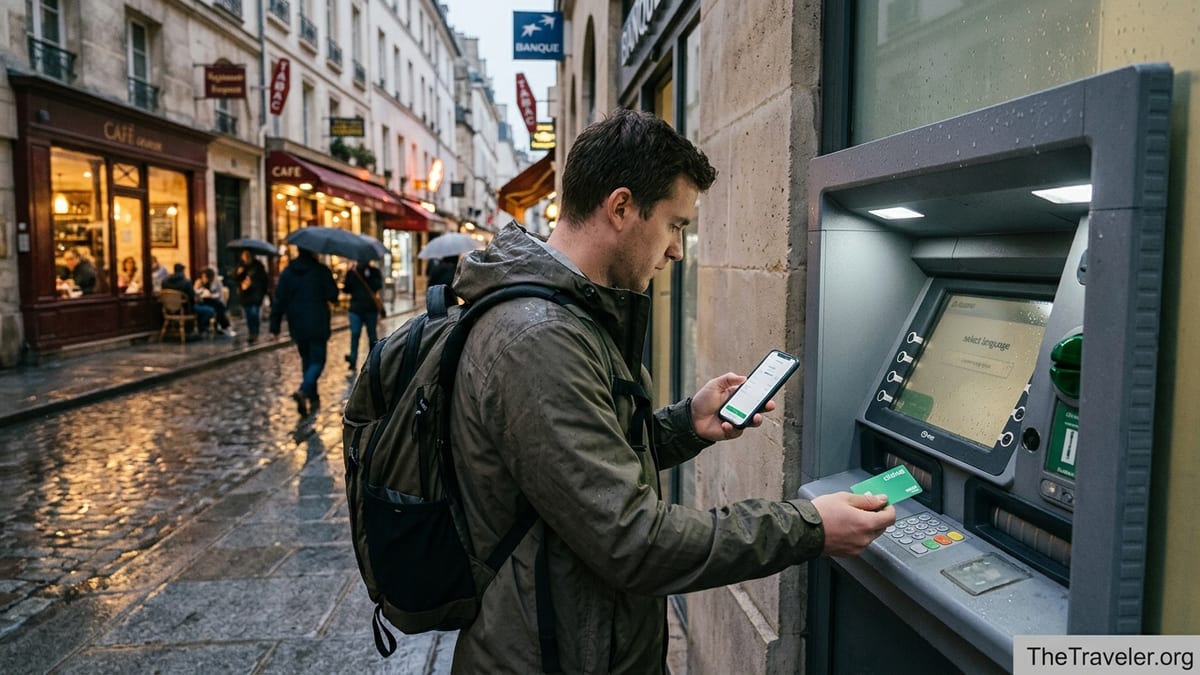
Chime’s fee story is different at ATMs. Inside the United States, you can withdraw cash for free at tens of thousands of in network machines in chains like Walgreens, CVS, 7 Eleven and Circle K. When you are overseas, however, almost every ATM you encounter will be out of network, which triggers Chime’s 2.50 dollar withdrawal fee on its side. On top of that, most foreign ATM operators add their own surcharge, which can range from the equivalent of around 1 to 5 dollars or more per withdrawal depending on the country.
Imagine you are in Mexico City and you withdraw 4,000 Mexican pesos, which might be roughly 230 dollars at current rates. The local bank’s ATM could charge an equivalent of 2 to 3 dollars as a fee, and Chime will add its 2.50 dollar out of network fee. You might be paying 5 dollars in total just to access the cash, which is a little over 2 percent of the withdrawal amount. In some European destinations, ATMs at major banks might have lower surcharges than convenience store machines, so it is worth walking an extra block to use a reputable bank’s ATM instead of the first one you see inside a tourist bar or metro station.
Because each international ATM withdrawal carries the flat Chime fee plus any local operator fee, larger but less frequent withdrawals are usually cheaper overall than many small ones. Instead of pulling out 40 dollars in cash four separate times in Tokyo and paying fees each time, consider withdrawing 160 dollars equivalent in one transaction. Just be sure you have a safe way to store the extra cash in your hotel or money belt rather than carrying everything with you.
Withdrawal limits matter too. Chime typically caps daily ATM withdrawals at a few hundred dollars equivalent, and those limits can apply abroad as well. If you are paying a month’s rent in cash in a foreign country or need a large deposit for a vehicle rental that only accepts cash, you may find that you cannot get enough out of Chime in a single day. One workaround some frequent travelers use is to combine a Chime withdrawal with a second card from a different bank that has higher international ATM limits or reimburses fees.
Card Controls, Security and What Happens If Something Goes Wrong
Chime gives you real time notifications for every card transaction, which is particularly useful abroad. When you tap to pay for a 6 euro espresso in Rome or a 1,200 yen subway ride in Osaka, you will usually get a push alert in seconds showing the U.S. dollar equivalent and the merchant name. That makes it much easier to spot suspicious transactions quickly than if you were using a traditional bank card with only a monthly statement.
The app also lets you instantly lock your card if it is lost or stolen. If you realize your wallet is missing after a crowded tram ride in Lisbon, you can open the Chime app, toggle the card off and immediately block new purchases and ATM withdrawals. That kind of quick self service is extremely helpful when you are in a different time zone or have trouble getting through to phone support. Once you find the card again or receive a replacement, you can toggle it back on from the same settings menu.
In the past, Chime allowed customers to separately enable or disable international transactions as an extra safeguard. More recently, some travelers have reported that this dedicated international toggle has been removed and replaced with a single overall card lock. Practically, that means if your card is active and your account is in good standing, it should be usable for foreign purchases wherever Visa is accepted, but you no longer have the same granular switch just for international charges.
If your card is declined abroad, troubleshooting can be more challenging because Chime does not have physical branches and its phone support may be harder to reach over an overseas mobile connection. Make sure your contact details and email are up to date before you travel, and consider having a U.S. based friend or family member who you can message to call Chime on your behalf if necessary. For example, if a hotel deposit in Bangkok is repeatedly declined with no clear reason, it is reassuring to know someone back home can help you reach support while you focus on checking in.
Using Chime for Hotels, Deposits and Long Stays
Not every card situation abroad is a simple restaurant or store purchase. Hotels, car rental agencies and some apartment hosts place temporary holds or security deposits on your card. Chime’s debit card runs on the Visa debit rails, which many large hotel chains and rental agencies accept with no problem, but a subset of merchants still prefers or requires a traditional credit card for deposits. This is especially common at business oriented hotels in Europe or at car rental counters in countries like Germany and the United Kingdom.
If you try to use Chime for a hotel deposit and the property does not accept debit cards for that purpose, you may be asked for a different card or a significant cash deposit. For example, a midrange hotel in Amsterdam might place a 150 euro hold on a credit card but demand a 300 euro cash deposit if you want to pay with debit. Before you arrive, check the payment policies of your accommodation and consider bringing a separate credit card with no foreign transaction fee specifically for deposits and holds, while using Chime for everyday spending and ATM withdrawals.
For long stays, such as spending several months working remotely in Portugal or Thailand, Chime can be part of your toolkit rather than your only banking solution. Some travelers maintain a secondary local account for rent and utilities but continue to route U.S. income into Chime. They then withdraw cash or make card payments from Chime when needed. In these situations, Chime’s lack of monthly fees and no foreign transaction fee on purchases are helpful, but you will want to be mindful of ATM costs if you are withdrawing cash every week for rent in a cash heavy market.
If you rely on direct deposit to Chime from a U.S. employer, it is also important to think about how you will access and move funds if you lose phone access or cannot log into the app from abroad. Some digital nomads keep a small buffer in a separate bank that has strong international support, such as a major U.S. bank or a brokerage account with debit card features, so a single technical problem with Chime does not leave them stranded without money in another country.
Best Practices and Realistic Backup Plans
Used thoughtfully, Chime can fit well into a broader travel money plan. A common real world setup looks like this. A traveler brings a Chime debit card, a separate no foreign transaction fee credit card from another issuer and a small amount of U.S. dollar cash for emergencies. Chime handles day to day expenses in local currency and modest ATM withdrawals, while the credit card is reserved for hotels, car rentals and any unexpected high value purchases.
For example, on a one week trip to Paris, a traveler might pay for metro passes, cafes and museum tickets with Chime, avoiding foreign transaction fees on dozens of small purchases and benefiting from the Visa exchange rate. When checking into a hotel that wants a 200 euro security hold, they might instead use a different credit card that is explicitly designed for international travel, leaving Chime’s balance fully available for spending and cash access. If an ATM in a touristy area insists on a high flat fee plus an unfavorable exchange rate, the traveler may choose to walk to a major bank branch ATM instead, or switch to using the backup card at merchants that accept it.
Because Chime is an online focused company, you should also think through connectivity. Download statements or at least take screenshots of recent transactions and balances before you leave so you have a record even if you cannot log in temporarily abroad. Store a copy of the Chime customer service phone number in your notes or an offline document so you are not dependent on the app to find it in an emergency.
The most important habit is not to rely solely on any one card, including Chime. Even cards that work flawlessly 99 percent of the time can be randomly declined because of network glitches or fraud filters. Carrying at least one additional payment method, ideally on a different network or from a different institution, is cheap insurance against being stuck in a foreign airport with a hungry family and a card that suddenly will not swipe.
The Takeaway
Chime can be a very useful part of your travel money setup if you understand where it shines and where it falls short. The lack of foreign transaction fees on purchases and reliance on generally competitive Visa exchange rates make it a better deal than many traditional checking accounts for everyday spending abroad. Instant transaction alerts and in app card controls add a layer of security that is especially valuable when you are navigating unfamiliar places.
At the same time, Chime is not a perfect all in one travel banking solution. International ATM withdrawals are subject to a flat fee from Chime plus any local operator charge, which can add up on a cash heavy trip. Some hotels and rental agencies still prefer traditional credit cards for deposits. Access to the app and support can be less predictable in certain countries compared with large global banks that have dedicated international travel desks and extensive overseas infrastructure.
If you plan ahead, test your card, keep an eye on fees and bring at least one strong backup payment option, Chime can slot smoothly into your broader travel finances. Treat it as one tool in your wallet rather than the only one, and it can help you stretch your budget and simplify daily spending without the unpleasant surprise of hidden fees.
FAQ
Q1. Does Chime charge a foreign transaction fee when I use my card abroad?
Chime does not currently charge its own foreign transaction fee on card purchases in another currency. You still pay whatever exchange rate Visa applies on the day the transaction settles, and merchants or ATM operators can add their own fees, but Chime itself does not tack on the typical 2 to 3 percent foreign transaction surcharge that many traditional banks charge.
Q2. Will my Chime card work in any country I travel to?
Your Chime Visa card generally works in most countries where Visa is accepted, but Chime blocks usage in a small list of restricted or high risk countries and sometimes limits access to its app in certain regions. Before traveling to a less common destination, check Chime’s current help information and consider testing your card with a small online purchase in the local currency, and always bring a backup card from another issuer.
Q3. How much will I pay to withdraw cash from an ATM overseas with Chime?
When you use an out of network or international ATM, Chime typically charges a 2.50 dollar fee per withdrawal, and the foreign bank or ATM operator may add its own surcharge on top. That means a single withdrawal in another country could easily carry combined fees of around 3 to 5 dollars depending on the machine, so it is usually more cost effective to make fewer, larger withdrawals rather than many small ones.
Q4. Do I need to turn on international transactions or set a travel notice with Chime?
Chime does not require a traditional travel notice, and in many recent cases international transactions are simply allowed when your card is active and in good standing. Earlier versions of the app had a separate international transactions toggle, but some travelers report that this specific switch has been removed and replaced with a general card lock. The safest approach is to verify your card settings in the app before departure and confirm that your card is unlocked and ready for use.
Q5. What exchange rate does Chime use when I pay in a foreign currency?
When you make a purchase abroad or online in another currency, Chime relies on the standard Visa network exchange rate to convert the transaction into U.S. dollars. That rate is usually reasonably close to the mid market rate published by currency sites, often within around 1 percent in many major currencies, though it can move during volatile periods. To avoid extra markups, always choose to pay in the local currency and decline dynamic currency conversion offers that let the merchant charge you in U.S. dollars.
Q6. Can I use my Chime card for hotel deposits and car rentals abroad?
Sometimes, but not always. Many hotels and some rental agencies accept Visa debit cards like Chime for both payment and deposits, while others insist on a traditional credit card for security holds. If a hotel in Europe or a rental desk in the United Kingdom refuses your debit card for a deposit, you may need to provide a separate credit card or a significant cash deposit. It is wise to carry at least one no foreign transaction fee credit card alongside Chime for this purpose.
Q7. What should I do if my Chime card is lost or stolen while I am overseas?
If you lose your Chime card abroad, open the Chime app as soon as possible and use the card settings to lock the card, which blocks new purchases and ATM withdrawals. Then contact Chime support using the phone number or channels listed in your account to report the card lost or stolen and request a replacement. In the meantime, rely on your backup cards or cash, which is why it is important not to travel with only one payment method.
Q8. Are there daily limits on how much I can spend or withdraw with Chime while traveling?
Yes, Chime sets daily limits on ATM withdrawals and card spending that generally apply whether you are in the United States or abroad. The exact numbers can change and may depend on your account history, but they often mean you cannot withdraw more than a few hundred dollars per day from ATMs and there may be caps on purchase amounts in a single day. If you expect to need large sums in cash or to pay for a big purchase, plan ahead so you are not constrained by these built in limits.
Q9. Can I rely on Chime as my only bank account when traveling long term?
Some people do rely mainly on Chime for long term travel, especially digital nomads, but it carries risks. Because Chime is an online focused company without branches and with certain app and country restrictions, a technical issue, card loss or local block can leave you temporarily cut off from your funds. A more resilient plan is to use Chime for everyday spending and savings while keeping at least one additional account or card from a different institution as a backup.
Q10. How can I minimize fees when using Chime abroad?
To keep costs low, use Chime primarily for card purchases in local currency, avoid dynamic currency conversion, withdraw cash less often but in slightly larger amounts to spread the flat ATM fees and favor bank operated ATMs in safe areas over heavily marked up tourist machines. Combine Chime with a backup no foreign transaction fee credit card for deposits and emergencies, and review your settings and contact details in the app before departure so you can quickly lock the card or reach support if something goes wrong.