


São Paulo/Guarulhos International Airport (GRU) is Brazil’s busiest international gateway and a major connection point for flights across South America. For many travelers it can also be confusing: different terminals, mixed international and domestic operations, and the need to clear immigration and customs on many connections. This guide walks you step by step through bags, immigration, customs and terminal transfers at GRU, with realistic connection times and concrete examples for common itineraries.
Get the latest updates straight to your inbox!
How GRU Airport Is Laid Out: Terminals and Airlines
Guarulhos has three passenger terminals: Terminal 1, Terminal 2 and Terminal 3. Terminal 3 is the main long-haul international terminal, handling most intercontinental services such as LATAM to Europe and the United States, TAP Air Portugal, Lufthansa, Swiss, Qatar Airways and North American carriers. Terminals 2 and 1 handle a mix of domestic and regional international flights, with Terminal 2 in particular acting as the core hub for LATAM, Gol and Azul’s domestic networks.
Most international arrivals from Europe and North America still use Terminal 3, though specific assignments can change by airline and season. A Delta or United flight from the United States will typically arrive into Terminal 3, while a regional flight from neighboring countries might arrive in Terminal 2. Domestic services to cities such as Rio de Janeiro (SDU and GIG), Brasília, Belo Horizonte, Salvador and Manaus are concentrated in Terminal 2, used heavily by LATAM, Gol and Azul.
Travelers should be aware that Terminal 1 is relatively small and serves mainly Azul’s shuttle-type operations and some regional traffic. There is no direct indoor walkway between Terminal 1 and the others, so anyone connecting from Terminal 1 usually relies on the free airport shuttle bus. In contrast, Terminals 2 and 3 are linked by an internal airside and landside walkway at the departures level, which makes international to domestic transfers more manageable.
Because airlines at GRU operate from more than one terminal depending on whether the flight is domestic or international, the same carrier may use Terminal 3 for long-haul international services and Terminal 2 for domestic legs. For example, a traveler flying from New York to São Paulo on LATAM may arrive in Terminal 3, then connect onward to Florianópolis or Recife from Terminal 2, even though both flights are on the same airline.
Immigration, Customs and Baggage: What Always Happens on Arrival
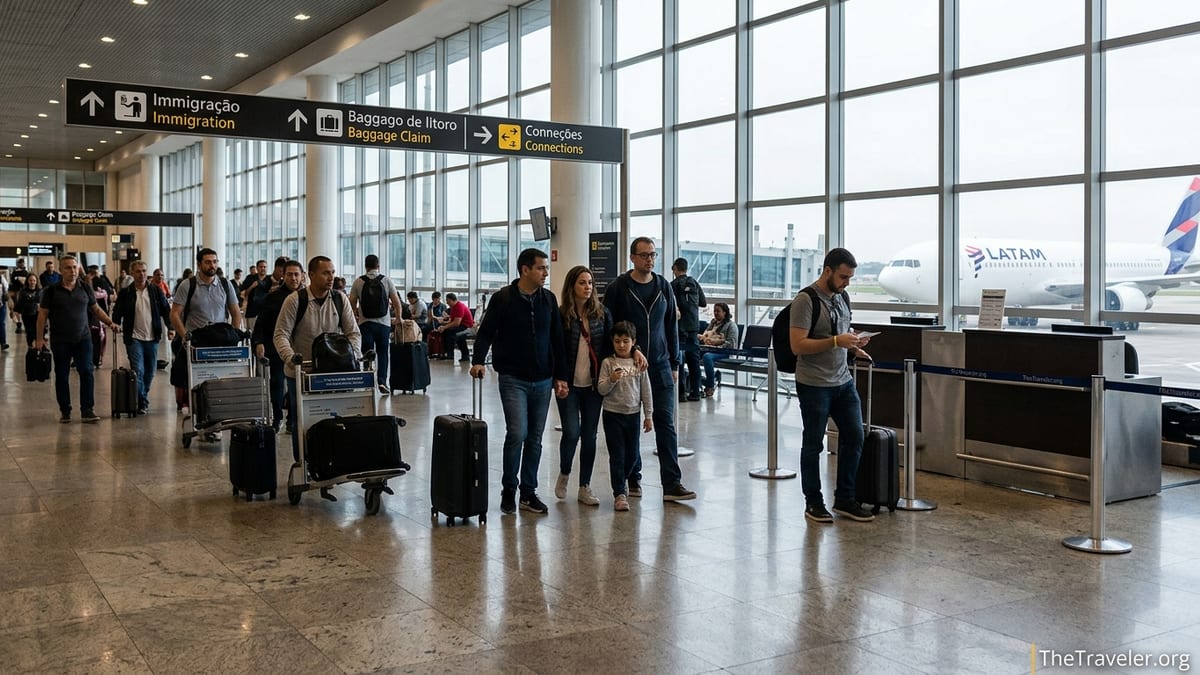
Regardless of your final destination inside Brazil, if your first point of entry into the country is São Paulo Guarulhos you must clear Brazilian immigration and customs there. This applies even if your bag is tagged through to a smaller domestic city. After disembarking, passengers follow signs for “Imigração / Immigration,” queue for passport control, and then continue down to baggage claim.
Once you reach the baggage claim hall in Terminal 3 or 2, you wait for checked luggage in the usual way. Even if your boarding pass shows your final domestic destination, you still take your suitcase off the belt at GRU. Brazilian regulations require that your bags be physically presented to customs at your first point of entry. After collecting your luggage, you walk through customs where you will be asked to choose the green channel for “nothing to declare” or the red channel if you are carrying goods above duty-free allowances or special items like professional equipment.
Only after you have exited customs can you recheck your baggage for a domestic connection. The process is similar to airports in the United States, where international arrivals with domestic connections, such as Atlanta or Miami, require you to pick up bags for customs inspection before dropping them again for the connecting flight. At GRU, this process is concentrated at the end of the arrivals route, just after you leave the duty free area and customs corridor.
In practice, the timing of this sequence varies by time of day and crowd levels. A midweek morning arrival from Europe at around 5:00 or 6:00 can sometimes clear immigration in 20 to 30 minutes, with bags appearing shortly after. On very busy days or when multiple widebody flights land together, immigration queues can stretch to 45 minutes or longer, and baggage delivery may add another 20 to 30 minutes. When planning connections, you should treat immigration and baggage collection as the least predictable part of the journey.
International to Domestic Connections: Step-by-Step
Most readers use GRU for an international to domestic connection, for example flying from New York, London or Madrid to São Paulo and then onward to Rio de Janeiro, Florianópolis or Foz do Iguaçu. The sequence is largely the same, but knowing the exact order reduces stress. The standard path for a Terminal 3 international arrival connecting to a domestic flight in Terminal 2 is: immigration, baggage claim, customs, domestic baggage drop, walk or shuttle to Terminal 2, security, and domestic boarding.
A real-world example: you arrive from Lisbon at 06:15 in Terminal 3 and have a separate LATAM ticket to Belo Horizonte at 09:45 from Terminal 2. After leaving the aircraft, you follow signs to immigration, clear passport control, then collect your suitcase from the assigned belt. You push your trolley through the customs channel into the public arrivals area. Immediately ahead, slightly to one side, are connection counters and baggage-drop belts for domestic flights on major Brazilian airlines. You show your domestic booking, your bag is retagged to Belo Horizonte and placed on the belt. With your bag handled, you walk along the signposted internal corridor to Terminal 2, pass through domestic security and proceed to your gate.
On through-ticket itineraries where the same airline or partners sell you the full journey, the recheck process is normally straightforward. For example, if you buy London to Recife on one ticket operated by a European airline plus LATAM, you still collect your bag at GRU but usually can drop it at a dedicated domestic connections counter without joining the general check in line. On separate tickets, you may be required to use regular check in desks in Terminal 2 rather than the connections area, especially if your layover is very long or you want to check in much later than the airline’s domestic connections desk is geared for.
There are occasional variations that catch travelers by surprise. A few airlines sometimes arrive into Terminal 2 rather than Terminal 3 during certain seasons or due to operational changes. In that case, the flow is similar, but your baggage claim and customs will be in Terminal 2 and you simply continue landside to your domestic airline’s check in area in the same building. It is always worth checking your arrival terminal on your booking or app the day before travel so you know whether to expect the Terminal 3 to Terminal 2 walk.
Domestic to International and Domestic to Domestic Transfers
Domestic to international connections at GRU usually feel more familiar to travelers from large hub airports. If you are arriving from a Brazilian city into Terminal 2 and continuing internationally, you will normally disembark, follow signs for connections, and either remain airside if your bags are tagged through and your airline offers airside transfer, or collect your bag and proceed to check in landside if they are not. For example, on a single LATAM or Gol ticket from Curitiba to Frankfurt via São Paulo, your luggage is often tagged all the way to Frankfurt and you simply follow the international connections path without exiting to landside.
When domestic and international legs are booked on separate tickets or involve uncoordinated airlines, you should assume that you will need to collect bags and check in again. A common case is a traveler flying Azul from a secondary city like Campinas or Navegantes into Terminal 1 or 2, then separately booked on a European carrier from Terminal 3. In this scenario you normally collect your luggage at GRU, pass through the exit, walk or shuttle to Terminal 3, join the check in line for your international airline, then clear security and exit immigration before boarding.
Domestic to domestic transfers within Terminal 2 are often simpler. If you are flying LATAM from Porto Alegre to São Paulo and then onward to Recife on a single ticket with checked baggage, your luggage is typically transferred automatically and you remain airside, moving from one gate area to another after checking the monitors for your onward flight. When you switch airlines or hold separate tickets, you may need to go to baggage claim, retrieve your suitcase, and then head back upstairs to departures to check it in again for the new airline, just as you would at most large domestic hubs.
Connection times for domestic to domestic transfers can be much shorter than international to domestic. For example, experienced travelers regularly report making same-terminal domestic connections on LATAM in around 60 to 75 minutes when flights are on time and they move quickly. That said, if you are unfamiliar with GRU, traveling with children or carrying a lot of hand luggage, adding a buffer and aiming for 90 minutes or more is wise to reduce stress.
Moving Between Terminals: Walkways, Shuttles and People Mover
Once you have cleared customs and, if applicable, dropped your bag for a domestic connection, you may need to change terminals. Terminals 2 and 3 are connected by an internal walkway at the departures level, which many travelers use when connecting between international and domestic flights. The walk between the two usually takes around 10 to 15 minutes at a normal pace, slightly longer if you are pushing a trolley or walking with small children.
For connections involving Terminal 1, or for travelers who prefer not to walk, the airport operates a free shuttle bus linking Terminals 1, 2 and 3. The service typically runs from early morning to around midnight, with buses arriving approximately every 15 minutes in normal conditions. The ride between adjacent terminals can be as short as 7 minutes, but you should also allow for waiting time and potential traffic around the terminal loop road, especially during peak hours.
In addition to the inter-terminal links, GRU is now served by a people-mover style system that connects the terminals to the nearby commuter rail station. This is most relevant if you are leaving the airport to stay in São Paulo city between flights or connecting via train. For pure airside or landside terminal changes during a normal connection, most passengers rely on the internal walkway between Terminals 2 and 3 or the shuttle buses for Terminal 1.
If you have mobility challenges or are traveling with very heavy luggage, you can request wheelchair assistance through your airline, which will normally include help with terminal transfers. Some premium passengers and those using paid meet-and-assist services may also be driven between terminals in an electric cart or van, but this must be arranged in advance and does not change the underlying requirement to clear immigration and customs where applicable.
Realistic Minimum Connection Times and Risk Levels
Official minimum connection times, which airlines use when selling through itineraries, can be as low as around 45 to 60 minutes for certain combinations at GRU. While these numbers may be technically valid under ideal conditions, they leave very little room for delays at immigration, slow baggage delivery or long walks between gates. For independent travelers booking separate tickets, relying on official minimums is particularly risky.
A more realistic guideline for international to domestic connections that require immigration, baggage claim, customs, recheck and a transfer from Terminal 3 to Terminal 2 is to allow at least 3 hours, and preferably closer to 3.5 hours, between scheduled arrival and departure. This buffer accounts for typical morning or evening queues at passport control, the variability in when bags appear on the belt, and time to walk between terminals, clear security again and find your gate. Many experienced travelers report that they can complete the process in around 90 minutes in light traffic, but also recount days when immigration alone has taken nearly an hour.
For domestic to international connections on one ticket, especially when both flights use LATAM or another major carrier with coordinated systems, connection times of 1 hour 40 minutes to 2 hours are commonly considered acceptable. If you are on separate tickets or changing terminals, extending this to at least 2.5 to 3 hours reduces the risk of a missed long-haul flight, which is generally more costly and disruptive to rebook than a missed domestic leg.
Domestic to domestic transfers within Terminal 2 are the least demanding. When staying with the same airline on a single booking, connections as short as 60 minutes can work, especially outside of severe weather or holiday peaks. However, for travelers unfamiliar with GRU, for those checking luggage on separate tickets, or for anyone traveling with young children or older relatives, stretching domestic connection windows to 90 minutes or more is a sensible compromise between efficiency and peace of mind.
Separate Tickets, Protected Connections and Irregular Operations
One of the biggest sources of confusion at GRU is the difference between protected connections on a single ticket and self-made connections on separate tickets. When you buy, for example, Madrid to São Paulo to Salvador on a single airline ticket, the operating carriers treat the itinerary as one continuous journey. If your first flight is delayed and you miss the domestic leg, the airline generally rebooks you on the next available flight at no additional fare, subject to seat availability. They may also help with meals or accommodation if local regulations or company policy require.
On separate tickets, responsibility is split. Consider a traveler who books New York to São Paulo on a North American carrier using frequent flyer miles, then adds a separate low-fare domestic ticket from GRU to Fortaleza on a Brazilian airline. If the long-haul flight is delayed, Brazilian immigration queues are unusually long, or bags take an hour to appear, causing the traveler to miss the domestic flight, the second airline has no obligation to rebook for free. The passenger may have to purchase a new one-way ticket, which on busy days can cost several hundred US dollars, especially on popular routes such as Rio or Recife.
Because of this risk, many seasoned travelers treat GRU like other large intercontinental hubs and build generous buffers when using separate tickets. For an international arrival into Terminal 3 followed by a separately booked domestic flight, planning at least 4 to 5 hours between scheduled arrival and departure is often recommended. This not only gives room for delays but also allows time for a shower, meal or short rest in one of the landside or airside lounges if everything runs on time.
In cases of severe disruption, such as weather events or air traffic control restrictions affecting multiple flights, overnight stays become more common. GRU has a selection of on-airport and near-airport hotels, and some travelers also use paid lounges with resting cabins or the landside coworking lounges that offer daybeds and showers. If you have a very long layover on separate tickets, you can sometimes check your bag onto the next domestic flight later in the day, leave the airport to rest in a nearby hotel in Guarulhos, and return to check in once the domestic airline’s counters open for your flight.
Practical Tips on Bags, Security and What to Expect
Understanding how airlines at GRU handle baggage can save you headaches. On interline or codeshare tickets, such as a European carrier feeding a LATAM domestic leg, your bag will typically be tagged to the final domestic city at your origin. Nevertheless, you still collect it at GRU for customs. Look at your bag tags when you check in at your starting point: if they show a three-letter code for a Brazilian city beyond São Paulo, you can be confident that you are on a protected connection, even though you physically see your bag again in São Paulo at customs.
When traveling on low-cost or separate domestic tickets, remember to account for baggage fees and check in cut-off times. Brazilian carriers often close domestic check in around 40 minutes before departure for passengers with checked bags, and longer for some regional airports. If you arrive at the domestic counter too close to this time, even with your bag in hand, you may be denied boarding. Printing or downloading boarding passes in advance when possible, and using bag-drop lanes rather than full-service counters, can reduce queuing time at Terminal 2.
Security procedures at GRU are broadly similar to those at major North American and European airports. You remove large electronics from your bag, place metal objects in trays and pass through a walk-through detector. Liquids rules are enforced on international departures in line with global standards, while domestic security can be somewhat more flexible but still expects common-sense restrictions. On domestic connections after an international arrival, you must pass through security again in the domestic terminal, so keep laptops and important items easy to access.
Language and signage are another practical consideration. Most signage at GRU is in Portuguese and English, with clear icons for connections, baggage claim and customs. Many airport staff in frontline roles speak at least basic English, particularly in Terminal 3, but this is not guaranteed in every shop or checkpoint. Having your next flight details written down, including airline name, flight number, destination city and terminal, can make it easier to ask for help if needed.
The Takeaway
São Paulo/Guarulhos International Airport is busy, spread out and constantly evolving, but with an understanding of its basic structure and procedures, connections can be manageable. All international arrivals that enter Brazil must clear immigration and customs at GRU, and that usually means collecting checked bags, even when they are tagged to a domestic city. Terminal 3 handles most long-haul international flights, while Terminal 2 is the main domestic hub, and the two are joined by a practical internal walkway plus shuttle buses that include Terminal 1.
For international to domestic connections involving immigration, baggage claim, customs, recheck and a change from Terminal 3 to Terminal 2, a realistic buffer is around 3 to 3.5 hours on a single ticket, and longer if you are combining separate tickets. Domestic to domestic connections within Terminal 2 can work with shorter times, especially on the same airline, but adding a margin for delays is always wise. Separate tickets carry more risk, as missed connections are not protected, and may require expensive last-minute rebooking.
By checking your terminals in advance, understanding when you must pick up your luggage, and allowing adequate connection time for your particular itinerary, you can turn GRU from a source of anxiety into a predictable link in your journey across Brazil and beyond. Build in a sensible buffer, follow the signs to immigration, customs and connections, and treat the airport as you would any major intercontinental hub where preparation and time are your best safeguards.
FAQ
Q1. Do I always have to pick up my checked bag at GRU when connecting to a domestic flight?
Yes. If São Paulo Guarulhos is your first point of entry into Brazil, you must collect your checked baggage for customs inspection before rechecking it for any domestic connection, even when your bag is tagged to your final city.
Q2. How much time should I allow for an international to domestic connection at GRU?
For most travelers, 3 to 3.5 hours between scheduled arrival and domestic departure is a realistic minimum, covering immigration, baggage claim, customs, bag recheck, terminal transfer and domestic security.
Q3. Is 90 minutes enough to connect from domestic to domestic within Terminal 2?
Often yes, if both flights are on the same airline and one ticket, and you do not need to collect bags. However, 90 minutes still leaves limited room for delays, so more time is safer if you are unfamiliar with the airport.
Q4. How do I get from Terminal 3 to Terminal 2 for my domestic flight?
After customs and any baggage recheck in Terminal 3, you follow signs to the internal walkway to Terminal 2, which usually takes around 10 to 15 minutes on foot. If needed, you can also use the free inter-terminal shuttle bus.
Q5. What happens if my long-haul flight is delayed and I miss my domestic connection?
If your flights are on a single ticket, the operating airline normally rebooks you on the next available flight. If you used separate tickets, the domestic airline is not obligated to assist and you may need to buy a new ticket.
Q6. Are immigration queues at GRU very long?
They vary by time and day. Some travelers clear immigration in 20 to 30 minutes, while others report waits close to an hour when several widebody flights arrive together. This variability is a key reason to allow generous connection time.
Q7. Do I need to go through security again for my domestic connection after arriving internationally?
Yes. After immigration, baggage claim, customs and baggage recheck, you must pass through domestic security screening in the terminal from which your next flight departs before you can reach your gate.
Q8. Can I stay airside for an international to international connection at GRU?
In some cases, yes. If both flights are international, on one ticket and using compatible terminals, you may remain in the international transit area and your checked luggage is transferred without customs clearance in Brazil, since you are not entering the country.
Q9. What should I do if I am on separate tickets and worried about missing my connection?
Book a longer layover from the start, ideally 4 hours or more for international to domestic. If you are already committed, move quickly on arrival, and if delays threaten your connection, contact the onward airline or its app to explore same-day changes as early as possible.
Q10. Are there places to rest or shower during a long layover at GRU?
Yes. GRU has both airside and landside lounges, some accessible by paid entry or lounge programs, that offer showers and quiet areas. There are also nearby hotels that provide shuttle services for travelers with overnight or very long layovers.