


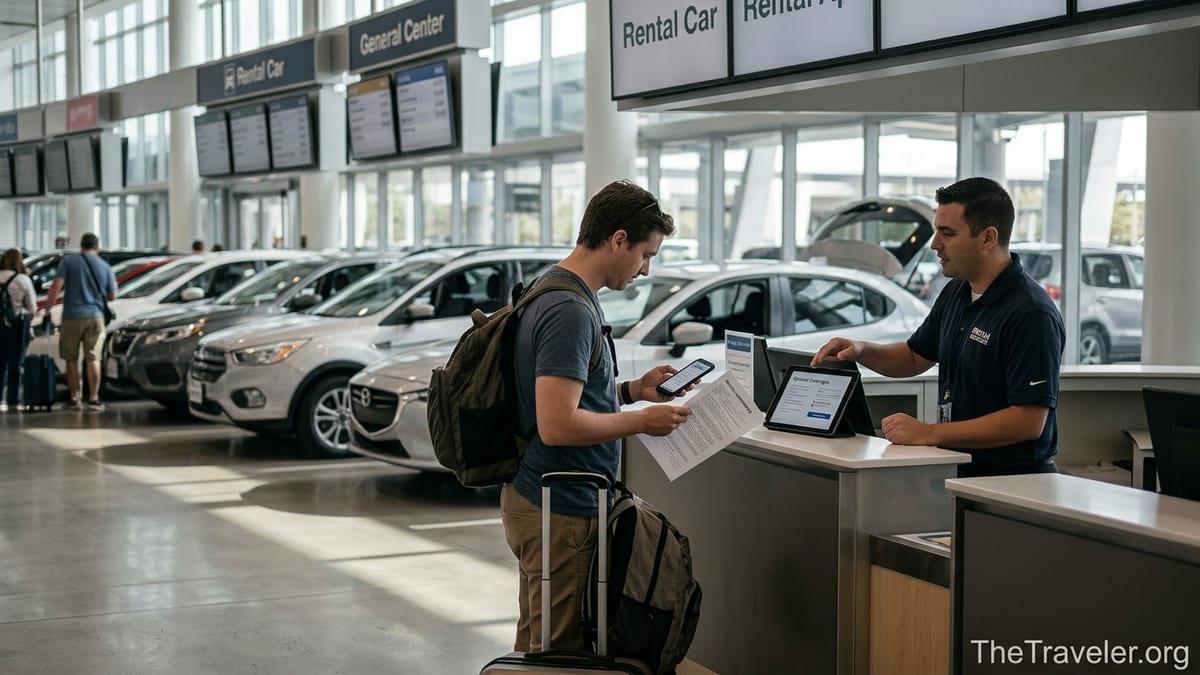
It is one of the most uncomfortable moments of any trip: you have just landed, you are tired, and at the rental counter someone is urgently asking if you want extra insurance that can easily double the cost of your car. Many travelers now try to dodge this hard sell by buying third party protection such as RentalCover before they fly. Used well, it can be a smart way to save money and plug gaps in your protection. Used badly, it can be an unnecessary extra on top of coverage you already have. Understanding when RentalCover makes sense and when it does not can save you hundreds of dollars and a lot of stress if something goes wrong on the road.
Get the latest updates straight to your inbox!
What RentalCover Actually Is (And How It Works)
RentalCover is a specialist provider of rental car protection that sells policies online, often through partners such as Booking.com and Rentalcars.com. Instead of being sold at the counter by Hertz or Avis, you buy it up front on a website and arrive at the desk already covered for damage to the rental vehicle. The protection is typically much cheaper per day than what the rental company offers and follows you across many different rental brands, which is why frequent travelers pay attention to it.
Unlike the collision damage waiver you buy at the counter, RentalCover usually works on a reimbursement basis. If your rental car is damaged or stolen, you still deal first with the rental company and pay any charges they demand for repairs, towing, administrative fees or loss of use. Afterwards, you submit those bills, the rental contract and incident report to RentalCover and request reimbursement up to the limits of your policy. According to the company’s own help materials, approved claims can often be processed quickly, with payment issued electronically rather than through a long paper process.
The important nuance is that RentalCover is not a full substitute for every type of insurance you might need. Its focus is the financial risk attached to the rental vehicle itself: body damage, theft, glass, tires and sometimes extra fees that rental firms add on top of repair costs. It is not a liability policy, so it does not replace the third party liability coverage you are legally required to have when you drive in the United States, Europe or elsewhere. To drive legally, you still need either the rental company’s liability coverage or liability extended from your own auto policy.
In practice, that means RentalCover is best understood as a way to cap or eliminate your financial exposure to damage claims on the car you are renting, not as a replacement for all other protections. Once you see it clearly in that narrower role, it becomes easier to judge when it is worth buying and when other tools such as your credit card, personal auto policy or travel insurance already cover the same risk.
How Rental Company Coverage Works in the Real World
To understand when RentalCover adds value, you first need a clear picture of the coverage that rental companies themselves sell. In most U.S. rentals, the base rate includes only minimal state required liability coverage. Any protection for the car itself is an extra. The most common product is a collision damage waiver, usually described as CDW or LDW, which is technically a waiver of the rental company’s right to collect money from you for damage to or theft of the vehicle rather than a traditional insurance policy.
In a typical U.S. scenario, a renter might arrive at Orlando International Airport and find that the base prepaid rate for a compact car is 35 dollars a day. At the counter, the agent offers LDW at 30 to 40 dollars per day. If you accept, you may walk away with almost no financial responsibility for damage to the car, but your daily cost has effectively doubled. In Europe, the structure is often different. Basic CDW is usually bundled into the rate but comes with a very high excess, commonly 1,000 to 2,500 euros. The counter agent will then offer “Super CDW” or “excess reduction” to bring that excess close to zero, often at 15 to 25 euros per day on top of your base price.
These waivers are convenient and simple. If you scrape a pole in a Rome parking garage after buying Super CDW from the rental brand, you may be able to drop the keys and walk away with no bill and no claim to file. The simplicity is the main selling point. However, the waivers can have important gaps. Many exclude windows, mirrors, tires or underbody damage, and they may not cover administrative fees or loss of use that rental companies frequently add to repair bills. On top of that, the price can easily exceed the cost of the rental itself on longer trips, which is why savvy travelers look for alternatives.
Because rental company coverage is expensive but convenient, the key question for any traveler is whether there is a cheaper way to get equivalent or better protection against damage to the rental car. That question is exactly where RentalCover enters the picture, promising similar or broader coverage at a flat daily rate bought in advance rather than at a stressed counter conversation.
When RentalCover Makes Strong Financial Sense
RentalCover generally makes the most sense when you are facing high excesses or very expensive waivers from the rental company, and you do not already enjoy generous rental car coverage from another source. A classic example is a U.S. traveler booking two weeks in Portugal in August. The rental company’s quote for a compact car in Lisbon may be 40 euros per day, but the full excess reduction package at the counter runs another 20 euros per day, or roughly 280 euros for the trip. When the same traveler gets a RentalCover quote during the online booking flow, the price for an excess reimbursement policy might be closer to 8 to 10 euros per day, or about 120 to 140 euros for the same two weeks.
In that Portugal scenario, the renter has no European auto policy and their U.S. personal auto coverage usually does not extend to cars hired overseas. Some U.S. credit cards offer primary rental damage coverage abroad, but many travelers still carry cards that provide secondary coverage or no coverage at all. In that case, a RentalCover policy that reimburses up to, for example, 50,000 dollars equivalent for damage, towing, glass and tires can effectively step into the role that a rental company’s expensive Super CDW would play, at roughly half the cost. The tradeoff is that the traveler must be willing to pay the rental firm if something goes wrong and then wait for reimbursement rather than walking away immediately.
Another situation where RentalCover can make sense is long rentals in places with notoriously aggressive damage charging practices. For instance, consider an Australian backpacker planning a six week road trip in the United States without owning a car at home. They have no personal auto insurance in the U.S., and their low fee credit card does not include any car rental protection. The rental brand in Los Angeles might quote LDW at 35 dollars per day, which over 42 days adds up to more than 1,400 dollars. A RentalCover policy for the same period can often be purchased at a much lower flat rate for the entire trip, significantly reducing the cost of guarding against body damage and theft.
RentalCover can also be attractive when you are particularly worried about items that are often excluded from rental company waivers and some credit card policies, such as tires, wheels, windscreens or underbody components. Road trips in Iceland on gravel roads, ski trips where chains may be needed, or drives on narrow village lanes with stone curbs in the United Kingdom are examples where travelers frequently suffer tire, wheel or glass damage. A policy that explicitly lists those parts as covered can provide real peace of mind compared with a basic CDW that leaves them out.
When You Probably Do Not Need RentalCover
There are many common situations where purchasing RentalCover is unlikely to provide enough incremental benefit to justify the cost. The most straightforward is when you already have comprehensive collision coverage on a personal auto policy that extends to rentals, and you carry a credit card that offers robust rental car damage protection on top. For a typical U.S. resident who owns a car and drives it daily, these two layers often already protect the rental vehicle itself in most domestic scenarios.
Imagine a driver from Denver who has a mid range full coverage auto policy and pays for a rental in Phoenix with a travel rewards credit card that advertises primary collision damage waiver. If they have an accident in the rental, the credit card’s benefit may pay first for the damage to the rental car, while their auto policy is available for liability claims and any excess. In this case, buying a separate RentalCover policy that reimburses the same category of damage expenses provides far less value. It is another layer covering essentially the same risk rather than plugging a true gap.
RentalCover may also be redundant if you are renting in a country where the rental company’s own package already includes low excess coverage at a reasonable cost. In some parts of Latin America, for example, local regulation or market practice leads rental companies to bundle more complete protection in the base rate than is typical in the United States. If you have shopped around and found a prepaid rate that already includes a low damage excess and clear coverage for glass and tires, the marginal benefit of a third party reimbursement policy is reduced. You would essentially be paying twice for similar protection just to avoid a modest remaining excess.
Finally, RentalCover will not solve situations where your real gap is liability protection rather than damage to the rental car. If you are driving in a U.S. state with only minimal statutory liability limits and you cause a serious accident that injures others, the most important coverage is liability, not the cost of repairing the rental vehicle. RentalCover is all about the car itself. In that scenario, spending extra on a higher liability package from the rental company or raising liability on your auto policy will do more to protect your finances than adding a third party excess reimbursement product.
Key Details Travelers Often Miss About RentalCover
Because RentalCover works as a reimbursement product, understanding its mechanics matters as much as understanding the headline price. If you return a car in Dublin with a scratched bumper and the rental brand charges your credit card 1,500 euros on the spot for repairs and fees, you must have the credit limit or cash flow to handle that immediate hit. You then gather documents such as the rental contract, final invoice, photos and incident reports to submit your claim through RentalCover’s online portal. For organized travelers who photograph existing damage at pickup and keep paperwork, that process tends to be smoother than for those who do not.
Another important detail is that RentalCover expects you to use any other available cover first. The company’s policy wording notes that where appropriate it can require travelers to pursue reimbursement from a free credit card insurance benefit or another travel insurance policy before claiming on a RentalCover policy. In practical terms, that means a traveler who has, for example, a premium credit card with primary CDW might find that RentalCover views its protection as secondary in the event of a claim, which can introduce extra documentation and time.
Travelers should also be aware of coverage limitations related to vehicle type, rental length and location. Policies frequently exclude certain high value or specialty vehicles such as luxury sports cars, large cargo vans or motorhomes. There can also be maximum rental durations per policy, such as 45 or 60 days, after which coverage stops even if the rental continues. If you are planning a long term rental in Europe for several months, you may need to stitch together separate contracts and policies or look for a different form of insurance entirely. Reading the summary of cover for your specific quote is essential.
Finally, it is worth noting that RentalCover focuses on the physical car, not personal accident benefits or belongings inside the vehicle. Medical bills for you and your passengers after a crash are generally addressed by health insurance, personal accident cover in a travel insurance policy, or specific personal accident insurance sold by rental brands. Theft of luggage from the trunk is usually a matter for travel insurance or homeowners insurance. Expecting RentalCover to act as a comprehensive travel policy will only lead to disappointment in the event of a serious incident.
Comparing Real World Costs: RentalCover vs Other Options
One of the most practical ways to decide whether RentalCover makes sense is to run the numbers for a specific trip and compare it against other realistic alternatives. Consider a five day trip to Los Angeles in September. The traveler is a New York resident who does not own a car and therefore has no personal auto policy. The rental brand quotes 45 dollars per day for a midsize sedan and offers LDW at 34 dollars per day. Buying LDW for five days would cost roughly 170 dollars before tax. A quote for RentalCover for the same dates might come in at around 12 to 15 dollars per day, or 60 to 75 dollars in total, less than half the price.
In that Los Angeles example, the traveler’s main alternatives are to rely on a credit card benefit, to buy the rental company’s LDW, or to purchase third party coverage such as RentalCover. If their credit card only offers secondary coverage and explicitly excludes loss of use charges or administrative fees, they may still face substantial bills from the rental company that cannot be recovered fully. A RentalCover policy that lists those items as covered can be appealing, particularly when the price gap with LDW is large and the traveler has no personal auto insurer to step in.
Contrast that with a three day work trip within the United States for a driver who owns a car with good insurance and carries a premium travel credit card. If their card offers primary coverage everywhere outside their home country, a long European rental might be fully protected already as long as they decline CDW from the rental brand and pay with the card. In that scenario, adding RentalCover at, say, 10 dollars per day for 21 days in Spain would cost more than 200 dollars and provide little new benefit compared with the coverage already available through their card and any travel insurance they purchased for medical or baggage reasons.
Numbers will of course vary by destination, season and car class, but the pattern is consistent. When the rental company’s waiver is extremely expensive and your existing coverage is thin, third party products such as RentalCover look attractive. When your other coverage is already strong and rental company pricing is modest, the incremental value of another policy shrinks quickly. The choice is rarely about good versus bad, and more about the marginal value of one more layer of protection.
Practical Steps to Decide If RentalCover Is Right for Your Trip
Because every traveler’s mix of insurance, credit cards and destinations is different, the decision about whether to purchase RentalCover should follow a simple but disciplined checklist. The first step is always to review what you already have. Call or log into your auto insurer and confirm whether your collision and comprehensive coverage extend to rental vehicles in your home country or abroad, and under what limits. A recent consumer guide from a major personal finance outlet in the United States noted that many drivers with full coverage auto policies are already protected when driving rental cars domestically, which means they may be able to safely decline some counter products.
Next, look up the rental car protection benefits for the credit card you plan to use. Many U.S. travel cards include some form of collision damage waiver, described as primary or secondary. Legal and consumer guides point out that secondary coverage often becomes primary when you have no personal auto policy at all, but exclusions, country limitations and vehicle value caps still apply. If your card offers only limited secondary coverage in the country you are visiting, RentalCover may still offer a broader safety net for a modest fee.
Only after you understand your existing coverage does it make sense to compare quotes. Get a real time RentalCover quote for your specific dates and car category while you are logged in to your booking, and note what it claims to cover: damage, theft, glass, tires, towing, administrative fees, loss of use and so on. Then compare that cost with what the rental company is charging for LDW or excess reduction on the same booking summary page. In many cases you will see a clear difference, with RentalCover priced significantly lower. In other cases, such as short rentals in low season, the gap may be small enough that you decide the simplicity of the rental company’s product is worth a modest premium.
Finally, think realistically about your risk tolerance and ability to handle surprises. If an unexpected 1,500 dollar charge on your credit card while on the road would seriously disrupt your finances, you may prefer a product that prevents that bill from arriving in the first place, even if it is more expensive. If you are comfortable fronting that amount temporarily in exchange for a lower total cost and can stay organized for a claim, a reimbursement based solution such as RentalCover is easier to embrace. Reflecting honestly on your own situation will lead to a better choice than following a blanket rule.
The Takeaway
RentalCover and similar third party rental car protection products occupy a useful middle ground between expensive waivers sold at the counter and relying entirely on personal insurance or credit card perks. They typically make the most sense when you are renting in countries where excesses are high and local waivers are costly, or when you do not have robust existing coverage through your own auto policy or a premium credit card. In those settings, the ability to cap your exposure to damage bills at a relatively low daily rate can be a real advantage.
On the other hand, travelers who already carry strong personal auto insurance that extends to rentals, along with high quality credit card protection, gain far less from stacking yet another layer of coverage on top. For them, RentalCover often duplicates rather than replaces existing benefits, turning what sounds like extra security into an unnecessary expense. The same is true when the rental company already includes comprehensive damage protection at a fair price in the base rate; under those circumstances, a third party policy may add cost more than confidence.
The most reliable way to decide is to map out your specific trip, add up the cost of each available option and read the fine print about what each one does and does not cover. Pay particular attention to how claims are handled, whether you must pay first and seek reimbursement later, and where liability coverage fits in. Armed with that information, you can treat the counter conversation as a formality rather than a high pressure test and choose calmly between the rental brand’s waiver, your existing benefits and third party tools like RentalCover.
Viewed that way, RentalCover is less a magic shield and more a flexible option in a broader toolkit. Used in the right situations, it can cut your costs and narrow your financial risk in case of damage to a rental vehicle. Used indiscriminately, it can simply become another line item on a long travel bill. The travelers who get the best value are those who understand the difference.
FAQ
Q1. Does RentalCover replace the rental company’s insurance completely?
Not usually. RentalCover focuses on reimbursing you for damage, theft and related costs for the rental vehicle itself. It does not typically replace the third party liability coverage you need to drive legally, so you still rely on either the rental company’s liability package or a personal auto policy for that.
Q2. If I have a credit card that covers rental cars, do I still need RentalCover?
It depends on how strong your card’s coverage is and where you are renting. Some cards offer primary collision damage waiver with broad coverage, while others are secondary and have more exclusions. If your card benefit is limited or does not apply in the country you are visiting, a RentalCover policy may still add value.
Q3. How much cheaper is RentalCover compared with rental counter waivers?
Prices vary by destination and season, but many travelers find that RentalCover can be noticeably cheaper than the waivers sold at the counter, especially in Europe where reducing a high excess can be expensive. Running a live quote for your dates is the best way to see the difference.
Q4. What happens if I damage the car while covered by RentalCover?
You first deal with the rental company, which may charge your card for repairs, towing and fees. You then collect the paperwork and submit a claim to RentalCover. If your claim is approved under the policy terms, RentalCover reimburses you up to the coverage limit.
Q5. Does RentalCover cover tires, glass and underbody damage?
Many RentalCover policies are designed to include common exclusions from standard waivers, such as tires, wheels, windscreens and underbody damage, but the exact coverage depends on the policy for your country and rental. You need to check the summary of benefits for your quote to be sure.
Q6. Is RentalCover worth it for short weekend rentals close to home?
If you already have full coverage auto insurance that extends to rentals and a decent credit card benefit, many short domestic rentals are adequately protected without extra products. In that case, the incremental value of RentalCover for a single weekend can be small.
Q7. Can I buy RentalCover after I pick up the car?
RentalCover is generally designed to be purchased before you collect the vehicle, often during the online booking process or up to shortly before pickup. Once the rental has started, adding a new policy for that same rental is usually not possible.
Q8. Does RentalCover include roadside assistance?
RentalCover focuses primarily on financial coverage for damage and theft rather than roadside assistance services. Some rental companies sell roadside assistance as a separate product, and your own auto club membership or travel insurance may also offer help such as towing or lockout service.
Q9. What kind of documents do I need to file a RentalCover claim?
Typically you will need your rental agreement, the final invoice or damage bill from the rental company, any incident or police reports, photos if available and proof of payment. Keeping digital copies of these documents during your trip can make the claims process smoother.
Q10. Is RentalCover valid in every country?
Coverage depends on your country of residence and the destination where you are renting. Some countries, vehicle types or rental durations may be excluded or treated differently. You should always read the eligibility section for your specific quote to confirm that your route and rental meet the policy conditions.