


The Basilica Cistern is one of Istanbul’s most atmospheric sites, but its popularity means your experience can swing from quietly mystical to shoulder-to-shoulder busy depending on when you go. Understanding how the crowds move through the day, the week and the year is the key to deciding when to walk down those famous steps under Sultanahmet for the most memorable visit.
Get the latest updates straight to your inbox!
Understanding Current Opening Hours and Crowd Patterns
In 2026 the Basilica Cistern operates on an all‑day schedule that effectively creates two experiences: a standard daytime visit and an evening "Night Shift" session. Recent visitor guides and crowd trackers consistently report opening hours of roughly 9:00 to 18:30 for daytime entry, with a separate evening session typically running from about 19:30 to 22:00. The cistern is usually cleared between 18:30 and 19:30 so staff can reset lighting and prepare for the night programme, which often includes more dramatic illumination and curated sound.
These generous hours mean there is no “closed midday” lull when crowds naturally vanish. Instead, patterns resemble a popular museum: a rush in late morning, a plateau through early afternoon, then a gradual dip late in the day. On peak summer days, several crowd‑tracking sites and first‑hand reports describe queues of 45–60 minutes at midday even for visitors holding a pre‑booked time slot with an audio guide. On quieter winter weekdays, those lines can shrink to 10–20 minutes or vanish entirely just after opening or late in the afternoon.
Ticket prices have also risen sharply, especially for foreign visitors. In early 2026, independent pricing guides estimate daytime entry at roughly the equivalent of 40–45 US dollars for foreigners, while Night Shift tickets typically cost around two‑thirds more, closer to 65–70 US dollars per person. This higher evening price tier naturally keeps overall visitor numbers lower at night, but it has not eliminated peak‑season congestion around the most photographed spots such as the Medusa heads.
Because pricing, hours and management are in flux, it is wise to verify the latest information a few days before you travel using an up‑to‑date Istanbul attractions guide or the city’s official museum information channels. Treat any printed guidebook older than a year as historical rather than current when it comes to both operating hours and crowd dynamics.
The Busiest Times of Day to Avoid
If your goal is to step into the cistern’s half‑dark silence and feel its scale without constant jostling, your main enemy is the late‑morning tour wave. Several 2026 crowd calendars show a clear surge between about 11:00 and 14:00, when large bus tours and multi‑site city excursions tend to time their Basilica Cistern stop between Hagia Sophia and lunch. On popular combo tours that include the Blue Mosque, Hagia Sophia and the cistern, guides often aim to reach Yerebatan Sarnıcı just before midday. The result is a thick flow of groups moving in file along the walkways, with guides stopping every few metres to talk.
In practical terms, that means the worst bottlenecks appear at the narrowest sections of the metal walkways and at the few “must‑get” photo angles near the Medusa bases and the column known as the Peacock’s Eye or Weeping Column. Visitors in April and May 2026 report needing to queue again inside the cistern just to get a quick photo by the Medusa heads, which can easily add 10–15 minutes to an already busy visit at peak times.
Another crowd spike hits around 15:00–16:00 during high season, when independent travellers who lingered over lunch finally make their way to the cistern and overlap with lingering tour groups. This is especially noticeable on weekends and during European school holidays in late June, July and August. In those weeks, arriving between 11:00 and 16:00 almost guarantees you will share the platforms with hundreds of others.
Evening can feel calmer in terms of raw numbers, but the first part of Night Shift, roughly 19:30–20:30, attracts visitors who spent their days at Topkapi Palace or across the Golden Horn and want a final atmospheric stop before dinner in Sultanahmet. Ticket windows reopen specifically for this session, and fast‑track tours often schedule departures around 19:00. If you buy a Night Shift ticket at the door right at 19:30, expect a short initial queue followed by a steady stream of people entering behind you for the next hour.
The Sweet Spots: Best Times of Day for a Quieter Visit
Across recent guide updates, one recommendation repeats with near‑total consistency: go as soon after opening as you can. Arriving about 8:45–9:00, before the line has formed, is still one of the most effective ways to reclaim the cistern’s hushed atmosphere. Visitors entering in the first 30–45 minutes often describe having long stretches of the walkways with clear sightlines and enough space to stop, listen to the drip of water and take photos without being rushed along from behind.
For travellers who are not early risers, a second reliable window tends to open in the late afternoon, from roughly 16:30 until last daytime entry around 18:00. By then, big group tours have mostly departed for Grand Bazaar shopping or Bosphorus cruises, and many individual travellers are drifting toward dinner. The cistern remains far from empty in peak season, but you are more likely to share it with independent visitors moving at their own pace rather than clusters of flag‑following groups.
If you opt for Night Shift, consider aiming for the last possible entry time instead of the first. In practical terms, that often means entering around 21:00 or a little later. By then, the initial wave of visitors who came straight after dinner has already cycled through, and late‑evening wanderers spread themselves naturally across the space. Some photographers and content creators even plan their day around this time slot, timing their visit so they can take longer‑exposure shots from the rear corners of the cistern with fewer people in the frame.
Whatever time you choose, give yourself at least 45–60 minutes inside. The space is not huge, but when it is quieter you will want time to circle back to the Medusa heads, linger around the more intricately lit columns and pause on the central platforms simply to absorb the dim light reflecting off the water. Rushing through in 20 minutes almost always feels like a missed opportunity, especially if you have managed to avoid the worst of the crowds.
Seasonal and Weekly Patterns That Influence Crowds
Crowd levels at the Basilica Cistern fluctuate not only by hour but by season and day of the week. In rough terms, the busiest months are April through early November, with pronounced peaks in late April, May, late June to August and the autumn shoulder season of September and early October. During these months, Istanbul receives heavy numbers of European city‑break travellers, Gulf families escaping summer heat at home and cruise passengers on day visits, all of whom converge on Sultanahmet.
By contrast, December through early March can feel dramatically calmer. Rainy winter weekdays in particular are often described by locals as the best times to drop into the cistern: queues are short or non‑existent, and the cool damp underground actually feels cosy compared with the wind on the Hippodrome above. However, Christmas and New Year weeks can behave more like high season because of increased European tourism, so early‑morning and late‑afternoon strategies still matter then.
Weekends are consistently busier than weekdays. Saturday midday in April or May can feel as crowded as any summer afternoon, with local families from other parts of Istanbul joining international visitors. If your schedule is flexible, a Tuesday or Wednesday morning outside of school holidays will usually be quieter than a Friday or Sunday at the same time. Public holidays, especially during major religious festivals, can also affect traffic patterns as some Istanbul residents have time off and choose to visit headline attractions.
Finally, weather plays an understated role. On very hot summer afternoons, the cistern can act as an accidental refuge from the sun for visitors who have been walking around the Blue Mosque and Hippodrome. That means crowds can spike precisely when you might expect people to retreat to air‑conditioned cafes. Planning your visit for the morning in summer helps you enjoy both lower crowd density and cooler air inside and outside the cistern.
Ticket Strategies and Realistic Queue Expectations
The most reliable way to cut down your time in line is to treat the Basilica Cistern like a headline European museum: assume there will be a queue and choose your tools accordingly. In 2026, cash is no longer accepted at the entrance; foreign visitors pay by card or through digital tickets sold by authorized resellers and tour companies. Several large platforms advertise “skip‑the‑line” or fast‑track entry that pairs an audio guide with a timed meeting point near the entrance, typically inside a nearby cafe or on the plaza facing Hagia Sophia.
While these timed entries generally move faster than the standard line, they do not eliminate queues entirely on busy days. Travellers in spring 2026 report waiting 20–30 minutes even with fast‑track vouchers when they turned up at peak times around late morning. Think of these products as queue‑reduction tools, not magic doors. They work best when combined with smart timing, such as a 9:00 slot or a late‑afternoon entry around 17:00, when the regular line is already shorter.
Guided combo tours can also help you manage crowds if you value context as much as efficiency. Many operators bundle Basilica Cistern entry with Hagia Sophia, the Blue Mosque or Topkapi Palace, spreading visits across the day so that you hit each site at a relatively reasonable time. For instance, a typical itinerary might start at 9:00 at the Blue Mosque, cross to Hagia Sophia by 10:30 and drop into the cistern just after midday. If you choose such a tour, ask explicitly which time they expect to reach the cistern and how large the group will be. Smaller group sizes usually translate into a calmer experience once you are inside.
If you prefer to buy your ticket at the door, build the queue into your day rather than fighting it. On a busy Saturday in July, that might mean arriving at 10:15, accepting a 30‑minute line and using the time to hydrate, review the history of the cistern on a downloaded offline guide or simply rest your feet in the shade. Trying to “squeeze in” the cistern between other fixed plans at midday is when visitors become most frustrated, especially if they underestimate how quickly a modest line can turn into a 45‑minute wait in the sun.
Inside the Cistern: Micro‑Crowds and How to Navigate Them
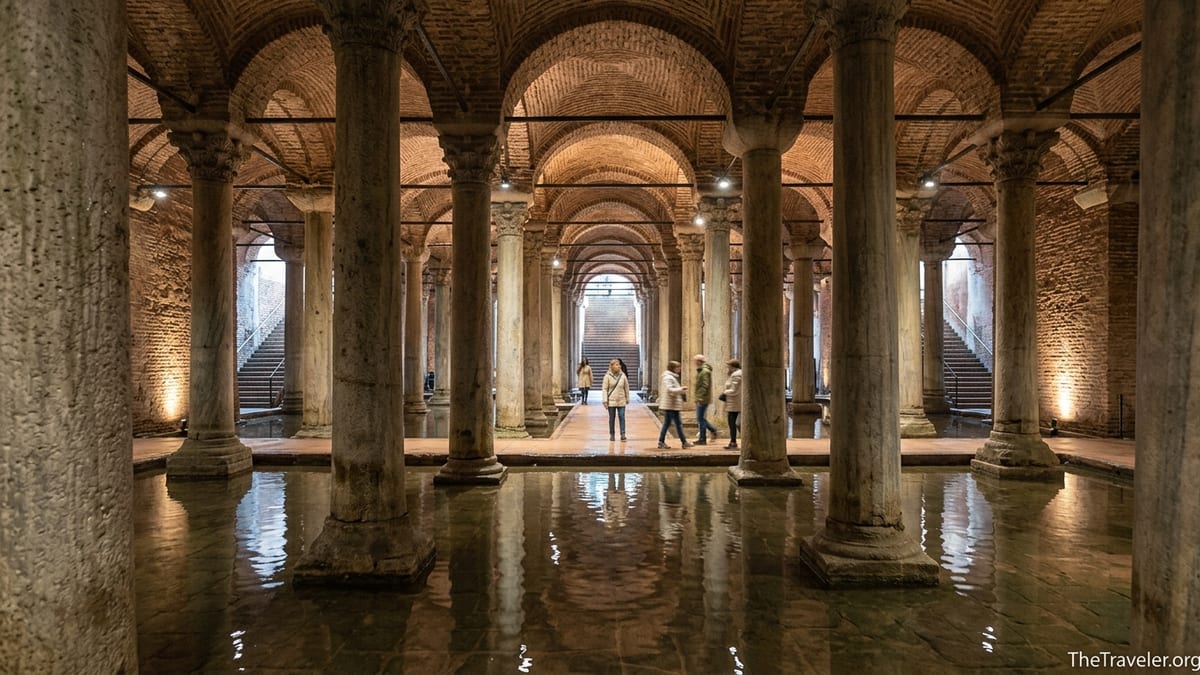
Even on days when the Basilica Cistern is undeniably busy, the experience is not uniformly crowded. Instead, density tends to cluster around a few specific points. The initial stairway and narrow first platform feel tight because everyone is adjusting to the dark and slowing down to take their first photos. Once you move beyond that, the walkways open out, and you can often find gaps simply by letting faster visitors pass and then drifting into the space behind them.
The most intense congestion typically surrounds the Medusa heads, located on two column bases in a back corner. Many visitors treat these as the cistern’s “end point,” walking fairly briskly past dozens of columns only to stop and bunch up in a small area for selfies. If you find this corner swamped when you arrive, do not hesitate to continue beyond it, explore the perimeter platforms and then circle back later. Crowd pulses often run in waves; five minutes can make the difference between standing three‑deep at the railing and walking straight up to the stone faces.
Similarly, the Weeping Column area, with its distinctive teardrop‑shaped engravings, attracts disproportionate attention. Photographers line up here to catch the interplay of greenish light and moisture, while some visitors circle the column in the belief it brings good luck. If you want a quiet moment to appreciate the texture of the brick vaults and the reflections in the water, seek out less famous stretches of the central walkway instead. Standing still in the middle of the cistern for a full minute without a camera in hand is one of the best ways to reconnect with the space, and it is much easier to do when you resist the instinct to cluster where everyone else is clustering.
Lighting also shapes how crowded different sections feel. Recent renovations introduced more theatrical illumination, with some zones bathed in deep red or blue light, others left more restrained. People are naturally drawn to the most dramatically lit columns, which can cause small jams on the narrow offshoot platforms. Moving just a few metres away into more neutrally lit sections often yields the same architectural views with far fewer people in front of your lens.
Alternatives and Backup Plans When It Feels Too Busy
Despite careful planning, you may still encounter a wall of visitors at the Basilica Cistern, particularly on summer weekends or during major events in the city. Having a backup plan can turn that frustration into an opportunity. Within a 10–15 minute walk you will find two other historic cisterns that see far fewer visitors: the Cistern of Philoxenos, also known as Binbirdirek Cistern, and the Theodosius Cistern. Both are smaller and less famous, but each offers a compelling mix of brick vaults, columns and modern art installations with much lighter foot traffic.
Binbirdirek, just west of the Hippodrome, retains a rougher, less polished feel than the Basilica Cistern. Because it is not included on most large‑group itineraries, you are more likely to share it with a handful of independent travellers or small guided groups. The Theodosius Cistern, tucked a little farther away, has been used for immersive projections and tends to draw design‑minded visitors rather than mass tourism. On a day when the line outside Basilica Cistern is snaking halfway down the block, pivoting to one of these spaces can still give you a powerful sense of Istanbul’s underground architecture.
Another practical strategy is to reorder your day on the fly. If you arrive mid‑morning and see a daunting queue, consider swapping plans: visit the nearby Istanbul Archaeology Museums or walk through Sultanahmet’s backstreets and return to the cistern in late afternoon. Many travellers fixate on ticking off the “big three” of Hagia Sophia, the Blue Mosque and the cistern back‑to‑back, which funnels them into the busiest window whether they intend to or not.
Finally, remember that you do not need to see every famous viewpoint inside the cistern to have a meaningful experience. If the Medusa corner is packed and you are short on time or patience, it is entirely acceptable to skip the close‑up selfie and focus instead on the repetitive forest of columns, the dim ripples in the water and the echo of footsteps. In some ways, refusing to chase the same few images everyone else is chasing is the most direct route to a quieter, more personal connection with the space.
The Takeaway
In 2026, avoiding crowds at the Basilica Cistern is less about discovering a secret empty hour and more about making deliberate choices. The cistern will rarely be deserted, but with a bit of planning you can tilt the odds in favour of a slower, more contemplative visit. The most dependable tactics are simple: aim for opening time or late afternoon for daytime visits, or choose a later Night Shift entry if you prefer the evening ambience.
Layer those choices onto the seasonal and weekly rhythms of Istanbul. Prioritise weekday mornings outside major holidays when possible, and accept that July and August Saturdays will always feel busy no matter what you do. Use ticket strategies to reduce but not entirely avoid queuing, and be prepared to pivot to smaller cisterns or nearby attractions if the line outside Yerebatan Sarnıcı looks unmanageable.
Most of all, remember that the essence of the Basilica Cistern is not captured solely at the Medusa heads or the most shared Instagram angle. It lives in the cool air, the rhythmic plink of water droplets and the way hundreds of columns fade into darkness. By timing your visit thoughtfully and resisting the urge to rush, you give yourself the best chance to feel that atmosphere even on a busy day.
FAQ
Q1. What is the least crowded time of day to visit the Basilica Cistern?
The quietest windows are usually just after opening, roughly 9:00 to 10:30, and in late afternoon from about 16:30 to 18:00 on most weekdays outside school holidays.
Q2. Is Night Shift at the Basilica Cistern less crowded than daytime?
Night Shift tends to have fewer total visitors but still feels busy in the first hour after doors open. A later entry, around 21:00, is often calmer than arriving right at 19:30.
Q3. How long should I plan for my visit if I want to avoid feeling rushed?
Plan for at least 45–60 minutes inside the cistern, plus whatever time you are likely to spend queuing. On busy days you may need an extra 20–40 minutes for the line alone.
Q4. Are weekdays really better than weekends for avoiding crowds?
Yes. Tuesdays and Wednesdays are typically the most relaxed, while Saturdays and public holidays see extra visitors from within Turkey as well as international tourists.
Q5. Do skip‑the‑line tickets remove queues completely?
No. Fast‑track or guided tickets usually shorten the wait, especially at peak times, but you can still face 15–30 minutes in line on very busy days.
Q6. Which months are the busiest at the Basilica Cistern?
The busiest periods are generally late April, May, late June through August, and September to early October. December to early March, excluding holiday weeks, is quieter.
Q7. What should I do if the queue is very long when I arrive?
If the line looks overwhelming, consider returning later in the afternoon, shifting your visit to another day, or heading to smaller cisterns like Binbirdirek or the Theodosius Cistern instead.
Q8. Can I visit the Basilica Cistern comfortably with children despite the crowds?
Yes, but timing matters. Early morning visits are best for families, giving children room to move without constant jostling and reducing time standing in line.
Q9. Is there a best day to combine Basilica Cistern with Hagia Sophia and the Blue Mosque?
Combining all three works best on a weekday. Start at one of the mosques at opening time, then aim for the cistern mid‑morning or late afternoon rather than exactly at noon.
Q10. Will renovations or management changes affect crowds in 2026?
Recent years have seen changes in pricing and ticketing, which can shift visitor patterns. Always check updated local sources shortly before your trip for any new policies or temporary closures.