


I arrived at Istanbul’s Basilica Cistern fully prepared to be underwhelmed. On paper it sounded like a predictable stop on the Sultanahmet circuit: an old underground water tank, a few dim lights, a long line of tourists with phones held aloft. I had seen the photos and assumed the atmosphere was mostly the work of clever editing. It was only when I descended the stone steps and felt the air change around me that I realized how wrong I had been.
Get the latest updates straight to your inbox!
From “Just a Cistern” to Sunken Palace
Above ground, the Basilica Cistern hardly announces itself. The entrance sits a short walk from Hagia Sophia in Sultanahmet, behind a modest ticket line and a low, reddish brick building that you could mistake for a neighborhood museum. When I visited, signs advertised standard opening hours from mid-morning to early evening, with an extra nighttime slot several days a week, and tickets for foreign visitors priced in the mid hundreds of Turkish lira range, significantly more than for locals. You buy from a simple booth or machine, then shuffle toward the stairway with everyone else who has also been told that this is a “must see.”
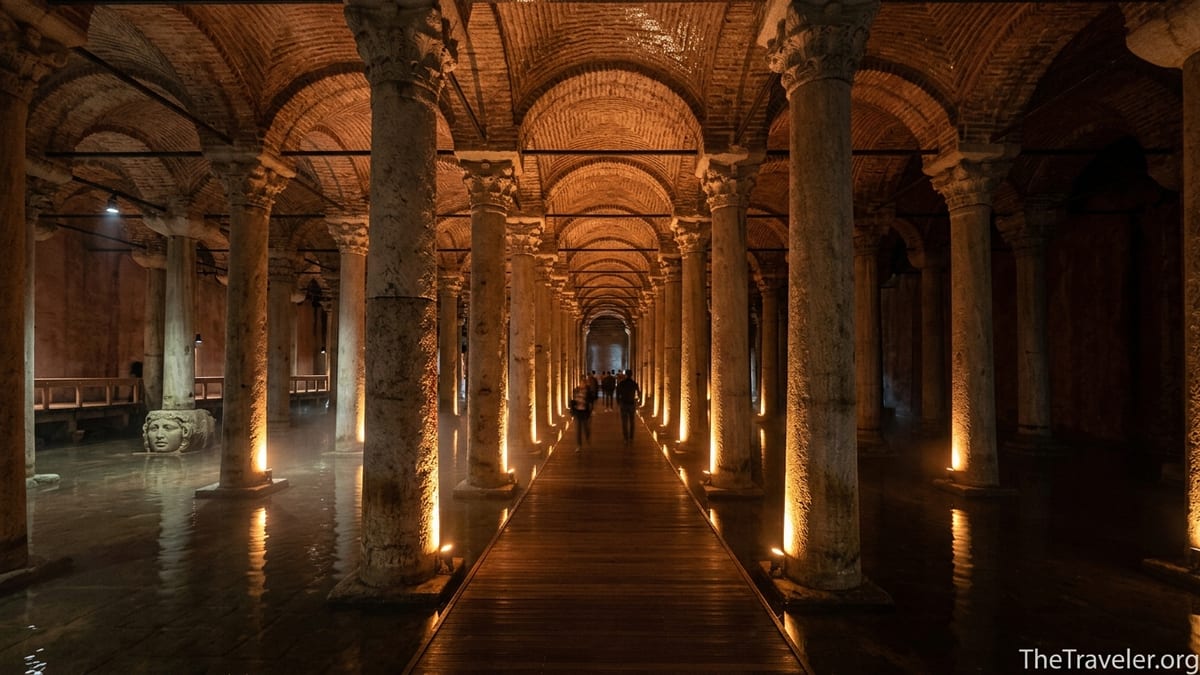
The skepticism stayed with me through the first few steps. Then the noise from the street fell away, replaced by a cool, damp quiet. Halfway down the stairs, the city disappeared. You step off the last stone and suddenly you are standing in a vaulted space the size of a small cathedral, supported by a forest of marble columns. The Basilica Cistern covers roughly 9,800 square meters and holds 336 columns, most about 9 meters high, laid out in a grid of 12 by 28. That grid is what hits you first: row after row of pillars fading into the dark, their reflections doubling in the shallow water below. It feels less like walking into a utility structure and more like entering a palace that someone forgot to empty.
In daylight photos, this scale can be hard to grasp. In person, your eyes need a moment to adjust to the low amber lighting that now replaces the harsh white bulbs of the past. After a comprehensive restoration completed in 2022, the city removed the heavy concrete walkways and thick cement that once covered the original floor. What you see today is closer to the sixth century engineering that Emperor Justinian I ordered in the early 500s, a massive reservoir built to quietly feed the Great Palace and nearby buildings during sieges and dry spells. It is that mix of careful restoration and palpable age that begins to dispel any doubts.
The Details That Photographs Miss
Most images of the Basilica Cistern focus on its famous Medusa heads or long symmetrical views, but they rarely capture the smaller details that bring the place to life. When you step onto the new metal and wood walkways, the first thing you often notice is the smell: a faint mineral scent of stone and water that never fully dries, mixed with a hint of damp earth. The air feels several degrees cooler than the streets above, especially welcome in Istanbul’s summers, and you can hear slow drops of water somewhere in the distance.
Walk a few meters and the columns start to differentiate themselves. These were not carved as a matched set. Many were recycled from earlier Roman buildings across the empire, their capitals mixing Ionic, Doric, and especially Corinthian styles. Look closely and you see weathered carvings, tool marks, and repairs that speak to different centuries and purposes. Some shafts are smooth, others fluted. On one, known informally as the “Crying Column,” moisture runs down its surface more than on its neighbors, creating the impression of carved eyes that weep, amplified by the sheen of the water on the stone.
The lighting design, updated during the recent restoration, is where modern curation quietly shapes your experience. Small spotlights at the base of many columns send their reflections shimmering across the water. The color temperature leans warm, but not theatrical, so the reds in the brick ceiling and the creams and greys of the marble feel natural. In a few sections, projection art and subtle installations are used, but the best moments are the simplest. Stand between two rows of columns and look up: you see the repetition of brick arches, each course laid one on top of another in careful rings, still holding steady after nearly 1,500 years and now reinforced with modern seismic supports hidden above the visitor path.
Meeting Medusa in the Shadows
The Basilica Cistern’s most famous residents are two immense Medusa heads tucked away in the northwest corner. If you arrive following the natural flow of the walkways, you meet them only after you have absorbed the broader space. This delay makes them feel less like a headline attraction and more like a secret someone has told you to seek out. The heads sit at the base of two columns at the far end of the cistern, one placed sideways, the other completely upside down. To reach them, you follow the path as it curves past quieter pools where carp move just enough to disturb the reflections.
When you finally see Medusa, the mood changes again. The head that lies on its side appears first, its serpentine hair eroded but still clear, the face softened by centuries under water. A few steps away the second head stands inverted, chin in the air, forehead toward the floor. No one knows exactly why these sculptures, likely lifted from an earlier Roman monument or temple, were used here. Some guides will mention practical reasons: they were simply the right size and available. Others share later theories that early Christians wanted to symbolically neutralize a pagan symbol by turning it over. In reality, the cistern’s builders probably combined convenience with little concern for mythological meaning, but once you are standing in front of those eyes in the half light, it is easy to see why legends grew.
From a practical perspective, this corner is also where crowds bunch up. In busy months the line to take a photo beside the upside-down head can snake across the surrounding platform. You may see people tossing small coins into the shallow water around the base for luck, even though staff do not encourage it. If you want more space to appreciate the carving and the oddity of such a refined piece of sculpture pressed into service as a buried column base, it helps to let the line pass and come back a few minutes later when a group has moved on.
How the Modern Visitor Experience Really Feels
For all its romance, the Basilica Cistern is also a functioning city museum, and that shapes the way you move through it. Official sources list standard daytime opening from around 9 in the morning until early evening, with an additional nighttime session on some days that can extend toward 10 at night. Exact timings shift slightly by season and special events, so it is wise to double check the latest hours soon before you go. Queues are longest in high summer and on weekends when cruise ship excursions and group tours flock to Sultanahmet. On a July afternoon, waiting 45 minutes to over an hour to buy tickets is common, even for people who had originally hoped to prebook online but found digital sales paused or redirected.
Once you are inside, the visit is mostly self guided. Audio guides are sometimes offered at the entrance, and independent guides often cluster just outside, proposing short tours that include basic history, the engineering story, and a walk to the Medusa heads. Prices vary, but you can expect to pay more for a private guide than for an audio device. For many travelers, a brief introduction to Byzantine water systems before descending, combined with ten minutes on-site, is enough to give context without overwhelming the simple pleasure of wandering slowly among the columns.
The walkways are level and reasonably wide, but the descent and ascent involve stairs. There is usually a handrail, and the humidity can make steps slightly slippery, so flat shoes with decent grip are more comfortable than thin sandals. The space is cool but damp; if you arrive from hot streets you may feel the temperature drop by several degrees. This makes the cistern an excellent refuge in Istanbul’s humid summer afternoons. Conversely, on cold winter days you will be glad of a light jacket as you linger among the columns.
Planning Your Visit Without the Guesswork
One of the most common frustrations visitors report is conflicting information about tickets and temporary closures. In recent years, the Basilica Cistern went through a long restoration, several soft re-openings, and occasional short shutdowns for maintenance or events. As of mid 2026, it is operating as a municipal museum managed by the city, not by the national Ministry of Culture. That means it is not typically included in Turkey’s national museum passes, and you almost always need a separate ticket purchased either at the site or via official city ticketing when available. At times, third party sites may still advertise time slots even when the official operator has paused advance sales, which leads to confusion about whether online tickets are valid.
In practice, this is how a visit often plays out now. You arrive in Sultanahmet and see a short or medium line outside the entrance building. A board lists current ticket prices separately for Turkish citizens and for foreign visitors, with international tickets several times higher. Payment is usually by credit card or local bank card, with cash accepted but not always encouraged at peak hours. If you come early, shortly after opening, you might be inside in 15 to 30 minutes. If you come midday in June or July, you may queue for closer to an hour. During shoulder seasons like April, May, late September, or October, the line shortens considerably, and some visitors walk straight in during late afternoon.
Night visits deserve special mention. When evening openings are running, the atmosphere shifts again. The city is quieter above ground, and many day trippers have already left the old town. Inside, the lighting feels more pronounced against the darkness, yet crowd levels are often lower. If you are comfortable navigating a slightly dimmer setting and want to experience the cistern at its most atmospheric, consider timing your visit for the first or last hour of the day, subject to the latest schedule when you travel.
Beyond the Cistern: Understanding Its Place in Istanbul
Stepping back outside, blinking in the daylight, it can be tempting to file the Basilica Cistern under “spectacular one off” and move on. Yet part of what ultimately won me over was realizing that this reservoir is just one piece of a much larger story beneath Istanbul’s streets. The city is riddled with ancient waterworks. A short walk away you can visit the Cistern of Philoxenos, often called the Binbirdirek Cistern, the second largest in the city, with its forest of brick columns. Farther afield lies the Theodosius Cistern, another beautifully restored underground chamber that now hosts temporary art exhibitions among its arches.
Seeing these sites in sequence deepens your appreciation of the Basilica Cistern. You start to understand why the Byzantines poured so much energy into storing water. Constantinople was one of the most besieged cities in history, and secure supplies meant survival. Aqueducts brought water from the hills outside the city, and cisterns like this one stockpiled it within the walls so that palaces, baths, and entire neighborhoods could endure months of uncertainty. In that context, the architectural flourish of marble columns and sculpted capitals becomes more than decoration; it reflects a culture whose infrastructure and imperial self image were entangled.
In the modern city, this legacy takes on new meaning. Istanbul has turned several of its old cisterns into cultural spaces, pairing historic engineering with contemporary art and performance. At the Basilica Cistern, temporary installations sometimes float on the shallow pools or use the columns as canvases for digital projections. These projects do not always please purists, but at their best they invite new generations to engage with a space that might otherwise feel remote. For many visitors, the long exposure photographs they take here become one of the visual anchors of their Istanbul memories, alongside the skyline of domes and minarets and the ferries crisscrossing the Bosphorus.
The Takeaway
Looking back, my initial skepticism about the Basilica Cistern came from assuming I already knew what to expect. An underground hall with a few pretty columns did not sound like it could compete with walking through Hagia Sophia or watching sunset from a rooftop terrace over the Golden Horn. It was only by giving the cistern time to work on me that I understood why it has endured as a signature Istanbul experience.
Part of its power lies in contrast. One moment you are negotiating tram tracks and street vendors in Sultanahmet, the next you are enveloped in a cool, echoing twilight where every drop of water seems to belong to another century. The site’s scale, the rhythmic repetition of its 336 columns, the quiet presence of the Medusa heads at the end of the path, and the careful blend of old brick and new infrastructure together create a mood that photographs alone cannot reproduce.
If you are debating whether to fit the Basilica Cistern into a tight Istanbul itinerary, it is worth making space. With a bit of planning around opening hours and likely queues, the visit itself rarely takes more than 45 minutes to an hour, yet it adds an entirely different dimension to your experience of the city. This is not just a side attraction beneath a busy square. It is a reminder that Istanbul’s most enduring stories often flow quietly below the surface, waiting for you to step down a flight of worn stone steps and listen.
FAQ
Q1. Where exactly is the Basilica Cistern located in Istanbul?
The Basilica Cistern sits in the Sultanahmet district of Istanbul’s historic peninsula, a short walk from Hagia Sophia and the Blue Mosque, just off the main square.
Q2. How much time should I plan for a visit to the Basilica Cistern?
Most visitors spend between 30 and 60 minutes inside, depending on how long they pause for photos, the Medusa heads, and any temporary art installations.
Q3. What are the typical opening hours of the Basilica Cistern?
In recent seasons, daytime hours have generally run from around 9 in the morning to early evening, with some days offering an additional nighttime session; check current times close to your visit.
Q4. Do I need to book tickets for the Basilica Cistern in advance?
Advance tickets are sometimes offered through official city channels but can be paused without much notice, so many travelers simply buy tickets on the day at the onsite ticket office.
Q5. Is the Basilica Cistern included in Turkey’s national museum passes?
No. The Basilica Cistern is operated by Istanbul’s municipal authorities rather than the national Ministry of Culture, so it is usually not covered by standard national museum passes.
Q6. What should I wear when visiting the Basilica Cistern?
Wear comfortable walking shoes with good grip and bring a light layer. The interior is cooler and damp compared with the streets above, and the steps can feel slightly slippery.
Q7. When is the best time of day to visit to avoid crowds?
The first hour after opening and the last hour before closing, including some evening sessions, tend to be quieter than midday, especially outside peak summer months.
Q8. Are there guided tours available inside the Basilica Cistern?
Yes. Independent guides often offer short tours starting near the entrance, and audio guides are sometimes available for rent, providing history, engineering context, and stories about Medusa.
Q9. Is the Basilica Cistern suitable for children and sensitive visitors?
Many children enjoy the atmosphere and reflections, but the low light, echoes, and images of Medusa can feel eerie. Sensitive visitors may prefer shorter visits and to stay near well lit areas.
Q10. Can I combine a visit to the Basilica Cistern with other nearby sights?
Absolutely. The cistern pairs well with Hagia Sophia, the Blue Mosque, Topkapı Palace, and the Hippodrome, all within easy walking distance in the Sultanahmet neighborhood.