


Deep beneath the busy streets of Istanbul’s historic Sultanahmet district, the Basilica Cistern offers one of the city’s most atmospheric experiences. This vast underground reservoir, with its forest of marble columns and famous Medusa heads, is both a masterpiece of Byzantine engineering and a moody, photogenic stop that fits easily into any first-time Istanbul itinerary. This guide brings together the latest practical details for 2026 with clear on-the-ground advice so you know exactly what to expect when you descend the stairs into the "sunken palace."
Get the latest updates straight to your inbox!
Understanding the Basilica Cistern and Why It Matters
The Basilica Cistern, known in Turkish as Yerebatan Sarnıcı, was built in the 6th century during the reign of Emperor Justinian I as part of Constantinople’s water system. Hidden beneath what was once a public square near the great basilica of Hagia Sophia, it stored hundreds of thousands of cubic meters of water brought via aqueducts from reservoirs outside the city. For centuries it helped feed fountains, palaces, and baths across the imperial capital.
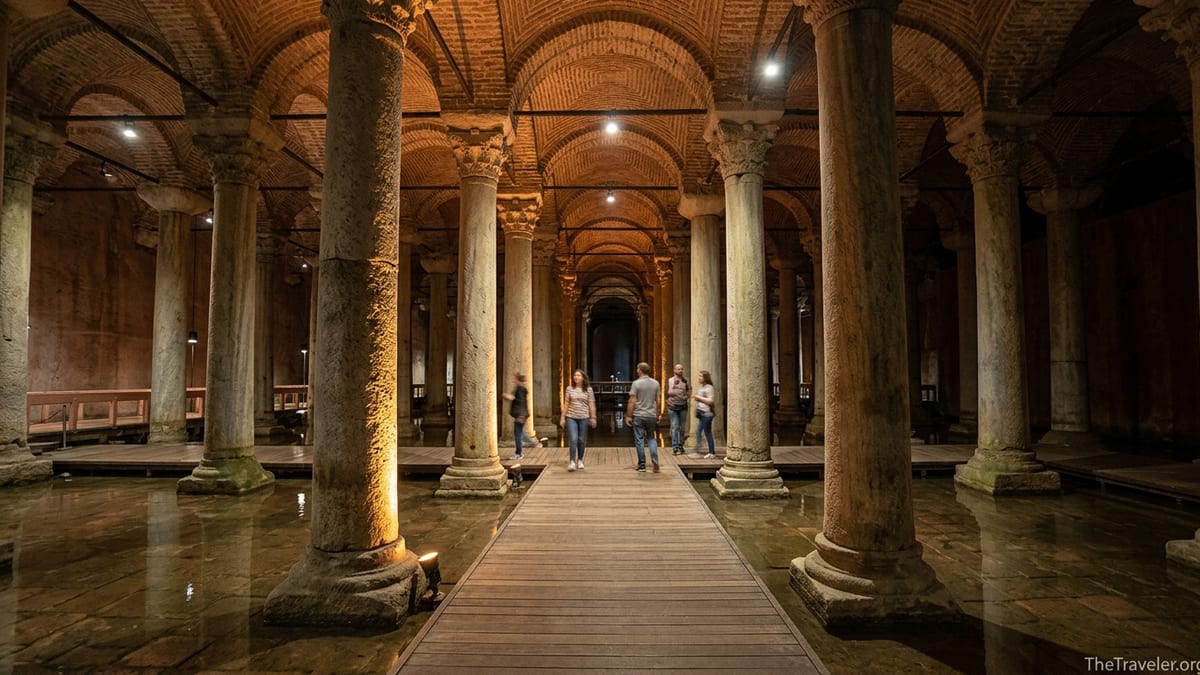
Walking inside today, you see why locals refer to it as the “subterranean palace.” The cistern is supported by more than 300 columns, many reused from earlier Roman structures. Spotlights pick out arches, brick vaulting, and the ripples in the shallow water at your feet. It feels part archaeological site, part art installation, yet it is also a very functional example of how a great city managed water long before modern plumbing.
The site has gone through major restorations since the 1980s and again in the 2010s and early 2020s. The interior now includes reinforced walkways, careful lighting, and occasional contemporary art pieces that highlight the architecture instead of distracting from it. For first-time visitors, this means you get a well-organized route and plenty of chances to pause, take photos, and absorb the details without feeling rushed.
Culturally, the cistern has also become a minor celebrity. It has appeared in films, television series, and travel photography around the world, often standing in for an archetypal “mysterious underground chamber.” For many visitors, it becomes the most unexpectedly memorable stop in Sultanahmet, often rivaling bigger names like Topkapı Palace or the Blue Mosque in emotional impact.
Location, Opening Hours, and How Long to Allow
The Basilica Cistern sits in the heart of Istanbul’s historic peninsula, in the Sultanahmet neighborhood of the Fatih district. Its main entrance is on Yerebatan Caddesi, just across from the northern side of Hagia Sophia and a short walk from the German Fountain and Sultanahmet Square. If you arrive by tram on the T1 line, get off at Sultanahmet station; from the platform it is roughly a 5-minute walk past the square and the Hagia Sophia entrance.
As of mid 2026, the cistern typically opens in the morning and runs into the evening, often around 9:00 to 19:00, with last entry about an hour before closing. These times can shift seasonally or for special events, so when you are planning for a visit on a specific date, it is worth checking same-week information from your hotel or a local tourism office. In practice, most visitors find it easy to combine the cistern with a morning or afternoon at Hagia Sophia, the Blue Mosque, or the Hippodrome, because all of these are within a few hundred meters of each other.
For a first-time visit, plan at least 45 minutes inside the cistern. If you like photography or want to read every descriptive panel, allow 60 to 75 minutes. That does not include any time you might spend queuing outside. In peak summer months like July and August, it is common to wait 20 to 40 minutes in line during late morning and mid-afternoon. In shoulder seasons like April, May, September, or October, waits are usually shorter, especially earlier in the day.
If you prefer quieter conditions and cooler temperatures, consider visiting shortly after opening or later in the evening. Early arrivals often share the space with smaller tour groups, and you are more likely to have clear shots of the famous Medusa heads without crowds pressing in. Late-evening visits can feel particularly atmospheric as you emerge from the dim cistern into an already-dark Sultanahmet lit by streetlamps and the domes of nearby mosques.
Tickets, Prices, and Skip-the-Line Strategies
Ticketing for the Basilica Cistern has changed several times since 2022, including shifts in management and pricing. As of June 2026, there is a separate admission fee and the site is not covered by Turkey’s national Museum Pass. International visitors pay a substantially higher fee than local residents, and the price is reviewed regularly, so expect it to be in the higher range of Istanbul’s major attractions. It is common for travelers to find the cistern ticket among their more expensive single-site purchases in the city.
The most reliable strategy is to budget generously for the ticket in your daily plan, then confirm the exact price once you are in Istanbul. Hotels in Sultanahmet and tour desk operators regularly update printed rate sheets and can tell you the current adult admission cost. As a practical example, many visitors in early 2026 reported paying a little over the cost of Hagia Sophia’s upper gallery ticket for the cistern alone, which gives a rough benchmark; family and child discounts are limited and may apply only to Turkish citizens or residents, so foreign families should assume they will pay close to full adult prices for most older children.
There is usually a standard ticket line at the entrance and a separate lane for small group tours. Third-party tours that include the Basilica Cistern often advertise “skip-the-line” access. In practice, this generally means the guide collects tickets in advance and joins a shorter group-entry line rather than avoiding security altogether. For example, a 3-hour walking tour that visits Hagia Sophia, the Hippodrome, and the cistern may cost the equivalent of several standard tickets but can save 30 to 60 minutes of queuing during peak periods.
For independent travelers, the simplest skip-the-line method is timing. Arriving within the first hour of opening or after the peak midday tour wave has passed typically shortens waits. Travelers staying near Taksim or Karaköy often catch the tram after breakfast, reach Sultanahmet by 9:15 or 9:30, and are inside the cistern before the largest bus tours arrive. Another option is visiting later in the day after an early dinner in Sultanahmet; even if ticket prices remain the same, you are effectively trading money for a much more relaxed experience.
What to Expect Inside: Layout, Highlights, and Atmosphere
After buying your ticket at street level, you descend a staircase to reach the main interior. The first impression is usually auditory: the sudden hush, broken mainly by footsteps on the walkways and the drip of water, is a sharp contrast to the street noise above. The cistern is dimly lit with warm spotlights that emphasize textures in the stone and brick vaulting. The air is cooler and often a little humid, which can be a relief on hot summer days.
The standard visitor route follows a raised walkway that loops around the central section of the cistern. You walk past row after row of marble and granite columns, many with Corinthian or Ionic capitals, reflected in the shallow water below. Along the way you may see subtle exhibits or contemporary installations that use light and sculpture to highlight the structure’s depth and perspective rather than draw attention away from it. For first-time visitors, the experience feels less like walking through a museum and more like wandering through a dreamlike hall where the roof seems to float on pillars.
Toward the back of the route you reach one of the cistern’s main highlights: two column bases carved with the face of Medusa. One is set sideways and the other upside down. There is no definitive explanation for why they are positioned this way. Popular theories range from practical reuse of available stone to a symbolic attempt to neutralize the Gorgon’s power. In practical terms, this is also the most crowded corner of the circuit, as nearly everyone wants a photograph. If you are patient and wait a few minutes, gaps often appear between groups that allow for a clear view.
Another feature to notice is how the lighting changes subtly as you move. Some sections are lit more dramatically, with strong contrasts that emphasize the height of the columns. Other areas use softer, more diffused light that lets your eyes adjust and pick out details in the brickwork. First-time visitors who rush through in 20 minutes often miss these variations. If you can, pause occasionally and look up toward the ceiling to appreciate the full span of the vaults and the sophistication of the engineering.
Best Times to Visit, Pairing With Other Sights, and Photography Tips
The Basilica Cistern is one of the few major historic sites in Sultanahmet that works almost equally well in bright sunshine or rain. On hot days, the underground coolness makes it a natural escape around midday when Hagia Sophia’s exterior courtyards feel exposed and crowded. On wet days, the cistern becomes an atmospheric shelter where you can still sightsee without getting soaked. For this reason, many travelers keep it as a flexible option in their schedule, slotted around weather forecasts and energy levels.
In terms of pairing, the most popular combination is Hagia Sophia plus the Basilica Cistern plus a walk around the Hippodrome and the German Fountain. This route keeps everything within a roughly 500-meter radius. A practical example for a first-timer might be: arrive at Sultanahmet by 8:30, visit Hagia Sophia shortly after it opens, take a late-morning break in a nearby café, then tour the cistern before lunch. In the afternoon, wander the Hippodrome, visit the Blue Mosque when visitor hours allow, and perhaps continue on to the Istanbul Archaeology Museums if your energy holds.
Photography inside the cistern can be rewarding but challenging. The low light and high contrast call for steady hands and thoughtful settings. Smartphones with good night modes generally perform well, especially if you brace your elbows against the railing. If you are using a dedicated camera, a fast lens in the 24 to 35 mm range at a wide aperture works well for capturing both wider views of the column forest and tighter frames around the Medusa heads. Tripods are typically not allowed, both for safety and to keep the flow of visitors moving, so plan on shooting handheld.
To avoid harsh glare, watch for reflections from spotlights on wet surfaces. Many visitors find their best images by stepping slightly off the main clumps of people and shooting diagonally across the rows of columns rather than straight down them. This creates depth and avoids symmetry that can feel flat or artificial. Remember also that the atmosphere is part of the appeal. A small amount of motion blur from a passerby or a slightly hazy corner can make your images feel truer to the lived experience inside the cistern.
Accessibility, Comfort, and Practical On-the-Ground Tips
For an underground monument built 1,500 years ago, the Basilica Cistern is relatively visitor-friendly, but there are still limitations. Access from street level is via a staircase that can be steep and a bit narrow. Once inside, most of the route follows sturdy raised walkways with railings, but some sections can feel damp or slightly slippery, especially near the water’s edge. Comfortable, closed-toe shoes with good grip make a noticeable difference to your comfort and sense of security.
Lighting is intentionally low, which adds atmosphere but can be difficult for visitors with limited vision. The walkways are generally well defined, yet there are moments where it helps to pause, let your eyes adjust, and let faster groups pass by. Families with children often find that holding hands or keeping younger kids close avoids accidental bumps into other visitors or railings. Strollers are technically possible but not convenient because of the stairs and crowds; many parents prefer a baby carrier for infants and toddlers.
Temperature inside the cistern is usually cooler than at street level and can feel pleasantly fresh in summer. In winter or on windy, rainy days, the humidity and cool air may feel chilly, so a light jacket or scarf is useful even if you have been comfortable outside. There are restrooms at or near the entrance area at street level, and it is a good idea to use them before you descend, since there are no facilities underground and re-entry is often not permitted on the same ticket.
For travelers with mobility challenges, it is important to ask your hotel or guide for the latest information before planning your visit. Some recent accessibility assessments note that handrails and structured walkways improve safety once inside, but the initial staircase remains a significant barrier for wheelchair users. In real terms, this means that some visitors choose to appreciate the cistern from above through photography and virtual tours while focusing their in-person time on more accessible sites like parts of Topkapı Palace’s courtyards or the open sections of Sultanahmet Square.
Etiquette, Safety, and Respecting the Site
Although the Basilica Cistern is not a religious building in active use, it is still a fragile historic monument and a shared space. Keeping your voice low maintains the quiet atmosphere that makes the visit special for everyone. The acoustics amplify sound, so even ordinary conversations can echo; many guides adjust by speaking to their groups in short segments and encouraging questions after they step to one side.
Food and drink are not typically allowed inside beyond small bottles of water. There are cafés and restaurants just outside on Yerebatan Caddesi and around Sultanahmet Square, so it is easy to eat before or after your visit. Flash photography is discouraged because it flattens the carefully designed lighting and can disturb other visitors. Most smartphones and cameras perform well enough without flash, especially if you pause for a second while the device adjusts.
From a safety perspective, the main concerns are footing and crowd flow. Taking your time on stairs, using handrails, and avoiding leaning too far over the railings for a dramatic selfie are simple but important habits. During busy times, keep your bag in front of you in crowded sections, just as you would in any major European or Middle Eastern city; petty theft is not rampant but it is sensible to stay alert in popular tourist areas.
Finally, remember that the cistern continues to evolve as a managed site. Lighting schemes, small exhibits, and even ticketing arrangements can be updated as authorities balance conservation with visitor numbers. Approaching the visit with a bit of flexibility, rather than a rigid checklist, helps you enjoy what is actually in front of you on the day you walk down those stairs, rather than what you expected from an older guidebook or a social media post.
The Takeaway
For a first-time visitor to Istanbul, the Basilica Cistern combines history, atmosphere, and convenience in a way few other sites can match. It sits only a few steps from some of the city’s most famous landmarks yet offers a completely different sensory experience. You move from bright plazas and tram bells into a cool, echoing hall of columns and reflections, then emerge again into the light with a new perspective on how old this city truly is.
Planning ahead makes a clear difference. Allow an hour inside, arrive early or late to minimize lines, budget for a higher-end ticket, and wear shoes that cope well with slightly damp floors. Pair the cistern with nearby highlights such as Hagia Sophia, the Blue Mosque, or the Hippodrome, and treat it as a flexible anchor in your day, especially when the weather is hot or unpredictable.
Most importantly, give yourself time to slow down once you are below ground. Step away from the nearest crowd, lean on the railing, and look past the famous Medusa heads to the distant rows of columns fading into shadow. That quiet moment, standing in a space that has held water and stories for more than a millennium, is what tends to stay with travelers long after they have left Istanbul’s old city behind.
FAQ
Q1. How much time do I need to visit the Basilica Cistern?
Most first-time visitors are satisfied with 45 to 60 minutes inside, which allows time to follow the full walkway loop, photograph the Medusa heads, and soak up the atmosphere without rushing.
Q2. What are the usual opening hours in 2026?
As of mid 2026, the cistern generally opens in the morning and closes in the early evening, often around 9:00 to 19:00, though hours can vary by season and special events, so confirm locally just before your visit.
Q3. Is the Basilica Cistern included in the Museum Pass for Turkey?
No. The Basilica Cistern is managed separately from many national museums, so it usually requires its own ticket even if you have a Museum Pass for other Istanbul attractions.
Q4. Can I buy tickets online in advance?
Ticketing systems and online sales options have changed several times in recent years, so the most reliable approach is to ask your hotel or a trusted tour operator in Istanbul for current options during the week of your visit.
Q5. Is the Basilica Cistern suitable for young children?
Yes, many families visit with children who enjoy the dramatic space and lighting, but parents should supervise them closely on the stairs and walkways and be prepared for the low light and occasional crowded corners.
Q6. How accessible is the Basilica Cistern for visitors with limited mobility?
Inside, the walkways are generally flat and have railings, but the main access is via a staircase from street level, which presents a significant challenge for wheelchair users and some visitors with mobility impairments.
Q7. What should I wear for a comfortable visit?
Comfortable, closed-toe shoes with good grip are recommended because some surfaces can be damp, and a light layer such as a jacket or scarf is useful since the underground space is cooler than the street.
Q8. When is the best time of day to avoid crowds?
Arriving within the first hour after opening or later in the afternoon to early evening usually means shorter lines and fewer tour groups than late morning or early afternoon.
Q9. Is photography allowed inside the Basilica Cistern?
Yes, personal photography is generally allowed and very popular, but flash and tripods are usually discouraged or prohibited to protect the site and maintain a pleasant experience for other visitors.
Q10. Can I combine the Basilica Cistern with other major sights in one day?
Absolutely. Because it is only a few minutes’ walk from Hagia Sophia, the Hippodrome, and the Blue Mosque, many visitors include the cistern as part of a compact walking route through Sultanahmet.