


Winter 2026–2027 is shaping up to be one of the best seasons in years for Northern Lights hunters. Solar Cycle 25 is still near its peak, which means more frequent and more intense auroral displays than in a quiet year. For travelers, that raises a practical question: where should you go between November 2026 and March 2027 to give yourself the best odds, and what will the experience actually look like on the ground in terms of darkness, cloud cover, excursions and costs?
Get the latest updates straight to your inbox!
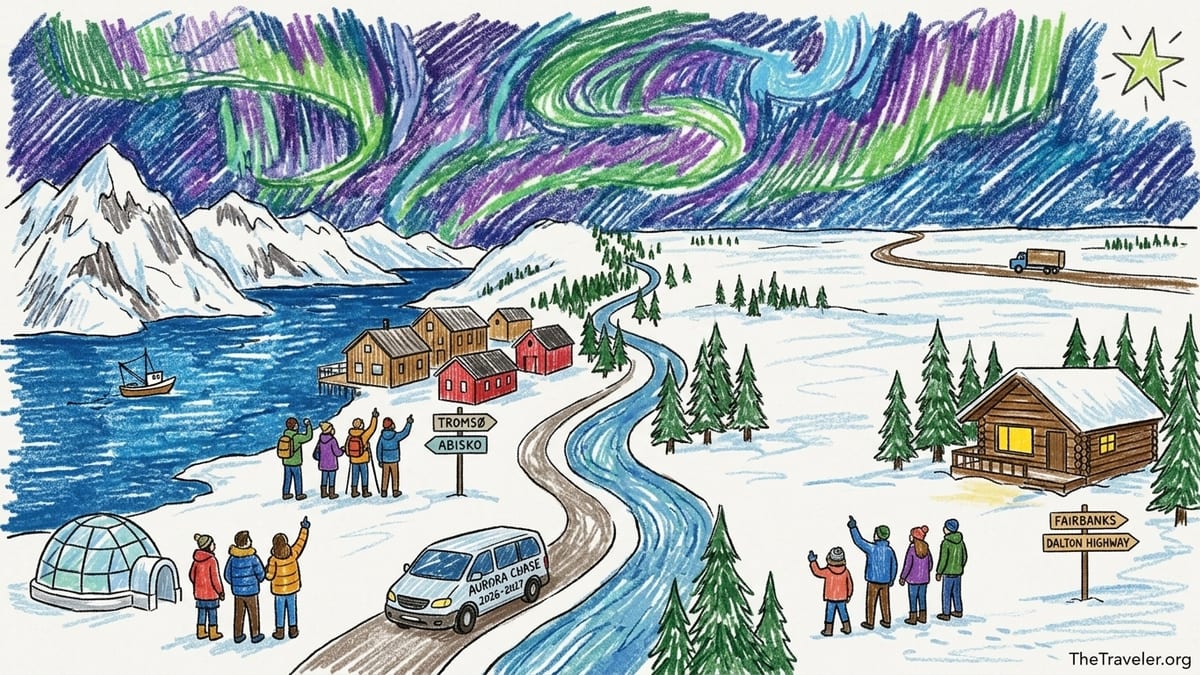
Understanding the 2026–2027 Aurora Season
Auroral activity follows an approximately 11 year solar cycle. Activity peaked around 2024–2025 and is forecast to remain elevated through at least 2027, which means winter 2026–2027 sits in a sweet spot. Space weather specialists note that strong geomagnetic storms will remain more common than in the quieter years that follow, increasing the chance of vivid curtains and fast moving arcs rather than faint glows low on the horizon.
High auroral activity is only half the equation. You still need darkness and clear skies. Across the Arctic, the prime travel window for first time visitors is usually late September to late March, but for this article we focus on the heart of winter from roughly mid November 2026 through March 2027. In this period, nights are long at latitudes around 65 to 70 degrees north, which covers classic destinations such as Tromsø in Norway, Abisko in Sweden, Finnish Lapland, Iceland and Interior Alaska.
Cloud cover is the other key factor. Some regions, like coastal Norway and Iceland, often have excellent auroras hidden behind low cloud or snow squalls. Other locations in the auroral oval, such as the Abisko area in Swedish Lapland, sit in a relative rain shadow and are known for clearer skies even when the wider region is cloudy. This is why many operators based in cloudier cities run “chase” tours by minibus or van that can drive two or three hours inland or to a different fjord in search of holes in the cloud.
Finally, it helps to understand that auroras rarely appear as a guaranteed, on demand “show.” Most guided experiences involve several hours of waiting outdoors, watching and photographing as the sky brightens, fades and flares again. When comparing options for winter 2026–2027, pay close attention not only to where you go, but also to how flexible operators are about moving to clearer skies and how many hours they actually spend under the night sky.
Norway’s Tromsø: Easy Access, Variable Clouds
Tromsø, well above the Arctic Circle in northern Norway, is one of the most popular Northern Lights bases thanks to its good air links and lively winter city atmosphere. Dozens of local and international operators are already selling Northern Lights tours for the 2026–2027 season, ranging from basic bus excursions to small group minivan “chases” that last six to nine hours. Recent price checks on widely used booking platforms and operator sites suggest that a standard minibus Northern Lights chase in January or February 2027 typically runs in the region of 1,500 to 2,000 Norwegian kroner per adult, which at current exchange rates is roughly 140 to 190 US dollars.
The trade off in Tromsø is cloud cover. Local guides and recent traveler reports from early 2026 and late 2026 note that downtown Tromsø itself is often cloudy and suffers from significant light pollution. As a result many operators stress that they do not simply drive to a fixed camp. Instead, they check real time satellite imagery and weather models during the day, then decide on a route that might head inland toward Finnish or Swedish Lapland or along coastal fjords where gaps in the cloud are expected. This style of tour typically departs Tromsø around 18:00 and returns after midnight, so it helps to plan for a very late night back at your accommodation.
For travelers keen on keeping costs lower, Tromsø can also work for semi independent viewing. Locals often recommend darker spots a short drive or bus ride from the city center, such as beaches on Kvaløya island or elevated viewpoints accessible by road. Some visitors also use the city cable car to reach a darker hillside outside the brightest streetlights and watch from there, paying only the cable car fare instead of a full guided tour. In winter 2026–2027, this can be a good option for repeat aurora chasers who are confident driving on snow and ice and comfortable reading basic aurora and cloud forecasts.
If you choose Tromsø for winter 2026–2027, it is worth booking at least one guided “chase” during your stay, even if you plan to do other nights on your own. Having a local guide for one long night teaches you what clear skies actually look like, how fast the weather can change between fjords, and where safe roadside pullouts are in midwinter conditions. It also gives you a realistic benchmark for what a professional operation looks like, which is useful if you are comparing offers from dozens of companies.
Swedish Lapland and Abisko: Darkness and a Drier Microclimate
For travelers who prioritize clear skies and are willing to accept a quieter setting than Tromsø, Abisko in Swedish Lapland remains one of the strongest bets anywhere in the auroral zone for winter 2026–2027. Abisko lies inland, close to the Norwegian border, and sits in the rain shadow of surrounding mountains. Meteorological data for the area describe it as one of the driest parts of Sweden, which in practice often translates to more frequent cloud breaks even when nearby regions are overcast.
Abisko village and the surrounding national park have built a tourism infrastructure around this advantage. Companies such as Lights Over Lapland base multi night aurora holidays and photography courses here, and the well known Aurora Sky Station uses a chairlift to ferry guests up to a dark mountaintop for viewing. Planning documents and price lists for the 2026 winter season from local tourism organizations indicate that the chairlift and viewing experience is sold as an evening product that can be bundled with accommodation at nearby hotels or hostels, with prices that, when converted, often come out similar to or slightly higher than an average guided chase tour from Tromsø.
Cost wise, independent travelers can keep expenses in Abisko under control by staying at simple guesthouses or hostels and booking only a handful of guided nights. Many visitors spend two or three evenings walking down to the shores of Lake Torneträsk or along marked trails away from the village lights and watch independently, saving their budget for at most one premium mountaintop experience or guided photography workshop. Because Abisko has little competing light pollution, it is relatively forgiving for do it yourself stargazing as long as you dress for subzero temperatures and understand winter trail conditions.
Swedish Lapland beyond Abisko also offers strong options. The railway and E10 highway connect Kiruna, Abisko and Narvik, making it possible to combine Swedish and Norwegian fjords in one trip. Package providers already promoting winter 2026–2027 often combine nights in glass roofed cabins or panoramic houses with evening aurora excursions and daytime snowshoe or dog sled outings. In sample winter packages published for 2026–2027, nightly rates for aurora focused cabins with large sky facing windows in remote parts of Lapland often start in the low to mid hundreds of euros per person when bundled with meals and activities, which can be good value when compared with paying separately for standard rooms and nightly tours.
Finnish Lapland: Cabins, Glass Igloos and All Inclusive Packages
Finnish Lapland continues to invest heavily in aurora tourism, and this is clear from price lists and package descriptions already live for December 2026 through March 2027. Around Rovaniemi, Levi, Saariselkä and Inari, travelers can choose between simple cabins, family run guesthouses, and high profile properties with glass roofed igloos or aurora domes. Tour companies marketing winter 2026–2027 northern lights breaks position Finland as a place where you can combine comfortable lodging with bundled excursions such as reindeer sleigh rides, husky safaris and snowmobile outings.
Recent pricing examples checked for the 2026–2027 winter indicate that a basic evening Northern Lights minibus tour from Rovaniemi or Levi typically costs in the region of 80 to 150 euros per adult, depending on group size, inclusions and date. Some operators focus on budget friendly experiences that last three to four hours and include hot drinks rather than full meals. Others market premium “aurora hunting” nights that can stretch to six hours or more, with a higher price tag reflecting both distance driven and included thermal clothing.
For travelers planning a full week in winter 2026–2027, Finnish Lapland’s package deals can work out competitively. For example, sample seven night winter packages sold for December 2026 to March 2027 at cabin complexes in northern Finland show per person package prices that cover accommodation, breakfasts and several included activities over the week. When divided by the number of nights, these packages often land somewhere between a mid range city hotel rate and a full service resort price, while giving you at least a couple of dedicated aurora evenings without the need to book separate nightly tours.
As with other Nordic destinations, cloud cover varies across Finnish Lapland. Coastal areas and locations further south can be cloudier, while interior locations around Inari and Utsjoki tend to have darker skies and slightly better odds of clear nights. Several Finnish operators emphasize in their 2026–2027 marketing that they run flexible aurora “hunts” by minivan, advertised to change direction on short notice based on updated cloud maps, which mirrors the chase model seen in Tromsø and can significantly increase your chances of finding a gap in the clouds on marginal nights.
Interior Alaska: Fairbanks and the Dalton Highway
On the North American side of the auroral oval, Fairbanks, Alaska is once again emerging as one of the best value bases for the 2026–2027 season. It sits almost directly under the average position of the auroral oval, which means that on many active nights you may see lights even with relatively low geomagnetic activity levels. Travel and personal finance outlets profiling winter 2026–2027 trips have highlighted Fairbanks as a place where you can rent a car, watch from cabin rentals outside the city lights, or join guided tours according to your budget.
Recent rate sheets for major Fairbanks based aurora operators for the 2025–2026 season show evening Northern Lights viewing tours priced around 200 to 250 US dollars per person for a typical six to eight hour excursion that includes hotel pickup and transport to a dark viewing location. Updated pricing guidance compiled in late 2026 for the Fairbanks market, drawing from several local tour operators, suggests that many small group aurora “chase” tours in the city sell seats for approximately 200 to 230 dollars per night for winter 2026–2027, with premium options such as yurt based dinners, photography instruction or very long Dalton Highway trips pushing prices into the 300 to 400 dollar range.
Fairbanks is also a hub for multi day Northern Lights trips that head north along the Dalton Highway toward Coldfoot and the Brooks Range. Pricing documents from major operators list combination packages for the 2025–2026 aurora season at several thousand US dollars per person, including guided road transport from Fairbanks to Coldfoot, nights in basic but warm lodging, and a flight back. While specific 2026–2027 rates have not yet been published in every case, it is reasonable to expect broadly similar pricing adjusted for inflation, given the cost of aviation fuel, remote lodging and winter highway operations.
For travelers seeking a lower cost approach in winter 2026–2027, Fairbanks offers several alternatives. Budget minded visitors often rent a car, book a cabin or vacation rental outside the city limits and use free online aurora forecasts and local Facebook groups to decide each evening whether to drive out to simple roadside pullouts or designated viewing areas north of town. Snowmobile based aurora excursions from local outfitters near Fairbanks, highlighted in recent travel coverage, typically start around 160 US dollars per adult for an evening tour, with prices rising for longer or more exclusive trips.
Iceland and Greenland: Balancing Drama and Cloud Cover
Iceland remains high on many travelers’ lists for winter 2026–2027, partly because it combines aurora potential with dramatic landscapes, geothermal pools and easy flight connections from both North America and Europe. However, it is important to be realistic about cloud cover. The island sits in the North Atlantic storm track, and many winter nights bring low cloud or snow that can completely obscure even very strong auroras. Iceland focused travel guides planning for 2026–2027 stress that the country is an excellent all around winter adventure destination, but may not offer the same number of clear nights as inland Scandinavia or Interior Alaska.
In practical terms, Reykjavik based tour companies already advertising for winter 2026–2027 typically sell basic Northern Lights bus tours in the region of 70 to 120 euros per person. Many of these products include a “second chance” policy that lets you join again free of charge if your first night is clouded out or the lights do not appear. Small group 4x4 or minibus tours cost more, often in the low hundreds of euros per person, reflecting the extra mileage needed to drive away from the bright capital into darker countryside or coastal areas.
Travelers who want a higher probability of clear skies while still seeing the North Atlantic coastline sometimes look to Greenland. West Greenland towns such as Kangerlussuaq and Ilulissat sit under the auroral oval and enjoy many clear winter nights, although access from North America and Europe is less straightforward and overall trip costs can be higher due to limited lodging and flight capacity. By winter 2026–2027, more niche operators are likely to offer bundled aurora and iceberg packages here, but travelers should plan carefully around flight schedules and be prepared for fewer backup options if weather closes in.
In both Iceland and Greenland, self driving is a common strategy in March, when roads are clearer and days longer. For travelers visiting between November 2026 and February 2027, however, joining at least one professionally guided night tour is wise, especially in Iceland where road conditions can deteriorate quickly and where local guides are adept at reading short term cloud forecasts and making go or no go calls.
Cloud Cover, Darkness and How Long to Stay
Regardless of destination, the main levers you can pull for winter 2026–2027 are length of stay, timing within the season, and how flexible you remain night to night. Statistically, giving yourself three to four nights in a location inside the auroral oval significantly improves your odds of seeing at least some auroral activity, simply because it is less likely that every night will be cloudy or geomagnetically quiet. Many tour companies structure their packages accordingly, selling long weekend or week long itineraries to spread the weather risk.
Darkness also matters. In November and December, locations at 65 to 70 degrees north enjoy extremely long nights, which can mean aurora viewing is possible from mid afternoon through the early hours. By March 2027, nights shorten but the trade off is often more comfortable temperatures and milder travel conditions. For example, a mid January night near Fairbanks can easily see temperatures below minus 25 degrees Celsius, while a March evening in Tromsø or Rovaniemi might feel significantly less harsh.
Cloud cover patterns differ dramatically from place to place. Coastal areas like Tromsø and much of Iceland see frequent low cloud and precipitation, which is why their better operators market themselves as “chase” specialists who will happily drive guests a long way inland if that is where the breaks in the cloud are predicted. Inland locations like Abisko and parts of Swedish and Finnish Lapland tend to have fewer cloudy nights, but they still see periods of overcast weather, particularly during passing low pressure systems. When planning a winter 2026–2027 trip, think of cloud cover as the main uncertainty you are trying to outsmart with extra nights and flexible logistics.
Another practical consideration for winter 2026–2027 is the influence of large scale climate patterns. Long range seasonal outlooks for the 2026–2027 North American winter mention a strong El Niño pattern, which may affect storm tracks and temperature anomalies in both North America and northern Europe. While these forecasts cannot predict cloud cover for specific nights months in advance, they reinforce the idea that booking slightly longer stays and building in a rest night between organised tours is a sound strategy.
What Aurora Excursions Really Cost in 2026–2027
One of the most common questions for winter 2026–2027 is how much to budget per night for an organised Northern Lights experience. Based on price lists and tour descriptions published in 2025 and updated in 2026 for the coming season, a useful rule of thumb for mid range operators is that a standard six to eight hour aurora tour in a minibus or van typically costs between about 150 and 250 US dollars or local currency equivalent per adult. This range covers most road based “chase” tours from Tromsø, Rovaniemi, Levi, Reykjavik and Fairbanks.
Premium products sit above this. In Alaska, multi day Dalton Highway trips or packages that include flights to remote communities, several nights of basic lodging and daytime Arctic experiences can easily reach into the low thousands of dollars per person. In Scandinavia, high end glass igloo stays or overwater cabins marketed specifically for Northern Lights viewing often charge several hundred euros per night before you add separate tours. In both cases, part of what you are paying for is the ability to watch the sky from a warm bed or private hot tub whenever the aurora appears, without having to join a group every night.
At the budget end, simple bus tours or short “aurora experience” evenings built around another activity can price in the region of 70 to 120 euros in Nordic countries or similar amounts in Iceland. Examples include snowmobile tours that include an hour or two of aurora watching, or reindeer sleigh rides followed by a short period outside a lavvu or kota tent. These can be memorable, but they do not offer the same focused, hours long hunting that dedicated aurora chasers prefer.
Travelers planning for winter 2026–2027 should also factor in hidden costs. Arctic rental cars in high season are rarely cheap, winter clothing rentals can add a meaningful sum if you do not bring your own gear, and some operators charge extra for high quality photos or for thermal boots and overalls. Trip planners who recently surveyed Finnish and Alaskan tour markets for 2026 highlight that the most cost effective strategies are often to book two or three high quality small group chases and combine them with independent viewing from dark accommodations, rather than signing up for a paid tour every single night.
Planning Your 2026–2027 Northern Lights Trip
Pulling these threads together, the best destination for winter 2026–2027 depends largely on your priorities. If you want vibrant nightlife and a large choice of day tours alongside Northern Lights hunting, Tromsø, Reykjavik and Rovaniemi all offer strong packages, accepting that cloud cover may limit your sky time and that you will likely rely on chase style tours. If your main goal is to quietly maximise clear nights, inland bases such as Abisko, Kiruna and parts of Finnish Lapland, along with Interior Alaska around Fairbanks, stand out for their combination of darkness and drier climates.
For most travelers, a realistic strategy for winter 2026–2027 is to choose one primary base, stay at least four nights, and pre book two or three organised aurora excursions with reputable operators. The remaining nights can be kept free for rest or self guided viewing. This approach spreads both weather risk and cost, while preserving the sense of adventure that comes from standing under a star filled Arctic sky waiting for the first pale arc to appear.
Regardless of where you go, remember that the Northern Lights are a natural phenomenon. Even in a strong solar year like 2026–2027 there will be quiet nights, cloudy spells and short, subtle displays mixed in with the headline grabbing outbursts. The more you treat an aurora trip as a broader winter journey, with sled dogs, ski trails, saunas and cultural visits to fill the days, the more likely you are to return satisfied even if the sky only erupts in colour once or twice.
As bookings build toward the peak months of January, February and early March 2027, availability at smaller lodges and with the best rated aurora guides is likely to tighten. If seeing the Northern Lights has been on your list for years, the continuing strength of Solar Cycle 25 and the detailed tour offerings already published for the 2026–2027 season make this a compelling winter to finally head north.