


In a park famous for soaring peaks and tumbling rivers, Great Smoky Mountains visitors often assume the tallest waterfall will be the most impressive. Then they hike the 5-mile roundtrip trail to Abrams Falls in Cades Cove, stand at the edge of its vast churning pool, and realize that raw power in the Smokies is not just about height. At just 25 feet, Abrams Falls routinely leaves a deeper emotional imprint than waterfalls three and four times its size, a surprise that has turned this compact cascade into one of the park’s most talked-about hikes.
Get the latest updates straight to your inbox!
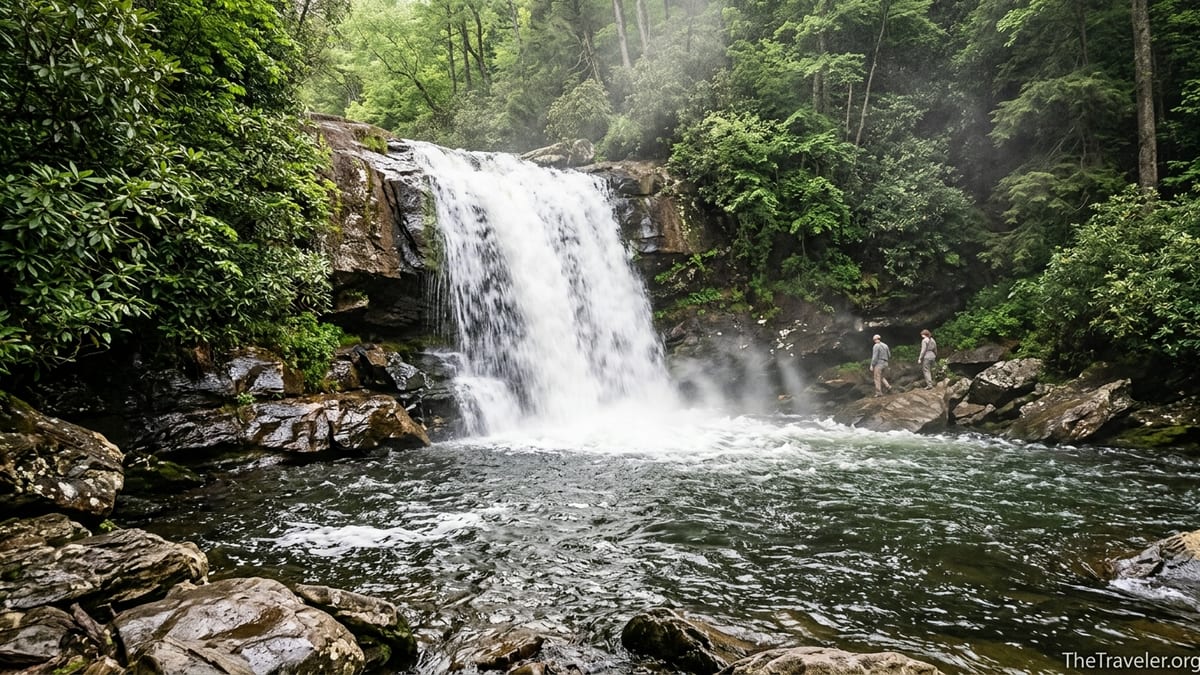
Abrams Falls in Context: Short, Stocky and Surprisingly Intense
On paper, Abrams Falls should be a supporting character in the Smokies waterfall lineup. The National Park Service lists it at roughly 25 feet high, a fraction of the 80-foot Laurel Falls and the 100-foot Ramsey Cascades, which is the tallest major waterfall in Great Smoky Mountains National Park. Yet Abrams Falls appears again and again in guidebooks, cabin company recommendations and visitor rankings as one of the park’s must-see sights. Travelers driving the Cades Cove Loop Road routinely plan their day around hiking to this particular waterfall, even when they know it is not the tallest.
What Abrams lacks in vertical drama, it makes up for with volume. Fed by Abrams Creek, one of the largest streams contained entirely within the park, the waterfall slams a broad, heavy sheet of water over a sandstone ledge into one of the biggest plunge pools in the Smokies. Stand on the boulders at the pool’s edge and the physical sensation is immediate: a dull, continuous roar in your chest, cool mist on your face, and turbulent water churning just a few feet away. Many hikers who have visited Ramsey Cascades, Rainbow Falls and Laurel Falls report that the shorter Abrams “feels” stronger, louder and more physically present.
That disconnect between height on a map and power in real life is the starting point for understanding why Abrams Falls affects travelers so deeply. In the Smokies, waterfall impact comes from a mix of geology, hydrology, trail design and human perception. Abrams happens to sit at the sweet spot where all those elements converge.
Water Volume and Pool Design: The Hydraulics of Power
The most important reason Abrams Falls feels so forceful is the amount of water moving through a very compact vertical drop. Abrams Creek drains a large, rain-soaked basin in the western Smokies, and flows strongly through much of the year. Instead of breaking into thin veils or multiple tiers, the creek narrows and plunges in a thick curtain into a tight rock amphitheater. Even in drier weeks, the flow is usually substantial enough that the sound drowns out trail chatter long before you get a clear view.
The plunge pool magnifies that effect. The falls pour into a deep basin scoured over thousands of years by the spinning turbulence at its base. The National Park Service warns visitors about strong currents and an undertow in this pool, a reminder that much of the waterfall’s energy is hidden below the surface. From a human perspective, you are looking at one concentrated zone where a powerful creek is slamming into deep water and then immediately squeezing between boulders downstream. The result is whitewater that seems to boil in all directions at once.
Compare that with a taller but more delicate waterfall such as Laurel Falls. There, an 80-foot drop is broken into an upper and lower section, with water fanning out over angled rock and a paved trail passing through the middle. It is picturesque and photogenic, but you can see how gravity is stretching the same amount of water over a much greater distance. The sound is a lighter rush rather than a chest-deep rumble. At Abrams, the shorter distance between lip and pool means more of that potential energy arrives all at once, and you feel it.
The geology at the site reinforces this impression of raw power. Abrams Falls spills over a relatively hard sandstone ledge, its lip sharply defined. The basin below is framed by house-sized boulders and steep banks lined with hemlock and rhododendron. There is little open, gentle rock leading away from the drop, so your entire view compresses the drama into a single compact frame: a heavy sheet of water, a dark swirling pool, and tangled rocks bracing the impact.
Trail Approach: How the Hike Sets Up the Finale
Part of what makes Abrams Falls feel so powerful is the way the trail leads you there. The Abrams Falls Trail begins off the one-way Cades Cove Loop Road and generally follows Abrams Creek through a rolling forest for roughly 2.5 miles one way. Much of the path undulates up and down short ridges rather than climbing relentlessly. You cross small bridges, pass rhododendron thickets and look down at riffles and small cascades on the creek below.
For long stretches, the sound of Abrams Creek is present but not overwhelming. You hear it as a background accompaniment while walking through pine and hemlock stands, or skirting mossy outcrops. There are hints of larger drops downstream, but you do not actually see the main waterfall until the final approach. That means your senses have twenty to thirty minutes of quieter stream noise to calibrate before the full roar of the falls suddenly takes over.
The final approach drops you into a rocky bowl where the creek contracts and plunges. Stones underfoot are damp and often slick, and the sound bounces off the surrounding cliffs. For many hikers, especially families staying in nearby Pigeon Forge or Townsend, Abrams is one of the first “moderate” Smokies hikes they attempt. They arrive a bit tired, a bit sweaty from humid Tennessee air, then step onto the last cluster of rocks and are hit with the combined wall of sound, breeze and body-scaled movement of water. The hike has carefully, if unintentionally, staged the reveal.
Compare that to Rainbow Falls, which sits higher on the slopes of Mount Le Conte. The trail there climbs steadily, gaining significant elevation on a rocky path. By the time you reach the roughly 80-foot waterfall, you are already aware that you are high in the mountains. The air is thinner and cooler, and the stream feeding Rainbow Falls is narrower. The waterfall itself is tall, and on sunny afternoons it can throw the rainbow that gives it its name, but the flow often feels lace-like rather than muscular. The build-up is more about gaining altitude and earning a mountain view than being drawn deeper into one powerful creek system.
Human Scale: Why Being Close Matters More Than Being Tall
Travelers rarely measure a waterfall’s impact with a tape measure. What registers is how the water feels, sounds and moves in relation to their own body, and on that front Abrams Falls has a decisive advantage. The plunge pool is close. There is no fenced-off overlook perched far above or across a wide gorge. You walk down to a gravel and rock shoreline and sit or stand within a few strides of the churning water. When parents tell children to step back, it is for good reason: they are genuinely, physically close to a deep, energetic pool. That proximity is what makes the experience visceral.
At Ramsey Cascades, by contrast, the final viewpoint is perched among large boulders beneath a 100-foot staircase of water. The falls are stunning, and hikers often rank this as the park’s best waterfall hike after a demanding 8-mile round trip that climbs over 2,000 feet. But the water is distributed among multiple ledges, fanning and bouncing through a jumble of rock. You feel awe and accomplishment, and you can sense the height, yet much of the flow is visually distant and spread out.
The human brain tends to read width and volume at eye level as power. Abrams delivers a wide curtain pouring almost directly in front of you. Even a visitor who is not especially outdoorsy will notice how quickly a tossed stick disappears into the turbulence, or how hard it would be to swim across the pool. Hikers often mention that the falls “sound like a freight train” in early spring or after heavy rain, an everyday comparison that signals their instinctive sense of scale.
Photographers feel this difference as well. Handheld shots taken on a basic smartphone or entry-level mirrorless camera at Abrams often show spray dots on the lens, blurred motion in nearby branches and a foreground of churning water that looks almost too close. The same cameras at Laurel Falls or Rainbow Falls typically produce images that feel more distant and composed, with a walkway or open rock providing a buffer. The images from Abrams convey immersion; the others, observation.
Sound, Sensation and Emotion: The Psychology of a “Powerful” Waterfall
Ask hikers leaving the Abrams Falls trailhead parking area what they remember most and many will mention the sound first. The roar begins as a low hum a few minutes before the falls come into view and builds into a sustained thunder that forces people to raise their voices. Low-frequency sound waves carry farther and are felt physically as a vibration, especially in the chest and stomach. That audio signature is part of why Abrams feels more muscular than its modest height suggests.
Psychologically, heavy sound and moving water trigger a mix of excitement and caution. Travelers frequently report that Abrams Falls feels “wild” even though the trail is well maintained. Children are often both thrilled and unnerved by the movement of logs rolling in the current or waves rebounding off submerged rocks. Adults, meanwhile, tend to linger in a semi-meditative state, watching the unending repetition of the falling sheet of water. The combination of volume, rhythm and unpredictability is emotionally absorbing.
Light and microclimate add another layer. Abrams Falls sits in a sheltered bowl surrounded by evergreens and rhododendron, so mist hangs longer in humid weather. On a bright June afternoon, sunlight filtering through leaves catches tiny droplets in the air, creating shifting sparkles rather than distant rainbows. On cloudy autumn days after rain, the setting feels nearly enclosed, with orange and gold leaves plastered to wet rock around the pool. Either way, moisture in the air cools the skin and reinforces the sense of standing inside the waterfall’s sphere of influence, rather than looking at it from outside.
That immersive quality contrasts sharply with roadside or drive-up waterfalls elsewhere in the region, where you might stand at a safe railing on a dry overlook. At Abrams, even people in expensive hiking sandals or brand-new sneakers find themselves hopping between wet rocks and feeling spray on their legs. Power, in this context, is not just the water’s force. It is the waterfall’s ability to pull you into its atmosphere and hold your attention longer than you expected.
Seasonal Shifts: When Abrams Feels Strongest
Like every stream-fed waterfall in the Smokies, Abrams Falls changes character with the seasons. Travelers visiting in late spring often find it at its most photogenic and dynamic. Snowmelt from higher elevations and frequent spring rainstorms keep Abrams Creek running high, and the surrounding forest is a deep, fresh green. The waterfall’s curtain looks thick and seamless, and mist hangs in the air. In these conditions, even people who have seen it before comment that it seems louder and faster than on previous visits.
In summer, flow can moderate but rarely disappears. Because Abrams Creek drains a relatively large basin, it tends to hold water better through dry spells than some smaller streams feeding other waterfalls. Families staying in Cades Cove campgrounds often budget a morning or late afternoon to tackle the hike, pairing it with biking the loop road on vehicle-free days. Late-day light can make the falls glow, with deep shadows on surrounding rock emphasizing the bright, moving water.
Autumn brings another layer of intensity. As hardwoods around Cades Cove peak, the hike to Abrams Falls turns into a corridor of yellows, oranges and reds. Fallen leaves plastered on wet rock near the pool remind visitors just how saturated the basin is. After a rainy October front, the creek can rise quickly, and park rangers sometimes emphasize renewed warnings about entering the water. The cold season, meanwhile, offers a different kind of power. On frigid mornings, spray from the falls coats nearby branches in a fragile skin of ice, and a thin rim of frozen foam can circle the plunge pool. The contrast between freezing air and constantly moving water underscores the system’s unstoppable energy.
Comparing across seasons can also highlight why height is not the only measure of impact. On a late-summer afternoon after a dry spell, a tall waterfall like Rainbow Falls can shrink to a shimmering ribbon of water, strikingly beautiful in its delicacy. Abrams, drawing from a larger creek, often remains a muscular torrent by comparison. Travelers who see both in the same trip often come away saying the shorter waterfall felt more alive.
Safety and Respect: Power Has a Dark Edge
The same attributes that make Abrams Falls feel powerful also make it one of the more hazardous locations in Great Smoky Mountains National Park. The National Park Service explicitly warns visitors not to swim at the base of the falls, citing the undertow and strong currents in the plunge pool. Over the years, drownings and serious injuries have occurred when people underestimated the force of the water, tried to wade across the pool, or scrambled onto wet rocks near the lip.
For travelers, this duality is important. Appreciating why Abrams feels so strong involves recognizing that the sensation of danger is not imagined. Large volumes of cold mountain water dropping into a confined pool create hidden hydraulics. A person standing waist-deep near the outflow might feel stable one moment and be knocked off their feet the next by a surge or by tripping on a submerged rock. Logs that look stationary can shift suddenly. Even on seemingly calm days, currents beneath the surface can pin swimmers against boulders.
Basic precautions help preserve the awe without courting risk. Most experienced hikers recommend enjoying Abrams Falls from solid, dry rocks a safe distance back from the water and saving swimming for safer stretches of river outside the park. Good footwear with grippy soles, such as light hiking shoes or trail runners, reduces the odds of slipping on wet stone. Keeping children within arm’s reach near the pool edge is essential. If the water appears especially high or discolored after heavy rain, it is wise to appreciate the added intensity from even farther back.
Far from diminishing the experience, that element of danger can actually sharpen travel memories. Many visitors remember the firm tone of ranger warnings at Cades Cove, the posted signs near the trailhead, and their own decision to stay ashore. The falls feel powerful, in part, because you know that entering the water would be crossing a line between safe admiration and real risk.
The Takeaway
For travelers planning a Great Smoky Mountains itinerary, Abrams Falls is a useful reminder that numbers on a sign do not capture how a place will feel. Height may make a waterfall famous, but volume, proximity and setting determine its emotional weight. Abrams is short, yet it channels one of the park’s largest creeks into a deep, confined plunge pool a few strides from where you stand. The trail approach tunes your senses, the rock bowl concentrates sound, and the mist-filled air closes the distance between viewer and cascade.
Put simply, Abrams Falls feels powerful because it interacts with you at human scale. You hear it long before you see it. You feel the vibration underfoot and in your chest. You taste the spray. In contrast, taller Smoky Mountain waterfalls often impress from a polite distance, their drama measured in vertical feet and panoramic photos. When you walk away from Abrams, the memory you carry is not of a number, but of a moment: standing close to a compact thunderstorm of water, small in stature but outsized in impact.
FAQ
Q1. How tall is Abrams Falls compared to other Smoky Mountain waterfalls?
Abrams Falls is about 25 feet high, much shorter than waterfalls like Laurel Falls at roughly 80 feet and Ramsey Cascades at around 100 feet, yet it often feels more forceful because of its heavy water flow and deep plunge pool.
Q2. Why does Abrams Falls feel more powerful than taller waterfalls?
Because Abrams Creek carries a large volume of water into a compact drop and confined basin, the energy is concentrated instead of spread over multiple tiers, creating a louder roar, stronger currents and a more physical sense of power.
Q3. How difficult is the hike to Abrams Falls?
The hike is about 5 miles round trip from the Cades Cove Loop Road trailhead, with rolling terrain and some short, steeper sections. Most visitors consider it moderate: manageable for reasonably fit adults and older children used to uneven, rooty trails.
Q4. Is it safe to swim at the base of Abrams Falls?
No. The National Park Service strongly advises against swimming there due to strong currents, an undertow and hidden hazards in the deep plunge pool. Visitors should admire the falls from solid, dry rocks a safe distance from the water.
Q5. When is the best time of year to visit Abrams Falls?
Late spring and fall are ideal for many travelers. Spring often brings higher flows and lush greenery, while autumn adds colorful foliage around the creek. Summer can still be rewarding but may be busier and, in drier periods, slightly lower in flow.
Q6. How does Abrams Falls compare to Laurel Falls for first-time visitors?
Laurel Falls offers a shorter, partially paved hike and an 80-foot two-tier waterfall, making it popular with families seeking an easier outing. Abrams Falls requires more effort but delivers a closer, more immersive experience with a stronger sense of water power.
Q7. Do I need special gear for the Abrams Falls hike?
Sturdy walking or hiking shoes with good traction are highly recommended, as rocks and roots can be slick. Bringing water, snacks, a light rain jacket and a small daypack is sensible, but specialized mountaineering gear is not necessary in normal conditions.
Q8. How crowded does Abrams Falls get, and when should I start?
Abrams Falls is one of the park’s more popular waterfall hikes, especially on weekends and during peak seasons. Starting early in the morning, before most Cades Cove traffic builds, gives you a better chance at parking and a quieter experience at the falls.
Q9. Are there facilities near the Abrams Falls trailhead?
The trailhead is located along the Cades Cove Loop Road, where you will find designated parking and, seasonally, restrooms and picnic areas elsewhere along the loop. There are no services at the waterfall itself, so you should bring what you need and pack out all trash.
Q10. Can children and less experienced hikers handle the Abrams Falls trail?
Many families hike to Abrams Falls successfully, but it is more demanding than the park’s shortest, paved walks. Children and beginners should be comfortable walking several miles on uneven ground, and adults should closely supervise kids, especially near the waterfall’s edge.