


Abrams Falls is one of the most beloved waterfall hikes in Great Smoky Mountains National Park, combining a relatively short distance with big scenery along Abrams Creek. Tucked at the far end of the Cades Cove Loop Road, the trail feels wild and remote despite its popularity. This guide walks you through everything to know before hiking Abrams Falls Trail, from current access and seasonal crowd patterns to safety, parking, gear, and realistic timing so you can enjoy the hike without surprises.
Get the latest updates straight to your inbox!
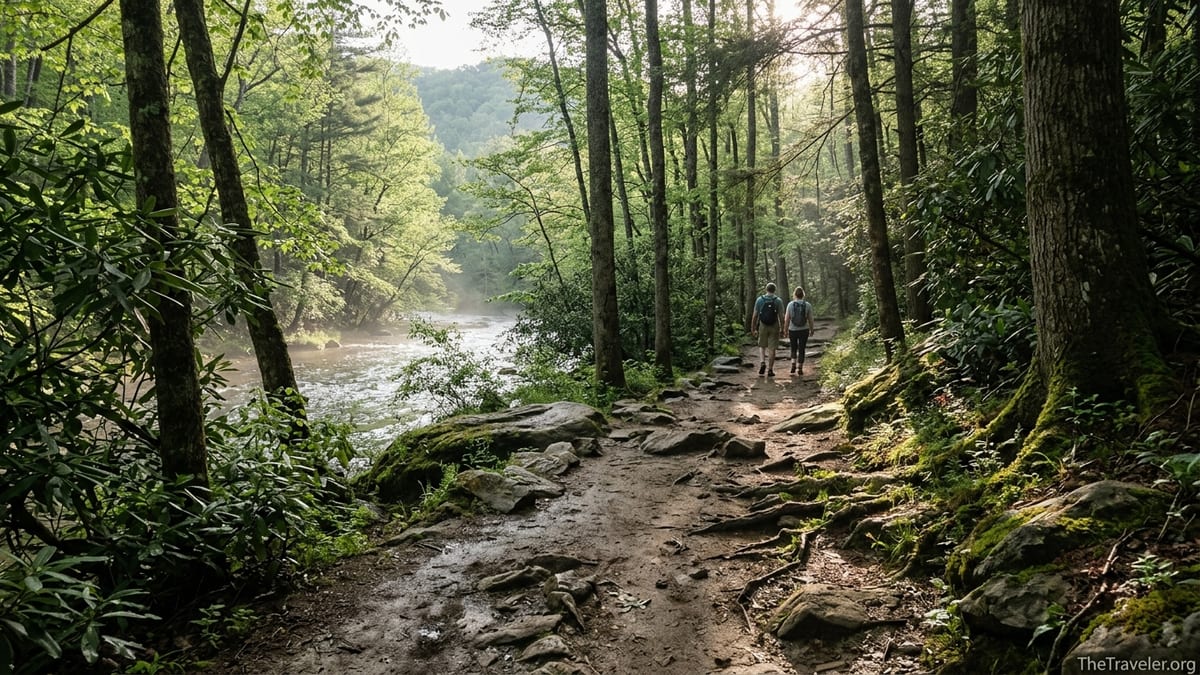
Trail Basics: Distance, Difficulty and What to Expect
Abrams Falls Trail is a 5-mile round trip hike that starts and ends on the Cades Cove Loop Road, following Abrams Creek to a powerful 20 to 25 foot waterfall that plunges into a deep pool. The distance is moderate, but the trail rolls over several short but steady climbs, so it feels more strenuous than a flat 5-mile walk. Most reasonably fit adults take about 3 hours of moving time, and many parties with kids or photo stops are on the trail for 3.5 to 4 hours.
Across those 5 miles, you will climb and descend roughly 600 to 700 feet in total, in a series of ups and downs rather than one big hill. The path is generally well defined and wide by Smokies standards, but it can be rocky and rooted in places. Several sections traverse side slopes above the creek where a twisted ankle or slip could have real consequences, especially when wet. Expect narrow sections, mud after rain, and step-downs that can be hard on knees during the return.
The trailhead sits at the western end of the one-way Cades Cove Loop Road, between signposts 10 and 11, in a dedicated parking area next to Abrams Creek. You will begin immediately with a sturdy wooden bridge crossing, then follow the creek closely for much of the route. Cell coverage is sparse to nonexistent for most carriers, so visitors should not rely on phones for maps or emergency calls and should download offline maps or carry a paper map before leaving Townsend or Gatlinburg.
Because it combines a big waterfall with a manageable distance, Abrams Falls is very popular. On peak summer Saturdays and during October leaf season it is common for the parking lot to overflow by mid-morning and for the first mile of trail to feel almost like a parade. Planning for timing and crowds is as important as planning your footwear.
Getting There, Hours and Parking Logistics
Reaching Abrams Falls Trail begins with reaching Cades Cove, an 11-mile one-way scenic loop at the western side of Great Smoky Mountains National Park. Most visitors approach from Townsend, Tennessee, a small gateway town with gas stations, basic groceries and outfitters. From central Townsend, the drive to the Cades Cove entrance typically takes 25 to 35 minutes in light traffic, but can stretch close to an hour during summer weekends and fall color season once you hit the park boundary.
The Cades Cove Loop Road is open from sunrise to sunset every day, weather and maintenance work permitting. Travelers driving in on June mornings often find the entrance opening around 6:00 a.m., while in December it tends to be closer to 7:30 a.m. During busy periods the National Park Service sometimes announces short-term closures for pavement repairs or hazard tree removal, particularly in winter and early spring, so it is wise to check the latest park alerts on the morning of your visit rather than assuming the loop will be open simply because it is not winter.
A key detail for 2026 is that on Wednesdays from early May through late September the Cades Cove Loop Road is reserved all day for walkers and cyclists, with no motor vehicles allowed. If you plan to hike Abrams Falls on those Wednesdays, you have two main options: bring or rent bikes in Townsend and pedal the roughly 5 miles along the loop to the trailhead, or walk the paved loop several miles to the same spot. Bike rentals in Townsend, such as at outfitters near the Wye intersection, commonly run around 15 dollars per hour for adults, so a half-day rental can easily reach 40 to 60 dollars per person. That extra cost and added time can be worth it for the quiet of a vehicle-free loop, but you must factor it into your plans.
Parking for Abrams Falls is in a dedicated gravel lot just off the loop road. On typical spring and fall weekdays, arriving by 8:30 or 9:00 a.m. often secures an easy spot. On a clear Saturday in July, visitors report the lot filling by mid-morning, with rangers occasionally directing overflow vehicles to line the roadside. Because the loop is one-way, if you pass the lot when it is full you cannot easily circle back without driving the rest of the loop. A practical strategy is to time your arrival at the Cades Cove entrance within 60 to 90 minutes of sunrise, drive steadily with only brief stops, and head straight to the Abrams Falls trailhead before exploring cabins and churches on the way out.
Seasonal Conditions, Crowds and Wildlife
Seasonality strongly shapes the experience of Abrams Falls. In spring, usually from late March through early May, temperatures are moderate, wildflowers bloom along the banks, and water levels often run high, making the falls especially impressive. Trails can be muddy, and cold fronts still bring occasional frosty mornings. Early spring also lines up with school breaks, so crowds can build quickly on fair days, especially around Easter weekend.
Summer is peak season in Cades Cove, with long days, warm temperatures, and heavy visitation from June through August. On the Abrams Falls Trail, this translates into very busy late mornings and early afternoons, frequent family groups with children, and a steady flow of hikers at the waterfall itself. Heat and humidity are major factors; even if Townsend is in the low 80s Fahrenheit, the effort of repeated climbs can make it feel hotter. Afternoon thunderstorms are common, particularly in July and August, so hikers should aim to start early enough to be off the trail by mid to late afternoon when storms usually roll over the ridges.
Autumn, from late September through early November, is a favorite time for many hikers. Cooler air, changing leaves, and often clear skies create very photogenic conditions at the waterfall. However, October weekends can be among the most crowded days of the year across the Smokies, and the Cades Cove loop often moves at a crawl. It is not unusual for drivers to spend over two hours completing the loop on peak foliage Saturdays. Planning a weekday hike or arriving shortly after sunrise is the most reliable way to experience Abrams Falls with some elbow room.
Winter brings a different kind of beauty, with bare trees opening up long views of the creek and ridges. Daytime highs can be pleasantly cool on sunny January days, but ice and snow sometimes close the loop road temporarily, and shaded parts of the trail can stay slick even when towns in the valleys are thawed. Wildlife sightings are possible year-round; black bears, white-tailed deer, wild turkeys and coyotes all inhabit the Cades Cove area. Bears are most commonly seen in spring and early summer. Visitors need to carry bear spray only if they are comfortable and trained in its use, but everyone should know how to store food properly, give animals distance, and avoid blocking traffic when someone spots a bear in a meadow.
Safety at the Falls: Swimming, Rocks and Creek Crossings
One of the most important things to know before hiking Abrams Falls Trail is that swimming in the pool below the falls is strongly discouraged. The waterfall is not exceptionally tall, but the volume of water from Abrams Creek creates a powerful current that feeds into an undertow at the base. Over the years, multiple accidents, including drownings, have occurred when visitors underestimated the force of the water or were pulled off slippery rocks into the churning pool. Even confident swimmers from flatland states can be caught off guard by cold mountain water and unpredictable hydraulics in the plunge pool.
The rocks around the falls are another real hazard. Algae and constant spray make the boulders deceptively slick, especially close to the main flow. It can be tempting to hop from rock to rock for the perfect photo angle, but this is where many ankle and wrist injuries happen. A safer approach is to pick one stable viewing spot, maintain three points of contact if you must scramble, and keep children well back from the edge. Visitors often see hikers in sandals climbing precariously near the falls; those are not examples to follow.
There are no major creek fords on the Abrams Falls Trail under normal conditions, but several small streams run across the path after heavy rain, and the main trail edges above steep drop-offs to the creek. In wet weather, roots and rocks along these side slopes become slick, and a simple misstep can turn serious. After heavy storms or during spring runoff, park staff sometimes advise against attempting the hike, or they highlight the trail as "more difficult" in visitor centers. If you arrive to find the creek running high and muddy, it is reasonable to shorten your hike and save the waterfall for a clearer day.
Visitors are also wise to treat this as a backcountry trail rather than a casual roadside stroll. There are no restrooms on the trail itself, only at the nearby Cades Cove facilities. Water from Abrams Creek is not safe to drink without proper treatment. Basic precautions like telling someone your planned return time, carrying a small first aid kit, and knowing the signs of heat exhaustion and hypothermia can make a significant difference if something goes wrong.
What to Bring: Realistic Gear and Packing Tips
Although Abrams Falls is not a long or technical hike, going prepared will make the day much more comfortable. At a minimum, hikers should wear closed-toe shoes with good traction. Lightweight hiking shoes or trail runners are ideal for most people; sturdy sandals with heel straps can work for experienced hikers in dry conditions, but flip-flops are a poor choice on this terrain. On summer weekends you will often see families at the trailhead in casual sneakers from big-box stores in Pigeon Forge. Those shoes can complete the hike in dry weather, but they offer less grip on wet rock and tend to become uncomfortable once dusty or muddy.
For water, a practical benchmark is at least one liter per person in cool shoulder-season weather, and closer to two liters per person on hot and humid days. A reusable bottle or a small hydration reservoir in a daypack works well. Many visitors underestimate how much water they will drink; buying a case of bottled water at a grocery store in Townsend the night before, then filling more durable containers for the hike, is both cheaper and easier than paying convenience prices inside Gatlinburg on the way in.
Snacks or a light lunch also help, especially if you plan to linger at the falls. Simple items like trail mix, energy bars, fruit, and sandwiches travel well. Families often plan a picnic at the falls, but it is important to pack out all trash, including fruit peels and nut shells, which can attract wildlife and degrade the experience for others. A small sit pad or compact camp towel can make sitting on rocks more comfortable if you expect to spend time enjoying the scene.
Other useful items include a lightweight rain jacket or poncho, even if the forecast looks good, because mountain storms form quickly; a brimmed hat and sunscreen for sunnier sections near midday; insect repellent from late spring through early fall; and a simple headlamp or flashlight as insurance in case you return later than planned. Trekking poles are optional but can be helpful for those with knee issues or anyone wary of rocky descents, and many older visitors are glad to have at least one pole on the way back to the trailhead.
Timing Your Hike and Building a Full Day in Cades Cove
Timing can make the difference between a magical waterfall hike and a frustrating slog. A common strategy for summer and fall is to enter Cades Cove as early as you reasonably can, drive straight to the Abrams Falls trailhead, and save the rest of the loop for after your hike. For example, a family staying in Townsend might leave their cabin at 6:30 a.m. in July, arrive at the Cades Cove entrance around 7:00 a.m., reach the Abrams Falls parking area by 7:30 a.m., and start hiking in the cool morning air. This schedule often means reaching the falls before the heaviest crowds and being back at the car by late morning, before storms and heat build.
If you cannot start early, consider hiking later in the afternoon outside storm-prone hours, especially in spring and fall. Entering the loop around 3:00 p.m. on a weekday and starting the hike before 4:00 p.m. can still provide enough daylight in April or September, but you must be realistic about your pace and sunset time. In midwinter, shorter days make mid-morning starts safer. Visitors should always check sunrise and sunset times for the exact day of their hike, and remember that Cades Cove can feel darker earlier than town due to surrounding ridges.
Many travelers want to fold Abrams Falls into a full day in Cades Cove. A practical approach is to hike first, then spend the afternoon exploring the historic cabins, churches, and fields along the loop. That might look like finishing the hike around 11:00 a.m., eating a picnic lunch at the picnic area near the loop entrance or at one of the pullouts, then stopping at a few cabins such as John Oliver Cabin or the Primitive Baptist Church on the way out. Wildlife viewing is often best in early morning or near dusk, so those who finish their day with a second partial loop drive around sunset frequently report good chances of seeing deer or turkeys, and occasional bear sightings in the fields.
Travelers based in Gatlinburg or Pigeon Forge should also factor in drive times to and from the park boundaries, which can run 60 to 90 minutes each way in peak seasons. For example, a couple staying near Dollywood who leaves after breakfast at 9:00 a.m. may not reach the Abrams Falls trailhead until close to noon on a busy Saturday, making the hike hot, crowded, and rushed. Building your day around the trail, rather than trying to squeeze it between shopping or shows, leads to a far more enjoyable experience.
Respecting Nature and Park Rules
Like the rest of Great Smoky Mountains National Park, the Abrams Falls area is protected land with specific rules designed to preserve both natural resources and visitor safety. Pets are not allowed on the Abrams Falls Trail, and there are no exceptions for carrying small dogs in packs or strollers. Bicycles are limited to the Cades Cove Loop Road and are not permitted on the trail. Camping is not allowed at the falls or along the route unless you have a backcountry permit for an official campsite on connecting trails beyond the falls junction.
Leave No Trace principles are especially important here because of the heavy use. That means staying on the established path even when social shortcuts seem faster, packing out all trash, and avoiding picking flowers or disturbing wildlife. In recent years, park staff and volunteers have reported increasing amounts of micro-trash such as bottle caps, candy wrappers, and tissue around the waterfall area, and there are periodic cleanup days organized by local hiking clubs. Visitors can help simply by double-checking that every wrapper and piece of fishing line makes it back to the trailhead.
Noise levels also affect the experience. While Abrams Falls will never be a solitary backcountry waterfall in the middle of a July afternoon, keeping voices moderate and avoiding portable speakers helps everyone enjoy the sound of the creek and the falls. Families with children can set expectations ahead of time about staying together, respecting other hikers’ space on narrow sections, and letting uphill hikers pass first.
Finally, be mindful that the Smokies do not charge an entrance fee in the traditional sense, but a valid parking tag is now required for most vehicles stopping longer than a brief drop-off in designated areas. Travelers typically purchase a daily or weekly tag online or at kiosks near park entrances and must display it inside their vehicle. This tag system helps fund ongoing maintenance and services, including trail work and facilities that directly benefit hikes such as Abrams Falls.
The Takeaway
Hiking Abrams Falls Trail is one of the most rewarding ways to experience Cades Cove beyond the car window. The hike offers a satisfying half-day outing, combining forested ridges, constant creek sounds, and the payoff of a powerful waterfall. At the same time, its popularity, rolling terrain, and water hazards mean it demands more preparation than a casual roadside stroll.
By understanding the current access patterns to Cades Cove, planning around vehicle-free Wednesdays, starting early in the day, and bringing appropriate footwear, water, and weather layers, you can stack the odds in favor of a relaxed, safe trip. Treating the pool below the falls with the respect it deserves, giving wildlife space, and packing out every crumb of trash ensures that Abrams Falls remains a highlight for future visitors as well.
Build your day around the hike instead of squeezing it between other attractions, and Abrams Falls becomes not just another stop in the Smokies, but a true memory: cool creek air after a humid climb, rhododendron framing the roar of the water, and the long, satisfying walk back through the woods to the loop road as the sun drops on Cades Cove.
FAQ
Q1. How long does it take to hike Abrams Falls Trail?
Most visitors should plan on about 3 hours of walking time, plus breaks. Families with younger children or frequent photo stops often spend 3.5 to 4 hours from trailhead to trailhead.
Q2. Is Abrams Falls Trail suitable for children?
Yes for many families, but it depends on age, fitness and trail experience. The distance and hills can be challenging for very young kids, and adults must closely supervise children near the waterfall, where rocks are slick and drop-offs are real.
Q3. Can I swim at Abrams Falls?
Swimming is strongly discouraged because of a powerful current and undertow in the plunge pool, along with hidden rocks and cold water that can quickly sap strength. Many accidents and rescues have occurred here, even among confident swimmers.
Q4. Do I need special hiking boots for this trail?
Sturdy hiking shoes or trail runners with good traction are recommended, but heavy boots are not mandatory for most hikers in dry conditions. Casual sneakers can work, yet they tend to offer less grip and support on wet or rocky sections.
Q5. Are pets allowed on Abrams Falls Trail?
No. Pets are not permitted on Abrams Falls Trail, even on leash or in carriers. They are also not allowed at the waterfall itself, so plan pet care before entering Cades Cove.
Q6. What is the best time of day to start the hike?
Starting within one to two hours after sunrise usually offers cooler temperatures, easier parking, and fewer crowds at the falls. In hot or stormy summer weather, an early start is especially important.
Q7. Is the trail open year-round?
In most years, yes, but access depends on the Cades Cove Loop Road being open. Winter storms, ice, or maintenance projects can temporarily close the loop, so visitors should always check the latest park updates before driving in.
Q8. How do vehicle-free Wednesdays affect access to the trailhead?
On designated Wednesdays from May through late September, the loop is closed to motor vehicles all day. To reach the trailhead you must walk or bike from the entrance. Many visitors rent bikes in Townsend and plan extra time for the ride.
Q9. Is Abrams Falls Trail crowded?
Yes, often. It is one of the park’s most popular waterfall hikes. Expect steady traffic on the trail and limited parking on summer weekends, holidays, and October leaf season. Early starts and weekday visits are the best ways to avoid crowds.
Q10. Do I need a permit or pass to hike Abrams Falls?
You do not need a special hiking permit for a day hike, but you must display a valid parking tag in your vehicle when you park in Great Smoky Mountains National Park, including at the Abrams Falls trailhead.