


On most weekends from spring through late fall, the small parking lot at milepost 50.7 on Skyline Drive fills quickly. Cars circle for open spaces, day hikers lace up boots beside rental SUVs, and families unfold paper maps that all seem to point to the same place: Dark Hollow Falls. In a park with more than 500 miles of trails, this short waterfall hike has quietly become one of the most walked paths in Shenandoah National Park. The reasons why say a lot about how modern travelers choose their adventures in the Blue Ridge.
Get the latest updates straight to your inbox!
A Classic Waterfall Payoff on a Short, Steep Trail
At its core, Dark Hollow Falls is popular because it delivers exactly what many visitors are looking for: a real hike with a real payoff in a manageable package. The trail forms about a 1.4-mile round-trip route from its dedicated parking area on Skyline Drive and drops roughly 400 to 450 feet in elevation to reach a 70-foot cascading waterfall. That combination of distance and reward lands perfectly for travelers who want something more adventurous than a roadside overlook, but less intimidating than a full-day backcountry trek.
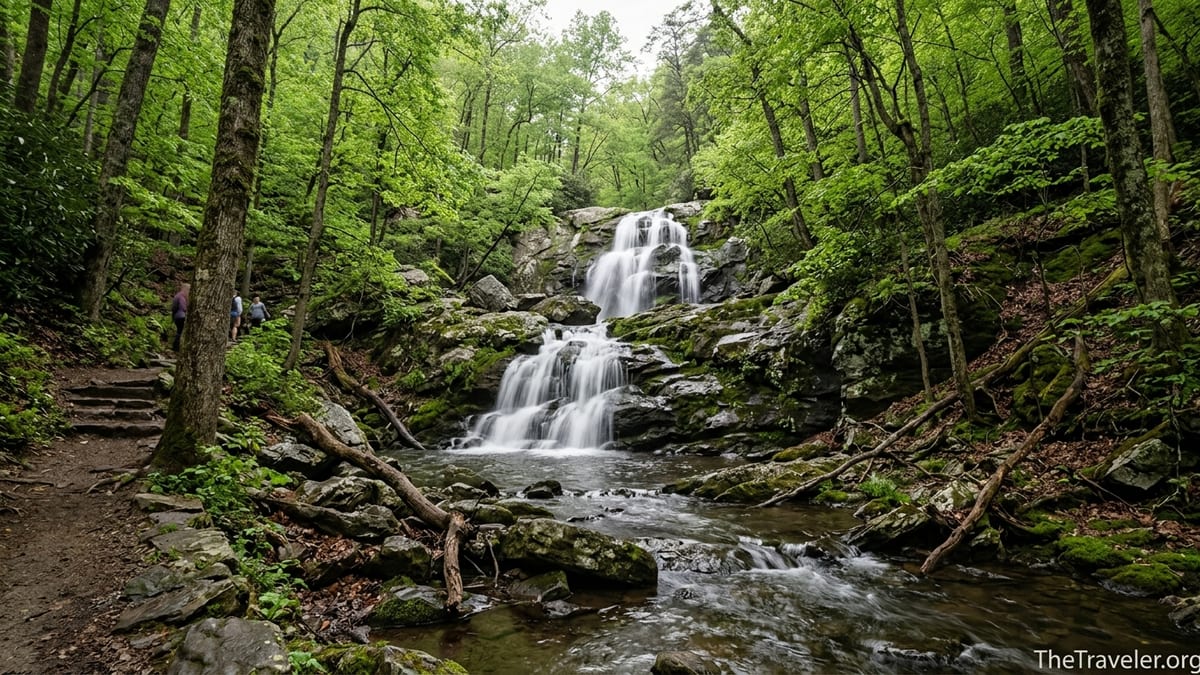
On the way down, the path follows the course of Hogcamp Branch, a tumbling mountain stream that offers smaller cascades and pools even before you reach the main falls. In practice, that means you are rarely out of earshot of moving water. Many hikers find themselves stopping at side spurs to admire miniature waterfalls or to let kids toss pebbles into shallow pools. The soundscape alone sets it apart from drier ridge hikes like nearby Hawksbill or Stony Man, where wind in the trees replaces the steady rush of water.
At the base of Dark Hollow Falls, the main cascade splits into tiers as it sheets over mossy rock ledges. After rainy periods in late spring or during snowmelt, the volume can be impressive, and mist hangs in the air. Even in late summer, when many waterfalls in the Mid-Atlantic shrink, there is usually enough flow for classic long-exposure photographs. That reliable scenic highlight is a major reason the trail appears so frequently in guidebooks and on social media feeds featuring Shenandoah.
Crucially, the hike feels like an accomplishment without requiring elite fitness or technical skills. Many visitors report completing it in about an hour to ninety minutes, with plenty of time for photos at the falls. For a family staying at Big Meadows Lodge or a couple on a Skyline Drive road trip, it fits neatly between a late breakfast and an afternoon viewpoint stop. That sweet spot between effort and reward is one of the main reasons Dark Hollow Falls sees such steady foot traffic in every season it is safely open.
Location, Location, Location: Right Off Skyline Drive
Another major ingredient in the trail’s popularity is its enviable location in the heart of Shenandoah. The trailhead sits on Skyline Drive at milepost 50.7, just a few minutes north of Big Meadows, one of the park’s central hubs for lodging, food, and services. For visitors driving in from Washington, DC, or Northern Virginia, it falls naturally on a first-day itinerary after entering at Thornton Gap or Swift Run Gap and cruising south along the ridge.
Because the trail begins directly from a dedicated parking lot on Skyline Drive, there is no need to navigate gravel forest roads or secondary park entrances. Travelers unfamiliar with mountain driving often appreciate being able to step straight from the paved scenic road onto a well-signed path. In practical terms, many people simply stop when they see the "Dark Hollow Falls" parking sign and the stream visible through the trees, especially if they have been driving for an hour or more and are ready to stretch their legs.
The hike’s proximity to Big Meadows Lodge, Big Meadows Campground, and the Big Meadows Wayside adds to its appeal. Overnight guests can leave their car at their room or campsite and be at the trailhead in under ten minutes by car. It is common to hear families at the lodge dining room planning a morning at Dark Hollow Falls before lunch at the wayside grill, or campers deciding to squeeze in the hike after returning from a longer ridge walk. When one of the most photogenic waterfalls in the park is also one of the closest major hikes to where people sleep and eat, high visitation is almost guaranteed.
Even for day trippers, the central location helps. A driver coming from Charlottesville via Rockfish Gap can enjoy much of Skyline Drive’s southern half, while someone from the Washington suburbs can enter at Front Royal or Thornton Gap. In many suggested itineraries published by regional magazines, Dark Hollow Falls is framed as the "don’t-miss" waterfall stop along that north-south journey, ensuring it continues to attract a constant stream of first-time visitors.
An Accessible Introduction to Shenandoah Hiking
Dark Hollow Falls has also become, for many people, their first real hike in Shenandoah National Park. Its shorter length and clear endpoint at a major natural feature make it an easy recommendation from rangers, hotel staff, and experienced hikers when friends ask where to start. It is not unusual for travelers to pair it with a short summit hike like Hawksbill or Stony Man on the same day and leave feeling they have sampled both waterfalls and vistas.
The trail itself is signed as moderately strenuous because the uphill climb back to the parking area can feel demanding, especially in humid summer weather. However, the path is straightforward: a well-defined tread descending along the stream, with stone steps and occasional benches that encourage breaks. For visitors bringing older relatives or children, that predictability matters. Many parents say they appreciate that they can turn around at any point along the way if the descent feels like too much, still enjoying creekside scenery without committing to reach the base of the falls.
There is also a psychological comfort in the trail’s popularity. A solo traveler setting out on Dark Hollow Falls on a Saturday in May will rarely go more than a couple of minutes without seeing another group. For hikers nervous about wildlife encounters or getting lost, having company on the trail and hearing other voices around the next bend makes the experience feel safer and more social. That is part of what distinguishes Dark Hollow from more remote Shenandoah routes like some sections of the Rapidan or Hazel Mountain areas, where you might walk for an hour without seeing anyone.
Over time, word-of-mouth has reinforced this role as an introductory hike. Online reviews and trip reports often frame Dark Hollow Falls as "perfect for beginners" or "a good first taste of Shenandoah," especially for people not used to mountain hiking. As that reputation has spread through travel blogs, regional magazines, and hiking apps, more new visitors choose it as their starting point, keeping the trail near the top of the park’s informal popularity rankings.
The Social Media Effect and Real-World Visitor Experience
Like many scenic waterfall trails in national parks, Dark Hollow Falls has benefited from the rise of photo-driven trip planning. Search for the park on photo-sharing platforms, and images of water pouring over the falls’ tiered rock slabs appear alongside sunrise views from Old Rag and Hawksbill. Travelers planning a weekend from the Baltimore or Richmond area often compile itineraries based on these photo galleries and then look for hikes that match the most shared scenes.
In practice, this means that a single compelling image of Dark Hollow Falls can drive dozens of future visits. A college student spending a fall weekend camping at Big Meadows might post a long-exposure shot of the falls to social media, tagging the park and mentioning that it was "only about a mile" from the road. Friends and followers see that a major national park waterfall is, in relative terms, easy to reach, which reinforces its status as a "must-see" stop.
Trip-planning apps and crowd-sourced trail guides also funnel hikers to Dark Hollow Falls. On several popular platforms, the trail appears in "Best of Shenandoah" lists, is marked as family friendly for older kids, and boasts thousands of user reviews. A visitor scrolling through options at a motel in nearby Luray is likely to notice that the Dark Hollow listing has more check-ins and photos than many other routes. That social proof often nudges undecided travelers to choose it over less documented hikes like Hazel Falls or some of the longer ridge loops.
The real-world result is that the trail can feel almost festival-like on peak weekends in October, with leaf-peepers, photography enthusiasts, and multi-generational families all sharing the same narrow path. This atmosphere can be part of the charm for some visitors, who enjoy the energy and conversations at the falls overlook, but it can come as a surprise to those expecting a quiet, secluded forest walk. Understanding this social media effect helps set expectations and explains why a relatively modest waterfall hike often feels busier than more dramatic but less publicized routes.
Logistics, Fees, and Seasonal Considerations
Part of what makes Dark Hollow Falls one of the most visited hikes in the park is simply that it is feasible for many kinds of travelers from a time and budget standpoint. As of 2024 and 2025, Shenandoah National Park charges around 30 dollars per private vehicle for a seven-day entrance pass, with per-person fees for those arriving on foot or bicycle. That means a carload of friends from Washington, DC can split the cost for a weekend, drive the length of Skyline Drive, and hike Dark Hollow Falls along with several other short trails without paying anything additional for each hike itself.
From the parking lot perspective, however, the trail’s popularity has created pressure. The dedicated lot beside Skyline Drive is relatively small, and on busy fall weekends it can fill by mid-morning. Drivers sometimes wait for spaces to open or continue to Big Meadows and return later in the afternoon. In a practical sense, this means planning is important: travelers who arrive at the park by 8:00 or 9:00 in the morning usually have a much easier time finding a spot and can enjoy the hike before midday temperatures rise and crowds peak.
Seasonal and weather conditions also shape the experience. In spring, melting snow and frequent rains give the falls their highest flows, making March through May particularly dramatic. Summer brings lush greenery and cooler air along the stream, but also higher humidity and afternoon thunderstorms that can make the climb back out feel more strenuous. Autumn offers colorful foliage reflecting in the pools, though the water volume may be lower after dry spells. In winter, sections can be icy, and there are periods when the park or specific trails may be temporarily closed for safety or maintenance, which has occasionally affected Dark Hollow Falls in recent years.
Visitors should always check current park alerts before planning the hike, as the National Park Service sometimes announces partial closures or trail work that can change access to popular destinations like Dark Hollow. Conditions can evolve quickly after heavy rain events or winter storms. Being flexible with timing and having a backup waterfall hike in mind, such as Rose River Falls or Lewis Falls, helps ensure that a visit to the park still includes a memorable hike even if Dark Hollow is temporarily restricted.
Crowds, Safety, and Protecting a Loved Trail
Heavy use brings challenges, and the story of Dark Hollow Falls is also a story of how a national park manages visitor pressure on a fragile trail corridor. The descent to the falls is steep, and in places the path can be rocky and slick from constant moisture. Each year, rangers respond to calls for twisted ankles, minor falls, and occasional more serious injuries when visitors leave the established path to scramble closer to the water or step onto wet rocks for photographs.
Because of this, the park posts clear warnings about staying on the trail and not climbing on or around the falls. In-person, that translates to visible signs near the viewing areas and frequent ranger reminders during busy periods. The sheer number of people using the route magnifies the impact when even a small percentage choose to step off the official path. That foot traffic can damage vegetation on steep slopes and destabilize soil, which is one reason the park occasionally undertakes maintenance projects or short-term closures to rebuild steps, shore up eroded segments, or improve drainage.
The popularity of the hike has also intensified simple but important etiquette issues. On busy days, the narrow path can bottleneck at switchbacks or viewpoints when groups stop to rest or take photos without stepping aside. Hikers who move to the uphill or downhill edge to let others pass, keep dogs on permitted routes only, and carry out all trash help preserve both the natural setting and the experience for others. Rangers and volunteer trail stewards sometimes patrol the area to answer questions and gently reinforce these shared norms.
For visitors, caring for Dark Hollow Falls in practice means accepting that they are sharing a beloved trail and adjusting behavior accordingly. Packing a small daypack for used snack wrappers, wearing proper footwear instead of smooth-soled sandals, and resisting the urge to wade into closed areas all contribute to keeping the trail open and enjoyable. The fact that Dark Hollow remains one of the park’s marquee hikes despite decades of heavy use is a testament both to ongoing maintenance efforts and to the many hikers who treat it with respect.
How Dark Hollow Compares to Other Shenandoah Favorites
Understanding why Dark Hollow Falls is one of the park’s most visited hikes also involves comparing it to other standout trails nearby. Old Rag, for example, is widely considered the park’s marquee challenge, a roughly nine-mile loop with rock scrambles that now requires a day-use ticket for most of the season. It offers thrilling views and a sense of adventure but is far beyond what most casual visitors or families with young children are prepared to tackle on a short visit.
Hawksbill and Stony Man, the park’s highest and one of its most accessible summits respectively, draw many hikers seeking big vistas with moderate effort. However, both focus on mountaintop views rather than waterfalls. Travelers often choose to do one summit hike and one waterfall hike in a single day. In that pairing, Dark Hollow Falls usually wins the waterfall slot because it is closer to Big Meadows and easier to slot into a tight schedule than longer options like Whiteoak Canyon or Overall Run.
Other waterfalls in Shenandoah offer quieter experiences. Rose River Falls, which shares the same general area as Dark Hollow, can be combined into a longer loop using fire roads and connecting trails. Lewis Falls sits just south of Big Meadows and involves a steeper climb than many expect. While each of these has its fans, they are slightly longer, less directly signed from Skyline Drive, or have trailheads that require a bit more navigation. That extra friction is often enough to steer first-time visitors back to Dark Hollow as the simplest choice.
In short, Dark Hollow Falls occupies a unique middle ground among Shenandoah hikes: more substantial than a roadside overlook, less demanding than a major summit or all-day waterfall loop, and ideally placed along the park’s main driving corridor. That combination ensures it appears on countless "top things to do" lists for Shenandoah and helps explain why its narrow path sees so many pairs of boots each year.
The Takeaway
Dark Hollow Falls has earned its status as one of Shenandoah National Park’s most visited hikes not through superlatives alone, but through a blend of beauty, convenience, and accessibility. The 70-foot cascade and creekside setting provide the kind of sensory reward visitors hope for when they picture a Blue Ridge waterfall, while the short, steep trail ensures the outing feels like a genuine hike rather than a quick roadside stop. Its central location near Big Meadows and direct access from Skyline Drive make it a logical choice for everyone from first-time park visitors to returning campers.
At the same time, its popularity brings real-world considerations: early arrivals to secure parking, realistic expectations about crowds on peak weekends, and a commitment to staying on the trail and following safety guidance. Travelers who embrace these realities tend to leave with strong memories and a better understanding of how heavily loved trails function inside a major national park.
For many people, Dark Hollow Falls is the hike that turns a scenic drive into an immersive Shenandoah experience, the place where they trade windshield views for cool spray and the sound of rushing water. Whether it is your first stop in the park or one of several hikes on a longer trip, approaching it with a bit of planning and respect helps ensure this classic trail remains a highlight for millions of visitors in the years ahead.
FAQ
Q1. How difficult is the Dark Hollow Falls trail in Shenandoah?
The hike is short but can feel moderately strenuous because you descend first and then climb back up about 400 to 450 vertical feet.
Q2. How long does it take to hike to Dark Hollow Falls and back?
Most visitors complete the round trip in about one to one and a half hours, allowing time for photo stops and a break at the waterfall.
Q3. Where is the Dark Hollow Falls trailhead located?
The trailhead sits directly off Skyline Drive around milepost 50.7 in the park’s central district, a few minutes north of the Big Meadows area.
Q4. Is Dark Hollow Falls suitable for young children or older adults?
Many families and older hikers complete the trail, but the steep climb back can be challenging; frequent breaks, sturdy footwear, and plenty of water are important.
Q5. Are dogs allowed on the Dark Hollow Falls trail?
Pets are not permitted on the Dark Hollow Falls trail itself, although they are welcome on many other Shenandoah hikes where park pet rules are followed.
Q6. When is the best time of year to visit Dark Hollow Falls?
Spring offers the strongest flows, summer brings cool streamside shade, and autumn adds colorful foliage; winter visits depend on trail and weather conditions.
Q7. How crowded does Dark Hollow Falls get?
On weekends from late spring through fall and during peak foliage season, the trail and parking area can be very busy, especially late morning to midafternoon.
Q8. Do I need any special permits or passes to hike Dark Hollow Falls?
You only need a valid park entrance pass; no separate day-use permit is required for this trail under current rules, though policies can evolve over time.
Q9. What should I wear and bring for the hike?
Closed-toe shoes with good traction, water, snacks, and a light layer for changing mountain weather make the hike safer and more comfortable.
Q10. Can I swim or wade at Dark Hollow Falls?
Wading or climbing on wet rocks near the falls is strongly discouraged for safety and resource protection; it is best to enjoy the water from designated viewpoints.