


More news on this day
American Airlines is recording the highest number of flight cancellations worldwide this weekend as a series of Federal Aviation Administration ground stops and delay programs ripple through the carrier’s seven largest U.S. hubs, compounding weather, staffing and congestion challenges across the peak summer travel period.
Get the latest news straight to your inbox!
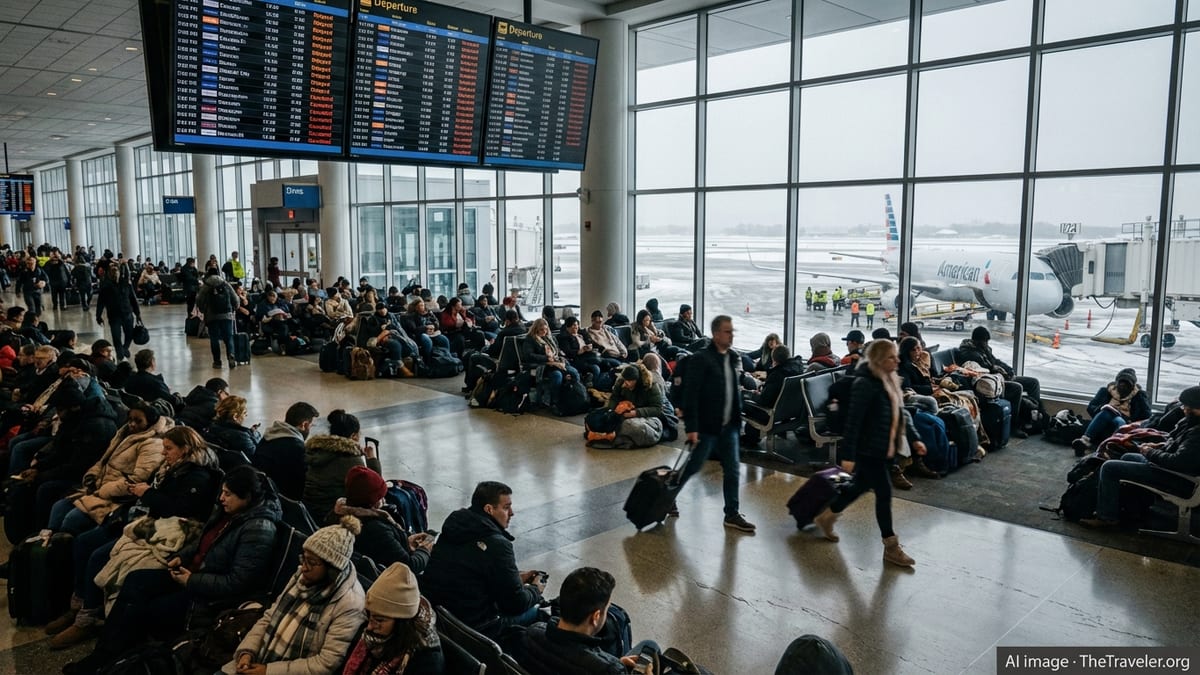
FAA Ground Stops Hit Key American Airlines Hubs
Publicly available advisories from the Federal Aviation Administration show a succession of recent and potential ground stops and delay programs affecting several high-traffic U.S. airports where American Airlines concentrates its operations. These include Dallas Fort Worth, Charlotte, Chicago O’Hare, Miami, Philadelphia, Phoenix and Washington National, which collectively handle thousands of American mainline and regional flights each day.
Ground stops temporarily prevent certain flights destined for an affected airport from departing their origin, typically in response to severe weather, airspace congestion or operational constraints. FAA operations plans published in recent days reference active or possible ground stops at Dallas Fort Worth and Newark, along with delay programs at other major hubs, signaling continuing strain on the national airspace system during one of the busiest travel periods of the year.
These traffic management initiatives are not targeted at a single airline, yet carriers with dense hub-and-spoke networks feel the impact most acutely. Because American schedules such a high volume of daily operations through a relatively small number of core hubs, disruptions at just one or two airports can rapidly cascade across its network, forcing cancellations even on routes far from the original weather or airspace constraint.
FAA material on summer operations emphasizes that weather remains the leading cause of delays and cancellations, and that the agency’s command center works with airlines to meter flows into constrained airspace. Nonetheless, the sheer scale of American’s schedule at its hubs increases the likelihood that traffic management orders translate into a higher absolute number of cancellations for the carrier than for many rivals.
Data Show American at the Top of U.S. Cancellation Tables
Recent federal performance data suggest that American has been operating with one of the highest cancellation burdens among large U.S. airlines. The U.S. Department of Transportation’s Air Travel Consumer Report for the spring of 2026 indicates that, when measured as a share of scheduled operations, American and its branded regional partners have a higher cancellation percentage than most full-service competitors, and cancel far more flights in absolute numbers because of the group’s size.
In the most recent monthly report available, American’s network is shown operating well over 100,000 scheduled flights in a single month, with several thousand cancellations recorded. While its percentage of canceled flights is in the low single digits, this still translates into more disrupted journeys than at airlines that operate smaller schedules or concentrate on less delay-prone airports.
For travelers, the distinction between rate and volume is largely academic. Analytics from aviation data providers and historical guidance documents show that, on a worldwide basis, American regularly ranks near the top of daily cancellation tallies because it runs one of the largest fleets and most complex schedules globally. Even modest percentages of cancellations can therefore place the airline at the front of global rankings during periods of intense disruption.
Industry analysis published earlier this year notes that American’s decision to route a high share of traffic through its core hubs improves aircraft utilization and revenue but leaves the airline more exposed when bottlenecks occur. When combined with FAA restrictions on arrivals, this structure can drive cancellation totals above those at point-to-point or more diversified carriers, particularly on short-haul regional routes that airlines often trim first to protect long-haul flying.
Weather, Staffing and Network Design Drive the Disruptions
Operational records and traveler reports from recent weeks point to familiar underlying causes behind American’s elevated cancellations. Severe thunderstorms, convective weather and seasonal storm systems have swept repeatedly across North Texas and the Southeast, prompting rounds of delays and cancellations at Dallas Fort Worth and Charlotte, both of which serve as critical connecting points for the airline’s domestic and international network.
When weather systems park over a hub, FAA ground stops and ground delay programs are used to throttle arrivals, keeping too many aircraft from converging on a constrained airport at once. Airlines then decide which flights to hold, which to reroute and which to cancel. American’s extensive schedule of short regional flights into its hubs often becomes the first lever to pull, since these services can be cut more easily than long-haul or widebody operations that carry larger numbers of passengers and have fewer alternative options.
Staffing limitations can magnify these pressures. Public commentary from pilots, flight attendants and travelers indicates that crew time limits, out-of-position aircraft and bottlenecks in providing hotel and transport arrangements have all contributed to rolling disruptions during recent storms. When crews reach FAA-regulated duty time limits while waiting out a ground stop, a flight that might otherwise operate late can instead be canceled altogether.
Network design choices create additional vulnerability. American’s emphasis on funneling traffic through hubs like Dallas Fort Worth, Charlotte and Phoenix maximizes connectivity but reduces redundancy. Once a hub’s schedule is thinned by weather or airspace constraints, subsequent waves of flights may depart with crews or aircraft missing, resulting in cancellations that persist even after the initial ground stop or delay program is lifted.
Travelers Face Cascading Delays and Limited Alternatives
The immediate effect for passengers is a sharp spike in same-day cancellations, particularly at hub airports where connecting flows are highest. Travelers posting their experiences in recent days describe hours-long waits, rolling departure time changes and late-night cancellations as American attempts to rebuild its schedule around FAA constraints and deteriorating weather.
Because the current disruptions involve multiple hubs at once, rerouting options have been constrained. When Dallas Fort Worth, Charlotte and other key airports are all operating under some combination of ground stop, delay program or residual congestion, rebooking passengers onto alternative flights can take days rather than hours, especially on peak travel weekends when aircraft across the system are already full.
Industry observers note that passengers flying on shorter regional legs into or out of hubs are often the most affected, since these flights are more likely to be cut in favor of preserving long-haul and international services. Travelers with tight connections at complex hub airports also face heightened risk, as a modest inbound delay can lead to a missed outbound flight that has few remaining open seats.
Consumer advocates reiterate that, while the FAA controls the airspace and issues traffic management orders, individual airlines make their own decisions about schedules and cancellations. As a result, travelers booked on American can experience a materially different level of disruption than those on another carrier passing through the same airport at the same time, depending on each airline’s network configuration and recovery strategy.
What the Latest Turbulence Means for Summer Flyers
The current wave of American Airlines cancellations underscores the fragility of large hub-and-spoke networks during peak travel periods. FAA guidance on summer flying notes that cancelation trends across the system are lower than in prior years, yet individual airlines and airports can still suffer intense localized disruptions when weather and traffic volume intersect.
For travelers planning itineraries through American’s key hubs in the coming weeks, the latest events serve as a reminder to build in extra connection time, favor early-morning departures where possible and remain prepared for last-minute schedule changes. Public flight tracking tools and airline mobile apps provide near-real-time updates, but gate changes and rebooking queues can still shift quickly once ground stops or delay programs are imposed.
American, for its part, has signaled through previous operational updates and public statements that it is investing in analytics and hub efficiency tools designed to reduce the need for last-minute cancellations. However, recent FAA traffic management actions highlight that external constraints on airspace and airport capacity continue to limit how much any single carrier can control.
As the summer peak intensifies, the combination of FAA-imposed traffic controls and the operational complexity of American’s hub structure means that travelers are likely to see the carrier remain prominent on global cancellation tables whenever storms, airspace restrictions or other disruptions intersect with its busiest hubs.