


Snowcard has a strong reputation in the UK as a go to name for skiers, snowboarders and climbers who want serious adventure cover. Its branding speaks directly to the kind of traveler who is happiest on a black run in Chamonix or a via ferrata in the Dolomites. But that specialist image can lull people into a false sense of security. After several seasons of planning mountain trips, reading the latest policy wording and talking to travelers who have had both smooth and messy claims, I have learned that Snowcard is not a policy I would ever buy blindly. It can be excellent for the right person on the right trip, yet there are enough sharp edges and exclusions that you need to read, question and compare before you type in your card number.
Get the latest updates straight to your inbox!
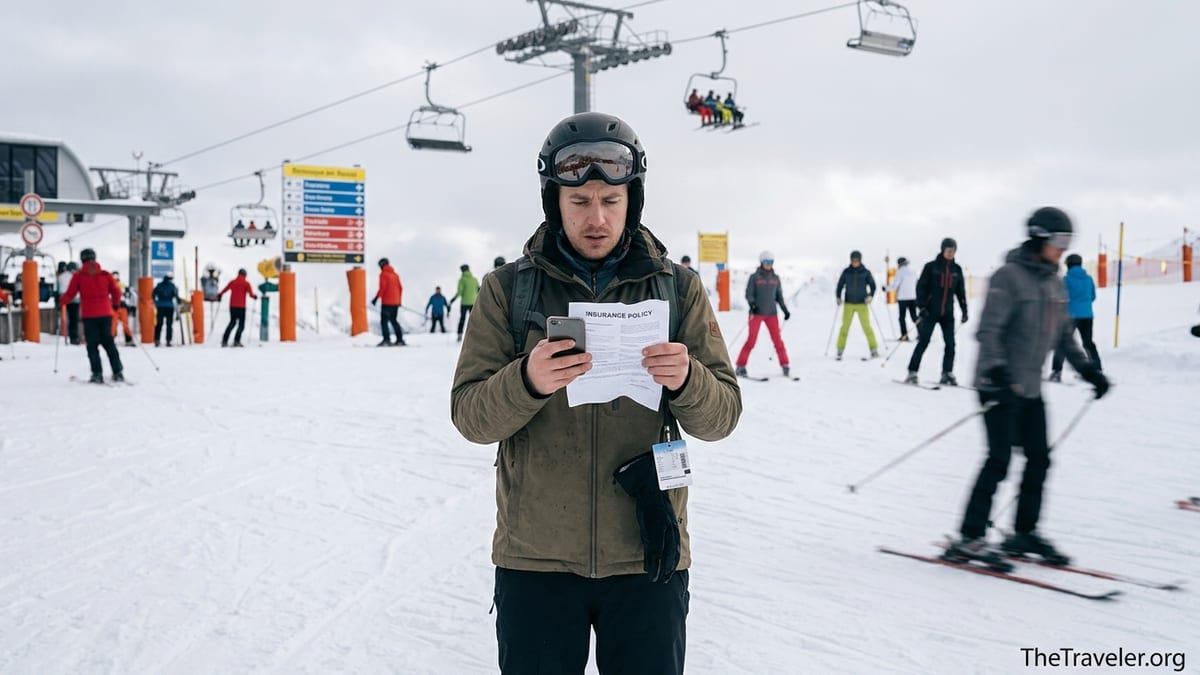
Snowcard’s Strength: Proper Mountain Cover, With Strings Attached
Snowcard’s appeal is obvious. It is a long established UK based specialist focused on winter sports and adventure, underwritten by a Lloyd’s of London syndicate, and its marketing is tightly aimed at people who ski off piste, climb, trek at altitude or head to remote places. On its own site, Snowcard highlights that policies can be tailored to specific activities such as snowboarding in parks, ski mountaineering and backcountry touring, often up to substantial altitudes that many mainstream insurers simply exclude outright. That makes it attractive if you are planning something more ambitious than a gentle week on the nursery slopes in Les Arcs.
Look at its snowboarding and ski pages and you will see detailed references to off piste, heli boarding, snowcat boarding and ski touring. Snowcard explicitly says that riders can insure themselves for both on piste and off piste days, with or without a guide, provided they pick the right activity level and disclose their plans accurately. This level of clarity is reassuring compared with generic travel insurers that use vague terms like “within resort boundaries” without ever defining what that means. If you are heading to, say, Verbier or La Grave specifically for ungroomed terrain, having a policy that acknowledges that reality is a big plus.
But strength in one area can hide fragility in others. The more I went through Snowcard’s current policy wording and health statement, last updated in early 2026, the more I saw that this is a product designed around a fairly narrow idea of the ideal customer: fit, generally healthy, willing to stick closely to declared activities and not expecting much flexibility if life deviates from plan. That is not a criticism in itself. Many specialist insurers work this way. It is simply a warning that you cannot assume that “mountain specialist” automatically means “for every mountain traveler in every situation.”
A practical example is a British couple in their late fifties planning a ski touring week in Norway. On paper, Snowcard looks perfect: it lists ski touring and even pulk pulling, and offers medical cover typically in the millions of pounds, which is what you want if a helicopter rescue turns into an intensive care stay. Yet if one of them has had a knee arthroscopy in the previous year or a cardiology check up six months ago, they suddenly run into Snowcard’s tough stance on pre existing conditions. Without reading that health section carefully, they might assume they are covered for all medical risks. In reality, they might only be covered for completely unrelated injuries, like a broken wrist, and find any heart or knee related claim firmly declined.
The Hard Line on Pre Existing Medical Conditions
The single biggest reason I would never buy Snowcard on autopilot is its approach to health. Snowcard’s health statement spells out that it will cover new injuries or illnesses that occur during the trip, but that there is no cover for pre existing medical conditions. It then adopts a broad definition of what “pre existing” means. According to its own documentation, any condition, including mental health conditions such as stress, anxiety or depression, that has led to a hospital or consultant referral in the previous 12 months counts as pre existing. It does not matter whether you feel perfectly fine now or whether your doctor is relaxed about your travel plans.
To make this concrete, imagine a snowboarder from Manchester who had a minor shoulder issue assessed by an orthopaedic consultant last autumn, was given physiotherapy, then signed off as fit. In March, they buy a Snowcard policy for a week in Tignes, pick an activity level that covers snow parks and off piste, and head out. On day three they crash in the park and dislocate that same shoulder. The local clinic resets the joint and advises further imaging back in the UK. The medical bills, while not catastrophic, are still several hundred euros. When they claim on Snowcard, the insurer can quite reasonably say that the shoulder problem falls under its definition of a pre existing condition because it was assessed by a consultant within the last 12 months. The new dislocation is arguably connected to that history. A claim rejection in that scenario would not be surprising.
Snowcard does allow you to buy a policy even if you have pre existing conditions. The key nuance is that it will only cover new issues that are not directly or indirectly linked to those conditions. So if you have been treated for depression in the last year, travel to the Alps and then break your ankle on a piste, your ankle treatment is likely to be covered, while any mental health relapse would not be. However, deciding what is “indirectly connected” can be contentious in real life. A mountaineer with long term high blood pressure who suffers a stroke at altitude might find themselves on the wrong side of that line. I would not risk assuming an insurer will interpret the medical picture generously.
This is a very different approach from some mainstream UK travel insurers or credit card backed policies that, while often offering weaker activity cover, do sometimes give you the option to declare certain pre existing conditions, pay an extra premium and receive full cover for them. For example, some bank packaged policies will screen you with an online questionnaire, then either accept your conditions at standard terms, offer to cover them for an extra charge, or decline. With Snowcard, the model is closer to “we insure you for new, unrelated problems, and the rest is on you.” For anyone with a medical history that is more complex than simple, long resolved injuries, that distinction is critical.
UK Only Eligibility and the GHIC Trap for European Trips
Another reason I would not just click “buy” is Snowcard’s restricted eligibility. On its site, Snowcard is clear that its policies are available to UK, Channel Islands and Isle of Man residents. If you live in the United States, Canada, Australia or almost anywhere else, Snowcard is off the table entirely, even though its marketing sometimes surfaces in international search results and on English language travel blogs. It is surprisingly easy for a non UK traveler to land on Snowcard’s quote page, assume that an online form means global eligibility, and waste time entering details for a policy they cannot actually use.
For UK residents heading to Europe, there is a different kind of trap. Snowcard, like many insurers, reminds customers to carry a valid Global Health Insurance Card, the replacement for the old European Health Insurance Card. British government guidance and financial press articles have repeatedly pointed out that a GHIC entitles you to state provided healthcare in participating countries on roughly the same basis as locals, but it does not cover private resort clinics, mountain rescue, or medical repatriation back to the UK. Insurers routinely design their benefits on the assumption that GHIC will pick up some of the cost from public hospitals. Snowcard is no exception and encourages its use.
In practice, a skier in Austria who is taken off the mountain by helicopter and treated in a private clinic at the foot of the slopes quickly learns that GHIC is irrelevant to most of the first and most expensive stages of care. The helicopter flight alone can run into the thousands of euros. A night in a private orthopaedic clinic can easily be charged at hotel like rates. Some British skiers have posted accounts of being asked for a credit card before treatment. Here, Snowcard’s strong emergency medical and rescue limits are genuinely valuable. Yet GHIC is woven into the policy language in a way that can make less experienced travelers overestimate how far it will protect them. I would only buy Snowcard after confirming that I understood which parts of the chain of care were supposed to be handled by GHIC and which parts depended entirely on the policy.
This matters especially on cheaper European ski trips, such as budget weeks in Andorra or Bulgaria, where people often try to economise on insurance after bagging a low cost package. Choosing Snowcard’s minimal options because “I have a GHIC anyway” misunderstands the nature of mountain accidents. The card is helpful once you reach a public hospital. It does nothing to get you off a closed piste in a snowstorm or from a private clinic to an air ambulance home.
Activity Choices, Exclusions and the Fine Print Problem
On paper, Snowcard shines when it comes to adventurous activities. Its quote journey walks you through different categories, from relatively tame resort skiing up to demanding undertakings like ski mountaineering, backcountry touring and high altitude climbing. Its own adventure guides and comparison articles note that many mainstream travel insurers either refuse to cover these activities or bury them under an expensive specialist add on. For dedicated mountaineers, Snowcard can look like the obvious choice because it openly lists the types of trips others shy away from.
The catch is that coverage is highly dependent on choosing the correct activity band and sticking to it. If your Snowcard quote is based on piste skiing and you throw in a day of unguided ski touring in Italy without updating your policy, you may find that the most serious day of your holiday is the one the insurer refuses to touch. The same goes for snow parks. Some Snowcard activity levels include freestyle park riding as standard, while others do not. In the rush of pre trip admin, it is remarkably easy to group all snowboarding as one thing, tick “snowboarding” on the form, and only realise after an accident that the specific terrain park session that caused the injury sat outside your declared cover.
This is not a purely theoretical concern. In online forums, snowboarders frequently complain that generic insurers were reluctant to pay out for park injuries because the policy wording only mentioned “recreational skiing and snowboarding on prepared runs.” Snowcard, to its credit, is much more explicit about park and off piste cover in its marketing materials. Yet it still conditions that cover on you matching your real itinerary to the correct policy level. A rider heading to Mayrhofen with the Vans Penken Park high on their wish list who forgets to select freestyle cover could run into exactly the same disappointment as someone mis sold a cheaper mainstream policy.
There are similar nuances around mountaineering and maximum altitude. Independent reviews compare Snowcard with UK alpine clubs’ policies and highlight that Snowcard often covers climbs up to 6000 or even 7000 metres, depending on the option, whereas more basic insurers draw the line far lower. That is excellent if you are planning a guided ascent of Kilimanjaro or a trekking peak in Nepal. It is also a massive responsibility. If you misjudge your route and stray beyond the permitted altitude or mix in a short section of technical climbing that technically belongs in a higher risk category, you are placing yourself in a grey area. I would not be comfortable doing that without a written confirmation from Snowcard that my specific route and elevation gain were inside my chosen cover.
Finally, Snowcard’s general exclusions page, updated for 2025 and beyond, contains the usual clauses you find in many policies: no cover if you travel against medical advice, no cover if you are travelling specifically for medical treatment, restrictions around claims that could reasonably have been expected, and limitations when other parties such as airlines or tour operators are responsible. None of this is unique. The problem is that mountain holidays generate exactly the sort of complicated, multi party mishaps that sit in these grey zones. When a resort closes lifts, an airline cancels flights, and a tour operator rearranges transfers during the same stormy weekend, untangling who should pay for what becomes hard work. Buying Snowcard blindly, without closely reading how these exclusions interact with real mountain logistics, is asking for trouble.
Comparisons, Claims Stories and Why Reputation Is Not Enough
One of the reasons people reach for Snowcard is word of mouth. If you spend time in UK climbing or skiing communities, you will hear that various guide services, clubs and seasoned mountaineers have used Snowcard for years. That history matters. It signals that the product is at least capable of handling serious accidents and evacuations, and that its underwriters are comfortable with risky environments where helicopters are a routine tool. At the same time, reputation alone does not guarantee that your particular claim will be smooth.
Travel forums and social media are full of stories of denied or disputed travel insurance claims from all kinds of providers, including those with strong specialist branding. Some of these stories involve clear misunderstandings of what was covered, others involve genuine ambiguities in wording, and a few suggest that insurers use technicalities to avoid paying. The common thread is that the policyholder often bought the cover quickly, perhaps through a club link or a recommendation, and never checked how their specific mix of activities, health background and logistics fit the small print.
Consider a British ski instructor working a season in the French Alps who plans a long weekend of personal ski touring in the Dolomites. They might assume that their employer’s insurance covers them for everything on snow, reach for Snowcard as an extra backstop without studying the duration limits or work related exclusions, then discover after a crash that their role as a paid instructor blurred the line between professional and recreational skiing during that trip. Another example would be a university mountaineering club organising a trip to the Atlas Mountains. The committee might recommend Snowcard based on older members’ experiences, but fail to notice that the latest 2026 wording tightened certain age limits or trip duration caps. In both cases, relying purely on reputation is risky.
In contrast, some mainstream comparison sites now highlight winter sports and adventure options from a range of insurers, showing which include off piste with a guide, which allow certain heights, and which accept declared pre existing conditions for an extra premium. Financial journalists have also compared specialist providers, noting that while Snowcard often performs well for pure adventure risk, it is not automatically the winner when you factor in health, cancellation and baggage. Reading those neutral comparisons has reinforced my own view: Snowcard can be a great tool but only if you approach it as one candidate in a field, not as a default choice that escapes scrutiny because climbers have used it for years.
How I Would Approach Buying Snowcard Carefully
None of this means I would never buy a Snowcard policy. On the contrary, in certain scenarios it might be at the top of my list. What it does mean is that I would only press “purchase” after a structured check rather than on brand trust alone. In practical terms, the first step would be to map out my trip in detail. If I was planning a March ski touring week in the Swiss Alps with two or three big days above 3000 metres, some time in a terrain park, and a couple of days of simple on piste cruising, I would write that down. I would include transfer days, side trips, and any remote huts that might require helicopter access in bad weather. Then I would compare that itinerary line by line with Snowcard’s activity bands to ensure every element fits.
The second step would be a brutally honest health audit. I would list any hospital or consultant visits in the previous 12 months, including tests that felt minor at the time, and any chronic conditions that sit in the background. Then I would read Snowcard’s health statement carefully, matching their definition of pre existing conditions against my reality. If there was any overlap, I would decide in advance which scenarios I was comfortable self insuring and which I was not. For anything in the grey zone, I would email Snowcard with specific questions. Something like: “I had a cardiology check up in October with no change to treatment. If I suffer a cardiac related event while ski touring in March, will this policy respond?” I would want a clear, written reply before committing.
Third, I would compare Snowcard with at least two or three alternatives for the same trip. That might include a reputable winter sports policy highlighted by a UK consumer champion, a specialist sold through a mountaineering club, and perhaps a flexible mainstream insurer that allows me to declare and cover pre existing conditions for a higher premium. I would look not just at headline medical limits, but at how each handles off piste, guiding, altitude, trip length and cancellation triggers. If another insurer offered slightly weaker backcountry cover but was willing to fully cover a declared medical condition that worried me, I might accept a small compromise on sport features in exchange for better overall protection.
Finally, I would read Snowcard’s sections on cancellation, trip delay, and piste closure, paying particular attention to how they define poor snow, resort closure and alternative travel arrangements. Ski seasons are becoming more erratic in Europe, with warm spells and sudden storms disrupting lift operations. I would only be comfortable with a policy that explicitly sets out when I can claim for a snowless or storm hit resort and when I am simply unlucky. If Snowcard’s wording left too much daylight between its marketing promises and its legal definitions, I would be ready to walk away, however strong its reputation in the climbing community might be.
The Takeaway
Snowcard is not a scam, nor is it a miracle product. It is a highly specific travel insurance solution designed around adventurous, mostly healthy UK based travelers who are willing to play by clear rules. For serious skiers, snowboarders and climbers, especially those heading off piste, ski touring or high into the mountains, it can be an excellent match. Its activity lists and medical limits are often better aligned with reality than those of generic travel policies. At the same time, it takes a hard line on pre existing medical conditions, leans on tools like the Global Health Insurance Card for part of its European risk, and expects you to declare and stick to your planned activities with care.
Those features are not automatically good or bad. They simply demand attention. In a world where many people click “add insurance” at checkout as casually as they add a seat reservation, Snowcard’s mountain focused branding can lull you into skipping the due diligence you might apply to a cheaper, less glamorous policy. That is why I would never buy it blindly. Instead, I would treat Snowcard as one of several candidates, test its wording against my health and my itinerary, and only proceed if I was comfortable with the gaps as well as the coverage. For some trips, especially complex winter or climbing expeditions, that process may well lead back to Snowcard. For others, it may point toward a different insurer entirely. The key is that the decision should be deliberate, not driven by reputation alone.
FAQ
Q1. Is Snowcard travel insurance good for off piste skiing and snowboarding?
Snowcard is one of the better known UK options for off piste and backcountry cover, but only if you choose the correct activity level and disclose your plans accurately. Some bands include off piste with or without a guide and even heli or snowcat accessed terrain, while others may not. If you plan to ski or ride away from marked pistes, you must check that your exact type of off piste, including whether you use a guide, is clearly listed on your policy schedule.
Q2. Does Snowcard cover pre existing medical conditions?
Snowcard’s own health statement makes clear that it does not cover pre existing medical conditions. It will insure you for new injuries or illnesses that arise during the trip, but anything directly or indirectly related to a condition that has led to hospital or consultant referrals in the last 12 months is generally excluded. You can still buy a policy if you have such conditions, but you are effectively self insuring any complication linked to them. Travelers with ongoing health issues should consider whether another insurer that allows full disclosure and additional premiums for those conditions might be a better fit.
Q3. Who can actually buy Snowcard travel insurance?
Snowcard policies are sold to residents of the United Kingdom, the Channel Islands and the Isle of Man. If you live outside those territories, including in countries such as the United States, Canada or Australia, Snowcard is not designed for you, however visible its brand may be online. Non UK residents should look for local or international insurers that operate in their jurisdiction and offer equivalent winter sports or adventure cover, rather than trying to bypass residency rules.
Q4. How does Snowcard work with the Global Health Insurance Card in Europe?
For UK residents travelling in Europe, Snowcard expects you to carry a valid Global Health Insurance Card, which entitles you to state healthcare on similar terms to local citizens. This can reduce costs once you reach a public hospital, and insurers often design their pricing with that in mind. However, the GHIC does not cover private resort clinics, mountain rescue, or repatriation. Those high cost elements depend entirely on your travel insurance. You should therefore treat GHIC as a useful supplement, not a substitute, and ensure your Snowcard policy has robust medical and rescue limits for the parts of an accident GHIC does not touch.
Q5. What are the main reasons Snowcard might reject a claim?
Common reasons, based on its policy wording, include claims arising from undeclared or pre existing medical conditions, travelling against medical advice, taking part in activities that fall outside the level you selected, or losses that another party such as an airline or tour operator is responsible for. Claims can also be reduced or declined if you fail to take reasonable care of your belongings or do not follow the claims process, such as obtaining reports and receipts. Before buying, read the general exclusions and think through how they might apply on your specific trip.
Q6. Is Snowcard better than a bank or credit card travel insurance policy?
It depends on what you are doing and on your health. For technical winter sports, off piste, mountaineering or high altitude trekking, Snowcard’s activity cover often outperforms free or inexpensive bank or card policies, many of which exclude such activities. However, some bank policies allow you to declare pre existing conditions for an extra premium, something Snowcard does not offer. If your main risk is medical complications from an existing condition, a more flexible mainstream insurer might protect you better, even if its sports cover is narrower.
Q7. How should I decide whether Snowcard is right for my ski trip?
Start by mapping your trip in detail: where you are going, what kind of terrain you will ski or ride, whether you will use guides, and how high you will go. Then compare that itinerary line by line with Snowcard’s activity levels and altitude limits. Next, review your medical history for the last 12 months and match it against Snowcard’s definition of pre existing conditions. Finally, obtain quotes from at least two alternative insurers, including one that allows full health disclosure, and compare not just price but how each policy handles your actual risks. If Snowcard still comes out on top after that process, it may be a good fit.
Q8. Does Snowcard cover things like piste closure and lack of snow?
Snowcard, like many winter sports policies, includes provisions for piste closure, but the details and limits matter. Typically, cover only applies if a significant portion of the lifts or runs in your resort are closed for a set period due to a lack of snow or severe weather, and it may pay a daily benefit or the cost of travelling to an alternative resort. It will not compensate you simply because conditions are poor or the snow is not to your taste. You must read the piste closure section of your specific policy version to understand what triggers a claim and what evidence you need.
Q9. What should I ask Snowcard before buying a policy?
Useful questions include: whether your exact activities and routes are covered under the activity band you plan to select, how your recent medical history interacts with their pre existing condition exclusions, what altitude limits apply, and how long individual trips on an annual policy can last. You might also ask for clarification on work related travel, if relevant, and on how cancellation and delay benefits work with your chosen airlines and booking methods. Get the answers in writing so you can rely on them if a claim later depends on those points.
Q10. If I already bought Snowcard, can I still change anything?
Policies often allow a short cooling off period in which you can cancel for a refund if you realise the cover is not suitable and you have not travelled or made a claim. If you simply need to upgrade your activity level or adjust trip dates, Snowcard may be able to amend the policy, potentially for an extra premium. The key is to act promptly: check your documents as soon as you receive them, compare them with your actual plans, and contact Snowcard immediately if there is any mismatch you want to fix before departure.