


Ask a Florentine where to go for a beautiful view without the tourist crush, and many will gently steer you past the famous Piazzale Michelangelo to a quieter neighbor just a little higher on the hill: San Miniato al Monte. This 11th century basilica and its terraced grounds look out over red-tiled roofs, the Duomo’s dome and the Arno, but with an atmosphere that feels contemplative rather than chaotic. For locals, it is as much a retreat as a viewpoint, a place where daily life slows down above the city’s noise.
Get the latest updates straight to your inbox!
A Viewpoint Locals Keep Returning To
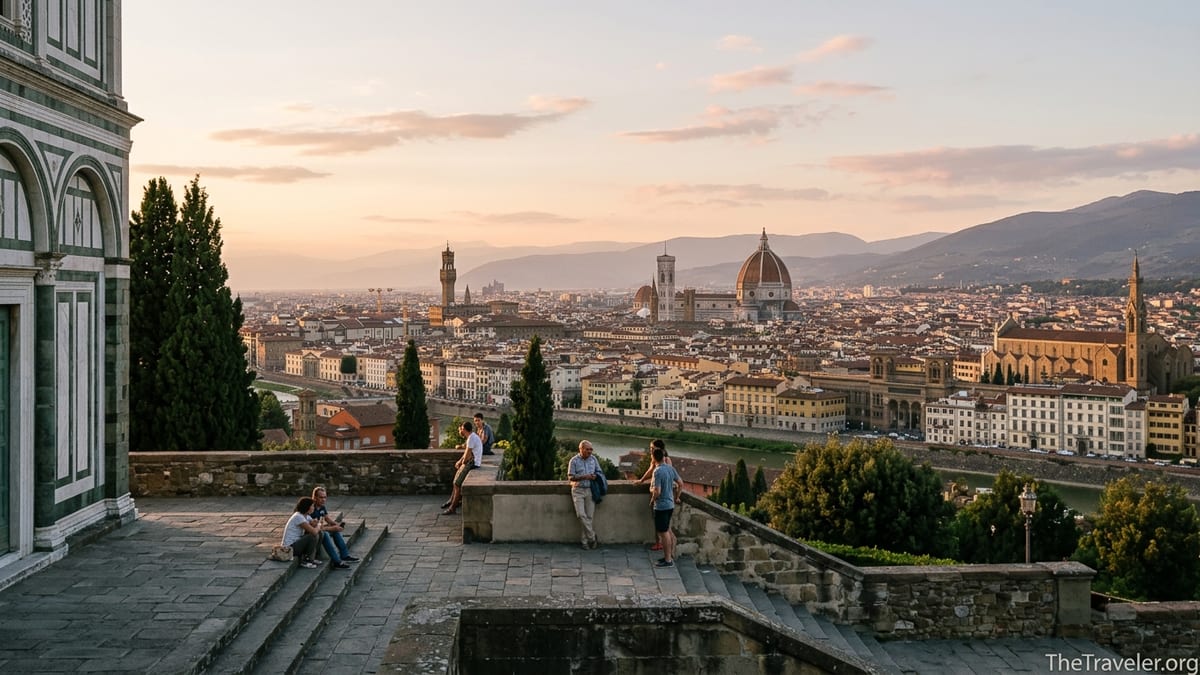
Perched on one of the highest points overlooking Florence, the terrace in front of San Miniato al Monte is a place many residents come back to again and again. Staring out across the skyline, you see the Brunelleschi dome centered in the distance, the bell towers of Santa Croce and Palazzo Vecchio, and the line of the Arno snaking below. The view rivals famous postcards of Florence, but up here the soundtrack is different: church bells, birds in the cypress trees, the murmur of a few conversations instead of loudspeaker buses and selfie-stick vendors.
Locals often describe San Miniato as the view they choose when they have time to themselves. A young professional might ride bus 12 after work, hop off near the cemetery entrance, and walk the last couple of minutes to the church for a ten-minute pause before heading home. A retired couple from the Oltrarno may plan their Saturday stroll to arrive around golden hour, sitting on the stone steps with a gelato from a bar near Porta San Niccolò. The appeal is not simply the cityscape, but the feeling that Florence is at arm’s length rather than right underfoot.
Compared with the constant traffic of tour groups at Piazzale Michelangelo, reviewers and residents alike report that San Miniato remains noticeably calmer, even at peak times. On a typical spring evening, you might share the terrace with a handful of local photographers, an architecture student sketching the facade and a few families watching their kids run up and down the steps. The mood is social but never frenetic, more neighborhood square than sightseeing circus.
Why San Miniato Feels Quieter Than Piazzale Michelangelo
Many visitors first encounter Florence’s hilltop views at Piazzale Michelangelo, a large paved terrace with bus parking, food trucks and a dense belt of souvenir stands. It is spectacular and lively, but for locals the atmosphere can be overwhelming. Just ten minutes’ walk uphill, San Miniato al Monte offers a sharp contrast. The basilica sits behind a small gravel square and is bordered by cypress trees and a historic cemetery, with far less commercial activity. There are no buskers with amplifiers directly on the terrace, and vendors are few, which keeps the soundscape subdued.
The slight extra effort to climb another flight of stairs beyond Piazzale is exactly what filters the crowds. Families from Florence who bring their children here know that strollers require a bit of pushing, but they gain the freedom to let kids roam without weaving through dense tour groups. Couples who have just watched the sun set from the square below often walk up and find that the number of people drops dramatically, giving them space to sit on the wall or steps without bumping shoulders.
Online discussions among residents regularly recommend San Miniato as the answer when someone asks for a quiet proposal spot or a reflective walk. One common suggestion is to arrive at Piazzale Michelangelo early, enjoy the street musicians and market stalls for a few minutes, then continue up to San Miniato when the crowd thickens. This layered routine has become almost a local script: embrace the energy at the piazzale, then seek silence just above it.
The Atmosphere Inside: Stone, Shadow and Gregorian Chant
If the terrace embodies Florence in panoramic form, the basilica interior embodies a different side of the city: ancient, shadowy and spiritual. San Miniato al Monte is one of Florence’s finest Romanesque churches, with a green and white marble facade that hints at the cool darkness inside. Stepping through the doors, visitors find a high timber roof, patterned marble floors, a raised choir and an atmospheric crypt illuminated by small pools of light. The space feels more monastic than monumental, the kind of place where locals instinctively lower their voices.
Many Florentines mention the evening Vespers service, when Benedictine monks sing Gregorian chant in the choir, as a defining experience. For residents, it is not a show but a living part of the city’s religious rhythm. Travelers who slip in quietly during this time often find themselves sitting alongside locals who have come after work or study, sharing the pews with a mix of regular worshippers and a few curious visitors. The chants echo under the wooden ceiling, blending with the faint sounds of the city outside, creating a calm that is hard to find in Florence’s busier churches.
The basilica’s relative lack of ticketing infrastructure also contributes to its atmosphere. While major museums in Florence tend to involve timed entries, security lines and audio-guide kiosks, San Miniato usually feels more like a functioning church that happens to welcome guests. Visitors come and go at a gentle pace, and on many weekdays it is still possible to find moments when you can stand alone in the nave, hearing only your footsteps on the stone floor.
A Favorite Local Walk: From the Arno to the Hilltop
Part of what makes San Miniato beloved by locals is the journey to get there. A classic route begins near the banks of the Arno at Piazza Poggi, where a long staircase climbs past fountains and terraces. Florentines use this climb like a built-in workout, timing themselves from the riverside up to the first plateau at Piazzale Michelangelo, then catching their breath while looking back at the city. The walk takes around 20 to 30 minutes from the historic center, depending on your pace and how often you stop to take photographs.
From Piazzale Michelangelo, residents in the know continue upwards along a shaded path lined with cypress trees, passing the rose garden on one side and stone walls on the other. This last stretch is where the atmosphere shifts most noticeably. The sound of engines and chatter fades, replaced by the rustle of leaves and the occasional church bell from below. Reaching the small square in front of San Miniato feels like stepping into a different layer of Florence, one that belongs as much to local dog walkers and evening joggers as to visitors with guidebooks.
Those who prefer not to tackle the hill on foot often use city buses 12 or 13, which climb the viale along the hillside. Locals treat this like a miniature scenic ride: seats on the right-hand side as the bus leaves the center offer glimpses of villas, olive groves and tiny lanes. Getting off at the San Miniato stop or at Piazzale Michelangelo and walking the final segment gives you the feeling of arrival without the full climb. Taxi drivers in Florence are also familiar with the church as a drop-off point, and groups of residents sometimes share a cab up for a birthday picnic or informal gathering on the steps.
When Florentines Go: Light, Seasons and Daily Rhythms
Ask locals about the best time to visit San Miniato, and many will answer almost automatically: sunset. In spring and early autumn, the golden hour light washes over terracotta roofs and the sky often turns soft pink behind the Duomo. Residents who live on the other side of the river might plan their day around this, perhaps stopping at a bakery in the Santo Spirito area for a slice of schiacciata alla fiorentina to bring up as a snack, and timing their walk so they arrive about 30 to 40 minutes before the sun dips behind the hills.
Others swear by early morning. On clear days outside high summer, locals and a few determined photographers arrive shortly after opening, when the terrace is almost empty and the air still carries a slight chill. From around 8:00 a.m., it is not unusual to see a runner cooling down on the steps, someone stretching near the low walls and a neighbor from the nearby villas walking a dog. This is the time when San Miniato feels most like a village church that just happens to hover above a Renaissance city.
Seasonally, Florentines adapt their routines. In July and August, when temperatures in the center can be intense, the hillside around San Miniato benefits from slightly cooler air and more consistent breezes. Residents might come later in the evening, when the city lights begin to glow and the worst of the heat has faded. In winter, clear days with crisp visibility are especially prized, and locals wrap in scarves and sit on the stone benches with takeaway coffee from a bar near Porta Romana or San Niccolò, appreciating the way the low sun slants across the valley.
Practical Tips: Experiencing San Miniato Like a Local
To capture some of the local spirit at San Miniato al Monte, it helps to approach your visit with unhurried time and simple rituals. Start by checking the current opening hours of the basilica, which can vary slightly between winter and summer seasons, and plan to arrive when the church is open so you can step inside before or after enjoying the terrace. Admission is generally free, though there may be donation boxes near the entrance and a small shop run by the monastic community selling honey, herbal liqueurs and other products made nearby.
Many residents favor practical footwear for the climb or descent, as the stone steps between the Arno and the basilica can be steep and occasionally uneven. Bringing a reusable water bottle is wise, especially in warm months. Some locals fill theirs at public fountains closer to the center before ascending. For those with limited mobility, there is a small parking area just beyond the church, and taxis can usually drop passengers on the gravel square at the front, making the viewpoint accessible even without the climb.
If you want to avoid the busiest moments, consider visiting on a weekday outside major holidays and school breaks. Late morning and mid-afternoon often see a manageable flow of small groups and individuals rather than large tour parties. Respecting the church’s role as a place of worship is important to residents: dressing modestly, speaking quietly and avoiding flash photography inside help preserve the atmosphere that makes San Miniato special. Outside, locals tend to sit on the edges of the steps, leaving pathways clear, and they rarely play loud music, preferring to let the city’s own sounds drift up from below.
Combining San Miniato With Nearby Local Favorites
Part of San Miniato’s charm for residents is how easily it folds into a broader day in the Oltrarno and the hills around Florence. A common local itinerary might start in the late afternoon with a stroll through the Giardino delle Rose, a terraced rose garden tucked beneath Piazzale Michelangelo. Here, families from Florence spread out on the grass between sculptures and rose bushes, children explore the paths and couples find shaded spots with partial city views. From the garden, the walk up to San Miniato is short but scenic, making it a natural next step.
Another beloved pairing is a visit to the church followed by dinner or aperitivo in the San Niccolò neighborhood at the base of the hill. This area, with its narrow streets, wine bars and small trattorie, has long been popular with locals. A typical evening might involve watching the sunset from the terrace at San Miniato, then walking back down via the Rampe del Poggi and stopping for a glass of Chianti and bruschetta in a bar on Via San Niccolò. For Florentines, this rhythm of quiet viewpoint and lively street life feels like a perfect balance.
On weekends, residents sometimes extend their hilltop time by exploring the historic cemetery adjacent to the basilica, which holds ornate tombs and offers yet more peaceful corners with city views. Others use San Miniato as a starting or ending point for longer walks along the ridge roads, passing villas and olive groves on routes that eventually descend toward Porta Romana or the neighborhoods beyond. In each case, the church serves as both landmark and refuge, anchoring local routines in a place where the city always looks a little removed and more comprehensible.
The Takeaway
San Miniato al Monte is not a hidden secret anymore, but it remains deeply loved by Florentines because it preserves something rare in a popular city: a sense of quiet on the edge of beauty. The basilica’s terrace offers what many consider the finest open view of Florence, yet the atmosphere stays measured and reflective, shaped by the daily life of a working church and the extra few steps it takes to reach it.
For travelers, following the local pattern means treating San Miniato not as a rushed photo stop but as a place to linger. Walk up from the river, pause among the roses or cypress trees, listen to the monks if you happen to arrive at Vespers, and give yourself time to watch the city shift in the changing light. In doing so, you will glimpse why, for many residents, this hillside sanctuary remains their preferred way to say good morning and good night to Florence.
FAQ
Q1. Why do locals prefer San Miniato al Monte over Piazzale Michelangelo?
Many locals feel San Miniato offers a calmer atmosphere, similar or better views, fewer vendors and less noise than Piazzale Michelangelo just below it.
Q2. How do I get to San Miniato al Monte from Florence’s city center?
You can walk uphill from the Arno in about 20 to 30 minutes via the steps to Piazzale Michelangelo, or take city buses 12 or 13 most of the way.
Q3. Is there an entrance fee for San Miniato al Monte?
Entry to the basilica itself is generally free, though donations are appreciated and there may be small charges for certain areas or items in the church shop.
Q4. What is the best time of day to visit for the views?
Sunset is especially popular with locals, but early mornings can be even quieter, with soft light, cooler temperatures and very few people on the terrace.
Q5. Are there services with Gregorian chant that visitors can attend?
Yes, Benedictine monks often sing Gregorian chant during evening services such as Vespers; visitors may usually attend respectfully, following current posted schedules.
Q6. Is San Miniato al Monte suitable for people with limited mobility?
The climb from the river can be challenging, but taxis and private cars can reach the small parking area near the church, reducing walking to a short, mostly level distance.
Q7. Can I visit San Miniato al Monte with children?
Yes, many local families bring children; the area in front of the church offers space to move around, though parents should supervise closely near steps and walls.
Q8. Are there places to eat or drink nearby?
There are a few options near Piazzale Michelangelo and more cafes, gelaterie and wine bars in the San Niccolò neighborhood at the base of the hill.
Q9. Is photography allowed at San Miniato al Monte?
Photography is widely practiced on the terrace outside; inside the church, visitors should check signs and avoid flash, especially during religious services.
Q10. How much time should I plan for a visit?
Most visitors who follow a more local rhythm spend around one to two hours, allowing time for the walk, the terrace views and a quiet visit inside the basilica.