


Walk a few minutes uphill from Naples’ chaotic centro storico and the city suddenly drops away beneath your feet. Here, in the working-class Rione Sanità district, the Catacombs of San Gennaro and San Gaudioso open a door into an underground Naples that is older than most European nations, yet very much alive in the present. Far from being just atmospheric burial tunnels, these catacombs sit at the crossroads of faith, art, archaeology and social change. For travelers, they offer one of the clearest windows onto why Naples is the way it is today, and where it may be heading next.
Get the latest updates straight to your inbox!
From Ancient Necropolis to Living Neighborhood
The Catacombs of San Gennaro and San Gaudioso exist because this part of Naples has always been a city of the dead as much as a city of the living. Long before Christianity arrived, the hills above modern Rione Sanità were dotted with Hellenistic tombs and underground hypogea, chosen because tuff stone is soft to carve yet strong enough to hold vaulted spaces. Later, from the 4th and 5th centuries, early Christian communities began to tunnel deeper into the slopes, creating extensive burial galleries that are now known as the Catacombs of San Gennaro and the slightly smaller, more intimate complex of San Gaudioso.
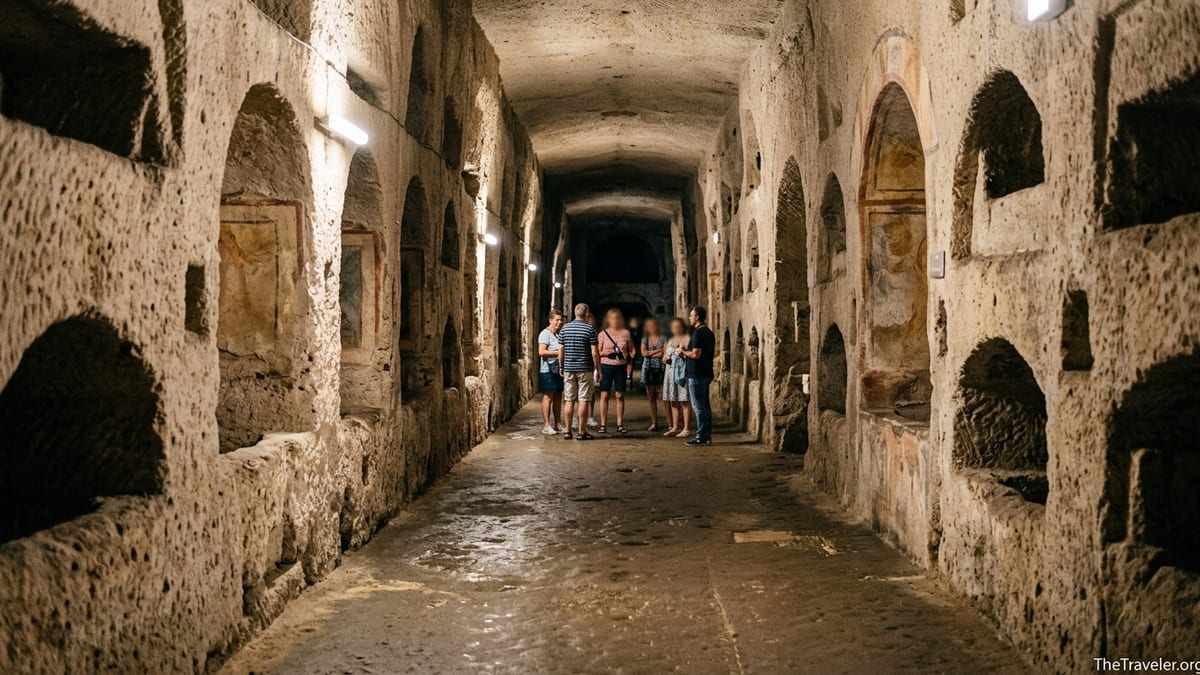
Today, you enter San Gennaro near the Basilica of Madre del Buon Consiglio and San Gaudioso from under the high altar of the Basilica of Santa Maria della Sanità. Above ground you find scooters, street shrines and kiosks selling espresso for barely more than one euro. Below ground, you stand amid frescoes, mosaics and tombs that once held local bishops and martyrs. This physical layering makes it obvious that the catacombs are not remote ruins; they are stitched into the everyday geography of Naples, and this is part of why they still matter.
For visitors arriving with a day trip mindset shaped by Pompeii or the Amalfi Coast, the Rione Sanità setting can be a revelation. It is not a polished historic center but a densely lived-in district where laundry hangs over narrow streets and teenagers crowd around soccer screens in café doorways. Walking from Piazza Cavour to the catacombs, you see how the ancient role of the area as a burial zone has, over centuries, given way to a crowded residential neighborhood that is now at the heart of debates around gentrification, tourism and opportunity.
Guardians of Early Christian Memory
The first reason the catacombs are still important is historical. San Gennaro is widely considered the most extensive Christian catacomb complex in southern Italy, with multiple levels, monumental burial chambers and a basilica area carved directly into the rock. In one chamber you can still make out 5th century mosaics depicting Quodvultdeus, the exiled bishop of Carthage, a concrete reminder of how intertwined the Mediterranean world was even in late antiquity. A guide may point out that the bishop ended up buried here after fleeing North Africa, forcing you to imagine early Christian Naples as a refuge city long before modern debates on migration.
San Gaudioso preserves a different but complementary slice of history. It began as a paleochristian cemetery associated with another North African bishop, Gaudiosus, whose cult drew devotion after his death in the mid-5th century. Walking through these galleries, you are not just observing anonymous skulls and bones. You can still see arcosolia tombs decorated with simple frescoes of fish, lambs and vines, the coded imagery used by Christians when overt symbols of faith were not yet common. These are not reproductions in a museum; they are fragile originals that survived despite centuries of damp and neglect.
For travelers interested in Christian art, these spaces offer something Rome’s monumental basilicas cannot: close contact with an early, more intimate visual language of belief. You stand at arm’s length from paintings that were never meant to be grand statements for emperors, but quiet affirmations for small, local communities burying their dead. That intimacy explains why many art historians consider the Neapolitan catacombs crucial for understanding the transition from Roman funerary art to a recognizably Christian aesthetic.
Art, Death and the Neapolitan Imagination
If San Gennaro shows the monumental side of early Christianity, San Gaudioso reveals how Neapolitans later wove death into their baroque imagination. In the 17th century, when the basilica of Santa Maria della Sanità was built above the older catacomb, Dominicans and local aristocrats reshaped parts of the underground spaces. They created macabre but highly theatrical burials in which skulls were set into the walls while the rest of the body was painted below, fully dressed in the noble’s garments and insignia.
On a modern guided visit, a local guide might stand beneath these figures and explain how the artist Giovanni Balducci, who painted the bodies, asked to be buried here among the aristocratic dead, accepting his work as payment. Looking up at a procession of painted torsos crowned by real skulls, you get an unfiltered glimpse of a Neapolitan attitude toward mortality that is neither clinical nor purely somber. Death is taken seriously but also staged, narrated and personalized. That nuance helps travelers better understand everything from the city’s famous Day of the Dead traditions to the cult of skulls at the nearby Cimitero delle Fontanelle.
In San Gennaro, the art is less theatrical but equally revealing. You walk through broad, tall corridors carved out like underground basilicas, with rough stone pillars and niches. Faded frescoes of saints gaze out from the walls, and fragments of geometric mosaics underfoot hint at the original flooring. When a guide switches off the lights for a moment to evoke the original candlelit atmosphere, you can sense how funerary ritual here must have blended fear, hope and pragmatic reuse of space. That layered emotional tone remains very recognizably Neapolitan today.
Community Regeneration Below and Above Ground
Perhaps the most compelling reason the catacombs still matter today is that they have become engines of local regeneration. In the mid-2000s, the area around the basilicas was largely bypassed by mainstream tourism, and Rione Sanità was known more in Italian news for unemployment and petty crime than for heritage. The story began to change when a group of young locals, supported by parish priest Don Antonio Loffredo, formed the social cooperative La Paranza in 2006 to manage the catacombs and create jobs through culture.
Instead of handing operations to an external tour company, the community chose to train neighborhood youth as guides, ticket staff and restorers. Over the years, this experiment has drawn growing numbers of visitors to San Gennaro and San Gaudioso, with the cooperative reinvesting income into new projects such as a small guesthouse in a former Dominican cloister and support for local artisans and cafés. It is common today to finish a morning catacomb tour with an espresso at a family-run bar on Via Arena alla Sanità, where the staff will casually mention that their cousin or neighbor works as a guide underground.
Travelers who join the official guided tours, which currently cost in the range of 11 to 15 euros for adults depending on combined tickets and discounts, are not just paying for access. They are contributing directly to a local experiment in community-led tourism. Guides take care to mention that the catacomb project has helped change perceptions of the neighborhood within Naples itself, encouraging domestic visitors who once avoided Sanità to return for concerts, festivals and evening events branded as the “Sacro Miglio” or Sacred Mile.
Understanding Naples Beyond the Postcard
Many visitors arrive in Naples with a mental image shaped by pizza, Vesuvius and colorful seafront postcards. The catacombs, by contrast, sit inland and uphill, away from cruise ship itineraries. This relative detour is exactly why they are so valuable for understanding the city beyond clichés. Walking through the Sanità district to reach San Gaudioso or San Gennaro, you pass low-cost produce stalls, inexpensive trattorias offering three-course fixed menus, and social clubs where older residents play cards under fluorescent light. This is a working-class Naples that rarely appears on tourism advertisements.
Yet the guided tours themselves feel carefully organized and accessible. English-language visits run regularly throughout the day in high season, typically lasting around an hour. Groups are kept at moderate size, and the tone is conversational rather than academic. A guide might casually point out film locations from a recent Neapolitan TV series or suggest a nearby pizzeria like Concettina ai Tre Santi, where you should expect to queue for a few minutes but pay far less than in more touristy quarters near the waterfront. These practical touchpoints make the experience feel rooted in contemporary life rather than a detached history lesson.
In an era when cities across Europe struggle with overtourism, the catacombs project offers a more balanced model. Visitors are guided into a neighborhood that needs economic activity, but the cooperative structure and limited capacity of the underground spaces help prevent uncontrolled influx. It shows that heritage travel can distribute benefits beyond postcard zones while preserving the dignity of places that have long been marginalized.
Practical Lessons for Travelers Today
For modern travelers, the ongoing life of the catacombs carries several practical lessons. One is that some of the most meaningful experiences in Naples require planning beyond the obvious. While you can buy tickets on site, especially in shoulder seasons, advance booking on official channels is advisable in busy months like May, June and September, when cruise passengers and weekend visitors from other Italian cities swell demand. Timed guided tours mean you need to think about metro schedules from central stops like Museo or Piazza Cavour, allowing 15 to 20 minutes on foot uphill to reach the entrances.
Another lesson is that attire and expectations should match the site’s dual identity as both heritage and sacred space. Even though the atmosphere is relaxed and many guides are only a little older than the guests they lead, you are still entering areas that were consecrated and used for burials. Shoulders and knees covered, quiet voices and no flash photography in delicate fresco zones are all part of a respectful visit. In practice, that might mean packing a light scarf in your day bag if you are visiting during high summer, when exterior temperatures in Naples often climb above 30 degrees Celsius, but the catacombs remain cool and slightly damp.
Finally, the catacombs remind travelers that meaningful tourism can have a social footprint. Choosing an official catacombs tour in Rione Sanità instead of one of the more generic “underground Naples” experiences sold near Piazza del Gesù not only exposes you to an earlier chapter of Christian history, it also channels your ticket money into a neighborhood cooperative rather than a distant operator. For visitors who care about where their euros go, this can be as important as choosing locally run guesthouses or neighborhood trattorias over global chains.
The Takeaway
The Catacombs of San Gennaro and San Gaudioso matter today because they hold together strands that are often pulled apart in travel narratives: faith and art, memory and daily survival, heritage and future possibility. Under the streets of Rione Sanità, early Christian mosaics sit a short walk away from 17th century skulls framed in paint, all now interpreted by young local guides who see in these spaces a path toward different lives for themselves and their neighbors.
For anyone planning a trip to Naples, carving out half a day to explore these underground worlds offers a perspective you will not get at the bayfront or on a quick pizza stop near the station. You come away not just with striking photographs of candlelit corridors, but with a more grounded understanding of how Neapolitans have lived with death, migration, poverty and resilience over 1,500 years. In a city that can sometimes feel overwhelming on the surface, the quiet of the catacombs provides context as well as calm.
In practical terms, the catacombs are among the most organized and rewarding heritage visits in Naples, with affordable guided tours and clear signage. In emotional terms, they may be the place where the city finally starts to make sense. You enter looking for history and come out sensing that the real story is not just about the dead, but about how the living choose to remember them.
FAQ
Q1. Do I need to book tickets in advance for the catacombs?
Booking ahead is strongly recommended in busy months, especially for English tours, as access is by timed guided visit and groups are limited.
Q2. How long does a visit to San Gennaro or San Gaudioso usually take?
Each guided tour lasts around one hour. Many travelers plan two to three hours total including walking time from the metro and a coffee or snack nearby.
Q3. Is it better to visit San Gennaro or San Gaudioso if I only have time for one?
San Gennaro is larger and more monumental, while San Gaudioso is more intimate and baroque in its treatment of death. If possible, visit both for a fuller picture.
Q4. Are the catacombs suitable for children or claustrophobic visitors?
The main corridors are relatively spacious and well lit, so many children and mildly claustrophobic visitors cope well, but those with severe claustrophobia should be cautious.
Q5. What should I wear inside the catacombs?
Wear comfortable shoes, bring a light layer because it is cooler underground, and dress modestly with shoulders and knees covered out of respect for the sacred setting.
Q6. Can I take photographs during the tour?
Photography without flash is generally allowed in many areas, but guides may restrict photos near fragile frescoes or during moments of explanation, so follow their instructions.
Q7. How do I reach the catacombs from central Naples?
Most visitors take the metro to Museo or Piazza Cavour and then walk uphill through Rione Sanità for 15 to 20 minutes, following local signs toward the basilicas.
Q8. Are the catacombs accessible for people with reduced mobility?
Some sections have steps, uneven floors and narrow passages, so access is limited. It is best to contact the official organizers in advance to discuss current options.
Q9. Is it cold or damp inside the catacombs?
Temperatures underground stay relatively cool year round with noticeable humidity, which many visitors find refreshing in summer but cool in winter without an extra layer.
Q10. Are there other sites nearby worth combining with a catacomb visit?
Yes, many travelers pair the catacombs with a walk through Rione Sanità, a stop at the Basilica of Santa Maria della Sanità and, time permitting, the Cimitero delle Fontanelle.