


Descending into the Catacombs of San Gennaro and San Gaudioso is one of Naples’ most powerful experiences: an encounter with early Christian art, centuries of devotion, and the modern life of the Rione Sanità neighborhood above. Before you go underground, it helps to understand not only how to visit, but what kind of place you are entering, how tours work, and what to expect from the atmosphere, the logistics, and the people who care for these sites today.
Get the latest updates straight to your inbox!
Why These Catacombs Matter in Naples
The Catacombs of San Gennaro and San Gaudioso are among the most important early Christian burial complexes in southern Italy. Carved into soft volcanic tuff on the northern side of Naples, they predate many of the city’s churches and preserve frescoes, mosaics and tombs that span from the 2nd to the 17th centuries. Visiting them is a way to see how Christianity and local devotion took form in a city built on overlapping cultures and eras.
San Gennaro, near the Capodimonte hill, is the larger of the two and is often described as the most significant Christian catacomb complex in southern Italy. Broad underground corridors, a vast basilica carved directly from the rock, and chambers linked to bishops and saints give it an almost architectural feel. San Gaudioso, under the Basilica of Santa Maria della Sanità, is more compact but arguably more intense: here you walk past skulls set into the walls and painted bodies, a striking 17th century tradition that merged older burial spaces with Baroque-era ritual.
Both catacombs sit just outside the formal historic center but within everyday Naples. A visit takes you through Rione Sanità, a once-marginalized neighborhood that has seen real change as a result of catacomb tourism and local social enterprises. Booking a tour is not just a cultural outing: it directly supports the cooperative of local young people who manage the sites and fund projects like community centers and restoration work in the area.
Because of this mix of archaeology, faith, and contemporary life, these are not “dark tourism” attractions in the sensational sense. Expect more discussion of art history, local saints and neighborhood stories than piles of bones. Many visitors come out saying the experience felt surprisingly uplifting, rather than macabre or frightening.
Tickets, Prices and How the Guided Tours Work
Both sites can only be visited on guided tours, and the same ticket usually grants access to San Gennaro and San Gaudioso within a set period of time, often 12 months. As of mid 2026, full-price adult tickets typically cost a little over 10 euro for the combined visit, with reduced rates for visitors under 18 or around student age, and free or heavily discounted entry for small children. Prices can vary slightly depending on whether you book directly, through a reseller, or in a package with other Naples attractions, so think in terms of “just over the cost of a simple pizzeria lunch” per adult.
Tours run throughout the day, with more departures in high season from spring through early autumn. Standard visits to San Gennaro last about one hour, which includes time in the basilica areas and the older, deeper galleries. San Gaudioso tours are usually shorter, around 45 minutes. Guiding is mandatory and included in the ticket price, and you can expect at least some departures in English as well as Italian. In busier months, mid-morning to early afternoon slots in English tend to fill first, especially on weekends.
You can generally buy tickets at the entrance shortly before your preferred time, but in peak periods such as late May, June and September, it is safer to reserve online the day before or earlier in the week. For example, a couple staying near Piazza Bellini in the historic center in June might walk into a ticket office at 11:30 and find the next English tour only available at 13:00, which could disrupt other plans. Booking a 10:00 or 16:00 slot in advance helps anchor your day.
Keep your ticket after visiting the first site. Visitors often go to San Gennaro in the morning, have lunch in Rione Sanità or back in the center, then head to San Gaudioso in the afternoon. The staff at each site are used to explaining how to move between them, and they may suggest combining your visit with a stop at nearby sights like the cemetery of Fontanelle or the church of Santa Maria della Sanità.
Opening Hours, Best Times and Seasonal Crowds
In 2026, the Catacombs of San Gennaro typically operate on a schedule that runs from late morning into late afternoon most days of the week, with a closing day that is often Wednesday. Schedules can be adjusted slightly in low season or for special events, so always confirm the current timetable close to your travel dates. Roughly speaking, you can expect first tours around 10:00 and last entries mid to late afternoon, with fewer time slots in winter.
San Gaudioso generally follows a similar rhythm but with fewer daily tours, sometimes concentrated in the afternoon. For example, on a typical Saturday in high season, you might find hourly or even half-hourly departures at San Gennaro from 10:00 to 17:00, while San Gaudioso might offer only several guided visits between late morning and 17:00. If you are visiting outside the main tourist months, it is worth checking a day in advance whether both sites will be running tours in your preferred language when you plan to go.
In terms of crowd levels, the quietest slots tend to be the first tours of the day and the last ones before closing. A family staying near Via Toledo in August may find that a 10:00 tour at San Gennaro has a group of 15 to 20 people, while a 12:00 slot could easily swell to 30 or more as tour buses and shore excursions arrive. Late afternoon, especially after 16:00, often feels calmer again, and the underground spaces can be particularly atmospheric as the city above softens into evening.
Weather plays a smaller role than you might think. The catacombs are naturally cool, with stable temperatures that offer welcome relief in July and August. On a 32 degree Celsius summer day, you might feel a drop of ten degrees as you descend. In winter, however, the same coolness can feel quite penetrating after 45 minutes underground, especially if you arrive already chilled by rain, so dress for a cave-like environment even if Naples itself feels mild.
Getting There: From Centro Storico to Rione Sanità
The catacombs sit a little uphill from the historic center, and many visitors underestimate the logistics of reaching them. San Gennaro’s main entrance is near the Basilica del Buon Consiglio on Via Capodimonte, on the slope leading up toward the Capodimonte Museum. San Gaudioso lies beneath the Basilica of Santa Maria della Sanità, anchored in the heart of the Rione Sanità district. The two are about a 10 to 15 minute walk apart, partly uphill.
If you are staying in the centro storico near Via dei Tribunali or Spaccanapoli, a common route is to walk or take the metro (Line 1) to Museo station near the National Archaeological Museum, then continue uphill by bus or on foot. Several local buses connect Piazza Cavour or the Museo area with Via Capodimonte; the ride usually costs just over 1 euro if you buy a ticket in a tobacco shop beforehand. From the nearest stop, expect a short but fairly steep walk to the entrance. Visitors with limited mobility or traveling with young children may prefer to take a licensed taxi directly, which from central areas like Piazza Bellini or Piazza Dante generally costs less than a typical dinner entrée at a midrange trattoria.
Reaching San Gaudioso on its own is slightly easier: you can walk from the Archaeological Museum to Rione Sanità in around 15 minutes, descending into the neighborhood through a series of old stone bridges and stairways. Many travelers choose to start at San Gaudioso and the church of Santa Maria della Sanità, have a coffee or pastry in one of the neighborhood bars, then continue to San Gennaro for a later tour. A real-world example: a pair of friends with a 14:00 ticket at San Gennaro might arrive in the area by 12:30, visit San Gaudioso on the earlier 13:00 tour if space allows, then stroll uphill in time for their next visit.
Driving personal vehicles is not recommended unless you know Naples well. The streets around Rione Sanità are narrow, trafficked and full of scooters, and parking near the catacombs is limited. If you are arriving by rental car from elsewhere in Campania, a practical approach is to park in a supervised garage near the Archaeological Museum or in the port area, then rely on taxis or buses for the last segment.
What You Will Actually See Underground
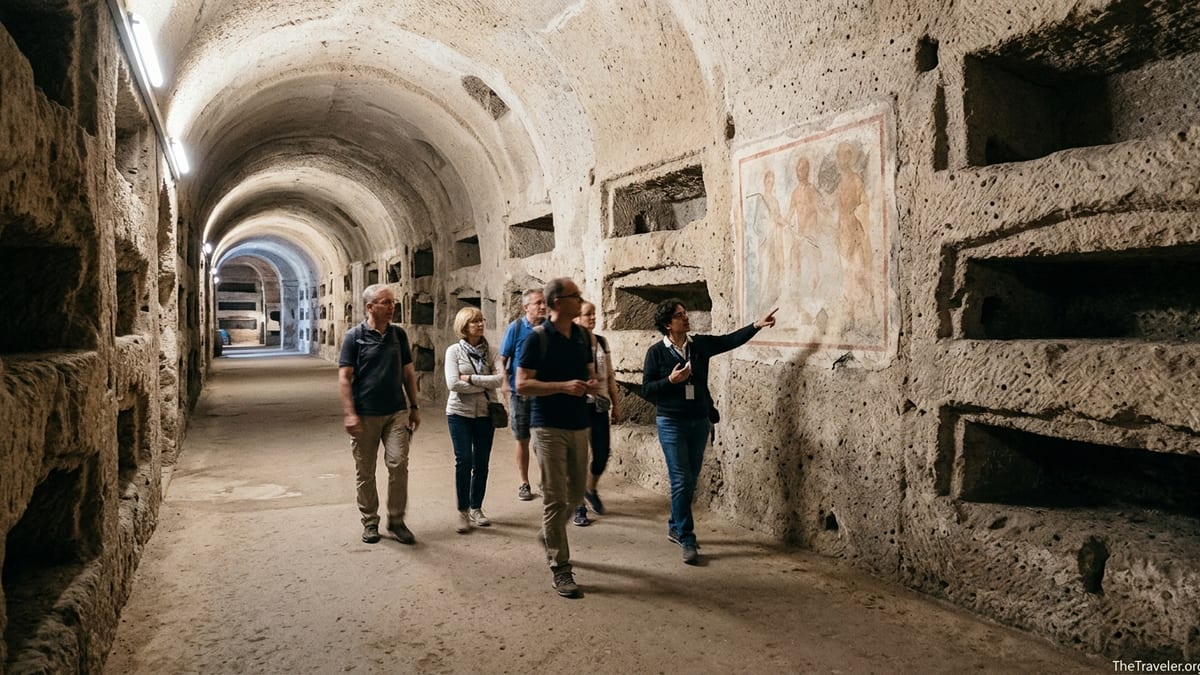
At San Gennaro, the visit usually begins near the upper basilica, where your guide will introduce the origins of the site as a 2nd century burial area that grew around the tombs of Christian communities and later bishops. From there you move into spacious galleries lined with loculi, the niches where bodies were once placed, and into larger chambers that served as underground churches. Many visitors are surprised by the sheer volume of space; it feels more like walking through a carved-out cathedral than crawling through a tunnel.
Key highlights often include frescoes of early Christian symbolism, mosaics linked to figures like Saint Agrippinus, and the so-called “confession” area associated with San Gennaro himself, the city’s patron saint. The tuff rock walls show layers of history where burials and worship adapted over centuries. For a concrete moment: your guide might point to a 5th century fresco of a bishop in one niche, then a 9th century painting overlaid nearby, explaining how later communities reused and reimagined earlier spaces rather than abandoning them.
San Gaudioso offers a different visual language. Here, the oldest parts of the catacomb preserve early Christian tombs and frescoes, but the most striking images for modern visitors are the 17th century skulls set into the walls with painted, almost life-size bodies below. These composite memorials belonged to nobles and clergy who wanted to be buried close to the saint and whose bodies were treated in particular ways before interment. Walking past them, you see a gallery of painted robes, armor and symbols of profession, each topped with a real skull, a vivid reminder of how Baroque Naples thought about death and status.
Beneath the Basilica of Santa Maria della Sanità, your guide will also draw attention to Byzantine-era frescoes, refine the differences between pagan and Christian burial imagery, and point out where volcanic activity and water flows have shaped the conservation of the complex. Interpretation is generally clear and accessible even if you are not a specialist; guides are used to answering questions from cruise day-trippers on one tour and archaeology students on the next.
Practical Tips: Clothing, Accessibility and Safety
The catacombs are not physically extreme, but there are practical considerations that will make your visit more comfortable. Temperatures underground feel cool year-round, roughly in the low to mid teens Celsius. In summer, bring a light layer, such as a thin sweater or long-sleeved shirt, especially for children who may feel the chill more quickly. In winter or during rainy periods, a warmer jacket is advisable. Footwear should be closed-toe and with good grip; think of what you would wear on a city walk in light rain. Floors can be slightly uneven or damp in spots, though major pathways are maintained to a good standard.
Accessibility is improving but still limited in parts. San Gennaro’s main areas have wider corridors and some ramps, and parts of the route may be manageable for visitors with moderate mobility issues when accompanied and with advance communication. However, expect some steps and inclines that cannot be fully avoided. San Gaudioso has tighter spaces and more stairs. If you rely on a wheelchair or have significant difficulty with steps, it is important to contact the operators or your tour provider ahead of time to discuss what is currently possible.
Safety underground is taken seriously. Group sizes are controlled, guides keep a clear pace, and emergency lighting is in place. Children are welcome, but strollers are best left above ground because of the stairs and narrow passages. Many families choose to visit with children aged seven or older, who can handle the walk and understand the context. For younger kids, whether the visit is suitable depends on the child’s sensitivity to tombs and darker spaces. Some parents report that their nine-year-old found San Gennaro “cool and mysterious” while a six-year-old sibling was unsettled by the dim light and talk of burials.
As for personal safety in the neighborhood, Rione Sanità has changed a lot in the past decade, largely thanks to community projects connected to the catacombs. During visiting hours, the streets around the entrances are lively with local residents, visitors, and volunteers. Normal city precautions apply: keep your bag zipped, be aware of scooters and traffic, and avoid flashing expensive watches or large amounts of cash. Most travelers who visit during the day and use common sense feel perfectly comfortable walking to and from the sites.
Respect, Photography and Local Etiquette
These catacombs are archaeological sites and former burial grounds, not theme-park attractions. Guides will often remind visitors at the start of the tour to keep voices low, avoid touching walls or frescoes, and walk carefully. While most human remains have long since been moved or are not visible, places like the skull galleries in San Gaudioso are still treated with respect by locals who see them as part of their spiritual heritage.
Photography policies can change, but recent practice has allowed non-flash photography in many areas, particularly wider corridors and basilica spaces. Flash is usually forbidden to protect fragile pigments, and tripods or large equipment are not appropriate on group tours. A realistic scenario: you will probably be able to take a few handheld photos of your guide silhouetted in a tuff corridor, or a distant shot of a fresco explained during the tour, but you may be asked not to photograph certain portraits or close-ups of skulls in San Gaudioso. Always follow the guide’s instructions; they are balancing visitor curiosity with conservation needs.
Clothing expectations are a little more relaxed than in active churches, but modest attire is still sensible. Covered shoulders and mid-thigh length shorts or skirts are generally fine. You will be spending part of your visit in or near basilicas like Santa Maria della Sanità, where local residents may be attending services, baptisms or funerals. It is good practice to remove hats when entering church interiors and to step aside quietly if a ceremony is in progress.
Many of the staff and volunteers are young people from the neighborhood working through the local social cooperative. Taking a moment to greet them, perhaps asking for a lunch suggestion nearby or buying a small item from the onsite bookshop, is a concrete way to support the ongoing regeneration of Rione Sanità. Several visitors report discovering excellent, unpretentious trattorias on side streets around the basilica simply by asking a guide where they eat themselves after a shift.
The Takeaway
Visiting the catacombs of San Gennaro and San Gaudioso is one of the most memorable ways to understand Naples as a layered city: ancient and modern, sacred and everyday, fragile and resilient. These are not just underground attractions, but living sites anchored in a neighborhood that has turned cultural heritage into a tool for community renewal.
If you prepare for cool temperatures, uneven ground and the emotional weight of burial spaces, you will likely find the experience more beautiful than morbid. Plan your logistics so that you arrive unhurried, build in time to move between the two sites and to explore Rione Sanità at street level, and approach the visit with curiosity and respect. In return, you will come away with a deeper sense of how Naples has carried its stories, its faith and its people through the centuries, literally carved into the rock beneath your feet.
FAQ
Q1. Do I need to book tickets for the catacombs in advance?
It is often possible to buy tickets on the spot, especially in the quieter months, but in late spring, summer and early autumn popular mid-day English tours can sell out. Booking online at least a day ahead is recommended if you have a fixed schedule or are visiting on a weekend or holiday.
Q2. How long should I plan for visiting both San Gennaro and San Gaudioso?
Allow at least three hours in total. A typical visit might involve a one-hour tour at San Gennaro, a short break or walk between sites, and a 45 minute tour at San Gaudioso, plus time to arrive and depart from Rione Sanità. If you also want to stop for a coffee or lunch nearby, plan half a day.
Q3. Are the catacombs suitable for people who are claustrophobic or afraid of the dark?
Many visitors with mild claustrophobia manage well at San Gennaro because the corridors are unusually wide and high for catacombs, and the lighting is soft but adequate. San Gaudioso has some narrower sections and a more intense atmosphere. If you are unsure, consider starting with San Gennaro, standing near the back of the group so you can exit more easily if needed.
Q4. Can children visit the catacombs, and is there a recommended minimum age?
Children are welcome on the tours, and many families visit with kids from about seven years old upward. Younger children can come too, but parents should consider whether their child is comfortable with darker spaces and talk of burials. Strollers are impractical because of steps and uneven floors, so very young children usually need to be carried at times.
Q5. Is there step-free access or accommodations for visitors with limited mobility?
Some areas of San Gennaro are more accessible than others, and the site has made efforts to improve access with ramps and clearer pathways, but steps and inclines remain. San Gaudioso is more challenging. Visitors with limited mobility should contact the operators or their tour provider ahead of time to discuss current options and whether a partial visit is possible.
Q6. What should I wear for a visit to the catacombs?
The key is to dress in layers and wear comfortable, closed-toe shoes with good grip. Temperatures underground are cool all year, so even in July a light sweater can be useful. Modest clothing is appreciated, especially as you will likely pass through active church spaces before or after the underground portion.
Q7. Are photos allowed inside the catacombs?
Non-flash photography is usually permitted in many parts of the catacombs, although flash and tripods are not allowed. Guides may restrict photos in certain more sensitive areas, particularly where human remains are visible. Always ask if you are unsure and follow the instructions given during your tour.
Q8. Is it safe to visit Rione Sanità and walk between the two sites?
During the day, Rione Sanità is generally safe for visitors, with many residents, schoolchildren and tourists moving through the streets. Walking between San Gennaro and San Gaudioso is common and typically takes around 10 to 15 minutes. Normal urban precautions apply, such as minding traffic, watching for scooters and keeping valuables discreet.
Q9. Are the catacombs very cold or damp inside?
The temperature underground is cool and quite stable, but not freezing. You may notice some humidity and occasional damp patches on the floor or walls due to the porous tuff rock and natural water flows. A light jacket or sweater is enough for most people, though visitors who feel the cold easily might prefer something warmer in winter.
Q10. Can I visit the catacombs on the same day as other major Naples sights?
Yes, many travelers combine the catacombs with a morning at the National Archaeological Museum or an evening in the historic center. For example, you might visit the museum near Piazza Cavour, have lunch, then take an afternoon tour at San Gennaro and San Gaudioso before returning by bus or taxi to dine around Via dei Tribunali or Piazza Bellini.