


Few experiences in Naples capture the city’s layered mix of faith, mortality, and street life quite like descending beneath Rione Sanità into the catacombs of San Gennaro and San Gaudioso. Both are among southern Italy’s most evocative early Christian burial sites, and both sit just a short walk apart in one of Naples’ most charismatic neighborhoods. But are they worth carving out precious hours from a busy itinerary of pizza, Pompeii, and the Amalfi Coast? The answer depends on what kind of traveler you are and how you like to explore cities. This guide breaks down what each catacomb offers, what a visit is really like today, and how to decide if they deserve a place on your Naples shortlist.
Get the latest updates straight to your inbox!
Understanding the Two Catacombs: San Gennaro vs San Gaudioso
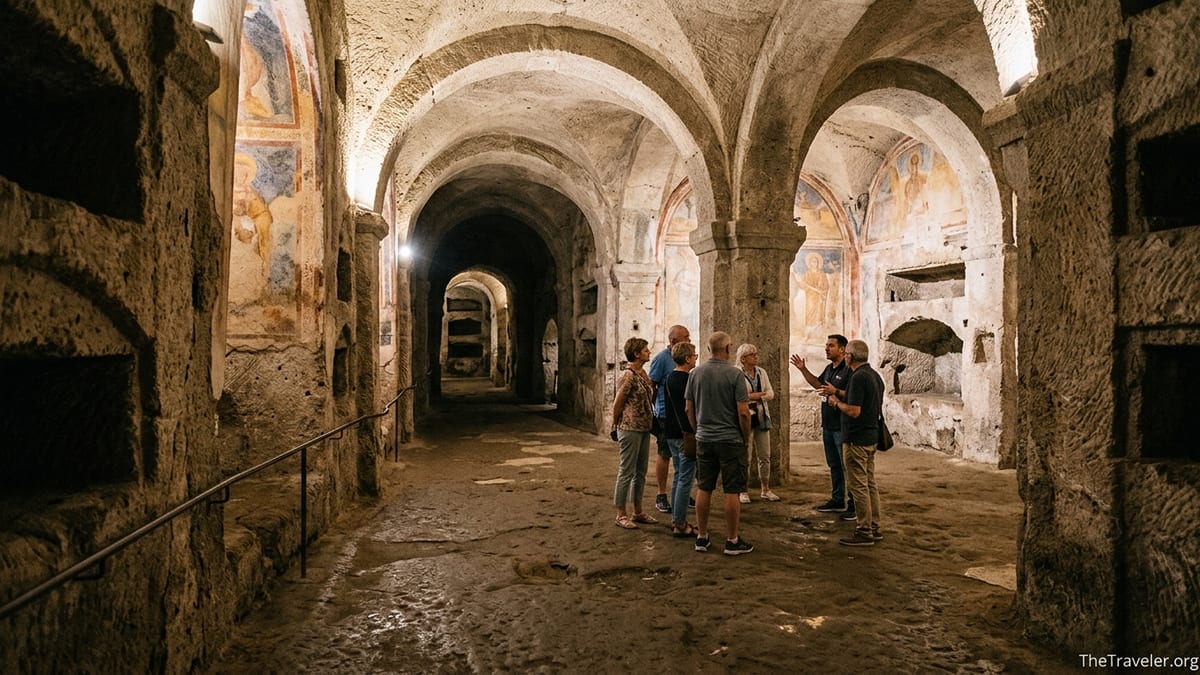
Naples has several underground sites, but when travelers talk about “the catacombs” they usually mean San Gennaro and San Gaudioso. The Catacombs of San Gennaro sit on the slope leading up toward Capodimonte, beneath the Basilica di San Gennaro extra moenia. Developed from the 2nd century AD, the complex expanded as Naples embraced Christianity, eventually becoming closely tied to the city’s patron saint, San Gennaro. Today visitors walk through large, carved-out spaces in the soft tuff rock, some of which feel more like underground basilicas than narrow burial tunnels, with frescoes and tombs still visible along the walls.
San Gaudioso, a 10 to 15 minute walk downhill in Rione Sanità beneath the Basilica di Santa Maria della Sanità, offers a more intimate and slightly eerie experience. These catacombs grew around the tomb of an African bishop, Gaudiosus of Abitina, who arrived in Naples in the 5th century. They later became a burial place for local nobles, who commissioned macabre yet fascinating artworks where their skulls were set into the walls and their bodies painted beneath. Where San Gennaro feels grand and spacious, San Gaudioso feels close, atmospheric, and deeply tied to neighborhood traditions surrounding death and devotion.
Both sites are run in coordination with local social cooperatives, and visits are by guided tour only. In practice, this means that even though they are historic sites, the experience is quite organized. Guides are often young locals from Rione Sanità who weave together archaeology, art history, and everyday life in Naples. For many travelers, this human element is an important part of the value of visiting both catacombs.
Most travelers who do visit feel that San Gennaro alone is a highlight of their time in the city, while San Gaudioso is often described as a more offbeat “bonus” for those who enjoy darker, more intimate spaces and have a bit more time. Understanding this distinction helps you decide whether to see just one, or both.
What a Visit Actually Looks Like Today
Visits to both San Gennaro and San Gaudioso are structured around timed guided tours, typically in small groups. At San Gennaro, English-language tours usually run several times a day, with Italian and sometimes other languages offered as well, especially in peak season. Tour schedules can change by month, but it is common for the first tours to start around mid-morning and continue through mid to late afternoon on most days of the week. Booking in advance online, especially for weekend or high season dates, is strongly recommended so you are not left waiting for the next available slot.
A typical San Gennaro tour lasts about one hour. After checking in at the ticket office near the basilica, the guide leads the group down broad ramps carved into the rock. The route usually includes the upper catacomb with its wide galleries, the remains of an underground basilica with frescoed vaults, and the older lower level with more compact burial niches. Lighting is soft but sufficient, and paths are generally even, though slightly damp underfoot in spots. Travelers who are comfortable with moderate stairs and walking can usually manage, but those with serious mobility issues may find certain areas challenging.
San Gaudioso visits are slightly shorter, often around 45 minutes, and the feel is more intimate. You enter through the church of Santa Maria della Sanità, then descend a staircase to a smaller network of tunnels. The guide points out early Christian burial niches, fresco fragments, and the distinctive 17th century “noble burials” where skulls are embedded in the walls above painted figures in aristocratic dress. Many visitors describe this space as both unsettling and strangely beautiful, and guides often explain how local beliefs about purgatory, the soul, and caring for the dead still shape Neapolitan culture today.
Combined tickets typically allow you to visit both catacombs with separate guided tours within a set period, often 12 months from the date of purchase. This means you do not need to rush both in the same day if your schedule is tight. In practice, many travelers choose to see San Gennaro in the late morning, have lunch in Rione Sanità, and then visit San Gaudioso early afternoon, turning the outing into a half-day exploration of the neighborhood.
Costs, Tickets, and Realistic Time Planning
Pricing for the catacombs can change slightly year to year, but as of mid 2026 you can expect a standard adult ticket for a single catacomb to cost in the range of a modest museum ticket in a major European city. Combined tickets for both San Gennaro and San Gaudioso are usually only a little more than visiting one site alone, making the combo good value if you have time for both. Reduced rates are generally available for children, students, and seniors, and kids under a certain age often enter free with an adult. It is wise to check current prices directly through authorized channels when you plan, as third-party tour resellers may add markups or bundle transportation and extras.
Because visits are guided, your time is tightly defined: about one hour for San Gennaro and 45 minutes for San Gaudioso. Add at least 15 to 20 minutes cushion on either side to allow for checking in, waiting for your group to be called, and browsing any small exhibits or book corners at the entrance. If you visit both catacombs plus wander Rione Sanità a bit, you should set aside at least three to four hours in your day, including a relaxed lunch or coffee stop.
In terms of value, many travelers compare the cost to other major Naples attractions like the National Archaeological Museum, Napoli Sotterranea, or the Cappella Sansevero with the Veiled Christ sculpture. The catacombs come out favorably for those interested in early Christian art, social history, or unusual underground architecture, especially given the inclusion of a live guide. If your budget is tight, a combined ticket is usually a better use of funds than paying separately for several overlapping underground tours sold to tourists in the historic center.
One important practical note is to bring a light jacket or sweater, even in July and August. The temperature underground typically feels cool and slightly humid year-round. Sensible closed shoes are also advisable. Flip-flops and smooth leather soles can be slippery on damp stone steps, and you will enjoy the visit more if you are not worrying about footing while the guide is explaining an ancient fresco.
Getting There and Experiencing Rione Sanità
Part of the appeal of visiting the catacombs is the chance to explore Rione Sanità, a densely lived-in neighborhood that many travelers would otherwise never see. The area lies north of the historic center, between the city’s main core and the Capodimonte hill. From central Naples, many visitors take Metro Line 1 to Museo or Materdei station and then walk about 15 to 20 minutes, or use local buses that stop near the catacombs’ entrance. Taxi and app-based rides are also a fairly straightforward option, particularly if you are traveling with children or older relatives and want to avoid uphill walks in summer heat.
Reaching San Gennaro first is common. From its entrance near Via Capodimonte, you can walk downhill into the heart of Rione Sanità, passing small grocery shops, bakeries, and shrines tucked into building corners. A practical route is to schedule a late-morning San Gennaro tour, then walk down toward Piazza Sanità, where you will find a mix of simple trattorias and street food stands serving fried pizza, cuoppi of fritti, and sfogliatelle. A sit-down lunch at a modest neighborhood pizzeria often costs considerably less than in the most touristy lanes around Via dei Tribunali, yet the quality can be excellent.
San Gaudioso lies directly under the basilica that dominates Piazza Sanità. After the tour there, many visitors linger to admire the church’s baroque interior or to stroll some of the side streets, where street art and religious iconography coexist. You might pair the catacombs with a walk up to the nearby Cimitero delle Fontanelle, another atmospheric ossuary, turning the outing into a themed exploration of Naples’ relationship with its dead. Just remember that while this is a fascinating urban district, it is also a working-class neighborhood: dress modestly, keep valuables secure, and be respectful when taking photographs, especially if residents are in the frame.
Travelers who feel nervous about exploring on their own can opt for organized “Sacred Mile” style walks that link the catacombs with other religious and historic spots in Rione Sanità. These usually include a local guide who manages timing, tickets, and navigation through backstreets that are not always well-signposted for visitors. For independent travelers comfortable with city environments, however, navigating by map app and following main streets is generally manageable in daylight hours.
Who Will Find the Catacombs Most Rewarding
The catacombs tend to be particularly rewarding for travelers who enjoy history with a tangible sense of place. If you found the early Christian rooms in the Vatican Museums fascinating or lingered in the crypts of Roman churches like San Clemente, San Gennaro will likely be a high point of your Naples stay. The large underground basilica-like space, with its faded frescoes and sarcophagi, offers a direct connection to the city’s Christian roots and to the cult of its patron saint that continues today, especially if you also visit the Duomo and the Chapel of the Treasure of San Gennaro elsewhere in town.
San Gaudioso, by contrast, tends to appeal to travelers drawn to more macabre or anthropological aspects of culture. The combination of skulls set in plaster above painted noble bodies, the layering of centuries of burial practices, and the neighborhood context of Rione Sanità give the visit a more intimate and slightly darker tone. Visitors interested in how societies handle death, memory, and social status often find this site particularly memorable.
Families with older children and teenagers often report that the catacombs are a hit, especially when kids are already studying Roman or early Christian history. Guides are usually adept at pitching their explanations to mixed-age groups without making the visit feel like a school lesson. That said, very young children may become restless in the low-light, structured environment of a guided tour, and some may find the human remains unsettling. If you are traveling with small kids or anyone who is highly sensitive to images of death, you may want to choose San Gennaro only, where skeletal remains are less visually central than in San Gaudioso.
Travelers who struggle with tight spaces, darkness, or the idea of being underground should weigh their comfort. San Gennaro’s broad galleries rarely feel claustrophobic and can be manageable even for mild claustrophobes, while San Gaudioso has lower ceilings and narrower passages in parts. If you know you dislike underground environments, you might prioritize other Naples highlights like Castel dell’Ovo, the National Archaeological Museum, or an evening stroll along the seafront instead.
When to Go and How These Sites Fit Into Your Itinerary
In terms of timing, late morning or early afternoon visits work well. The first guided tours of the day at San Gennaro are often a little quieter than late-morning time slots popular with bus tours and day trippers, especially from spring through early autumn. If your schedule allows, consider booking the earliest English-language tour of the day. You will usually share the space with fewer groups, making it easier to hear the guide and to linger briefly in front of frescoes or burial chambers.
On hot summer days, the catacombs can be a welcome respite from the heat. Combining a morning wander through the bustling streets of the centro storico with a cool, underground afternoon in Rione Sanità is both practical and atmospheric. In winter, some travelers appreciate the steady underground temperature compared to chilly, damp street conditions. Just remember that opening days can vary; it is common for certain weekdays to have reduced or no tours, so always verify current schedules when planning.
As for where the catacombs fit among Naples’ many attractions, they sit somewhere between a “must” and a “strong nice-to-have.” If you only have one full day in the city, you might logically prioritize the historic center, the Duomo, and the Archaeological Museum before heading underground. With two or more days, however, adding at least San Gennaro makes sense for most travelers who care about history and local culture. With three days or more, the combined visit to both San Gennaro and San Gaudioso becomes an easy yes, especially since you can pair it with food and street life in Rione Sanità.
Travelers planning day trips to Pompeii, Herculaneum, or the islands sometimes worry about “too many ruins.” The catacombs are different enough in atmosphere and time period that they complement the ancient sites rather than duplicate them. While Pompeii is open-air and Roman, the catacombs are intimate, Christian, and squarely rooted in Naples’ own story, so they can actually provide a welcome contrast in your overall itinerary.
The Takeaway
Are the Catacombs of San Gennaro and San Gaudioso worth visiting during your trip to Naples? For many travelers, the answer is yes, provided you have at least a second day in the city and an interest in history beyond the surface. San Gennaro, with its broad, basilica-like chambers and early Christian frescoes, offers a powerful, accessible introduction to Naples’ underground past and the enduring devotion to its patron saint. San Gaudioso, more intimate and macabre, deepens that experience for visitors curious about how Neapolitans have navigated death, faith, and social status through the centuries.
The guided nature of the visits adds value by connecting the archaeology to contemporary life in Rione Sanità, and the overall cost is modest compared with other major European historic sites, especially when you choose a combined ticket. On a practical level, the catacombs fit smoothly into a half-day outing that also showcases one of Naples’ most characterful neighborhoods and its food.
They are not for everyone. Travelers with severe claustrophobia, very young children, or a strong aversion to human remains may prefer to stay above ground and focus on churches, museums, and sea views. But if you are drawn to places where history, belief, and everyday life intersect in a very tangible way, the catacombs are among the most distinctive experiences Naples has to offer.
In short, if you have the time and the temperament for underground exploration, putting at least San Gennaro, and ideally both San Gennaro and San Gaudioso, on your Naples itinerary is a decision you are unlikely to regret.
FAQ
Q1. Do I need to book tickets for the catacombs in advance?
Booking in advance is strongly recommended, especially from spring through early autumn and on weekends, because visits are only by guided tour at specific times and popular English-language slots can sell out.
Q2. How long does it take to visit both San Gennaro and San Gaudioso?
Plan on about one hour for San Gennaro and 45 minutes for San Gaudioso, plus extra time for check-in, walking between sites, and a snack or meal. In practice, a relaxed combined visit with some neighborhood wandering usually takes three to four hours.
Q3. Are the catacombs suitable for children?
Older children and teenagers usually enjoy the catacombs, especially if they like history or a slightly spooky atmosphere. Very young children may become restless during the guided tours or be unsettled by human remains, so families should consider their kids’ personalities before booking.
Q4. Is photography allowed inside the catacombs?
Photography policies can vary and may restrict flash or tripod use, both to protect the frescoes and to keep tours moving smoothly. It is best to check current rules with your guide at the start of the visit and to be discreet and respectful when taking any photos.
Q5. What should I wear to visit the catacombs?
Wear comfortable closed shoes with good grip and bring a light layer, as temperatures underground remain cool even in summer. Because the catacombs and the churches above them are religious spaces, modest clothing that covers shoulders and knees is advisable.
Q6. Are the catacombs accessible for people with limited mobility?
The catacombs involve stairs, uneven floors, and some sloping passages, which can be challenging for visitors with significant mobility issues. There are usually no elevators down into the burial levels, so travelers who rely on wheelchairs or cannot manage stairs may find access very limited.
Q7. Can I visit the catacombs on my own without a guide?
No, visits to both San Gennaro and San Gaudioso are by guided tour only. This system helps protect the delicate underground environment, manage crowding, and provide context that makes the experience more meaningful.
Q8. Which catacomb should I choose if I only have time for one?
If you must choose just one, most travelers will get the broadest experience from San Gennaro, which is larger, less claustrophobic, and offers a strong overview of early Christian Naples. San Gaudioso is best kept as an additional, more atmospheric visit if your schedule and interests allow.
Q9. Is it safe to visit Rione Sanità around the catacombs?
Rione Sanità is a lively, authentic neighborhood where many visitors safely stroll during the day to reach the catacombs and nearby sights. As in any big city, use common sense: go in daylight, keep valuables secure, stay on main streets, and be respectful of residents and local businesses.
Q10. How do the catacombs compare with other underground tours in Naples?
The catacombs focus on early Christian burials and religious history, with broad chambers and frescoes, while other underground tours in the historic center emphasize ancient aqueducts, war-era shelters, or Greek and Roman foundations. Many travelers feel the catacombs offer a deeper cultural and spiritual perspective rather than just a novelty of being underground.