


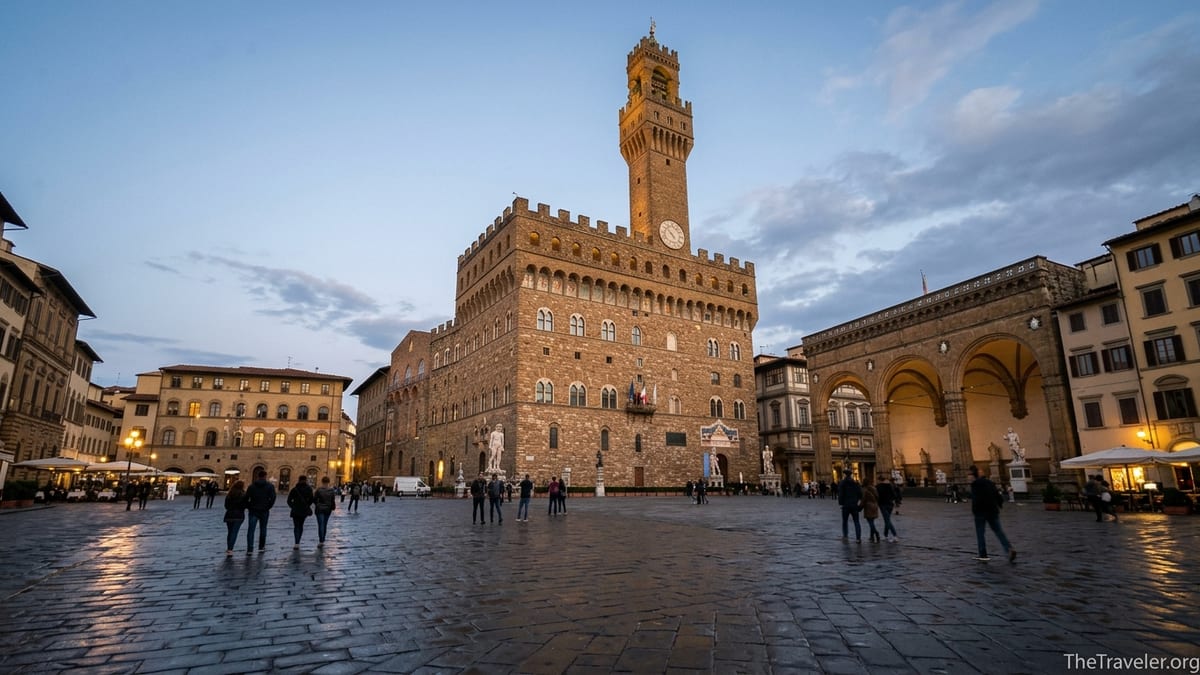
Stand in Piazza della Signoria at any hour and Palazzo Vecchio dominates the scene: a rough-hewn fortress, a needle-like tower, and a constant flow of locals and visitors crossing its threshold. For more than seven centuries, this building has been the stage on which Florence negotiated power, displayed its wealth, and told its own story to the world. What is remarkable is not just what happened here in the past, but how actively Palazzo Vecchio still shapes the city’s history and identity today.
Get the latest updates straight to your inbox!
The Political Heart of Florence, Then and Now
Palazzo Vecchio was conceived in the early 14th century as the Palazzo della Signoria, a fortified seat for the elected government of the Florentine Republic. Its crenellated roofline, iron-bound doors, and narrow windows were not stylistic flourishes but concrete responses to real fears of factional violence and popular uprisings. The message to anyone entering Piazza della Signoria was clear: this was where decisions were made, and where power was defended.
That political role never entirely disappeared. Since 1872, Palazzo Vecchio has housed the office of the mayor and the City Council of Florence, making it one of the few medieval town halls in Europe that still functions as a working city hall. Visitors who buy a museum ticket in 2026 may walk past staff heading into modern offices, or see signs indicating council chambers reserved for meetings later that day. In practical terms, the building is where contemporary debates about public transport, tourism regulation, and heritage protection are formally discussed and voted on.
The coexistence of civic administration and museum reflects how Florence sees itself. When the city hosts honorary citizenship ceremonies, international summit receptions, or commemorations of events like the 1966 flood, the Salone dei Cinquecento or adjacent rooms in Palazzo Vecchio are often chosen as venues. In October 2024, for example, a political reception in the Salone coincided with regular visiting hours, forcing the museum to reroute tourists while local politicians and dignitaries gathered inside. Episodes like this underline that Palazzo Vecchio is not a frozen monument but an address that still appears on official invitations and city calendars.
For travelers, this dual role makes a visit feel less like stepping into a distant past and more like entering Florence’s living nerve center. It is not unusual to emerge from the museum into the piazza and find a demonstration, a civic concert, or a public statement by the mayor unfolding on the stone platform in front of the palace, echoing centuries of political theatre that have taken place on the same spot.
A Stone Chronicle of Florence’s Power Struggles
Palazzo Vecchio’s architecture and decoration read like a chronological chart of the city’s shifting power structures. The austere lower levels and defensive tower designed by Arnolfo di Cambio around 1299 speak of a restless medieval commune, constantly threatened by rival families and neighboring states. Later, when Cosimo I de’ Medici transformed the palace into a ducal residence in the mid‑16th century, the interiors changed dramatically, mirroring Florence’s evolution from republic to princely court.
Nowhere is this clearer than in the Salone dei Cinquecento, a vast hall originally built for the 500-member Republican council in the late 15th century. In the 1540s and 1550s, Cosimo I commissioned Giorgio Vasari to redesign the room as a celebration of Medici rule. Today visitors stand beneath colossal battle scenes and elaborate ceiling panels that extol Medici victories and virtues. For a modern traveler, that decoration offers a tangible illustration of how new regimes in Florence repeatedly rewrote public spaces to legitimize their authority.
Temporary exhibitions keep these historical layers in active conversation. Between December 2024 and March 2025, a special exhibition focused on Vasari’s work in the great hall invited visitors to look closely at how political propaganda was embedded into its painted and architectural program. In late 2024 and early 2025, another exhibition, “Michelangelo and Power,” unfolded on the second floor, using sculpture, drawings, and letters to explore the artist’s relationship to popes, dukes, and republican ideals. Such shows use Palazzo Vecchio itself as a case study, helping visitors see the building not only as a backdrop, but as an instrument of power.
Even below ground, new research reinforces the sense that Florence’s political story has always centered here. Guided visits now lead small groups under the palace to view the remains of a Roman-era theater uncovered in recent decades. For a modest extra fee, travelers can descend into this archaeological level and see how the site evolved from imperial entertainment venue to medieval fortress to modern city hall, all within a compact footprint in the historic center.
Symbol of the City: Tower, Piazza, and Public Art
Palazzo Vecchio matters to Florentines at an everyday, emotional level because it is inseparable from Piazza della Signoria, the open-air stage of the city. The Arnolfo tower, with its unmistakable offset clock turret, is visible from much of the historic center and quickly becomes a reference point for anyone navigating on foot from the Duomo down to the Arno. Many first-time visitors use the tower the way locals do: as a wayfinding beacon and a mental anchor in the dense medieval street grid.
The palace also frames one of the most important concentrations of outdoor sculpture in Europe. On one side stand copies and originals of works that have shaped Florence’s identity: a replica of Michelangelo’s David, the Loggia dei Lanzi with its Medici-era marbles, and the Fountain of Neptune that once served as a statement of maritime ambition. Historically, even the Marzocco, the heraldic lion of Florence, stood at the edge of the raised platform in front of Palazzo Vecchio, guarding the space from which officials would address the crowd. Standing there today, a traveler can easily picture how speeches, proclamations, and even public executions turned this corner of the piazza into a theatre of civic life.
Climbing the tower drives that symbolism home in a visceral way. As of early 2026, visitors can buy combined tickets that include both the museum and the Torre di Arnolfo, then climb steep stone steps to a panoramic terrace. From the top, the urban fabric falls away into a network of terracotta roofs, with the Duomo’s dome and the hills of Fiesole in the distance. Looking back down into Piazza della Signoria, you see how tightly the palace is woven into the daily movement of people: school groups gathering at the base of the tower, office workers cutting across the square, and Florentines pausing on their way home to watch street musicians performing near the Loggia.
Because of this iconic visibility, Palazzo Vecchio frequently appears in contemporary branding and communication for the city. Posters for local festivals, government information campaigns, and tourism promotions still use its tower and silhouette as shorthand for Florence itself. For residents, seeing Palazzo Vecchio on a bus advertisement or municipal noticeboard is an everyday reminder that their present lives are grounded in an exceptionally dense historical landscape.
Where Florentines Perform Civic Life Today
Palazzo Vecchio’s monumental rooms may be steeped in Renaissance frescoes and gilded ceilings, but they also play host to an active calendar of civic events that keep the building in local people’s consciousness. The Salone dei Cinquecento is regularly used for conferences, university graduations, major cultural announcements, and high-profile award ceremonies. When the city signs partnership agreements with other European cultural capitals or welcomes international delegations, the formal photos are often taken beneath Vasari’s painted ceiling, instantly linking contemporary Florence with its Renaissance heritage.
Smaller events fill the rest of the complex. The media frequently reports on press conferences, book launches, and heritage presentations held in side rooms off the main courtyard. In late 2025, the Sala d’Arme, a ground-floor space that once stored weapons, hosted a video-art exhibition by a leading Chinese artist, part of a multi-year project connecting Florence with contemporary Asian art. Around Christmas 2024 and New Year 2025, another installation transformed the same hall with large-scale light projections, drawing in both international tourists and local families out for a seasonal stroll.
This steady flow of programming matters because it means Palazzo Vecchio is not reserved only for visitors from abroad. Many Florentines encounter the building first as schoolchildren brought on guided visits organized through the city’s cultural foundation, then again at public lectures, local art shows, or political events as adults. For some, their most vivid memory of the palace might be watching election-night coverage broadcast from its steps, or gathering in the piazza outside when the city’s football club won an important match.
Even quiet, daily routines pass through this monumental space. Early in the morning you may see municipal employees entering side doors beneath the rusticated stone, or cyclists cutting across the piazza on their way to offices nearby. Street cleaners, police patrols, and delivery workers all treat Palazzo Vecchio as a functional neighbor, not an untouchable relic. That constant movement reinforces the palace’s role as a lived part of the urban fabric rather than a museum sealed off from real life.
Palazzo Vecchio as Classroom and Civic Laboratory
Beyond symbolism, Palazzo Vecchio plays a direct role in how Florentines learn about their own history and civic responsibilities. The city’s museum network, run in collaboration with a cultural foundation, offers thematic tours, educational workshops, and family activities that use the palace as a teaching tool. School groups regularly move through the rooms with educators pointing out scenes from the foundation legends of Florence, allegories of justice and good government, and portraits of historical figures who shaped the city.
In practice, this means that a 10-year-old Florentine might learn about the concept of republic not from an abstract civics textbook but while standing in the Salone dei Cinquecento, discussing how the room’s function changed when Florence moved from communal government to Medici rule. Teenagers taking part in city-sponsored programs might analyze the imagery in the Council chambers to understand how rulers communicate authority, and then be asked to design their own civic symbols. Such exercises turn Palazzo Vecchio into a kind of laboratory where past and present political cultures are compared.
For international visitors, many of these educational efforts are visible through guided tours offered in multiple languages. Some focus on specific themes such as “Life at the Medici Court,” while others emphasize the palace’s role in the history of democracy and public participation. A family visiting Florence for a long weekend may book a small-group tour, paying a modest supplement over the standard ticket price, and find themselves crouched on the floor of a decorated chamber while a guide explains how secret ballots once worked in the Florentine Republic.
Workshops and lectures occasionally address contemporary topics too, from sustainable tourism and heritage management to the challenges of preserving frescoes in a warming climate. Holding these conversations in Palazzo Vecchio is a deliberate choice: it reminds all participants that debates about how to govern Florence, share its resources, and protect its treasures have centuries of precedent within these walls.
A Museum That Keeps Updating Its Story
Although Palazzo Vecchio still serves as Florence’s city hall, a substantial portion of the building operates as a museum, and that museum has been steadily modernizing. Visitors in 2026 encounter bilingual signage, updated lighting, and clearer wayfinding than in the past, along with an evolving roster of temporary exhibitions woven into the permanent route. The curators routinely collaborate with other institutions in Florence, from the Uffizi Galleries to smaller specialized collections, to borrow works that enrich narratives told in the palace rooms.
Recent years have seen Palazzo Vecchio host shows that re-examine canonical figures like Michelangelo through the lens of power, as well as exhibitions that spotlight the relationship between rulers and the artists who worked for them. In the Salone dei Cinquecento, for instance, modern display panels temporarily draw attention to under-studied details in Vasari’s cycles, encouraging visitors to look beyond the overwhelming spectacle and notice the subtle iconographic choices that signal Medici ambitions.
Pricing and access policies also say something about the building’s place in the city’s identity. As of 2026, a standard adult ticket for the museum is in the low teens of euros, with reductions for younger visitors, students, and organized groups, and a slightly higher combined ticket that adds access to the Arnolfo tower. Residents of Florence can take advantage of an annual card that offers free or heavily discounted entry to municipal museums including Palazzo Vecchio, underlining the idea that this heritage belongs first of all to the people who live with it every day.
At the same time, visitor numbers and queues show how strongly Palazzo Vecchio figures in the global imagination of Florence. Travelers trading tips online in spring 2026 report that wait times at the ticket office can stretch close to an hour at peak times in May, prompting advice to buy timed-entry tickets in advance or visit early in the morning. That sort of crowding, while occasionally frustrating, is also a sign that the palace’s story continues to resonate far beyond Tuscany.
Planning Your Own Encounter With Palazzo Vecchio
For travelers, understanding why Palazzo Vecchio still matters can transform a quick photo stop into one of the most rewarding experiences in Florence. A basic museum visit typically takes at least 90 minutes if you move steadily through the rooms, but allowing two to three hours lets you pause in the Salone dei Cinquecento, climb the tower if you have the combined ticket, and still have time to explore the archaeology level or a temporary exhibition depending on the current program.
Timing your visit can highlight different aspects of the building’s character. Arriving soon after opening, when tour groups are still forming, you are more likely to catch moments of relative quiet in monumental rooms. Late afternoon visits offer warm, slanting light in the courtyard and loggia, and on some days you may exit the palace as the tower bells ring the hour, a small but potent reminder of its civic function. Checking local listings or the information panels near the entrance can tell you whether exhibitions in the Sala d’Arme or upper floors are running during your stay.
Palazzo Vecchio also pairs naturally with other places where Florence negotiates the relationship between past and present. A traveler might spend a morning in the palace, then walk a few minutes to another Renaissance palazzo now used for international exhibitions, noticing how that building emphasizes Florence’s role as a global art hub while Palazzo Vecchio foregrounds governance and civic memory. Together, these spaces show how the city uses its historic architecture to host very contemporary conversations.
Simple, real-world choices during your visit will bring the building’s role into focus. You might stop for an espresso at a bar just off Piazza della Signoria and watch people stream in and out of the palace doors: city officials with lanyards, school groups clutching worksheets, tour guides corralling clients, and Florentines taking a shortcut under the arches. In that everyday choreography, the reasons Palazzo Vecchio still matters become easy to grasp: it is at once office, museum, classroom, and emblem, woven tightly into the way Florence understands and presents itself.
The Takeaway
Palazzo Vecchio endures at the center of Florence’s history and identity because it has never ceased to be useful. Born as a defensive town hall in a restless medieval republic, it evolved into a ducal residence, then into the symbolic and practical headquarters of a modern city government. Its tower still organizes how people move through the city, its halls still host conferences and ceremonies, and its rooms still teach generations of Florentines and visitors about power, art, and shared memory.
For travelers, engaging with Palazzo Vecchio is more than checking off another sight in the historic center. It is a chance to see how a city can inhabit its past without being imprisoned by it. Step inside with that perspective, and you will find that every staircase, fresco, and window on the piazza is part of an ongoing conversation about what Florence has been, what it is now, and what it hopes to become.
FAQ
Q1. Is Palazzo Vecchio still a functioning city hall?
Yes. Palazzo Vecchio houses the office of the mayor of Florence and the City Council, while much of the building is open to the public as a museum.
Q2. Do I need a ticket to enter Palazzo Vecchio?
You can walk into the main courtyard for free, but you need a paid ticket to visit the museum rooms, archaeological area, and the Arnolfo tower.
Q3. How much time should I plan for a visit?
Most visitors should plan at least 90 minutes, and up to three hours if you want to explore the museum thoroughly, see a temporary exhibition, and climb the tower.
Q4. Can I climb the tower of Palazzo Vecchio?
Yes, access to the Arnolfo tower is available with a combined ticket when weather and safety conditions allow, and involves a steep climb up narrow medieval stairs.
Q5. Are there guided tours inside Palazzo Vecchio?
Yes. The city’s museum network and private operators offer themed tours in several languages, ranging from Medici court life to archaeology and political history.
Q6. Is Palazzo Vecchio suitable for children?
Many families visit with children, and educational programs often include kid-friendly tours and workshops. However, parents should be aware of stairs, crowds, and the length of the visit.
Q7. What is the best time of day to visit?
Early morning or later in the afternoon generally sees fewer crowds. Midday in peak season can mean longer lines at the ticket office and busier rooms.
Q8. Is Palazzo Vecchio accessible for visitors with reduced mobility?
Parts of the museum are accessible by elevator and ramps, but some historic sections and the tower have stairs and constraints. It is best to check current access details at the entrance or in advance.
Q9. Are there temporary exhibitions at Palazzo Vecchio?
Yes. The museum regularly hosts temporary shows and installations, often in the Salone dei Cinquecento, Sala d’Arme, or upper-floor rooms, which are included in or added to the regular ticket.
Q10. Why does Palazzo Vecchio matter so much to Florence’s identity?
Because it combines active political functions, layers of artistic and architectural history, and daily use by residents, making it a living symbol of Florence rather than a static monument.