


First-time visitors to Florence usually arrive with a tight checklist: Michelangelo’s David, the Duomo dome climb, the Uffizi. Palazzo Vecchio, the city’s fortress-like town hall overlooking Piazza della Signoria, often sits a little further down the list. Yet for many travelers, it turns out to be the place that brings Florence’s political dramas and Medici legends vividly to life. Whether it is worth your time and ticket money depends on what you want from your Florence trip, how long you are staying, and how you handle crowds and stairs.
Get the latest updates straight to your inbox!
What Palazzo Vecchio Actually Is, Beyond “Just Another Palace”
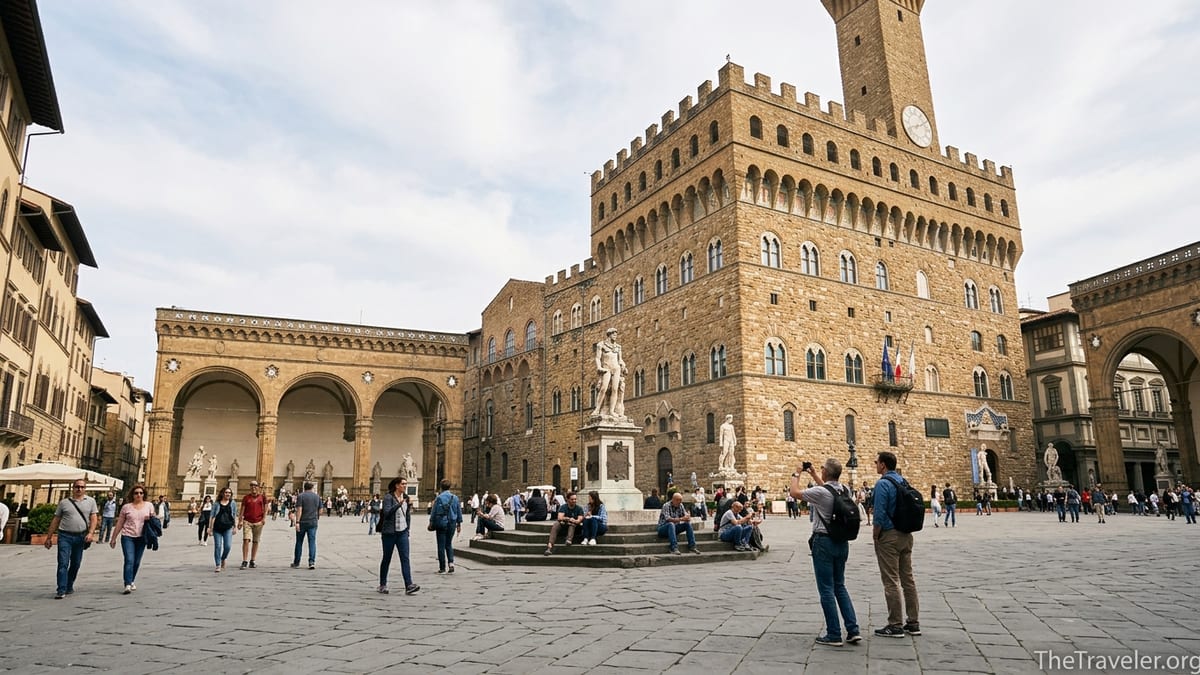
Palazzo Vecchio is Florence’s medieval town hall and one of the anchors of the historic center around Piazza della Signoria. From the outside you see a 14th century fortress with battlements and a tall clock tower, but inside is a richly decorated civic palace where the Medici family once ruled. Today it still houses parts of the city government while its grand halls and apartments function as a museum.
Unlike the Uffizi or Accademia, Palazzo Vecchio is less about rows of paintings and more about walking through rooms where crucial decisions for the Florentine Republic and later the Medici duchy were actually taken. The vast Salone dei Cinquecento, with its soaring painted ceiling and wall frescoes, was once the meeting hall for a 500-member council and later a stage for Medici propaganda. Travelers who enjoy connecting art directly to politics and power usually find this atmosphere compelling.
Because the building is embedded in everyday city life, a visit also feels different from entering a standalone museum. You pass security in the courtyard, see locals heading into municipal offices, and then step into ceremonial halls dripping with frescoes, carved ceilings, and bronze sculptures. For many visitors, this blend of living city hall and historical showpiece is exactly what makes Palazzo Vecchio feel more “real” than yet another gallery of masterpieces.
The palace’s location is another key point in its favor. It stands directly on Piazza della Signoria, just a few minutes’ walk from the Uffizi and 10 to 12 minutes from the Duomo on foot. That makes it easy to combine with other big sights during a single day without extra transport or long detours.
Tickets, Opening Hours, and How Much Time You Need
In 2026, standard adult tickets to the museum section of Palazzo Vecchio are typically in the mid single digits to low teens in euros when bought at the official counters, with various reduced rates for young visitors and free entry for small children. Third-party skip-the-line tickets and guided tours commonly start around 20 to 25 euros per adult and can be more if they include the tower climb or specialized experiences. These prices are lower than headline attractions such as the Uffizi, which in 2026 generally runs in the 20 to 25 euro range for basic admission, and still well below what visitors often spend on a Duomo dome climb bundle.
The museum is usually open every day from morning until early evening, with most days running roughly 9 am to 7 pm and a shorter day on Thursday, when closing is early afternoon. The last museum entry is normally one hour before closing. The Arnolfo Tower, the panoramic tower above the palace, often has an earlier last entry time in the late afternoon so staff can clear the staircase safely before evening.
For time planning, an unguided visit to the palace interiors typically takes 60 to 90 minutes if you walk through at a steady pace and pause for photos and the main highlights. Adding the Arnolfo Tower climb adds around 30 to 45 minutes, depending on your fitness level and how busy the staircase is. If you book a “secret passages” tour or a family-focused workshop, expect to spend closer to two and a half or three hours on site.
In practical terms, many travelers fit Palazzo Vecchio into a half day that also includes Piazza della Signoria, a stroll along the Arno, and maybe an evening aperitivo in the square. If your time in Florence is extremely limited, you can still experience the courtyard and the sculptures on the piazza for free, and then decide on the spot whether to allocate a full ticketed visit.
What You See Inside: Highlights That Make It Worth the Ticket
Inside Palazzo Vecchio you move through a sequence of spaces that show how rulers in Florence wanted to present themselves. The visit usually begins in the painted courtyard with its delicate frescoes and a bronze copy of Verrocchio’s Putto with Dolphin. From there you enter the Salone dei Cinquecento, a cavernous hall lined with immense historical frescoes and dominated by a richly coffered ceiling. Even travelers who arrive with “museum fatigue” often find the scale here surprising compared with the palace’s relatively austere exterior.
Upstairs, the private Medici apartments feature rooms dedicated to different members of the family and to mythological themes. Many visitors enjoy the Studiolo of Francesco I, a tiny windowless study lined floor to ceiling with painted panels and cabinets designed to hold rare objects. In other rooms, you find works attributed to artists like Bronzino and Vasari, but instead of hanging in a neutral white cube, they sit within gilded wooden ceilings and patterned walls, part of an overall decorative program.
One often overlooked section is the raised walkways and terraces that look onto the inner courtyard and out toward the city. On certain routes and tours, you can step onto a small balcony and frame classic Florence views through medieval stone arches, a detail that photographers and architecture lovers appreciate. Families often point out that these changing viewpoints and narrow passageways keep children more engaged than a traditional picture gallery might.
The museum also occasionally opens access to the archaeological area under the palace floor, where remains of the Roman theater that once occupied the site can be seen. Access is usually on a separate ticket or guided visit. For travelers deeply interested in layers of urban history, this adds another dimension, showing how a modern Italian city is literally built on earlier civilizations.
The Arnolfo Tower View: Is the Climb Worth It?
The Arnolfo Tower rises roughly 95 meters above the piazza, and climbing it is one of the main reasons travelers consider Palazzo Vecchio. The staircase is narrow and steep, with several hundred steps, and there is no elevator. Access can be restricted in bad weather or for safety reasons, and there are usually age restrictions for young children. Tickets for the tower are typically sold as a supplement to or in combination with the museum ticket, and the combined price can reach several tens of euros per adult when booked through tour operators.
What you get in return is one of the classic panoramas of Florence: terracotta roofs spreading out in every direction, Brunelleschi’s dome in profile instead of directly beneath your feet, and the Arno River and Tuscan hills in the distance. Compared to the Duomo dome or Giotto’s bell tower, the Arnolfo Tower sees fewer visitors, so many travelers report shorter waits and a slightly less claustrophobic climb, especially earlier in the day.
The tower is often subject to timed entry slots, and because capacity is limited for safety, same-day tickets can sell out on busy spring and summer days. Visitors who tried to walk up mid-afternoon in May or September have reported being turned away or asked to return much later. If this view is a priority for you, booking at least a day or two in advance or heading straight to the ticket office when it opens is a sensible strategy.
Is it worth it compared with other viewpoints? If you already plan to climb the Duomo dome or Piazzale Michelangelo hill, you might decide one major ascent is enough. However, travelers who did both often say the Arnolfo Tower provided more varied city views and better photo angles of the Duomo itself, while the dome climb gave them a dramatic look at the cathedral interior. For visitors with limited mobility or fear of heights, sticking to the palace interiors and skipping the tower is usually the better choice.
Palazzo Vecchio vs Uffizi, Duomo, and Other Florence Priorities
Deciding whether Palazzo Vecchio is “worth it” almost always comes down to trade-offs. If you are in Florence for just one full day, you may feel you must prioritize the Uffizi, the Accademia Gallery, and at least walking around the Duomo complex. In that tight scenario, Palazzo Vecchio may become a “nice to have” rather than an essential stop, especially if you generally prefer painting and sculpture to architecture and political history.
On a two- or three-day stay, the picture shifts. Many travelers on a 48- to 72-hour itinerary find that after ticking off the higher-pressure sights with mandatory reservations, Palazzo Vecchio offers a rewarding experience with less stress. Lines for on-the-spot museum tickets here are typically shorter than at the Uffizi, and visiting in late afternoon after the big galleries can feel pleasantly relaxed. The price point also makes it easier to justify, especially if you skip more expensive add-ons elsewhere.
Compared with Palazzo Pitti and the Boboli Gardens on the other side of the Arno, Palazzo Vecchio is more compact and centered on a single massive hall plus a handful of lavish apartments. If you love endless gallery rooms and pastoral garden landscapes, Pitti and Boboli might rank higher. But if you want one palace experience that is easy to reach from most central hotels and directly tied to Florence’s civic identity, Palazzo Vecchio tends to edge ahead.
For travelers on a strict budget, another realistic consideration is opportunity cost. A couple paying for two museum tickets plus a guided tower visit can easily spend the equivalent of a good trattoria dinner. If you are counting every euro, you might still choose to explore the free sculpture gallery under the Loggia dei Lanzi in the same piazza, admire the replica of Michelangelo’s David and other statues outside the palace, and leave the interior for a future visit when your budget is looser.
Passes, Money-Saving Strategies, and When to Book Ahead
Several Florence passes and cards circulating in 2026 include or bundle Palazzo Vecchio among multiple attractions. The well-known Firenze Card, priced in the mid double digits in euros for 72 hours of use at the time of writing, traditionally includes the major civic museums such as Palazzo Vecchio, the Bardini Museum, and others. There are also commercial passes sold by private platforms that combine skip-the-line entry for the Uffizi, Accademia, and sometimes an additional site, then add a city audio guide; these passes may or may not feature Palazzo Vecchio, so you need to read the inclusions carefully.
If you are staying in Florence for three days or more and plan to visit at least a handful of museums along with Palazzo Vecchio, a comprehensive pass may work in your favor. For example, a visitor who wants to see the Uffizi, Accademia, Palazzo Vecchio, and one or two smaller civic museums within a 72-hour period could pay roughly the same or slightly less with a pass than by buying individual timed tickets for each museum and paying separate booking fees. However, if your list consists only of the Uffizi, one dome climb, and wandering the streets, a pass is less likely to offer real savings.
In recent years, same-day ticket availability at Palazzo Vecchio has been more forgiving than at the Uffizi or the Duomo dome, but peak spring and autumn weeks can still produce queues of 30 to 60 minutes at the ticket counter by mid-morning. Online advance purchase from official or well-reviewed vendors generally costs a little more due to booking fees, but it lets you skip the ticket line and go straight to security. Travelers visiting in July or August, or during long weekends and local holidays, tend to appreciate that certainty.
To stretch your budget, consider pairing Palazzo Vecchio with low- or no-cost experiences in the immediate area. Before or after your visit, you can spend time on Piazza della Signoria admiring the statues under the Loggia dei Lanzi, walk five minutes to the Arno and across the Ponte Vecchio for river views, or sit with a takeaway coffee in the square instead of paying for a premium-priced drink at one of the cafés with outdoor seating.
Who Will Love Palazzo Vecchio, and Who Might Skip It
Palazzo Vecchio is particularly rewarding for travelers who enjoy stories of power, intrigue, and daily life as much as they enjoy individual artworks. If you have read about the Medici or watched dramatized series set in Renaissance Florence, seeing the actual council chambers, hidden staircases, and family apartments can be a highlight of your trip. History buffs, architecture and interior design enthusiasts, and photographers usually rate the experience highly.
Families often find Palazzo Vecchio a better fit for children than more formal galleries. There is room to move around in the big hall, ceilings and wall frescoes give kids plenty to look at, and interactive family trails or themed booklets are sometimes available at the entrance. The tower climb, for those old enough and physically able to manage the stairs, can feel like an adventure with a clear reward at the top. Parents of toddlers or anyone traveling with a stroller, however, should be prepared to navigate many stone steps and leave the stroller behind in some sections.
On the other hand, travelers who are primarily interested in individual masterpieces by famous names may feel their time is better spent at the Uffizi or Accademia. While Palazzo Vecchio contains quality works and elaborate decoration, it is not where you go to stand in front of Botticelli’s Primavera or Michelangelo’s David. Visitors who tire quickly in ornate Baroque or Mannerist interiors may also find the richly decorated ceilings and packed fresco programs visually overwhelming after an hour.
Accessibility is another factor. The main floors of the museum and the courtyard are served by elevators and accessible routes, but higher levels and especially the Arnolfo Tower involve narrow staircases that are not suitable for many visitors. If mobility is a concern, it is wise to focus on the palace interiors, which still offer a strong experience without the tower climb.
The Takeaway
So is Palazzo Vecchio worth visiting during a Florence trip? For most travelers spending at least two days in the city, the answer is yes. The palace offers a relatively affordable, centrally located way to step inside the halls where Florence’s civic and dynastic stories unfolded, with enough art, architecture, and dramatic space to feel special without requiring the intense advance planning that the Uffizi or Duomo dome demand.
If your stay is extremely short or your interests are focused tightly on specific masterpieces, you may reasonably choose to appreciate Palazzo Vecchio from the outside, enjoy the statues and atmosphere of Piazza della Signoria, and invest your limited time elsewhere. But for visitors who want Florence to feel like more than a checklist of famous canvases and crowded viewpoints, an hour or two inside the city’s fortress-town hall, with or without the Arnolfo Tower climb, often becomes one of the most memorable parts of the trip.
In practical terms, the palace is easiest to recommend to travelers who enjoy connecting architecture with history, who can handle a moderate amount of walking and stairs, and who appreciate a mix of grand spectacle and small details. If that sounds like you, Palazzo Vecchio deserves a firm place on your Florence itinerary.
FAQ
Q1. How much do Palazzo Vecchio tickets cost in 2026?
Adult museum tickets bought directly on site are typically in the mid single digits to low teens in euros, with reduced prices for young visitors and free entry for small children. Third-party skip-the-line or guided options that include extras such as the Arnolfo Tower climb often start around 20 to 25 euros per adult and can be higher depending on inclusions.
Q2. Do I need to book Palazzo Vecchio tickets in advance?
Outside the busiest spring and summer weeks, many visitors successfully buy tickets on the day at the palace, especially earlier in the morning or later in the afternoon. However, during May, June, September, and major holidays, queues at the ticket office can reach 30 to 60 minutes, and time slots for the Arnolfo Tower can sell out. If your schedule is tight or you particularly want to climb the tower, advance booking is advisable.
Q3. How long should I plan for a visit to Palazzo Vecchio?
A typical self-guided visit to the palace interiors takes about 60 to 90 minutes. If you add the Arnolfo Tower climb, allow an extra 30 to 45 minutes for the ascent, time at the top, and descent. Travelers joining a secret passages tour or a family workshop should plan for about two and a half to three hours total on site.
Q4. Is the Arnolfo Tower climb safe and suitable for everyone?
The tower climb is up a narrow, steep staircase with several hundred steps and no elevator, so it requires a reasonable level of fitness and sure footing. It is generally not suitable for visitors with significant mobility issues, heart or respiratory problems, or a strong fear of heights. Access for young children is often restricted by minimum age or height rules, and the tower may close in bad weather for safety reasons.
Q5. Is Palazzo Vecchio included in Florence museum passes?
Palazzo Vecchio is typically included in broader city or museum passes that cover Florence’s civic museums, such as the Firenze Card and some commercial multi-attraction passes. However, not all passes are the same, and some bundles focus only on state museums like the Uffizi and Accademia. Always check the current list of included sites to confirm that Palazzo Vecchio is part of your chosen pass.
Q6. Can I visit just the courtyard of Palazzo Vecchio for free?
Yes, the inner courtyard of Palazzo Vecchio is usually open to the public without a ticket, and many visitors step in briefly to admire the frescoed walls and central fountain before deciding whether to buy museum admission. The sculptures and monumental statues outside in Piazza della Signoria and under the nearby Loggia dei Lanzi can also be enjoyed at no cost.
Q7. How does Palazzo Vecchio compare with the Uffizi Gallery?
The Uffizi is primarily a picture gallery filled with world-famous paintings, while Palazzo Vecchio is a historic government palace where art is integrated into architecture and political history. Visitors who want to see specific masterpieces by Botticelli, Leonardo, or Caravaggio should prioritize the Uffizi, whereas those more interested in grand halls, Medici symbolism, and an immersive sense of place often rate Palazzo Vecchio just as highly, especially on longer stays.
Q8. Is Palazzo Vecchio suitable for children?
Many families find Palazzo Vecchio more engaging for children than traditional galleries because of its large halls, colorful ceilings, and sense of exploring a castle-like building. Some days there are family-oriented activities or themed materials available. However, there are many stairs and some narrow passageways, so strollers are not practical in all areas, and parents should be prepared to supervise children closely on the tower staircase and terraces.
Q9. What is the best time of day to visit Palazzo Vecchio?
Weekday mornings soon after opening and late afternoons are generally calmer, with shorter waits at the ticket office and more manageable crowds inside the halls. Midday, especially in high season and on weekends, can be noticeably busier as group tours arrive and cruise ship passengers visit the city. If you are combining the palace with a tower climb, booking an earlier time slot can also reduce the chance of weather-related closures later in the day.
Q10. Is Palazzo Vecchio still worth visiting if I am on a tight budget?
If your budget is very tight, you can still enjoy much of the atmosphere by focusing on free areas like Piazza della Signoria, the palace courtyard, and the open-air sculpture gallery under the Loggia dei Lanzi. However, compared with other major Florence attractions, the standard museum ticket for Palazzo Vecchio is relatively affordable, and many travelers feel that one paid visit here offers strong value for money in terms of history, architecture, and sense of place.