


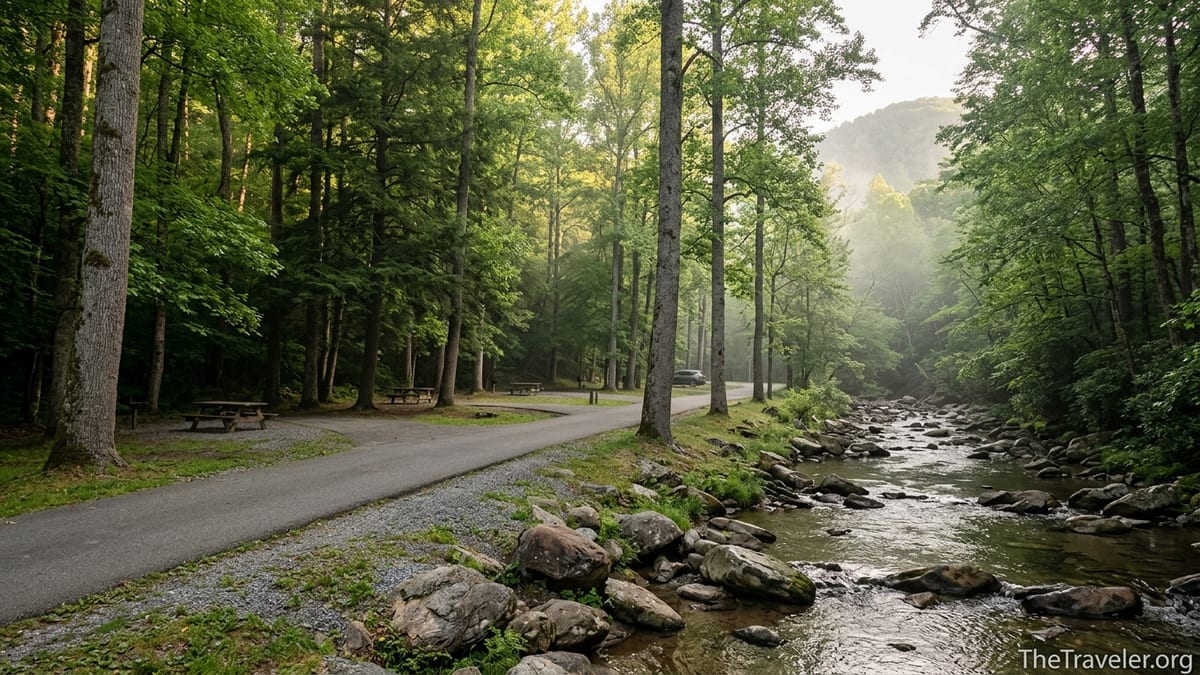
On a July weekend when traffic clogs the Parkway into Gatlinburg and selfie sticks crowd the overlook at Newfound Gap, the Cosby entrance to Great Smoky Mountains National Park tells a different story. Here, the road narrows, the forest closes in, and a campground shaded by tulip poplars and hemlocks hums with cicadas instead of tour buses. Most Smokies visitors never see this corner of the park, and that is exactly why a quiet subset of hikers, campers, and locals hopes it stays that way.
Get the latest updates straight to your inbox!
The Smokies’ Overlooked Gateway
Great Smoky Mountains National Park is officially one of the most visited national parks in the United States, with tens of millions of visits in recent years. Yet the vast majority of those travelers funnel through the same busy portals near Gatlinburg, Pigeon Forge, and Cherokee, chasing signature sights like Clingmans Dome, Cades Cove, and Laurel Falls. Far to the northeast on the Tennessee side, Cosby serves as one of the park’s lesser known gateways, despite sitting only about a 30 to 40 minute drive from downtown Gatlinburg and just off US 321.
Cosby itself is a small unincorporated community in Cocke County, framed by English Mountain to the north and the high ridges of the Smokies to the south. Instead of neon attractions and dinner shows, visitors arriving here pass country stores, roadside produce stands in season, and simple motels or cabins tucked into the woods. The official park entrance appears almost without warning, where Cosby Park Road leaves TN-32 and threads toward the campground, picnic area, and a cluster of trailheads.
Because it lacks the marketing heft and roadside spectacle of Gatlinburg or Pigeon Forge, Cosby rarely appears at the top of tour operator itineraries. Families booking hotel packages in Sevierville or big-name resorts near Dollywood often never realize there is another paved entrance to the Smokies in this direction. That omission has kept traffic lighter, parking less cutthroat, and the daily rhythm slower at Cosby, even during peak foliage in October and summer vacation season.
For those who come here on purpose, that under-the-radar status is part of the appeal. Travelers who have sat in gridlock trying to reach the Sugarlands Visitor Center or circled the Alum Cave trailhead lot for a parking spot often describe Cosby as feeling like a different park altogether. The same ridgelines rise above, but the energy is less theme park and more backroad gateway into a protected mountain forest.
Cosby Campground: A Forested Refuge From the Crowds
At the heart of this quieter corner is Cosby Campground, a frontcountry camping hub laid out under a dense canopy of hardwoods and hemlocks. The National Park Service lists 157 sites here, the majority tent-only, all without electrical hookups. There are flush restrooms and potable water, but no showers and no camp store, which subtly shapes who chooses to stay. You are more likely to meet hammock campers, backpackers prepping for a longer trek, and families who brought their groceries from Newport or Gatlinburg than RVers towing satellite dishes.
On a typical summer evening, temperatures at Cosby’s roughly 2,450-foot elevation run a little cooler than down in town. Campsites along the small creeks that lace through the campground echo with running water rather than road noise, helped by the fact that Cosby Park Road essentially ends in the park instead of carrying through traffic. Nighttime quiet hours are enforced, but in practice the setting enforces them too; once the lanterns dim, the loudest sounds are barred owls or the wind moving through the tulip poplars.
Travelers who have tried both Cosby and the better-known Elkmont or Cades Cove campgrounds often mention the same practical difference: it is simply easier to reserve and enjoy a campsite here. While prime summer weekends at Cades Cove can book out as soon as reservations open, Cosby frequently still has midweek availability even in June and July. A couple from Cincinnati, for instance, who struggled to find an RV hookup in Pigeon Forge for under a high nightly rate, opted instead for a tent site at Cosby. They traded hookups for shade and space, cooking over a campfire and driving into town only once every couple of days for ice and fresh produce.
The tradeoff shows in amenities. There is no on-site camp store, so you will not walk a few steps to buy forgotten marshmallows or a bag of ice. Cosby, the community, is about five miles away with small groceries and fuel, and larger supermarkets sit another 20 minutes or so down the highway in Newport. For visitors who do not mind planning ahead, the payoff is a campground that still feels like an older era of park use: lanterns on picnic tables, children playing in the creek, and stars visible when the night sky cooperates.
Trails That Start Quiet and Stay That Way
One of Cosby’s strongest draws is direct access to a network of hiking trails that see far fewer boots than the marquee routes near Newfound Gap Road. From the campground and adjacent picnic area, hikers can step onto Gabes Mountain Trail, Low Gap Trail, Snake Den Ridge Trail, and the Lower Mount Cammerer Trail without ever setting foot on the park’s busiest corridor. For those willing to climb, the Appalachian Trail lies roughly three miles uphill from Cosby via Low Gap, placing a portion of the famous long-distance route within day hiking reach.
Hen Wallow Falls, accessed by Gabes Mountain Trail from the Cosby Picnic Area, showcases the contrast with the park’s crowded western side. The waterfall itself is impressive, dropping around 90 feet as a slim creek widens into a 30-foot fan over a mossy rock face. The round-trip hike comes in at roughly 4.3 to 4.4 miles with about 900 feet of elevation gain. On a sunny Saturday in October, trail reports still describe stretches where hikers walk for 30 minutes or more without seeing another party, a scenario nearly unimaginable on comparably scenic waterfall hikes closer to Gatlinburg.
More ambitious hikers use Cosby as a gateway to bigger objectives that remain comparatively uncrowded. The strenuous climb up Snake Den Ridge connects the campground to the Appalachian Trail with sustained elevation gain and long views into the Cosby Creek valley in leaf-off seasons. The Lower Mount Cammerer Trail, starting just inside the park boundary near Cosby, offers a forested approach to the stone fire tower on Mount Cammerer when paired with the AT and connecting trails, creating one of the area’s classic full-day loops that still rarely feels congested.
Because these trails start in a quieter corner of the park, their parking areas also carry less stress. At Cosby, day hikers park in designated hiker lots near the picnic area or along the entrance road, typically finding spaces even on busy weekends if they arrive by mid-morning. That stands in sharp contrast to Newfound Gap Road trailheads, where rangers sometimes need to direct vehicles away from shoulders filled beyond capacity. For many regulars, that ability to start a hike without a battle for parking is as valuable as the scenery itself.
Life in and Around Cosby: Simple, Slower, More Local
Cosby’s personality differs markedly from that of Gatlinburg and Pigeon Forge, and travelers who fall in love with this side of the park usually mention that as a deciding factor. The area does not have towering hotel blocks or branded entertainment complexes. Instead, lodging tends to be small-scale: roadside motels dating back several decades, low-slung family-run cabin clusters, and rental houses on backroads where gravel driveways wind to porches with rocking chairs and views toward the ridges.
Dining follows a similar pattern. Rather than celebrity chef concepts or national chain restaurants, visitors typically find country diners serving biscuits and gravy in the morning and plates of fried catfish or meatloaf at night, often at price points noticeably lower than in Gatlinburg. A couple staying at a cabin off TN-32, for example, might split their time between simple meals grilled on the porch and dinners at family-owned restaurants on US 321, where the staff will often recognize repeat guests by the second or third visit.
Grocery options are more limited, which practically encourages a slower style of travel. Many park regulars who use Cosby as a base will stop at a larger supermarket in Newport, Sevierville, or even Knoxville before turning east, stocking coolers with fresh food for several days. Once settled, they may not drive back out each day. Instead of shuttling repeatedly between park and town, a typical Cosby itinerary might rotate between a long hike one day, a shorter creekside walk and hammock afternoon the next, and a day trip over the mountains to Cataloochee or the North Carolina side once during the stay.
That pattern of fewer daily miles behind the wheel and more time actually in camp or on trail embodies why some visitors treasure Cosby. Where the Gatlinburg side often invites a hybrid vacation of park mornings and attraction-filled afternoons, the Cosby side rewards travelers who are comfortable letting the park itself be the main event. Even evenings feel different; instead of strolling a neon-lit strip, many Cosby visitors end the day around a campfire or on a quiet porch, listening to katydids and planning the next morning’s hike.
Who Cosby Is Perfect For (And Who Might Be Happier Elsewhere)
The very qualities that make Cosby special mean it is not the perfect fit for every Great Smoky Mountains trip. Travelers who thrive on variety in dining, live shows, shopping, and family attractions will likely find more of what they want in or near Gatlinburg and Pigeon Forge. Families with young children who look forward to a day at Dollywood, an aquarium visit, and mini-golf between hikes may prefer basing closer to those hubs and treating Cosby as a day trip for a single hike or picnic.
By contrast, Cosby shines for visitors who see the national park itself as the primary destination rather than the backdrop to a broader entertainment vacation. Backpackers launching multi-day routes across Maddron Bald and Gabes Mountain, birders seeking warblers along Cosby Creek in May, and photographers who prefer fern-framed cascades to crowded overlooks all tend to speak highly of this entrance. Retired couples traveling in small trailers without need for hookups, solo hikers comfortable navigating less busy trails, and remote workers combining a rental cabin with trail time during shoulder seasons also gravitate here.
Budget-conscious travelers can find particular advantages. While prices fluctuate, nightly cabin rates and older motel rooms in the Cosby area often undercut equivalent accommodations in Gatlinburg by a notable margin, especially outside of fall foliage and major holiday periods. A family that might only afford two hotel nights in prime season near Gatlinburg could, by shifting to Cosby, potentially extend their stay to three or four nights in a simple cabin, balancing the tradeoff of longer drives to headline attractions with extra time immersed in the mountains.
There are practical limitations to weigh. Public transportation options are nearly nonexistent, so a private vehicle is essential. Cell service inside the park around Cosby can be patchy or absent, and even in nearby valleys coverage can fluctuate by carrier. Visitors used to relying on ride shares, food delivery apps, and constant connectivity may find the adjustment jarring. For travelers who see a Smokies trip as a partial digital detox, however, those same constraints feel like features rather than bugs.
Planning a Stay on the Quiet Side
Because Cosby remains less visited, planning a trip here is more straightforward in some ways and more hands-on in others. On the campground side, reservations through the standard national recreation booking system are generally required during the main season. Outside of holiday weekends and peak mid-October foliage, it is often possible to secure sites weeks rather than months in advance, especially for weekday arrivals. Tent campers will find the largest selection, while smaller trailers and RVs up to about 25 feet can navigate the paved loops and occupy combined-use sites.
Those preferring a bed and private bathroom have several typical strategies. One is to book a cabin or small lodge room advertised as being in or near Cosby along the US 321 corridor. Another is to split a longer trip, spending a few nights closer to Gatlinburg or Pigeon Forge for high-profile park sights and attractions, then relocating to Cosby for a quieter finale featuring hikes like Hen Wallow Falls, Lower Mount Cammerer, or a stretch of the Appalachian Trail. Travelers flying into Knoxville often rent a car at the airport, stock up on groceries at a city supermarket, and then drive about 1.5 to 2 hours to reach Cosby, depending on the chosen route and traffic.
Once in the area, simple habits help keep the experience smooth. Topping off fuel in Newport or Gatlinburg before arriving prevents any stress about the nearest gas station after a long day on the trail. Packing a basic cooler, camp stove or grill, and some staple ingredients reduces the need to drive back out for every meal. Paper maps or downloaded offline maps for the park trails around Cosby are wise, especially for those linking routes like Gabes Mountain, Maddron Bald, and Old Settlers into longer loops where intersections can be confusing to first-timers.
Weather considerations are similar to the rest of the Smokies but have local quirks. Summer afternoons often bring brief thunderstorms that pass quickly through the valleys, leaving trails slick and humidity high. In shoulder seasons like April and November, nights at Cosby Campground can fall into the 30s Fahrenheit even when afternoons feel mild. Snow and ice can affect higher elevation trails leading from Cosby to the Appalachian Trail well into spring. Visitors who pack with layers and flexible itineraries, planning creekside rambles on hot afternoons and ridge hikes on cooler mornings, tend to get the most from the area.
The Takeaway
Cosby exists as a kind of open secret within Great Smoky Mountains National Park. It is neither as remote as the backcountry nor as developed as the park’s marquee gateways. Instead, it offers a middle ground where paved roads and frontcountry campgrounds meet low-key trailheads and a small Tennessee community that has long lived in the park’s shadow rather than its spotlight.
Most Smokies visitors may continue to bypass this entrance, drawn instead to the bright lights and famous overlooks of the park’s better publicized corridors. For those who have discovered Cosby, that pattern is quietly welcome. The reward for driving a little farther along US 321, packing a bit more food in the cooler, and trading attractions for trailheads is a version of the Smokies where you can still hear the creek from your campsite, find a last-minute site in summer, and walk to a 90-foot waterfall without weaving through crowds.
If your image of a perfect Smokies trip involves more time under the trees than under neon, more trail miles than traffic miles, and evenings spent with crickets instead of crowds, Cosby may be the side of the park you have been looking for all along.
FAQ
Q1. Where exactly is the Cosby entrance to Great Smoky Mountains National Park?
The Cosby entrance sits in northeastern Tennessee near the small community of Cosby, off TN-32 and US 321, roughly a 30 to 40 minute drive from Gatlinburg depending on traffic.
Q2. Is Cosby less crowded than Gatlinburg and the main park entrances?
Yes. While visitation can still be busy on fall weekends and holidays, Cosby generally sees lighter traffic, easier parking, and quieter trails than the primary park gateways.
Q3. What kind of campground is Cosby Campground?
Cosby Campground is a forested frontcountry campground with around 150 sites, flush restrooms, and potable water but no electrical hookups or showers, giving it a simple, rustic feel.
Q4. Are there good hiking options that start right from Cosby?
Yes. Trails like Gabes Mountain to Hen Wallow Falls, Low Gap to the Appalachian Trail, Snake Den Ridge, and Lower Mount Cammerer all begin in or near the Cosby Campground and picnic area.
Q5. Is Cosby a good base for first-time visitors to the Smokies?
It can be, especially for travelers focused on hiking and quiet. First-timers who also want major attractions and popular overlooks often split time between Cosby and a stay closer to Gatlinburg.
Q6. What services are available near Cosby compared with Gatlinburg?
Cosby offers small groceries, fuel, simple cabins, and local diners. It lacks the extensive restaurants, large hotels, and attractions found in Gatlinburg and Pigeon Forge.
Q7. Do I need a reservation to camp at Cosby?
During the main season, advance reservations through the national campground booking system are generally required. Outside peak periods, sites are often easier to secure than at busier Smokies campgrounds.
Q8. Is cell service reliable in the Cosby area?
Cell coverage is often limited or patchy inside the park near Cosby, and it can vary by carrier in nearby valleys. Travelers should not rely on constant connectivity while hiking or camping.
Q9. Can small RVs or trailers use Cosby Campground?
Yes. Roads and driveways in the campground are paved, and smaller RVs or trailers, typically up to about 25 feet, can access many of the combined-use sites, though there are no hookups.
Q10. Who is most likely to enjoy staying on the Cosby side of the Smokies?
Hikers, campers, nature photographers, and travelers seeking a quieter, less commercial experience in the Smokies tend to appreciate Cosby’s slower pace and lower crowds.