


The first time I turned off U.S. 321 toward the Cosby entrance of Great Smoky Mountains National Park, I wondered if I had taken a wrong turn. The traffic thinned to almost nothing, the billboards vanished, and the roar of the park’s busier gateways faded into birdsong and the low hiss of Cosby Creek. Like many first-time visitors, I thought I knew the Smokies: crowded overlooks, packed trailheads and a relentless carousel of souvenir shops. Cosby showed me something else entirely, a quieter side of the mountains I was not expecting and that many travelers still overlook.
Get the latest updates straight to your inbox!
A Different First Impression of the Smokies
Most visitors meet Great Smoky Mountains National Park in a line of brake lights near Gatlinburg or Pigeon Forge, where neon signs and pancake houses press up against the park boundary. Cosby, tucked into the northeastern corner of the park in Cocke County, Tennessee, feels worlds away from that spectacle. The two-lane road slips past family farms, modest cabins and a single gas station instead of arcades and go-kart tracks. You still see the smoky blue ridges layered on the horizon, but here they rise above hayfields and church steeples instead of hotel towers.
As I rolled down the windows, the soundtrack changed, too. In place of tour buses and traffic, I heard wood thrushes, the hum of insects and the rush of Cosby Creek through the trees. The national park literature often calls the Cosby section one of the quieter, less developed corners of the Smokies, and it shows from the moment you arrive. Visitor numbers are noticeably lower here than around Gatlinburg, and the infrastructure reflects that: no large visitor center, no built-up commercial strip at the gate, just a small ranger station, a campground, a picnic area and a couple of trailhead parking lots nestled in the forest.
For travelers who have only seen the busier face of the Smokies, this first impression can be disorienting. It certainly was for me. I had packed all my usual “crowd strategy” tricks: pre-dawn starts, backup trail lists and the patience of a seasoned line-stander. Instead, I pulled into the Cosby Picnic Area in late morning on a Saturday in spring and still found open parking and empty picnic tables beside the creek. The park can never guarantee solitude, but here, even on fair-weather weekends, you often feel like you’ve slipped into a side door the crowds have not yet discovered.
Part of this difference comes down to geography and access. Cosby is about 20 miles east of Gatlinburg and sits off Tennessee State Route 32 rather than the main parkway, which naturally funnels fewer casual visitors in this direction. Yet the Cosby entrance still connects to some of the park’s classic backcountry routes, from Lower Mount Cammerer Trail to Snake Den Ridge and the Appalachian Trail, so the mountains themselves feel just as wild and dramatic. The contrast between accessibility and calm is precisely what makes Cosby so surprising.
Cosby Campground: Shady, Simple and Quiet
Cosby’s heart is its frontcountry campground, a shaded bowl of forest tucked along Cosby Creek. Operated by the National Park Service, Cosby Campground offers more than 150 sites beneath a high canopy of hardwoods at roughly 2,450 feet in elevation. The facilities are intentionally basic: tent and RV sites without hookups, flush toilets, potable water spigots and an amphitheater used for seasonal ranger programs. There is no camp store, no showers and no cell service to speak of inside the campground, which helps to keep the atmosphere relaxed and old-fashioned.
On my last visit, a standard tent site in Cosby cost roughly the same per night as other frontcountry campgrounds in the park, often in the range of a budget roadside motel room in nearby Newport during off-peak seasons and significantly less than the average cabin rental in Gatlinburg. Reservations are strongly recommended in peak season, but because Cosby sees fewer tour groups and large RV caravans than popular campgrounds like Cades Cove or Elkmont, it tends to feel less crowded even when most sites are full. The campground sits beneath thick shade trees, so summer afternoons that can be sweltering down in Sevierville feel noticeably cooler here.
The quiet at Cosby is partially protected by rules that rangers actively enforce. Official quiet hours generally run from late evening to early morning, and generator use is restricted during nighttime and early morning hours. Walking the loops after dark, what you mostly hear are murmured conversations, the occasional crackle of a campfire and the constant, soothing rush of the creek. It is easy to fall asleep early and wake with the first light, which makes pre-breakfast walks on the campground roads particularly magical as fog drifts between the trees.
Practical details matter here, too. Cosby Campground does not have hookups or a camp store, so RV travelers and tent campers alike need to arrive prepared. Cosby itself has a couple of small markets where you can pick up ice, firewood certified as heat-treated, and basic groceries, but selection is limited compared to the superstores in Sevierville. Many campers stop in Newport, about 25 minutes away, to fill gas tanks and coolers before heading up to the park. Once you are in your site and the lanterns are lit, though, the extra planning feels worth it. The lack of bright lights and generators makes the night sky over Cosby surprisingly dark for the eastern United States, with stars clearly visible between the branches on moonless nights.
Walking Into the Woods: Hen Wallow Falls and Beyond
If Cosby Campground is the relaxed living room of this corner of the park, the network of trails that radiate from it is the house’s back door, opening directly into the woods. One of the most approachable and rewarding options is the hike to Hen Wallow Falls via Gabes Mountain Trail. The trailhead begins near the entrance to the campground, just across from the Cosby Picnic Area. From there, it is roughly 2.1 miles one way to the falls, with an overall round-trip distance often listed around 4.4 miles and a moderate 900 feet of elevation gain.
Gabes Mountain Trail starts gently, rolling through a deep, mossy hardwood forest crossed by small wooden footbridges over side streams. This section of the Smokies is known for its lushness; in spring, wildflowers lap at the edges of the trail, and in midsummer ferns and rhododendrons create dense green walls. Black-throated green warblers call from the canopy, and the forest feels surprisingly enveloping even though you are never far from the campground road. Unlike iconic hikes such as Alum Cave or Laurel Falls, where human voices often carry ahead of you on the trail, the soundscape here is more likely to be birds, squirrels and the soft thump of your own footsteps.
Hen Wallow Falls itself is a slender ribbon of water that drops nearly 90 feet over a rock ledge, fanning out as it reaches the pool below. The final spur trail down to the base is steep and can be slick with mud or ice depending on the season, so sturdy footwear is essential. On a weekday in early May, I shared the overlook with only one other couple who had driven in from North Carolina for the day. We traded trail notes and then fell into a companionable silence, listening to the water and watching stray droplets catch the light. In a park that hosts millions of visitors each year, having that kind of relatively uncrowded waterfall experience still feels like a gift.
For hikers looking for something more strenuous, Cosby also serves as a gateway to longer routes. Lower Mount Cammerer Trail climbs through a series of switchbacks toward one of the park’s most beloved fire towers with sweeping ridgeline views, while the Snake Den Ridge and Low Gap trails connect up to the Appalachian Trail. These routes are serious mountain hikes, with significant elevation gain and total distances that can easily stretch into double digits if you summit Mount Cammerer or continue along the AT. Even then, the trailhead parking lots seldom resemble the packed, roadside chaos found near some of the busiest Smokies hikes. Starting early in the morning, you may walk for long stretches seeing only a handful of fellow hikers.
A Different Rhythm: Life Around Cosby Creek
What truly sets Cosby apart is not just the lower visitor density, but the slower rhythm of life that seems to permeate the area. Instead of souvenir superstores, you find a mix of mom-and-pop cabins, older roadside motels and a scattering of short-term rentals tucked along secondary roads. Weeknight cabin rates in the immediate Cosby area often run lower than comparable properties closer to Gatlinburg, especially outside of the peak fall foliage window and major holidays. Many have porches that look out on second-growth forest or small pastures rather than traffic-heavy parkways.
In the tiny unincorporated community of Cosby, a handful of local restaurants, barbecue joints and cafes serve hikers and locals alike. Menus tend to favor hearty, unfussy fare: biscuits and gravy for breakfast, pulled pork sandwiches, burgers and trout for dinner. One evening after hiking Gabes Mountain Trail, I joined a small line at a roadside eatery where the special was a plate of country-fried steak for about what you might pay for a fast-food combo meal back in Knoxville. At the next table, two trail crew volunteers in dusty boots compared notes on their work day, while a family from Ohio unfolded paper maps to plan their next hike.
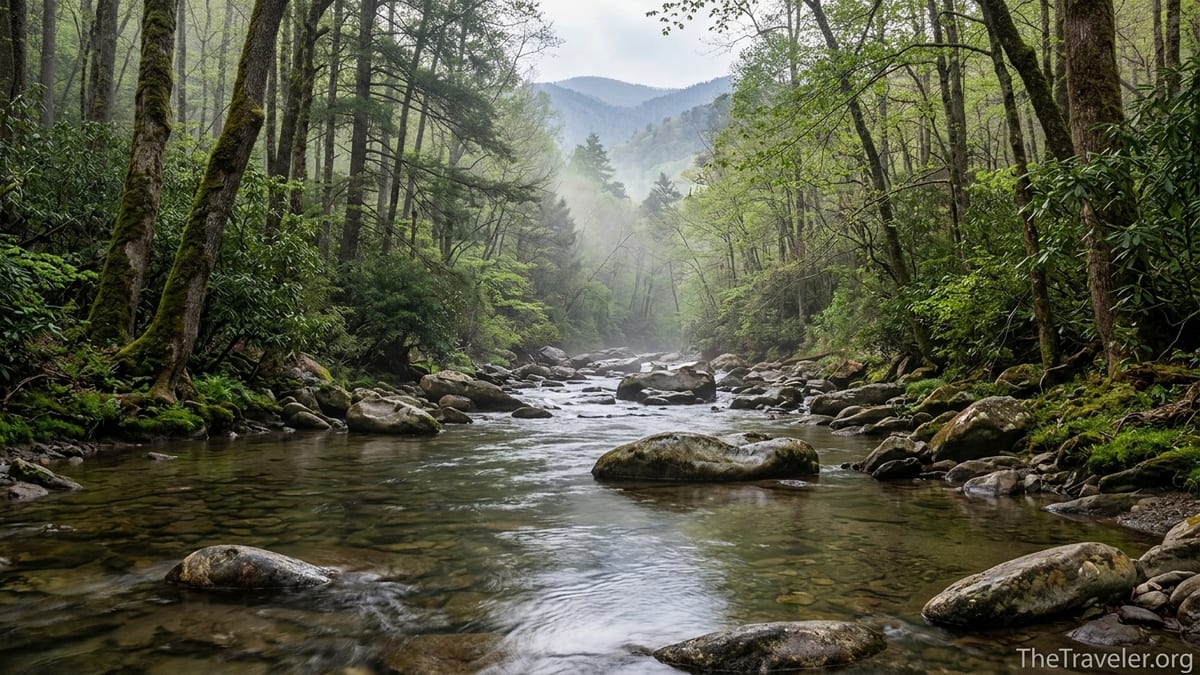
Beyond the developed recreation areas, Cosby Creek itself sets the tone. It murmurs alongside the campground and picnic area, tumbling over rocks that glow gold and green beneath the clear water. On warm afternoons, families spread out picnics on the creekside tables while children skip stones and wade in the shallows. Trout anglers, careful to observe state licensing regulations, pick their way downstream with light rods and fly boxes. Early in the morning, mist often hangs low over the water, and you can watch it lift as the first sunbeams filter down through the canopy.
Because there is limited cell coverage, you quickly adjust to planning days the old-fashioned way: checking paper maps, reading trailhead information boards and asking rangers or campground hosts for advice. Weather forecasts and road conditions should be checked before you leave town, whether in Newport, Gatlinburg or another base. Once in Cosby, that slight disconnect from real-time alerts can feel unnerving at first, but it soon becomes part of the appeal. The mountains dictate the schedule far more than your phone’s notification chime.
Planning a Stay: Seasons, Services and Practical Tips
Choosing when to visit Cosby can define the kind of quiet you find. Spring brings wildflowers, cool hiking temperatures and higher creek levels, along with the possibility of rain and rapidly changing weather. Summer is lush and warm, with long daylight hours ideal for big hikes and evenings that invite lingering around the campfire, though humidity can be high. Autumn is peak season for foliage, and while Cosby still feels less hectic than the park’s main corridors, cabins and campsites in October often book out far in advance. Winter is the Smokies at their most introspective; some loops in the campground may close seasonally, and certain higher-elevation trails may be icy or snow-covered, but lower routes near Cosby Creek can remain hikable on many days.
Because services inside this section of the park are intentionally limited, visitors should arrive with full fuel tanks, printed or downloaded maps and a basic emergency kit. The nearest full-service grocery options are typically in Newport or Gatlinburg, both a substantial drive from the campground. In recent seasons, the park has introduced and expanded parking fee systems in many frontcountry areas, so travelers should be prepared to purchase a daily or longer-term parking tag and display it while parked at trailheads, picnic areas and campgrounds. Machines at places like the Cosby Picnic Area can require card payment, and they may not be immediately obvious if you are expecting staffed fee booths, so it pays to look around the lot for signage when you arrive.
Lodging choices around Cosby fall into three main categories: national park campground sites, small private campgrounds just outside the boundary, and a patchwork of cabins and vacation rentals. Nightly cabin rates can vary widely depending on amenities such as hot tubs, game rooms and mountain views, but simple one- or two-bedroom cabins in the Cosby area are often more affordable than similar properties closer to Pigeon Forge, especially midweek outside of peak leaf and holiday periods. For travelers on a tighter budget, a tent site at Cosby Campground paired with simple meals cooked on a camp stove can yield several days of immersion in the park for roughly the cost of a single night in a chain hotel along the interstate.
Driving conditions also shape the experience. The road into Cosby is paved and generally well maintained, but it narrows and curves as you approach the park entrance. After dark, deer and other wildlife frequently appear along the shoulders, and fog can settle into the valley. Take your time on the approach, especially if you are towing a trailer or driving a larger RV. Arriving before dusk not only makes navigation easier, it lets you get your bearings at the campground, locate restrooms and water spigots, and enjoy the subtle way evening settles into the trees.
Why Cosby Feels So Different From Gatlinburg and Pigeon Forge
To understand why Cosby feels like such a different Smokies experience, it helps to compare it directly with the park’s busier gateways. Gatlinburg and Pigeon Forge thrive on volume. Their business models depend on attracting large numbers of visitors, which in turn encourages ever more attractions, larger hotels and an intense concentration of dining and entertainment. Even when you step into the national park through the Sugarlands or Roaring Fork entrances, that density lingers in the background: helicopters buzz overhead, tour buses cycle in and out of pullouts, and finding a parking space at midday in peak season can be an adventure in itself.
Cosby developed along another path. Historically, this corner of the Smokies was more associated with small-scale farming, homesteads and logging than with tourism, and it never saw the same explosive, attraction-driven growth. When the national park was established, the Cosby area became known more for trailheads and camps than for gateway spectacle. There are rental cabins and vacation homes now, and a modest tourism economy, but it remains small-scale and locally flavored. You are more likely to see a hand-lettered sign advertising homemade jam than a towering waterslide.
This difference carries through to the way you experience nature. In the central corridors of the park, scenic overlooks might host a dozen cars at sunrise, and some waterfalls see hundreds of visitors per day in high season. Around Cosby, even popular routes like Hen Wallow Falls or the Mount Cammerer fire tower rarely feel shoulder-to-shoulder. You still need to practice standard national park etiquette and bear-aware behavior, and you should not expect to have trails completely to yourself, but the sense of breathing room is real. The park’s 800-plus miles of trails do their work especially well in dispersing people here.
For some travelers, this quieter rhythm may initially feel “too empty,” particularly if they are used to having plenty of dining and entertainment options at their doorstep. There is no aquarium, no large-scale shows, no go-karts in Cosby. Evenings tend to involve campfires, board games in cabins, or drives out to catch last light over a nearby overlook rather than ticketed attractions. Yet for others, including many repeat Smokies visitors, this is precisely the draw. Cosby offers the chance to let the national park itself be the main entertainment, and to rediscover a version of the Smokies that prioritizes creeks, trees and stars over bright lights and noise.
The Takeaway
Before I visited Cosby, my mental image of Great Smoky Mountains National Park was dominated by crowded parking lots and busy trails. This quiet corner reshaped that image. Here, the park feels more like a vast backyard than a theme park backdrop. You can wake to birdsong in a shaded campground, walk directly from your campsite to a 90-foot waterfall on a moderate trail, spend your afternoons tracing creeks and ridgelines, and end your day under a dark, mostly silent canopy of trees.
Cosby is not for everyone. Travelers who prefer a suite of restaurants, nightlife and showy attractions within a five-minute drive may find it sparse. It demands more planning, more self-sufficiency and a willingness to trade convenience for calm. But for visitors who crave a quieter Smokies experience, where the loudest sound at night is a rushing creek and the most common evening activity is watching the fog roll through the trees, Cosby is a revelation. It shows that, even in one of the most visited national parks in the United States, there are still places where the mountains speak softly, and where listening closely is its own reward.
FAQ
Q1. Where exactly is the Cosby area in Great Smoky Mountains National Park?
It sits in the northeastern section of the park in Cocke County, Tennessee, accessed primarily via Tennessee State Route 32 off U.S. 321, about 20 miles east of Gatlinburg.
Q2. Is Cosby really less crowded than Gatlinburg and other main entrances?
Yes, Cosby typically sees fewer visitors because it lacks major attractions and is not on the main parkway, so campgrounds and trailheads usually feel calmer, especially outside peak fall weekends.
Q3. What kind of facilities does Cosby Campground offer?
Cosby Campground provides shaded tent and RV sites without hookups, plus flush toilets, potable water, picnic tables and fire rings, but no showers or camp store.
Q4. Do I need reservations for Cosby Campground?
Reservations are strongly recommended during busy periods such as summer and October foliage season, while some shoulder-season nights may still offer first-come, first-served availability depending on conditions.
Q5. What is the Hen Wallow Falls hike like from Cosby?
The Hen Wallow Falls hike is a moderate out-and-back of roughly 4 to 5 miles round trip via Gabes Mountain Trail, with about 900 feet of elevation gain and a short, steep spur down to the base of the 90-foot waterfall.
Q6. Are there services like gas and groceries near Cosby?
Limited supplies are available in the small community of Cosby, but most visitors stock up on fuel and groceries in larger towns such as Newport or Gatlinburg before driving into the park.
Q7. Is there cell phone service in the Cosby area of the park?
Cell coverage inside the campground and along nearby trails is usually weak or nonexistent, so you should not rely on your phone for navigation or communication once you are in the park.
Q8. What seasons are best for visiting Cosby?
Spring and autumn offer cooler hiking temperatures and either wildflowers or fall color, summer delivers lush greenery and long days, while winter brings the quietest atmosphere but can include cold, wet or icy conditions.
Q9. Are there longer, more challenging hikes that start from Cosby?
Yes, trails such as Lower Mount Cammerer, Low Gap and Snake Den Ridge climb toward the Appalachian Trail and high ridgelines, offering strenuous day hikes with significant elevation gain and expansive views.
Q10. Is Cosby a good base if I still want to visit Gatlinburg or Pigeon Forge?
It can work as a quiet base, but you should allow at least 40 to 60 minutes of driving each way to reach the busier gateways, and factor that commute into your daily plans.