


More news on this day
Electric air taxi companies racing to launch urban flight services are increasingly turning to defense customers, as evolving U.S. certification rules and shifting timelines push back the arrival of large-scale commercial operations.
Get the latest news straight to your inbox!
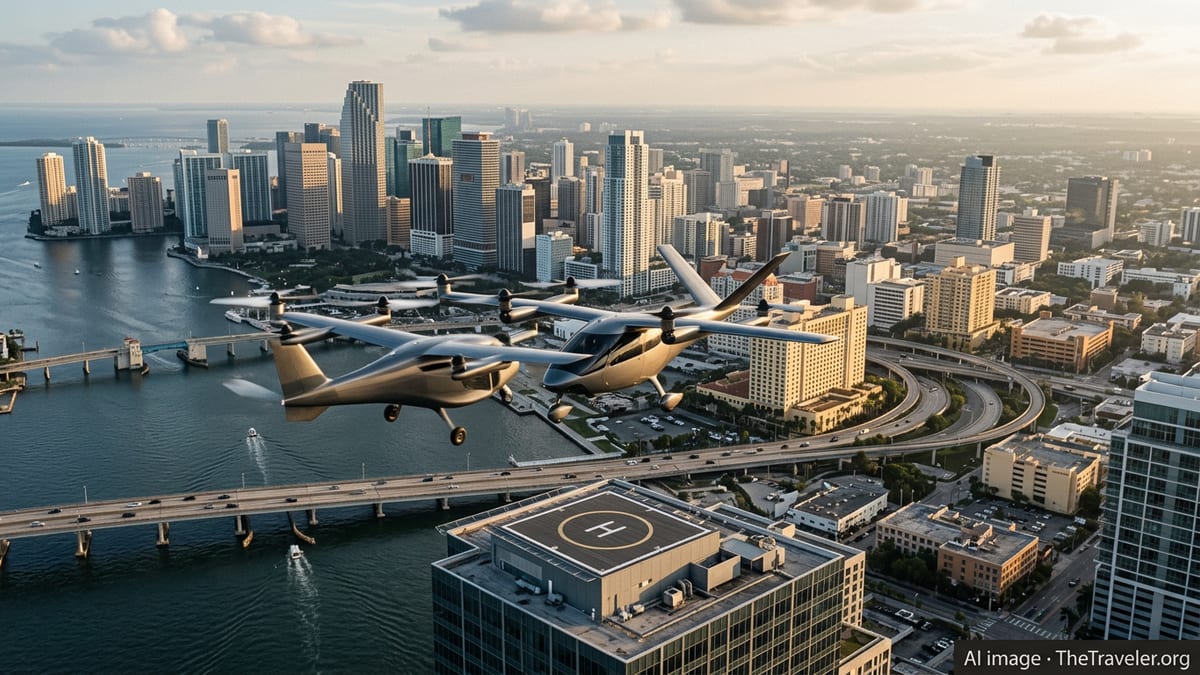
FAA’s evolving rulebook slows commercial eVTOL takeoff
Developers of electric vertical takeoff and landing aircraft have long highlighted 2025 as a symbolic target for launching air taxi services in major U.S. cities. That goal has become harder to reach as the Federal Aviation Administration refines its approach to certifying a new category of powered-lift aircraft. The regulator has moved from treating these vehicles like small airplanes to crafting a tailored framework, a shift that has added complexity and extended discussions over safety standards.
Publicly available FAA material shows that only a handful of eVTOL projects, including those from Joby Aviation and Archer Aviation, currently have detailed airworthiness criteria in place, while many others remain earlier in the queue. Industry trackers indicate that the leading U.S. designs have advanced deep into the multi-stage type certification process, but full approval has not yet been granted. Advisory circulars, special federal aviation regulations and a new operations rule have helped clarify expectations, yet companies acknowledge that key milestones have taken longer than originally projected.
Recent government assessments describe certification as a “gating factor” for commercial advanced air mobility, noting that the FAA is still refining long-term policy even as it reviews specific aircraft designs. That evolving landscape has complicated business plans built around dense networks of short-hop passenger flights in the middle of this decade. For listed air taxi developers that must regularly update investors, the message has shifted from firm launch dates to more conditional language tied to regulatory progress.
The result is that while prototype aircraft continue to log test flights, the revenue associated with routine fare-paying passenger service in U.S. cities remains some distance away. To bridge that gap, several leading manufacturers are seeking customers whose needs and acquisition processes are less tightly bound to the commercial airline model.
Agility Prime and the rise of the military eVTOL customer
The U.S. Department of the Air Force’s AFWERX unit, through its Agility Prime program, has emerged as one of the most important early buyers and testers of electric air taxis. Program documents and annual reports describe Agility Prime as an effort to accelerate the domestic eVTOL industry while exploring potential defense applications such as logistics, base support, medical evacuation and training. Rather than waiting for full civil certification, the military has been willing to evaluate aircraft under dedicated airworthiness assessments that focus on specific missions and risk profiles.
Joby Aviation has secured one of the most prominent Agility Prime agreements, with a contract that allows for the delivery of multiple aircraft, on-base operations and a mix of research, development and flight testing activities. Public releases describe Joby aircraft arriving at Edwards Air Force Base as part of a multi-year effort to understand how quiet, low-emission vertical flight might support distributed operations and rapid point-to-point travel for personnel and cargo.
Archer Aviation has followed a similar path. AFWERX documentation for recent fiscal years highlights funding awards and progress toward a military airworthiness evaluation of Archer’s Midnight aircraft. These steps enable the company to conduct on-base demonstration flights, train military maintainers and operators, and integrate its systems into existing Air Force infrastructure. Other U.S. developers, including Beta Technologies and smaller specialists, have also been tapped for flight trials and simulator work under the broader AFWERX umbrella.
For the services, these collaborations promise insight into an emerging technology that could complement helicopters and tiltrotors in certain roles, particularly where lower acoustic signatures or electric propulsion offer advantages. For the companies, they provide structured test environments, access to dedicated ranges and hangars, and non-trivial contract revenue at a time when commercial income is still on the horizon.
Defense contracts as a financial lifeline and proving ground
Industry analyses of leading U.S. air taxi firms emphasize the growing importance of defense and government business in their revenue mix. Securities filings and investor presentations show that multi-year contracts tied to Agility Prime and related initiatives can reach into the nine-figure range when all options are included. While only a portion of that value is typically booked in early years, the funding helps offset the high cost of flight testing, manufacturing of conforming prototypes and ground infrastructure.
According to these public disclosures, military work often covers not just aircraft deliveries but also pilot and maintainer training, digital twin development, ground support equipment and data collection. That breadth turns defense customers into partners across the entire development cycle, from design validation to fleet operations. Executives have described government programs as opportunities to “de-risk” technology by subjecting aircraft to demanding operational scenarios before mass-market deployment.
Beyond direct funding, military programs confer an additional layer of credibility that can help developers in later regulatory and commercial discussions. A successful series of flights at a well-known test base, under the supervision of experienced test pilots and engineers, offers a powerful demonstration that an airframe can withstand rigorous use. Because the Air Force and other branches maintain their own safety and airworthiness processes, data generated in military campaigns can feed back into civil certification packages and help refine maintenance and training concepts.
The trade-off is that companies must balance defense requirements with their original urban air mobility vision. Mission sets such as cargo transport to austere landing zones or base perimeter surveillance may demand different configurations, payloads or software than short intra-city passenger hops. Developers are attempting to design modular platforms that can satisfy both markets, avoiding expensive divergence between civil and military variants wherever possible.
Global competition and the risk of a permanent pivot
While U.S. startups deepen their relationships with defense agencies, international competitors are moving ahead with commercial services in more permissive regulatory environments. Authorities in China, for example, have already granted full type certification to at least one autonomous eVTOL design, enabling limited passenger operations in select cities. European regulators have also outlined clear pathways for certain piloted models, keeping pressure on the FAA and industry to demonstrate similar progress.
Market research and think tank studies warn that a prolonged lag in U.S. civil certification could push domestic manufacturers to prioritize military and government work for longer than originally planned. In this scenario, air taxis designed for dense urban networks might spend their early years flying base-to-base missions or specialized logistics routes instead of public shuttle services to airports and downtown vertiports. While such operations would still validate the technology, they might limit broader public exposure and slow the development of consumer trust.
Some analysts argue that a strong defense foundation could ultimately make U.S. eVTOL firms more resilient, offering stable demand and long-term sustainment contracts akin to those enjoyed by traditional aerospace primes. Others caution that an overreliance on military work could dull the focus on high-volume, low-cost passenger operations that underpin many air taxi business models. A platform optimized for small numbers of high-value defense missions may not seamlessly transition to carrying thousands of commuters each day.
For now, most leading developers continue to present defense and commercial markets as complementary. They frame military contracts as stepping stones rather than detours, even as timelines for broad public service in U.S. cities extend into the latter half of the decade.
What the pivot means for future travelers
For travelers hoping to book point-to-point air taxi rides over clogged highways, the growing military focus has mixed implications. On one hand, every hour an aircraft spends operating from a military base, flying realistic missions and cycling through maintenance provides hard data that can inform safer, more reliable future commercial service. Lessons learned about battery performance, turnaround times, weather limits and human factors can all strengthen eventual urban networks.
On the other hand, the near-term availability of eVTOL flights is likely to be concentrated in pilot corridors, special events and demonstration routes rather than everyday commuting. Government-led integration programs are beginning to identify specific metropolitan areas for trial operations, but these efforts remain tightly controlled and small in scale. Business travelers may first encounter electric air taxis in airport-to-airport shuttles, tourism flights or high-end charter offerings before they become an option on mainstream booking platforms.
The deeper involvement of defense customers also raises questions about public perception. Electric air taxis closely associated with military use may face additional scrutiny from communities that are sensitive to aviation noise, security or dual-use technology. Developers and regulators will have to communicate clearly about how military testing supports wider safety goals and how civilian operations will be managed once certification is achieved.
As the decade progresses, the trajectory of the air taxi sector will hinge on whether the current military pivot remains a temporary bridge or evolves into a defining feature of the market. For now, travelers watching the skies may be more likely to see electric aircraft in the livery of a defense program than a commercial airline, even as the long-term vision of quiet urban air mobility persists.