


Few places in Italy pack as much drama into such a compact sweep of coastline as the Bay of Naples. Here, ferries trace bright white lines across a deep blue sea, pastel houses cling to cliffs, a live volcano smokes on the horizon and Roman towns lie frozen in time just inland. For travelers choosing between Italy’s many famous shores, the Bay of Naples stands out as a place where spectacular scenery meets real life, living history and surprisingly down-to-earth experiences.
Get the latest updates straight to your inbox!
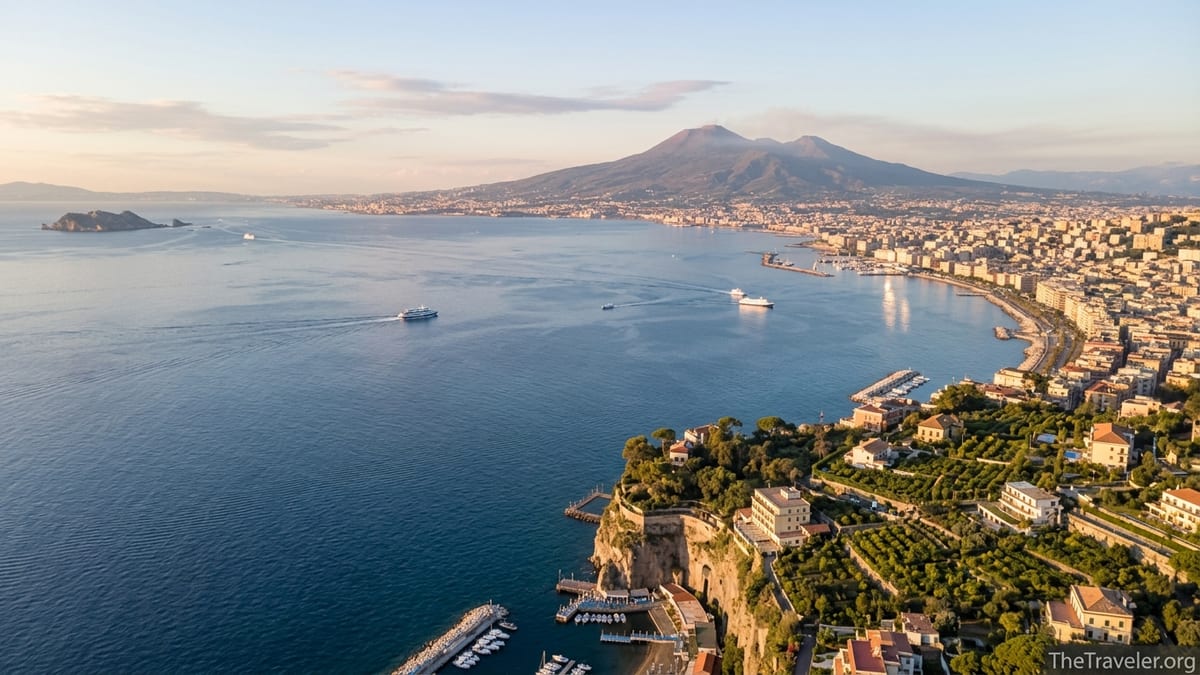
A Natural Amphitheater of Sea, Cliffs and Volcano
Look at a map and the Bay of Naples forms a near-perfect arc, about 15 kilometers wide, embracing the Tyrrhenian Sea with the city of Naples at its center and Mount Vesuvius rising directly behind. In reality, it feels like a giant natural amphitheater: ferries and cruise ships glide in and out like performers on stage, watched from tiers of terraces, rooftop bars and hotel balconies stepping up the hillsides. From the waterfront promenade in Naples, or from the Belvedere terrace in nearby Posillipo, you see the classic view that has seduced travelers for centuries: the curve of the bay, the islands of Capri and Ischia on the horizon, and Vesuvius dominating the skyline.
What makes this coastline so striking is contrast. On a clear winter morning the volcano is outlined in sharp blue-grey, sometimes dusted with snow, while orange fishing boats bob in the harbor below. In summer, haze softens the outlines and the entire bay glows golden at sunset, especially if you watch from a Sorrento terrace facing west. It is not pristine wilderness. Tankers share the water with fishing boats, and Naples’ working port is always in motion. Yet that blend of raw nature and everyday activity, of beauty and grit, is exactly what gives the bay its character.
Even brief visitors feel this immediacy. Spend half an hour on the Molo Beverello pier, where hydrofoils depart for Capri and Ischia, and you see office workers commuting to the islands, teenagers wheeling suitcases for a beach weekend, and cruise passengers rushing to catch a day-trip boat. The bay is not a backdrop. For people who live here it is a highway, a pantry, even a playground. For travelers, that constant movement turns the view into a living, changing spectacle.
Island Escapes: Capri, Ischia and Procida
The Bay of Naples is famous for its trio of islands, each with a distinct personality. Capri is the glamorous one, Ischia the lush spa island and Procida the small, photogenic fishing community. All three are easy to reach: fast hydrofoils from Naples typically take about 45 to 50 minutes to Capri, about an hour to Ischia and around 45 minutes to Procida, with slower ferries costing a bit less and taking longer. In high season there can be dozens of sailings a day, so travelers can often choose departure times around their plans rather than the other way around.
Capri delivers the kind of scenery that made the bay world famous. Approaching by boat, you pass the iconic Faraglioni sea stacks and vertical limestone cliffs, where private villas peek out from the greenery. On the island itself, prices reflect its high-end reputation: a coffee on the main piazzetta can easily cost several euros more than in central Naples, and a simple lunch with a sea view adds a premium. Yet there are affordable moments even here. Many visitors take an early ferry from Naples or Sorrento, ride the funicular up to Capri town, then walk the panoramic Via Tragara or the Pizzolungo path, where the Faraglioni views are completely free.
Ischia, by contrast, spreads low and green across the horizon, dominated by pine forests and vineyards rather than cliffs. Its appeal lies in thermal waters and long stays. Budget-conscious travelers often book small family hotels in neighborhoods like Forio or Casamicciola, where room rates are typically lower than on Capri, and spend their days rotating between volcanic-sand beaches and thermal parks. Entry to a basic thermal park can be comparable in price to a mid-range museum ticket in northern Europe, while more elaborate complexes with multiple pools and private beach access cost more but still feel like good value when you factor in a full day of relaxation.
Smallest of the three, Procida became widely known after it was named Italian Capital of Culture in 2022. Its pastel harbor of Marina Corricella, with houses stacked in yellows, pinks and blues, is now a familiar travel-magazine image. On a practical level it is also one of the easiest and least stressful day trips from Naples, with frequent ferries and a compact size that invites wandering without an agenda. Here, travelers regularly find island trattorias offering a generous plate of spaghetti with local lemon or seafood at prices far below Capri’s, with the same shimmering bay spread out below their tables.
Sorrento and the Gateway Towns Around the Bay
Along the southern curve of the bay, the Sorrentine Peninsula forms the natural boundary between the Bay of Naples and the Gulf of Salerno. At its tip sits Sorrento, a clifftop resort town that has acted as a gateway to the area since the days of the Grand Tour. Many visitors choose to base themselves here because it combines easy transport connections with classic holiday atmosphere. Fast ferries from Sorrento to Capri can take as little as 20 to 30 minutes depending on the vessel, and single fares in 2026 often fall in the range that many travelers associate with a casual restaurant meal, making a day on the island feel surprisingly accessible.
Sorrento’s own setting is spectacular enough that some travelers never feel the need to leave. The town’s historic center is perched on sheer tufa cliffs, with elevators and zigzagging paths down to small marinas and beach clubs below. From public viewpoints such as the Villa Comunale gardens, the view sweeps across the entire bay to Vesuvius. At sunset, the ferries returning from Capri leave foamy trails that light up in the low sun. For budget-conscious visitors, one of the best experiences costs nothing at all: joining locals on the benches facing the water in the evening and simply watching the light change.
Other coastal towns around the bay offer a more everyday flavor. To the west lies Pozzuoli, once a major Roman port and now a transport hub for ferries to Ischia and Procida. To the east, stretched along the shore below Vesuvius, are working communities like Torre del Greco and Castellammare di Stabia, where travelers board the Circumvesuviana train to reach Sorrento or the archaeological sites. These are not polished resorts, but they reward curious visitors with lively markets, affordable seafood restaurants and unfiltered slices of life, all framed by the same cinematic seascapes.
History on the Shoreline: From Pompeii to the Royal Palace
What sets the Bay of Naples apart from many other coastal destinations is the density of world-class historic sites within a short radius. Just inland from the water, at the foot of Vesuvius, lie Pompeii and Herculaneum, the Roman cities buried by the eruption of 79 AD. Travelers staying in Naples or Sorrento routinely combine a morning walk through ancient streets, where ruts from chariot wheels are still visible, with an afternoon swim back on the coast. Trains on the Circumvesuviana line link Naples, Pompeii and Sorrento in under an hour, making such combinations easy to plan.
History reaches right to the waterfront. In central Naples, Castel dell’Ovo sits on a small island connected to the city by a causeway, its massive stone walls rising directly from the water. The castle’s terraces offer sweeping views of the bay for the price of a museum ticket, and the lanes around its base are lined with seafood restaurants that have become favorites for Sunday family lunches. Further inland, the grand Bourbon-era Royal Palace of Caserta, sometimes compared to Versailles, can be visited on a half-day trip from the coast, though it lies slightly beyond the immediate bay area.
Centuries of strategic importance have also left their mark in subtler ways. Ancient Greek foundations, Roman villas, medieval churches and Spanish-era fortifications all dot the coastline, often side by side. A traveler might stay in a contemporary hotel converted from a noble 18th-century palazzo in Naples’ Santa Lucia district, then day-trip to a cliffside Roman villa above Sorrento, followed by a boat tour that passes sea caves once used by fishermen. The sense of moving through layers of history, with the bay as a constant backdrop, is one of the area’s strongest appeals.
Life, Flavor and Affordability in Naples Itself
Many visitors come to the Bay of Naples intending to head straight to Capri or the Amalfi Coast, only to find themselves lingering in Naples longer than planned. The city is one of Italy’s liveliest urban centers, with a historic core recognized for its dense network of churches, palaces and narrow lanes. Tourism has grown significantly in recent years, but Naples remains primarily a lived-in city rather than a stage set. That means prices for everyday things, from coffee at the bar to pizza in a neighborhood pizzeria, often stay noticeably lower than in more resort-focused destinations.
The bay shapes daily life in Naples. On weekends, families stroll along the seafront promenade that runs from Santa Lucia toward Mergellina, stopping for gelato at kiosks or lingering in outdoor cafés with uninterrupted views of Capri and Vesuvius. In the early morning, fishermen return to small harbors like Mergellina and Borgo Marinari, selling their catch directly from boats or makeshift stalls. Travelers who get up early or stay out late enough to witness these rhythms often describe them as some of their most vivid memories, even if they never set foot on Capri.
Culinary travelers find the Bay of Naples especially rewarding. Classic Neapolitan pizza, with its blistered crust and simple toppings, remains remarkably affordable compared with restaurant meals in many major European cities, especially at pizzerias further from the main tourist streets. Seafood is another highlight: clams and mussels from the bay appear in pasta dishes across the region, and simple fried fish cones are popular street snacks along the waterfront. Even a basic espresso at a standing bar in central Naples usually costs far less than a coffee in many northern capitals, which means travelers can immerse themselves in local habits without feeling they are splurging.
Easy Connections and Big-Trip Flexibility
For all its old-world atmosphere, the Bay of Naples functions as a modern transport hub, which makes it easier to fold into a larger Italian itinerary than many travelers expect. Naples International Airport sits only a short taxi or shuttle ride from the city center, and high-speed trains link Naples with Rome in roughly an hour and the north of Italy beyond that. From the central station, local trains continue to Pompeii, Herculaneum and Sorrento, while metro lines bring travelers nearer to the port and historic center.
On the water, a dense network of ferry and hydrofoil routes stitches the bay together. In high season there can be hundreds of sailings each week between Naples, Sorrento, Capri, Ischia and Procida, served by companies whose names travelers quickly become familiar with when browsing booking sites. Schedules and exact prices change from year to year and even by day, but as a broad guide, many short routes in 2026 are priced within what most visitors would consider a mid-range restaurant meal for one, especially when booked as one-way trips. This opens up options such as day trips from Sorrento to Capri, or from Naples to Procida and back, without taking a big bite out of the total travel budget.
The bay’s location also makes it a springboard for wider coastal exploration. The same Sorrento-based ferries that head to Capri often connect with services toward the Amalfi Coast in season, and longer routes from Naples reach down to the Cilento coast or across to the Pontine Islands. Travelers planning multi-stop coastal routes can, for example, spend several days in Naples, move on to Sorrento or an island for a change of pace, then continue to Salerno or head back north by train. The combination of urban center, resort town and islands all within a compact area is rare, and it allows trips here to be tailored easily to different budgets and travel styles.
When to Go and How to Experience the Bay at Its Best
Choosing the right season can transform how the Bay of Naples feels. July and August bring the highest visitor numbers, hottest temperatures and busiest ferries, especially on routes to Capri. Travelers visiting in these months should expect to buy boat tickets in advance when possible and to start their days early, particularly if they want to visit popular sights such as the Blue Grotto or Pompeii before midday heat and crowds build. Prices for accommodation and some services also tend to peak in these weeks.
Many repeat visitors favor the shoulder months. Late April through June and September into early October generally offer warm, swimmable seas with milder heat, and ferry schedules remain frequent. In these periods it is still wise to check timetables in advance, but travelers often find more flexibility for spontaneous day trips. A couple staying in Sorrento in May, for instance, might watch the weather forecast and decide over breakfast whether to take that day’s fastest hydrofoil to Capri, an hourly boat to Ischia or a train to Pompeii. In winter, some services run less often and certain tourist-oriented businesses close, but Naples itself and the larger towns stay lively, and clear, crisp days can bring superb visibility across the bay.
Within any season, how you structure your days can influence your experience. Early morning and late afternoon are often the most magical times: watching the sun rise over Vesuvius from a Naples hotel balcony, or seeing it set behind Capri from Sorrento’s public terraces, costs nothing yet feels priceless. Building in slower days helps too. Instead of packing every day with excursions, many travelers now choose a rhythm of one intense sightseeing day followed by a simpler one spent on a local beach or wandering Naples’ neighborhoods and waterfront. The bay rewards this slower pace, revealing more of its everyday life the more time you allow.
The Takeaway
The Bay of Naples stands out among Italy’s coasts because it combines postcard beauty with lived-in authenticity. Here, dramatic cliffs and islands are not isolated resorts but parts of a working seascape, where ferries double as commuter boats and fishermen share the water with cruise ships. Within a short radius, travelers can move from an ancient Roman street in Pompeii to a thermal pool on Ischia, from a bustling Naples market to a quiet sunset terrace in Sorrento, often in the course of a single day.
It is this closeness of contrasts that makes the bay one of Italy’s most spectacular coastal destinations. Luxury boutiques in Capri sit a short boat ride from neighborhood pizza places in Naples where dinner costs less than a cocktail in many other European hotspots. Historic palaces overlook a harbor alive with everyday traffic, and a still-active volcano frames a city that feels firmly rooted in the present. For travelers willing to look beyond a single famous town and see the bay as one interconnected world, the rewards are deep: a sense of place that is at once intensely scenic, richly layered and undeniably real.
FAQ
Q1. Is the Bay of Naples a good base for visiting both Capri and the Amalfi Coast?
Yes, especially if you stay in Sorrento or central Naples. From Sorrento, fast ferries reach Capri in under an hour and seasonal boats link to Amalfi Coast towns, while trains and buses cover the rest of the peninsula.
Q2. How expensive are ferry tickets around the Bay of Naples?
Prices vary by route, season and operator, but in 2026 many one-way tickets between Naples, Sorrento and the main islands are typically in the range of a modest restaurant meal, with slower ferries usually costing a bit less than fast hydrofoils.
Q3. Which island should I choose: Capri, Ischia or Procida?
Capri suits travelers seeking iconic scenery and upscale shopping, Ischia is ideal for longer, more relaxed stays with thermal spas and beaches, and Procida appeals to those who want colorful fishing villages and a quieter, more local feel, often on a day trip.
Q4. Is Naples safe for visitors who want to stay in the city?
Naples is a large, busy city with the usual big-city issues, but most visitors who take normal precautions, avoid obvious scams and stay in well-frequented central neighborhoods report feeling comfortable and welcome.
Q5. Do I need to book ferries and trains in advance?
For short local trains such as the Circumvesuviana line you can usually buy tickets on the day, while for ferries it is wise to book ahead in peak months, especially for morning departures to Capri and late-afternoon returns.
Q6. When is the best time of year to visit the Bay of Naples?
Late spring and early autumn often offer the best balance of warm weather, swimmable seas and manageable crowds, while July and August are the busiest, hottest and most expensive months on the coast and islands.
Q7. Can I visit Pompeii and still have time for the beach the same day?
Yes, many travelers do exactly that by visiting Pompeii early in the morning, then continuing to Sorrento or back to Naples in the afternoon for a swim or a few hours at a beach club or seaside promenade.
Q8. Is it possible to enjoy the Bay of Naples on a limited budget?
Yes. Staying in Naples or less-touristy towns, using slower ferries instead of the fastest hydrofoils, eating in neighborhood pizzerias and focusing on free viewpoints and public promenades all help keep costs down.
Q9. Do I need a car to explore the area?
No. Trains, ferries and buses cover most routes around the bay, and many visitors find driving stressful because of traffic, parking and narrow roads, particularly on the Sorrentine Peninsula and nearby Amalfi Coast.
Q10. How many days should I plan for the Bay of Naples?
A long weekend allows for a taste of Naples and one major excursion, but many travelers find that four to seven days give enough time to combine the city, an island visit and at least one major archaeological site without rushing.